By Amir Zadnemat
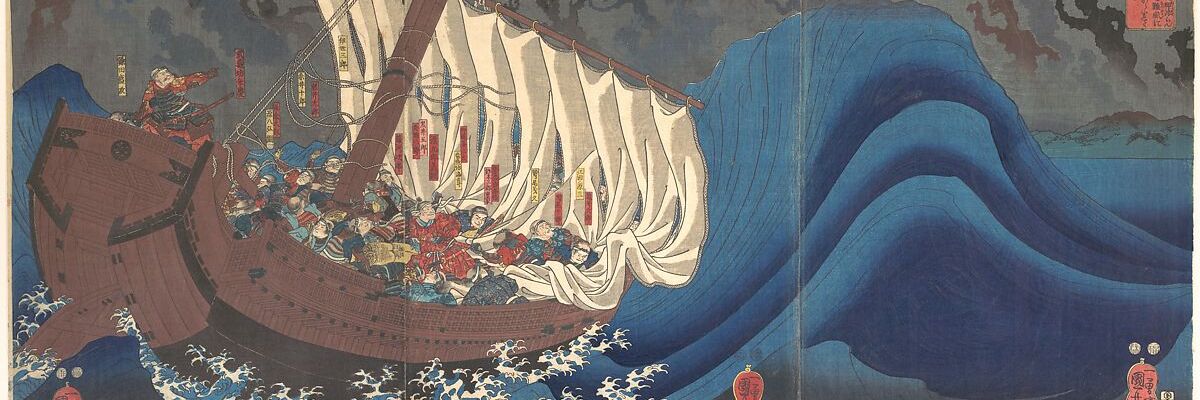
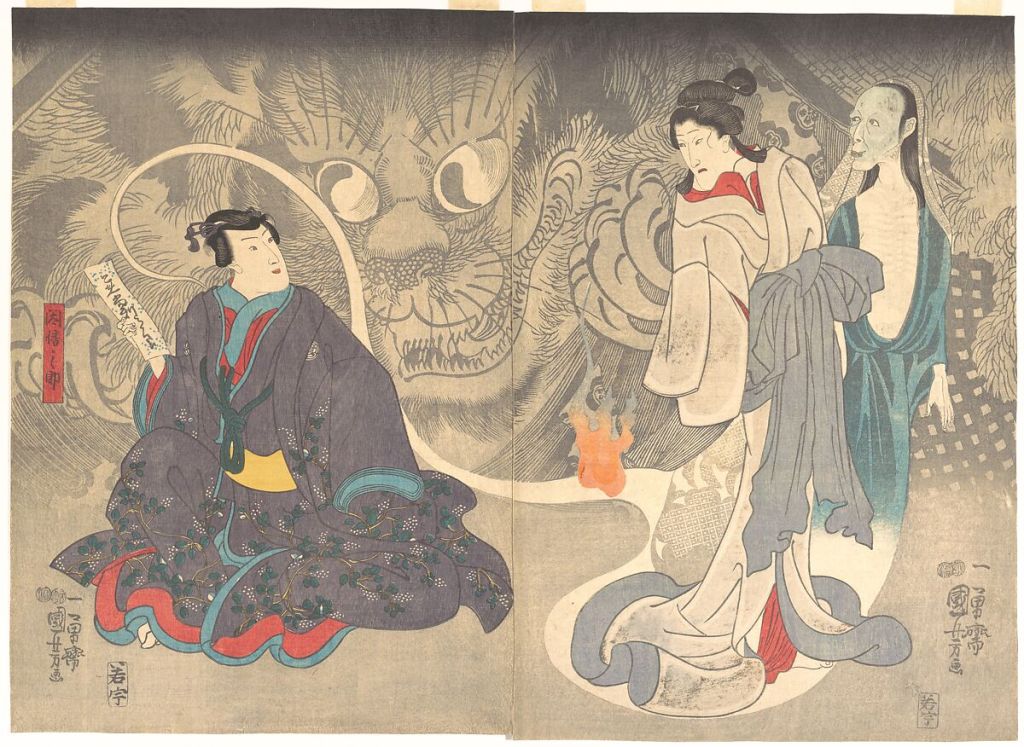
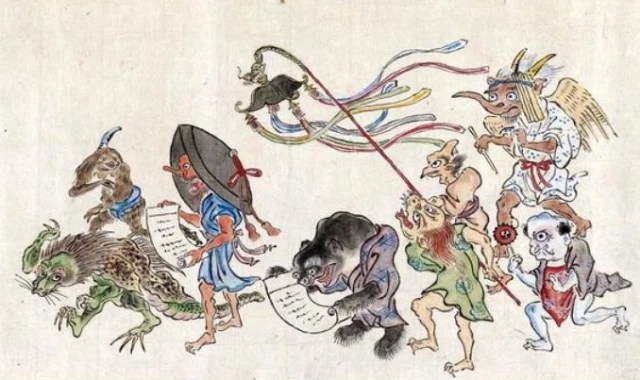
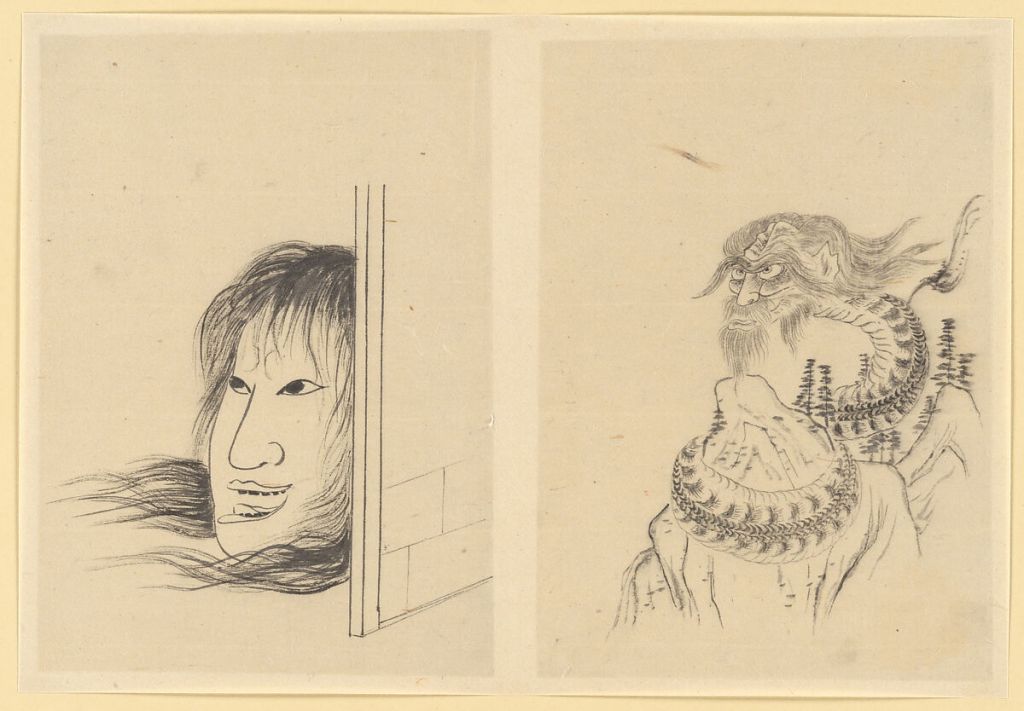
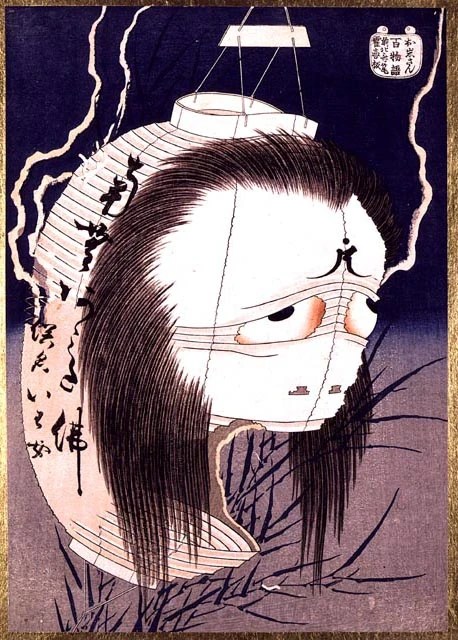
Long before a flickering television screen terrified modern audiences, Japanese ghost imagery had developed a distinctive visual vocabulary for the yūrei: the dead represented in white garments, with long, disheveled hair and, in the visual conventions that became especially influential during the Edo period, often without visible legs. These features were not created at a single moment, but gradually became conventionalized through painting, popular literature, woodblock prints, and theatre. By the eighteenth century, and especially in its later decades, the image of the female ghost in a white garment, with loose hair and an absent or obscured lower body, had become a recognizable and influential convention.
Maruyama Ōkyo’s Ghost of Oyuki is an important and highly influential example of this visual tradition. The painting is not securely dated to a single year; the Edo-Tokyo Museum places it in the An’ei period. What can be stated with confidence is not that Ōkyo invented the yūrei tradition or was necessarily the first artist to depict a ghost without visible feet, but that his paintings played a major role in popularizing and consolidating a visual form that later became strongly associated with the Japanese ghost. The Edo-Tokyo Museum specifically describes Ōkyo’s white-clad, footless ghost as a style that became a standard convention in later ghost paintings.
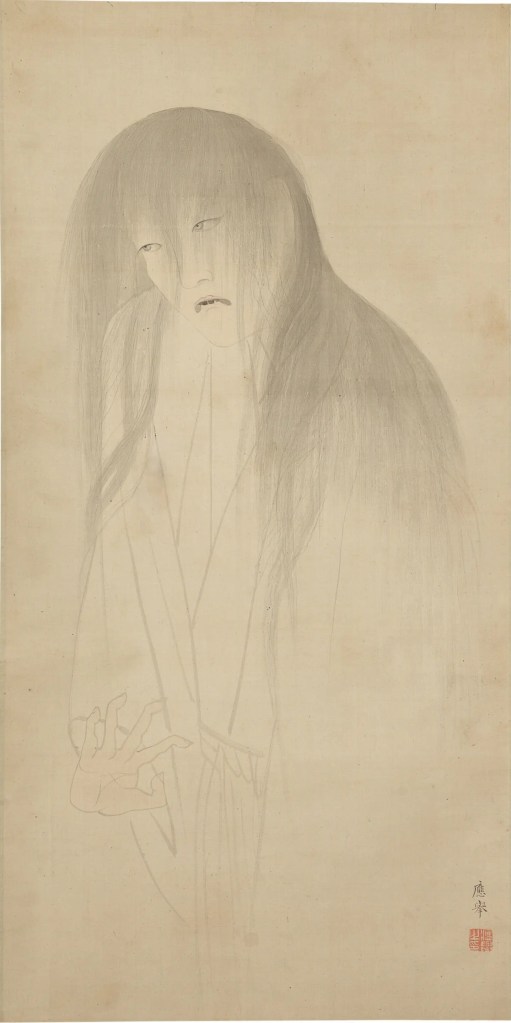
Ōkyo’s image therefore did not single-handedly create the yūrei tradition. Rather, it became one of the most influential visual examples in the development of the familiar ghostly figure. Later ghost paintings continued to reproduce and refine features associated with this tradition, helping establish conventions that remained influential into the modern period.
Sadako Yamamura, the ghost at the center of Hideo Nakata’s Ringu (1998), did not emerge from this tradition unchanged.
She is a modern transformation of it.
Her white clothing and long, disheveled hair recall established yūrei imagery, while her obscured face and unnatural movement are cinematic elaborations of that tradition. Her narrative role also brings her close to the tradition of the onryō, the resentful or vengeful dead whose grievance continues beyond death. Scholars of modern Japanese horror have explicitly described Sadako as a “techno-onryō,” emphasizing how the traditional figure of the vengeful spirit is transformed through modern media technology.
As an analytical distinction, yūrei is the broader term for a ghost or spirit of the dead, while onryō places greater emphasis on resentment, grievance, and vengeance. The categories should not be treated as rigidly separated historical classifications, however. Their meanings and uses have varied across periods and contexts, and a single ghost may be discussed in more than one of these terms.
Sadako, however, is not simply an Edo ghost placed inside a television.
Her mythology also intersects with a distinctly modern Japanese history of alleged psychic phenomena, particularly nensha (念写), commonly translated as “thoughtography” or psychic image projection: the alleged ability to impress thoughts or mental images onto photographic material. In the early twentieth century, psychologist and psychical researcher Fukurai Tomokichi investigated clairvoyance and thoughtography. His experiments became part of a major controversy over the status of psychic phenomena within academic and scientific culture in modern Japan. The claims he defended did not become accepted scientific evidence for paranormal abilities.
The controversy surrounding Fukurai became part of the cultural history associated with the fictional background of Ring. The National Diet Library explicitly connects Fukurai’s research and the historical “clairvoyance” controversy with the fictional background of Sadako’s parents in Koji Suzuki’s novel. Suzuki therefore drew on a real history of Japanese psychical research when constructing his supernatural fiction.
The relationship between nensha and Ringu should nevertheless be distinguished carefully between the novel and the film.
Suzuki’s 1991 novel makes the connection between psychic projection and the cursed recording part of a larger supernatural system that is eventually given a fictional biological explanation. Nakata’s 1998 film does not reproduce that biological explanation. Instead, the film presents the cursed images as a manifestation of Sadako’s psychic power and leaves the precise mechanism of the curse within the realm of supernatural horror. Japanese discussion of the film also explicitly describes the cursed videotape as the product of nensha, linking the traditional idea of psychic image projection to the modern video medium.
In other words, the film does not eliminate the idea of psychic inscription. What it removes is the novel’s later fictional biological explanation of how the curse operates.
Suzuki’s 1991 novel therefore incorporates real historical anxieties surrounding psychic phenomena into a fictional mythology.
Nakata’s film subsequently transforms that mythology again.
Sadako stands at the intersection of several traditions: the long-standing Japanese imagination of the restless and vengeful dead, the modern history of psychic research, and a late-twentieth-century imagination of invisible forces that can be impressed upon, preserved by, and transmitted through media.
When Sadako crawls out of a television screen, an old ghost has therefore not simply entered a new room.
She has entered a new medium.
The Magnetic Corpse: Analog Media Horror and the Cursed Videotape
The cursed videotape in Ringu brings together two different ideas of contamination and transmission.
One possible point of comparison lies in the older Japanese vocabulary of kegare, often translated as pollution, defilement, or impurity. Death and other conditions have historically been associated with forms of impurity within Japanese religious and ritual traditions, although the meaning of kegare has varied considerably across historical contexts. It should not be reduced to a supernatural equivalent of modern infectious disease: its meanings have also involved taboo, disorder, impurity, and the need for purification.
Ringu does something different.
It makes the videotape behave, metaphorically, like contamination.
To watch the tape is to expose oneself to danger. To reproduce it is to create the means by which that danger can be passed onward. The curse therefore acquires a logic that resembles contagion without literally being a disease.
The rule is brutally simple: a viewer is destined to die seven days after watching the tape unless the curse is passed on by copying it and showing the copy to someone else. The film thus turns reproduction itself into a condition of survival. Scholarship on Ringu has explicitly emphasized the film’s analogy to cultural contagion and its dependence upon the reproduction of the cursed videotape.
And the carrier is not blood.
It is information.
More precisely, it is recorded information embodied in a physical medium.
The choice of VHS is significant. The videotape was a familiar, reproducible consumer medium within late-twentieth-century domestic media culture, capable of carrying recorded images from one household to another. Ringu transforms that ordinary property into a mechanism of horror. The film’s cursed object therefore depends not only on its supernatural content but also on the material and reproductive properties of videotape.
The images themselves are fragmentary and difficult to interpret. Their disjointedness makes the recording feel less like a conventional narrative message than like an intrusion into the medium itself.
The analog image becomes part of the terror.
Static, distortion, degraded contrast, and the unstable texture of recorded video give the supernatural a physical presence. Sadako’s image does not merely appear on a screen; it seems to belong to the unstable boundary between image and reality.
This is one of Ringu’s most powerful ideas:
The medium is no longer merely carrying the ghost. The medium has become the ghost’s body.
That sentence is best understood as an interpretation rather than a literal description of the film’s mechanics. Yet it captures an important strand of scholarship on Ringu, which treats video technology, reproduction, transmission, and the materiality of recorded images as central elements of the film’s horror. Sadako’s status as a “techno-onryō” likewise emphasizes that her haunting is inseparable from the technology through which it circulates.
The Tragedy of the Well: Murder, Discovery, and the Failure of Catharsis
Beneath the supernatural machinery of Ringu lies a human act of violence.
Sadako, a young woman with extraordinary psychic abilities, becomes the victim of violence at the hands of her father, Professor Heihachiro Ikuma. In the 1998 film, a vision reveals that Ikuma attacks Sadako, throws her into a well, and leaves her trapped there after the opening is closed. Reiko Asakawa and Ryūji Takayama reconstruct what happened through their investigation and the vision associated with the well. The film presents the well as the place where Sadako was imprisoned and where her remains are eventually discovered.
The well becomes the physical and narrative center of the buried violence behind the curse.
It is a place of imprisonment and concealment: the site where Sadako was trapped and where her remains later lay hidden.
The well is therefore crucial to the story not because the film establishes it as an independent supernatural mechanism that generates the curse, but because it is the hidden site of Sadako’s imprisonment and the place where the circumstances of her death are eventually uncovered. The supernatural curse is associated with Sadako and with the psychic images impressed onto the videotape, while the well functions as the concealed physical location in which the violence inflicted upon her took place.
Japanese ghost narratives have repeatedly imagined the dead as beings whose relationship with the living may remain unsettled after death. Narratives of yūrei and onryō frequently associate supernatural return with violent death, unresolved grievance, or the failure of the dead to attain release. These traditions existed alongside broader practices involving graves, memorialization, offerings, mourning, purification, and relations between the living and the dead. They should not, however, be reduced to a single rule according to which every violent death automatically produces a ghost.
Ringu invokes that expectation—and then refuses to satisfy it.
Reiko and Ryūji locate the well and recover Sadako’s remains, with Reiko ultimately pulling the body from the bottom. For a moment, the story appears to offer the possibility of closure. The dead has been found. The hidden crime has been uncovered. The body has been brought into the light.
But the curse continues.
The discovery of Sadako’s remains does not restore the world to order. Recognition is not enough. The past has been uncovered, but it has not been undone.
That failure is central to the film’s horror.
The curse does not end with the discovery of the dead.
It survives through transmission.
There is an important chronology distinction here.
The 1998 film establishes that Sadako was still alive when Ikuma trapped her in the well and that she tried to climb out. What the first film does not establish is the exact duration of her survival there.
That chronology is specified more precisely in Ringu 2 (1999).
In that film, an autopsy indicates that Sadako had died only one or two years before her remains were discovered, even though the well had been sealed for roughly thirty years. The film also states that her fingernails were found embedded in the sides of the well, indicating that she had repeatedly tried to escape.
The distinction matters because the two films construct Sadako’s history differently.
Ringu presents the well primarily as the hidden site of her imprisonment and the place where the circumstances of her death are uncovered; Ringu 2 adds the extraordinary physical detail that she remained alive in the sealed well for most of the intervening decades.
Survival as Transmission
Reiko eventually discovers the mechanism that allowed her to survive.
She did not escape because the curse had been defeated.
She survived because she had copied the tape and shown it to Ryūji.
The distinction is crucial. The action that protects one viewer is also the action that perpetuates the curse. Survival is therefore inseparable from transmission.
This transforms the ending of Ringu into a disturbing moral paradox. The means of preserving one’s own life requires exposing another person to the same danger. The film makes the mechanism explicit through its central rule: the curse can be passed on by reproducing the videotape and showing it to another person.
The horror is therefore not simply that Sadako kills.
It is that the living become participants in the continuation of her curse.
Reiko’s realization becomes especially painful because her reason for continuing the chain is not hatred. It is the desire to protect her son, Yōichi.
The final sequence shows Reiko heading to her father’s house with the tape and a VCR, apparently intending to show the tape to him in an attempt to save her son.
The 1998 film does not show him actually watching the tape or establish his fate onscreen.
What follows is left outside the frame.
The curse survives not because the living necessarily embrace Sadako’s hatred, but because they refuse to die.
That is one way to read the bleakness of the ending.
The curse reproduces itself through the human will to survive.
This is a thematic interpretation rather than an objective statement about the film’s single “meaning,” but it corresponds closely with scholarship that reads Ringu through reproduction, cultural contagion, transmission, and self-reproducing media.
From Novel to Virus: How the Curse Entered the Modern World
The mythology of Sadako exists in significantly different forms in Koji Suzuki’s novel Ring (1991) and Hideo Nakata’s film Ringu (1998).
The difference is fundamental.
In Suzuki’s novel, the curse ultimately receives an explicit fictional biological explanation involving a virus connected to smallpox and Sadako’s psychic abilities. The novel therefore moves decisively toward the territory of science fiction and biological horror: Sadako’s supernatural abilities become connected to a material agent capable of reproduction and transmission. Scholarship on Suzuki’s novel and its adaptations identifies the virus as a key element of the original mythology.
Historical accounts of Suzuki’s novel also connect its mythology to Japanese psychic research and to the idea of psychic projection onto photographic material. The National Diet Library explicitly identifies Fukurai’s research and the broader “clairvoyance” controversy as historical models for the fictional background of Sadako’s parents.
Nakata’s film largely removes that explicit biological explanation.
Instead, Ringu concentrates the supernatural mechanism into the cursed videotape. A viewer watches the tape, receives the curse, and faces death seven days later unless the tape is copied and shown to another person. The film does not explain the phenomenon through a fictional virus. Japanese accounts of the film nevertheless describe the cursed videotape as a manifestation of Sadako’s nensha, connecting psychic inscription to the magnetic medium of videotape.
The change is more than a technical adaptation.
It changes the metaphor.
Suzuki’s novel imagines horror through a language of infection, biological reproduction, and viral propagation. Nakata’s film relocates much of that logic into the media environment, where recorded images become vehicles of supernatural transmission. This difference is also reflected in scholarship that uses the figure of the virus to analyze both Suzuki’s novel and Nakata’s film.
In the novel, the biological mechanism is part of the fictional system itself.
In the film, transmission is mediated through recorded images.
That distinction becomes especially striking in retrospect.
In 1998, the curse required a physical cassette, a VCR, a television, and another person to whom a copy could be shown. In the digital age, information can be duplicated and redistributed on a vastly greater scale without a physical object changing hands.
Seen from the present, the structure of Ringu can therefore be read as an eerie metaphor for viral digital media:
You see it.
You are exposed.
You copy it.
Someone else sees it.
And the cycle continues.
This is a retrospective interpretation, not evidence that Ringu literally predicted social media, recommendation algorithms, or the contemporary internet. The analogy becomes visible because later technologies made the film’s fictional mechanism resemble the circulation of digital information in ways that were less immediate in the era of VHS.
Yet the metaphor remains remarkably powerful.
Sadako’s emergence from the television is frightening because it collapses the boundary between viewer and screen. A television is conventionally a device through which images from elsewhere enter the home.
In Ringu, that relationship is reversed.
The image looks back.
And then it comes through.
The well, therefore, is more than a location.
It is the buried site where the history of Sadako’s violence and death returns to the surface: a physical place containing her remains and, symbolically, the violence that the characters had believed they had uncovered.
But Sadako should not be understood simply as an unchanged survival of an Edo ghost tradition.
Her mythology is a modern synthesis: older yūrei and onryō imagery is recombined with twentieth-century psychic research, the history of thoughtography, and late-twentieth-century media technology. That combination is precisely what makes her different from the ghosts that came before her.
In the age of physical videotape, Sadako climbed out of the television.
In the age of endlessly reproducible digital images, the deeper metaphor feels even more familiar:
The haunted image no longer needs a well, a cassette, or even a television. It only needs somewhere to be seen—and someone willing to pass it on.
Amir Zadnemat is an Iranian writer with an MA in Literature from the University of Gilan, Iran. His writing engages with cinema as a poetic language shaped by light, shadow, and narrative.