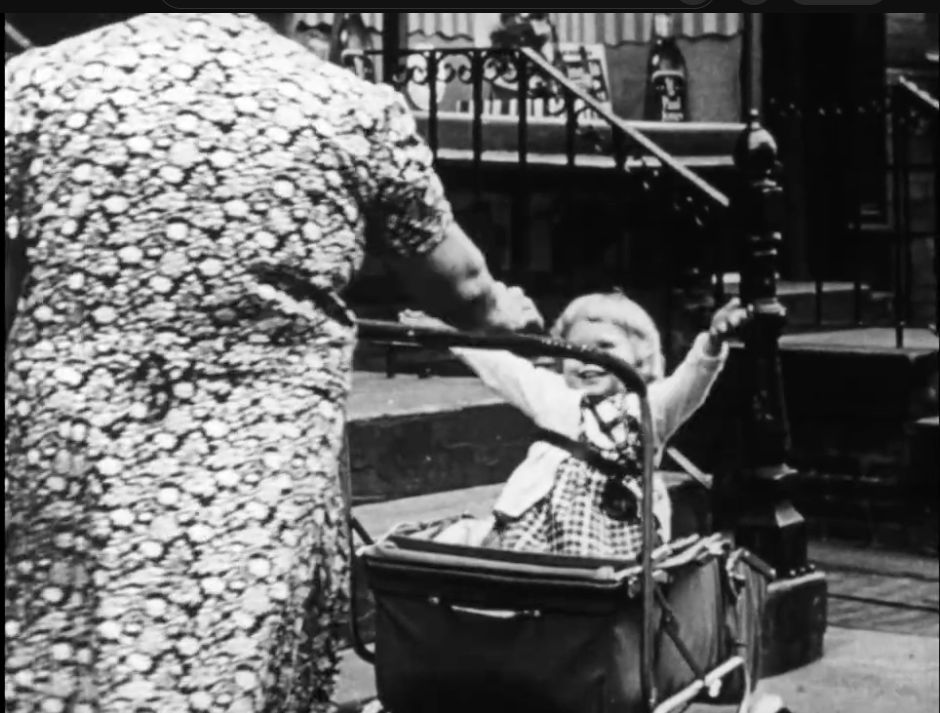
One of the first scenes in In the Street, a 13-minute silent film by Helen Levitt, James Agee, and Janice Loeb, shows a little girl in a baby carriage in the middle of the sidewalk. The carriage is buffeted by men in suits walking by with their newspapers and suitcases. The girl breaks into a laugh at the sight of a stout, beaming woman in a flowered house dress, with her arms outstretched in a universal gesture of warm welcome. The little girl responds with her arms raised, the universal gesture for “pick me up.” This is followed by scene after scene of cats and kids and dogs and adults canoodling and complaining and wrestling — people of all ages working and playing and fighting in the hot summer streets.
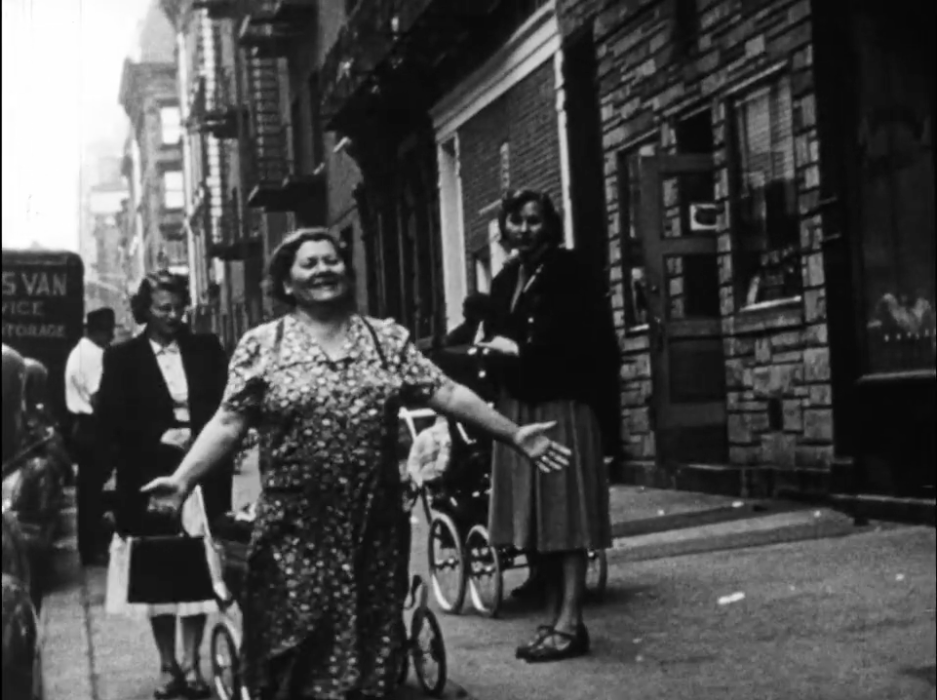
In the Street was shot in East Harlem just after World War II. It follows a succession of glimpses into people’s lives, lived on the street or emerging from dark doorways and windows. We make connections as we watch — between the shots, between the people — because that’s how the human brain works, and in turn, how film works. The connections are quiet and fleeting, but though you could argue that there is no pattern, there is a clearly stated purpose. It’s a documentary film, ostensibly, but of course the footage is not entirely documentary, as no film ever is. In a few titles before the film, likely written by James Agee, we are told:
“The streets of the poor quarters of great cities are, above all, a theater and a battleground.
There, unaware and unnoticed, every human being is a poet, a masker, a warrior, a dancer: and in his innocent artistry he projects, against the turmoil of the street, an image of human existence.
The attempt in this short film is to capture this image.”
Somehow there’s a faint whiff of judgment here, of “these people,” of the real artist versus the poor, innocent, unaware fool. But this doesn’t do justice to the film itself. Unlike Helen Levitt’s still photography, which she made using a device to obscure the direction her camera was pointed, there’s some complicity in this. The people in the streets and doorways and windows know they’re being filmed, though they don’t always seem to care, because their lives are clearly as important to them as whatever is happening with this camera.
As Roy Arden says in his wonderful essay “Useless Reportage,” there was a reason Levitt chose these streets in this neighborhood as the subject of the film: “The street here is a common area not just to pass through but in which to live out all of life’s aspects. The different races and nationalities are here equalised, if not quite united in poverty, forced to interact while they escape the heat or dead air of their tenement apartments.”
We can see why they chose this neighborhood. It really does feel like a microcosm, not just of America at that time, or America at any time, but of how we live as humans, in all of our shared absurdity and beauty.
Amidst all the house dresses and dirty smocks, a woman in black appears wearing heels and stockings and a kennel-full of foxes around her shoulders. She doesn’t look elegant, she doesn’t look comfortable. She looks like she’s wearing a costume. We move from her to scenes of young girls wobbling awkwardly down the street in high heels, laughing. It’s Halloween. We see kids with charcoal mustaches and rubber band halos and slightly disturbing pointed white ghost hoods. There’s a real sense, throughout the film, that the adults are every bit as much in costume as the children, though it’s the kind that adults wear every day, pretending that we have the things we need to get through our day. Halloween comes at the time of year when spirits walk among us, and in this film, we see so many bright, warm, weary, happy, contesting spirits. And where are they now, where are they now?
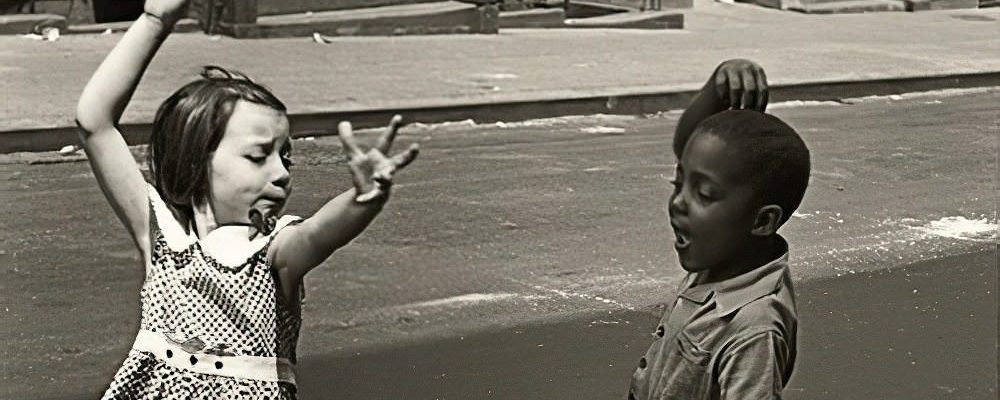
There’s a game these kids are playing, some in costumes, some not. They fill stockings, maybe, with chalk, maybe, and they swing these around trying to hit each other as they race about the streets and tussle and come together and move apart and pile on top of each other. As with life, the rules are vague, you’re not always sure who is with you or against you As with life, there’s some laughter, but plenty of tear-stained faces by the end.
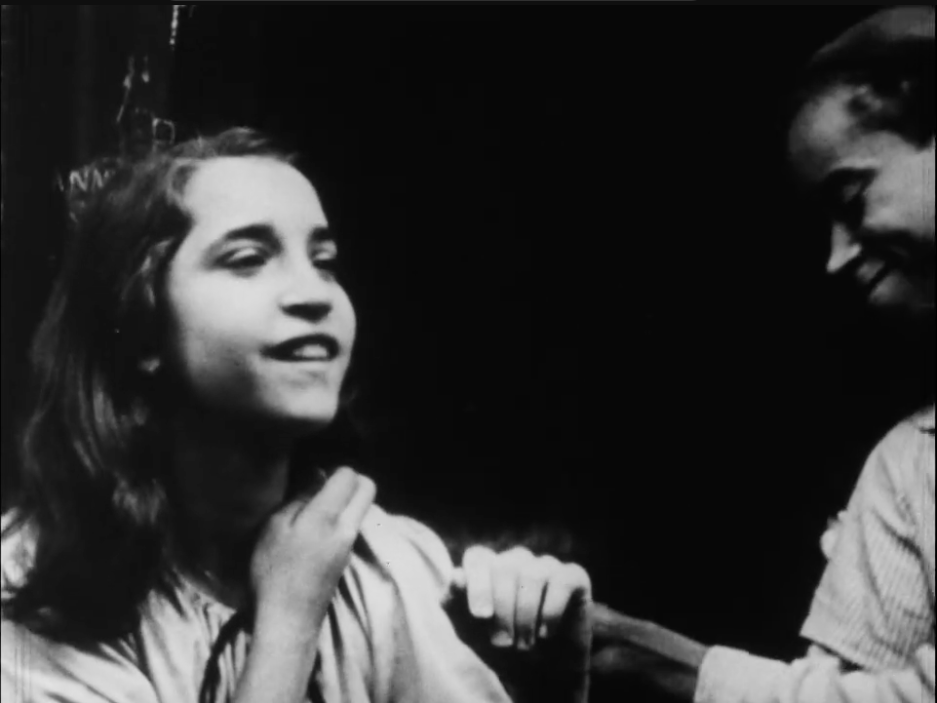
In every way, the neighborhood feels diverse, with people of different races and ages acting out the same story of embracing and flirting and whispering to each other or complaining to each other: generation after generation. There’s a beautiful beautiful scene that plays out in the liminal poem of a doorway, dark within, bright without. A very young man and woman, kids, really on the edge of the next frightening step, flirt in the way people do when they first learn to flirt. There’s such a sweet glow about them. You wonder how the world will treat them, as they grow and the world changes and the game changes and the rules become harsher and people become more hateful, and we end up where we are now, in the America we live in now. I wonder how their lives unfolded.
I can’t know what life was really like there, at that time, but it seems to be a testament to the fact that in our homes and neighborhoods, we get along. Maybe this isn’t how the filmmakers wanted it to be read, and maybe this isn’t how their lives were lived, but this his how I need to read it now, in these terrible times, when we’re as likely to send armed thugs to arrest the children as to send poets and photographers to record the beautiful nothing and everything of their daily lives.
I need to know that deep down we all share the same joys and worries and hopes and loves and losses. We’re all the kid in the baby carriage, confused and vulnerable, buffeted by men in suits. We can all be the woman in the house dress, holding out our arms in a gesture of warm welcome.
Categories: featured, film, photography