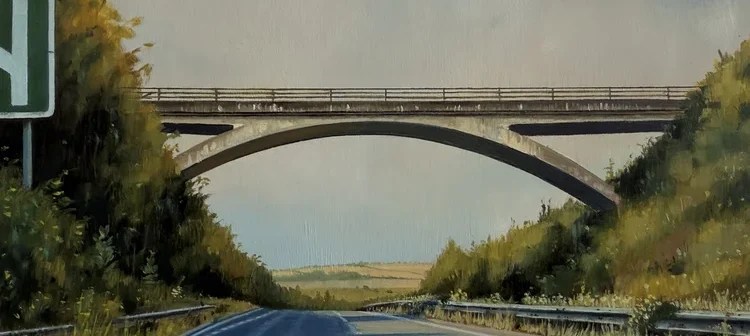
There are no humans in Jen Orpin’s paintings, but somehow her work captures what it means to be human. Our industry, our passion, our memories, our foolishness, our relation to nature, our imperviousness to that relationship; the passing of time in all of its hideous crimes, in our lives and structures and place in the world. There’s such silence and grace in the paintings — a sort of poetry of stillness discovered in an environment designed for people to noisily cross through or over it or through it, going where they need to go or want to go. A silence that places us above the noise, beyond the noise, looking at it from a different time and a different space. The traces of humanity in the paintings, so urgent and solid, now, are almost shown as cave paintings, as mysterious vestiges of our impact on the earth, but with a resonating tenderness and warmth that reminds us that though we may be going different places at different paces, we’re all on a shared separate journey: We’re all in it together till the end. We were beyond grateful for the opportunity to ask Jen a few questions about her work.
Magpies: I’m always curious about how much of “the human element” artists include in landscapes. Although your paintings largely deal with human-made landscapes, actual people are notably absent. It feels so quiet! It’s almost as though the paintings are a record of our time seen from, if not another time, then another less-human perspective. What went into the decision to not include people?
Jen Orpin: It’s recently been said to me that even though my paintings are devoid of people they are very human. The designer of my recently published book of bridge paintings — ‘The Architecture Of Connection’ said after its completion, “it’s such a warm, human book — without a single person in it.” I love this and I do love people, it’s what the paintings are all about really but the decision not to put people in my paintings came very early on. From the beginning, I knew I wanted to place the viewer as the sole occupier of the paintings, for an intimacy to be created between the two and I think this is made so much easier without the distraction of anyone else in the scene. When you’re looking at the paintings, it’s your view, it’s your journey, it’s your road and this creates, I think, an easier way to connect you to the to the painting.
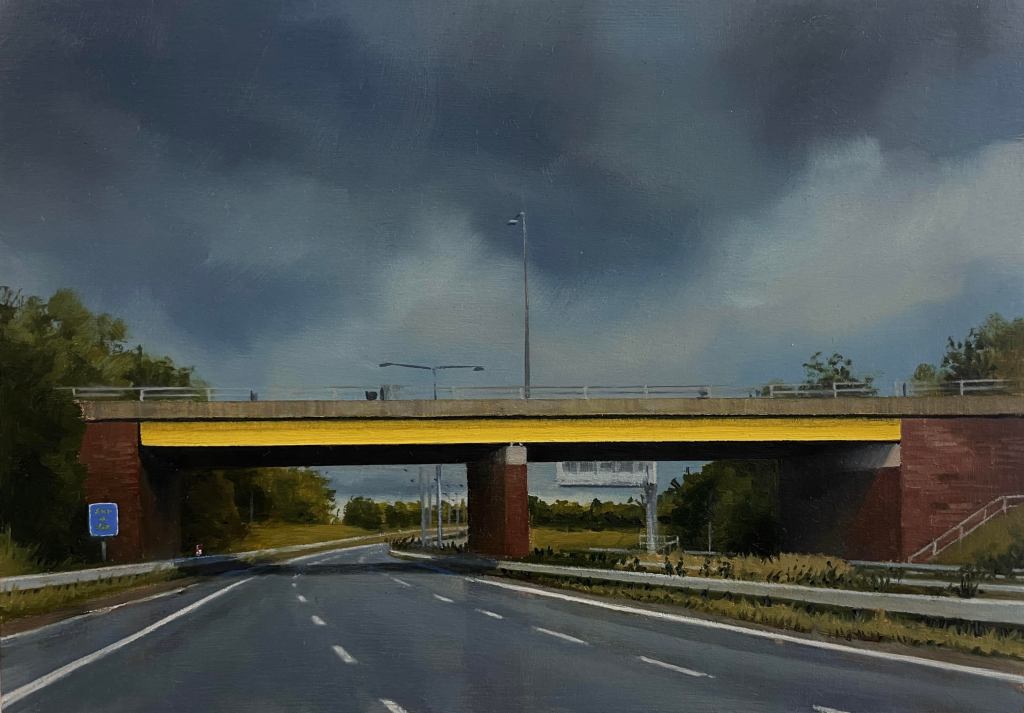
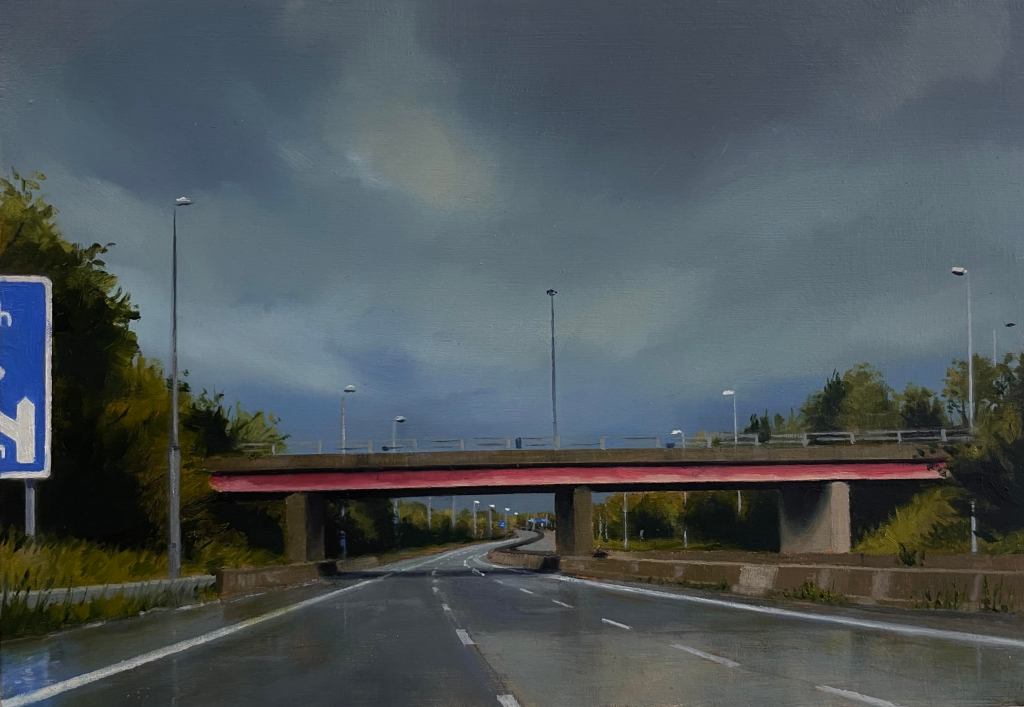
Also, very notable for paintings of motorways and overpasses, no cars! Maybe that’s part of the source of the silence I feel in your paintings. Historically, there’s such a sense that cars have shaped the way we treat landscapes, build cities and homes, eat, shop, work. In your paintings I almost feel a different way of looking at that influence. A reclaiming, maybe, by us – the drivers and the graffiti artists and the protestors – and by the nature surrounding the roads and bridges. Also, there’s nothing that quite sets a painting or photograph in a certain time like the model and make of the vehicles they portray. Was it a different sort of decision to leave the cars out than to leave out the people traveling in them?
Again, like people, I think the addition of cars would creative a narrative within the paintings that I just don’t want to be there. People often say my paintings have a film quality, are apocalyptic or post-apocalyptic and I quite like that. If you think about those kinds of movies and films, one of the first images you often see is the camera sweeping along deserted roads, across a bridge, there’s bits of rubbish, human detritus, ivy and plants reclaiming the landscape and taking over the concrete — as well as a silence, there’s a quiet you only get with the absence of people. When there are no cars on the road, it’s the first thing we notice and that doesn’t happen that much these days. The first time it happened in recent times, I think, was through Covid and lockdown. So maybe I’m embracing a little bit of that film quality, but ultimately though, I don’t want any distractions, it’s just about you, the landscape and the journey.
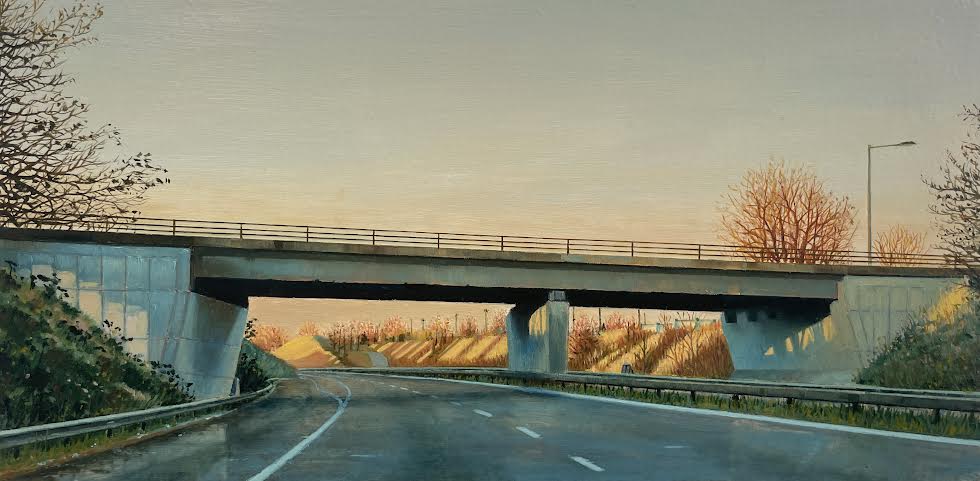
All that being said, cars, in themselves, are a bit of a time capsule. You remember the cars your parents drove, the smell of them, the feel of the seats in hot or cold weather. Family trips with rotting bananas or sticky sweets or stinky dogs. Roads are clearly made for traveling. I love how calmly and quietly you pack all of that emotion into your paintings. Are some of these paintings places you remember from your childhood? In what sense are the overpass paintings a sort of key to unlocking layers of (maybe even communal) memory?
Despite the fact that there are no people in your paintings, they feel full of tenderness to me, I can somehow feel affection for people even if we’re not portrayed in the painting – for our travels and our worries and the things we’ve constructed or what we’ve painted on those things. I had read that you drew on memories of trips to visit your father in the hospital. We made weekly trips last year to a relative in memory care, and somehow even the blighted landscape of highways and strip malls on the way there took on a sort of beauty worth noticing and remembering. How did your destination shape the subject and execution of your paintings?
In 2015, I made a journey from Manchester to Surrey every week twice a week for three months to be with my dad in hospital and my family. This journey became a really fundamental part of what was happening at the time, a time to think, prepare and process everything that was happening. The bridges were my landmarks, my markers of time and distance, familiar faces that looked back at me through the window. It was this journey that became the catalyst in starting to make the paintings of roads and bridges.
I often tell the story of my mum and dad throwing me and my 3 siblings in the back of my dad’s beloved Ford Cortina with its slippy slidey vinyl seats, no seatbelts of course, it was the 70s! These are the memories that came flooding back to me when I was making that journey every week to the hospital to visit my dad. I spent a lot of time with my siblings then, when my dad was in hospital and we talked and connected in a way we hadn’t really done since becoming adults.
I don’t think it was the destination as such but the reason for making the journey, a journey I had made so many times since moving to Manchester, to visit friends and family in the south. Then all of a sudden, a life changing moment meant that very ordinary, mundane journey took on a whole new meaning and the dynamic of that journey changed forever.
As I mentioned before, I really do love people, I think my personal experience that changed things and bought me to this place of painting bridges and roads has meant I’ve connected to so many people through the paintings. People also commission me to paint their bridges, landmarks, their special markers and in doing so share their story, their journey and connect with me. It’s often sad or emotional and I become so invested in this and then consequently I pour all my love into their painting. I think that’s partly responsible for where the tenderness and affection comes from.
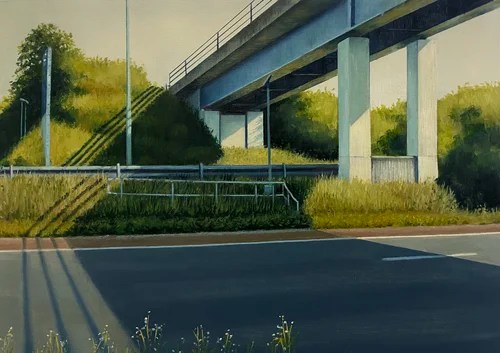
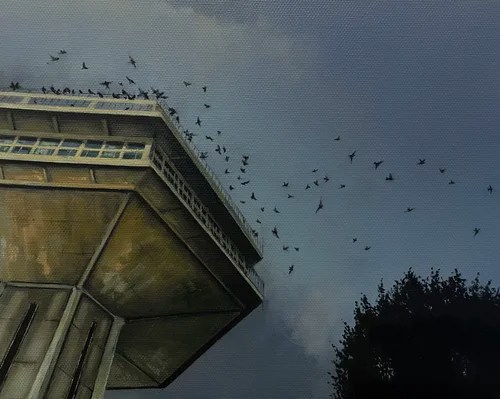
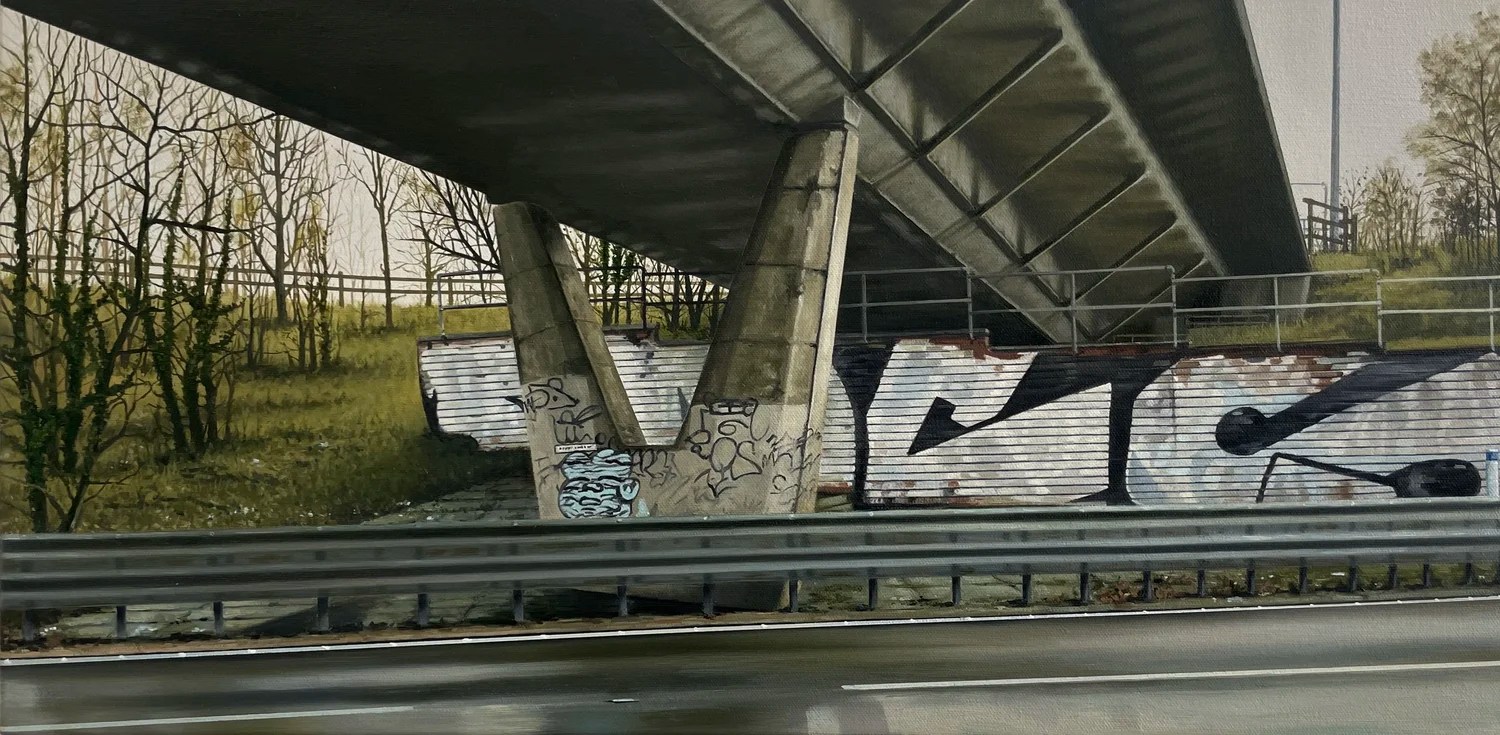
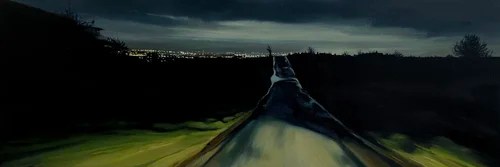
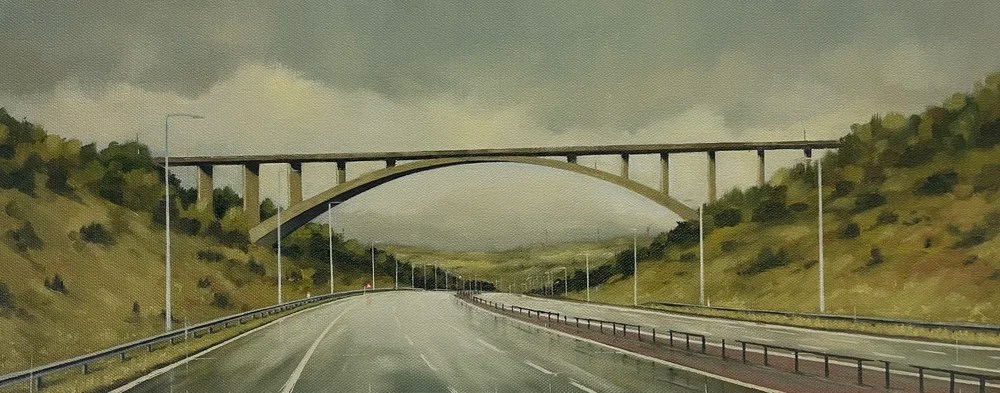
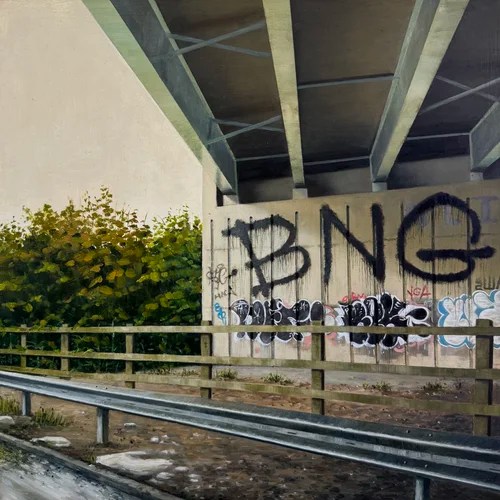
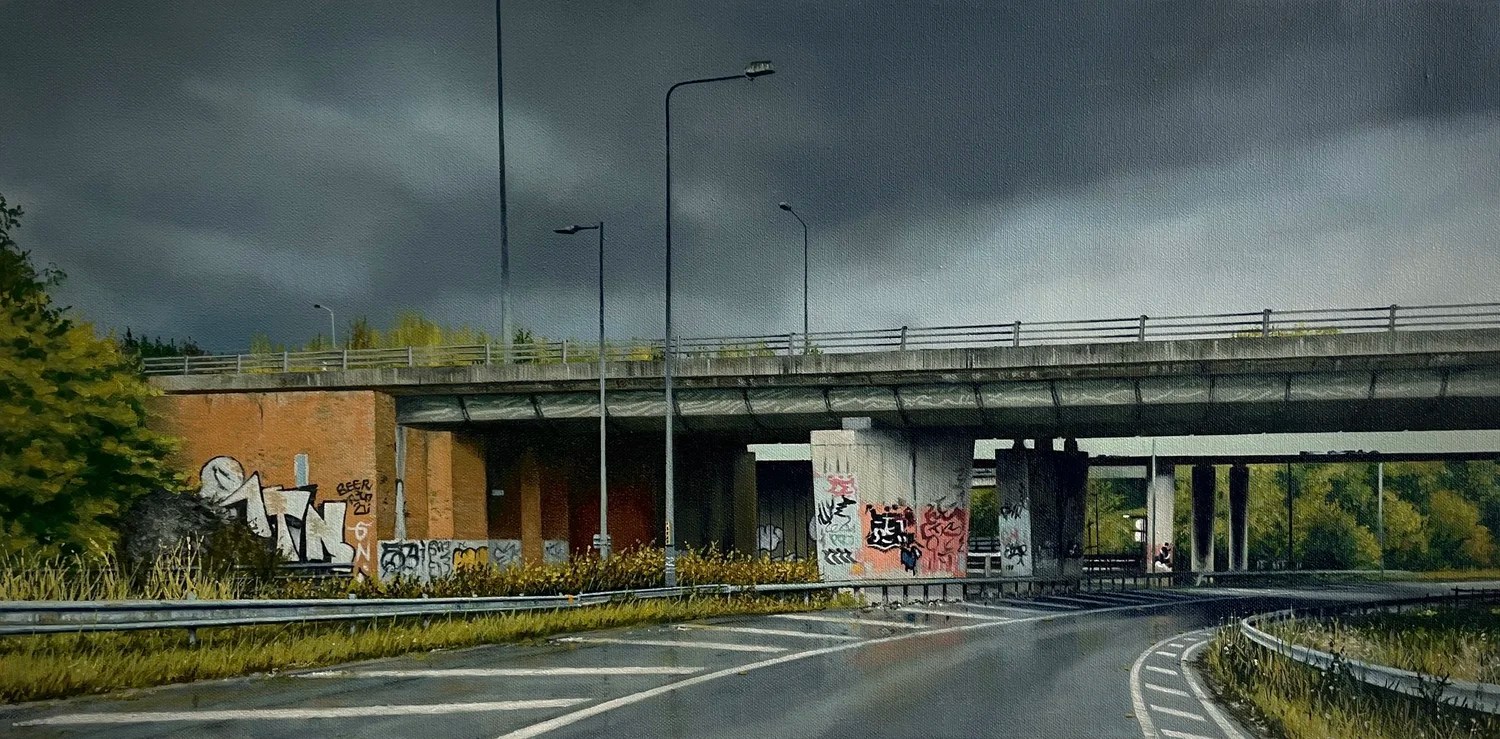
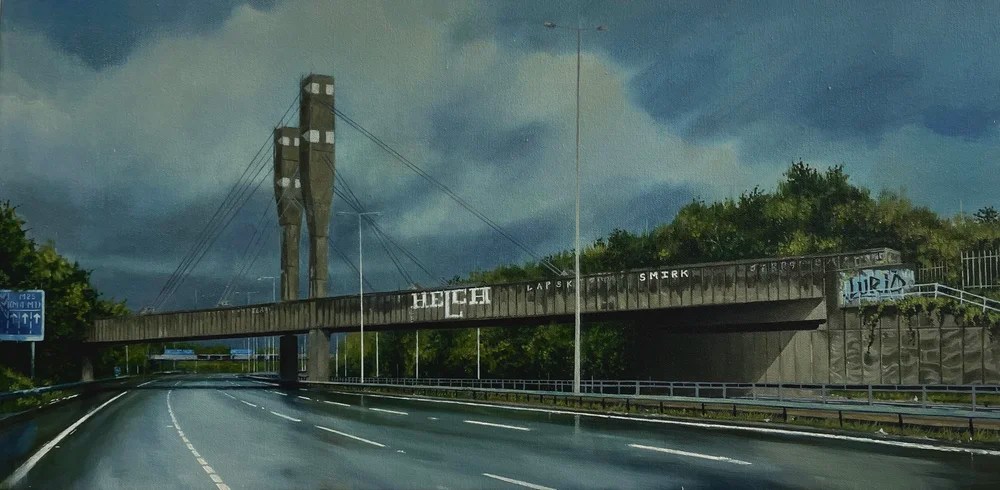
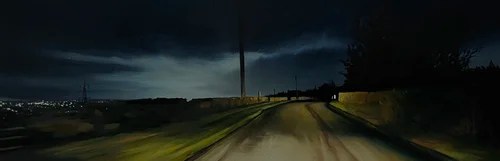
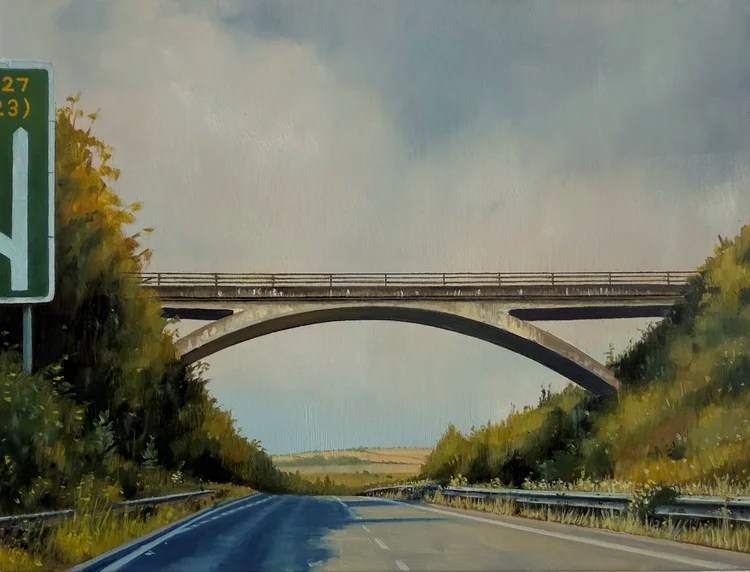
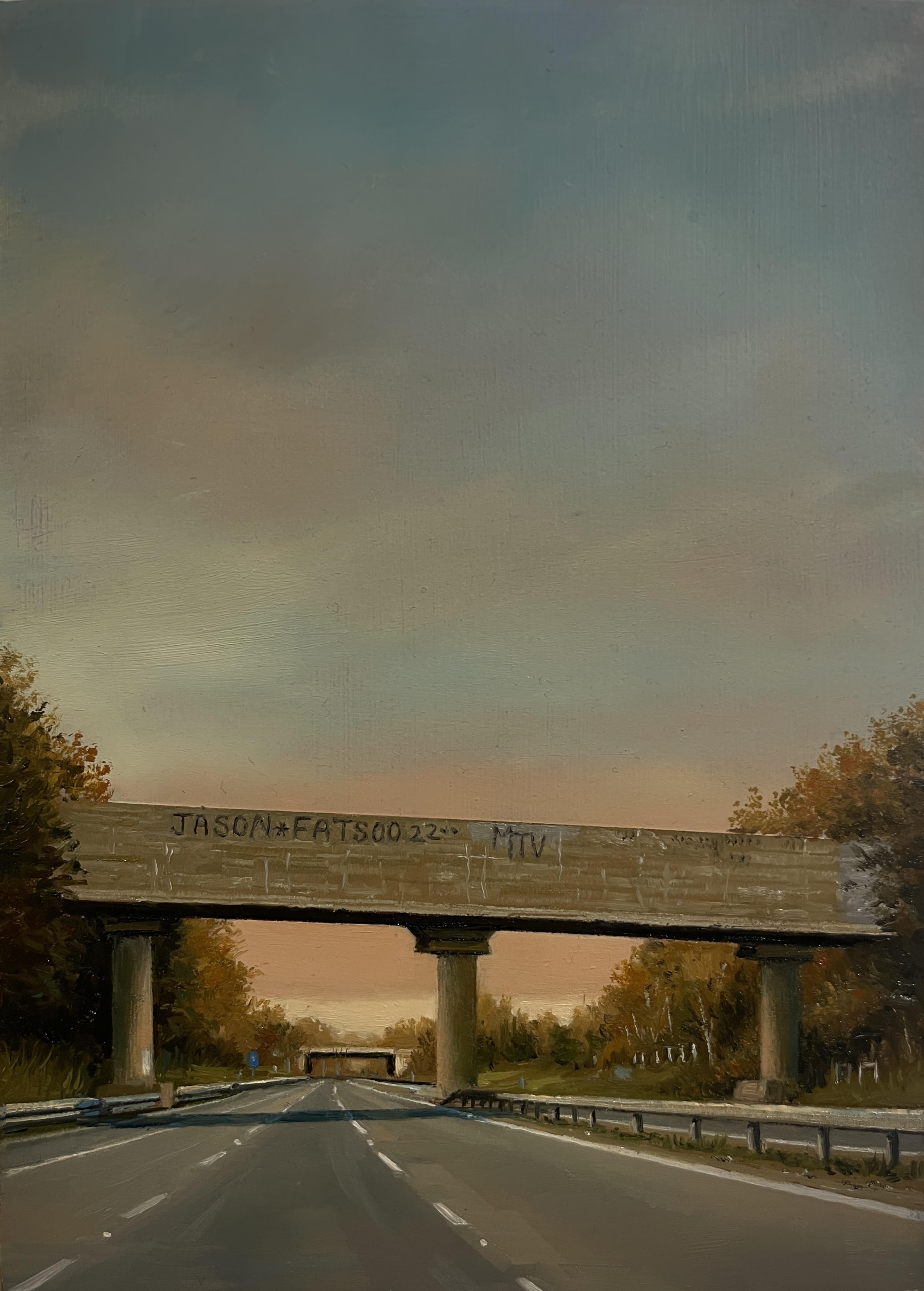
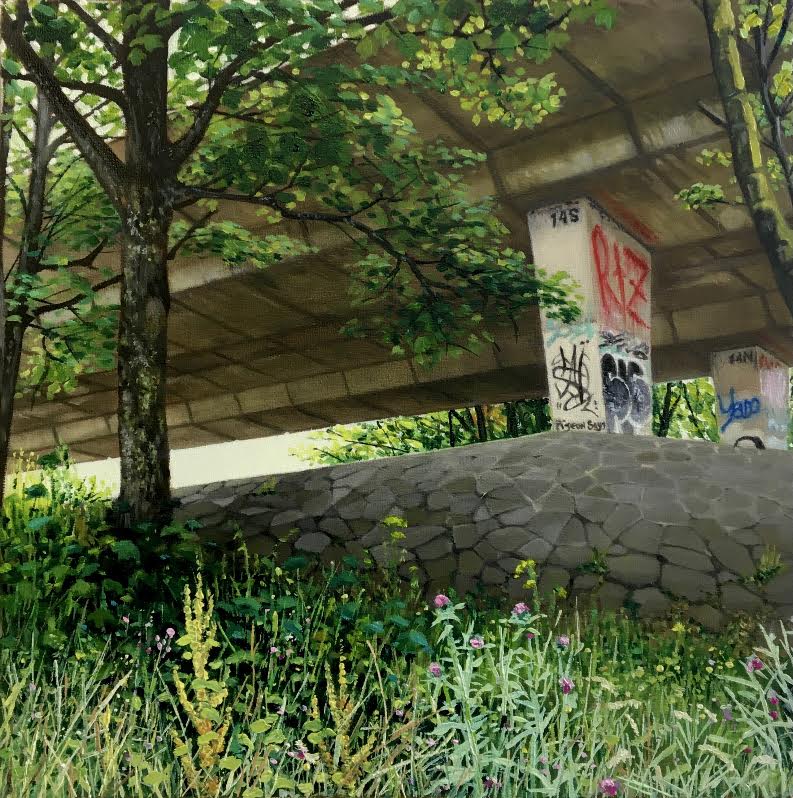
I always feel there’s something beautiful about the plants that grow on the side of the road. They must be tenacious of life, but that means they can often take over the landscape and even crowd out the manmade objects that define the place. In your paintings, the glimpses of nature on the sides of structures or seen under and through bridges remind me of Renaissance paintings, where you’d find a gorgeous little landscape painting out a window or through a door. Off to the side, but maybe the prettiest thing in the painting – maybe my favorite part. What role does nature play in your work?
The landscape and nature play a huge role in my paintings. Often, what I see surrounding a bridge or a road can make or break whether that scene makes it onto the easel or not. I love that you’ve picked up on the paintings having a feel of an old master, that’s an angle I’m leaning into a little more at the moment. The contrast of a very British countryside, painted with that era in mind and a manmade contemporary structure with maybe graffiti on it right through the middle of the scene. Two very different moments in time bought together to maybe question how we view landscapes now, how we relate to the topographies that shape our every day and what role they play in our contemporary lives. I’ve made several paintings where the bridges look like they have grown out of the landscape, they look like they’ve always been there, or where nature has started to grow over the structure, like it’s reclaiming back its space and taking hold of the structures. Some of the titles of these paintings are a direct link to this, here are some examples. ‘Nature Will Rule’, ‘Thriving’, ‘You’re Growing On Me’
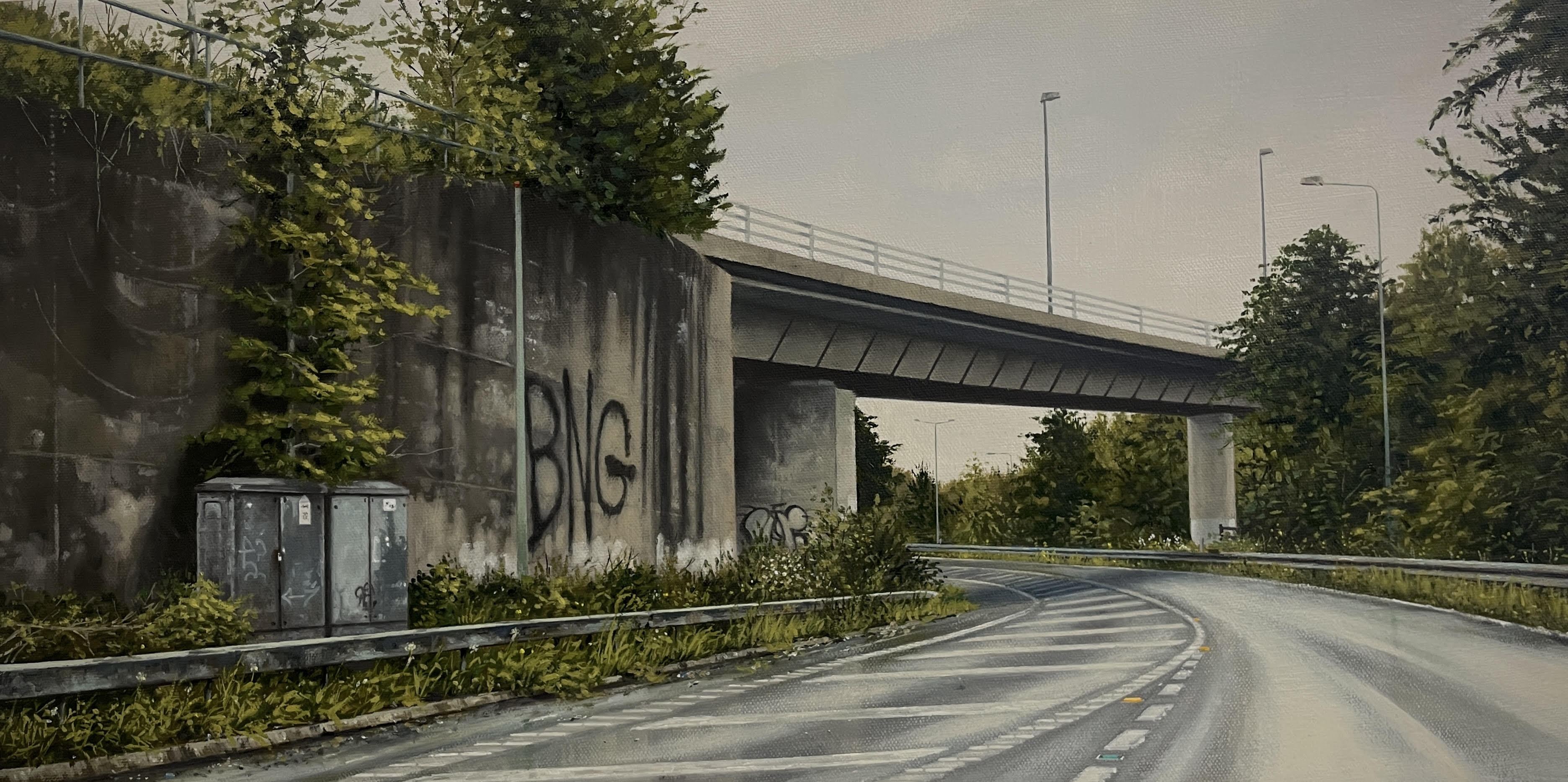
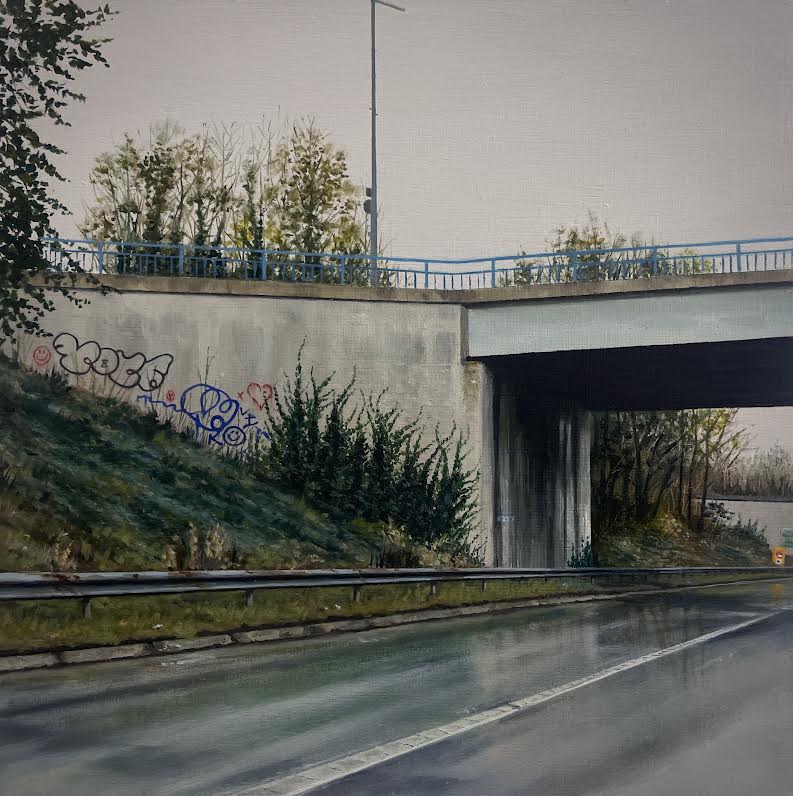
Similar question, I guess, in your paintings time of day/time of year and the light that each carries seems to convey emotion and maybe even meaning. The light feels like a character in the story of the painting. Do you have a favorite time of year or day to paint? Or was it important to explore the way these things change over time? Do you work from life or photographs?
Light is such an important element, as is the weather, it can set the mood, tone and feeling of the painting. Most pieces start with the sky being painted in first. If it’s a bright sky, blue, with warmth, then there are often lovely deep, dark, sharp shadows to consider. If it’s a grey and gloomy day with heavy clouds then everything becomes a little muted and even — but brightly painted concrete and steel can pop beautifully against a grey sky. My favourite time of year to paint is autumn and winter. This means I get to paint winter skies, autumnal colours on the trees and lovely wet roads with reflections. I’ve made a collection of works whose time of day is dawn, I’ve painted the beautiful colours of an early and clear morning. There’s something about seeing the sunrise and the optimism of the start of a new day and the road ahead stretched out before you that I really love.
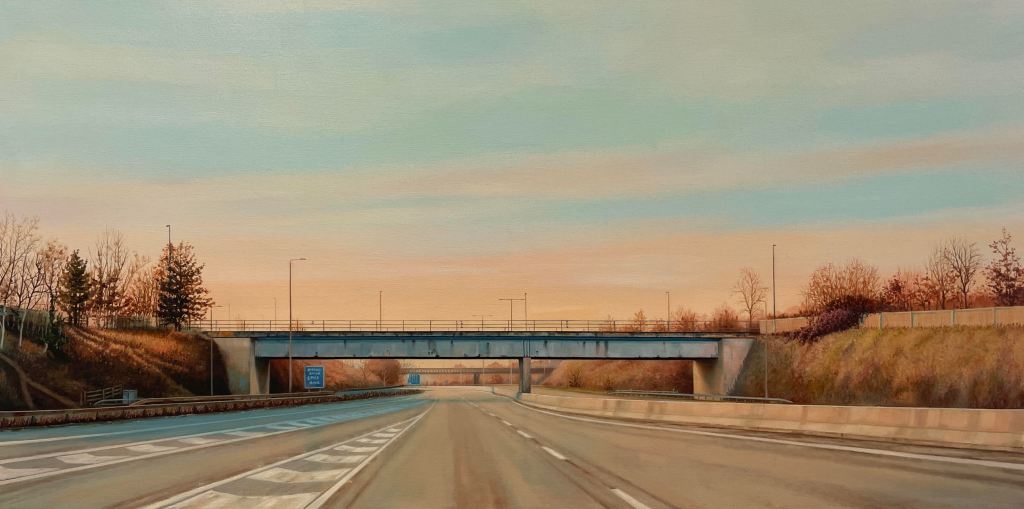
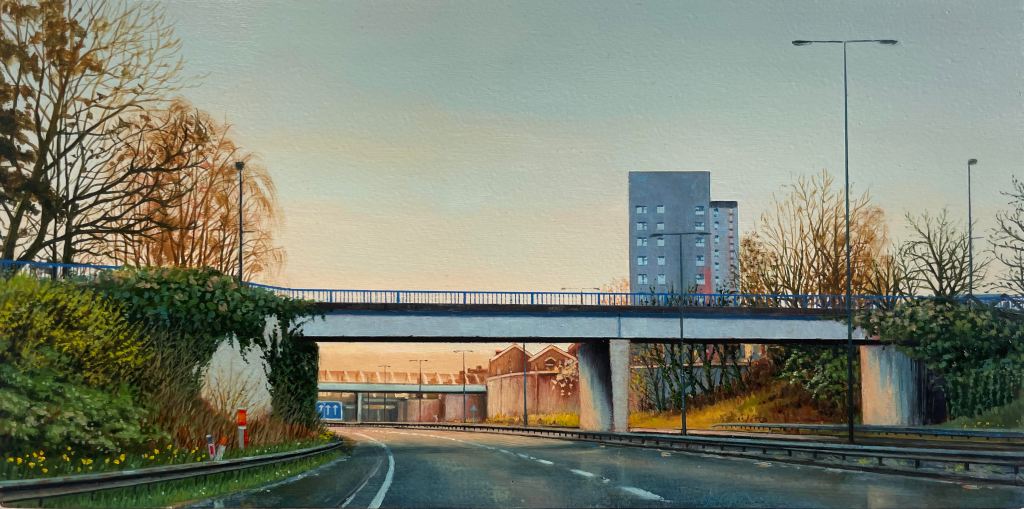
Your paintings seem to work on two different planes, or axes, maybe. On the one hand, there’s the liminal, a threshold to the road forwards; on the other, there’s connection, the road leading off to each side, and the bridge that joins all of this. Does this sort of idea of the direction of movement and the connectedness of, I don’t know, our landscapes and our journeys affect the framing and composition of your paintings?
It does in a way yes. When I’m considering the composition, I’m thinking about where the bridge connects to the landscape and if there are any slip roads, what’s connecting to what. It’s important to get this right and create a balance between the road, the bridge, the surrounding landscape and the sky. The bridge and the road below it can often contain a framed view of the landscape beyond the bridge, so the painting becomes a scene within a scene.
I am struck in your work by the perfect balance of the shape or structure and the detail. The shape of the overpasses themselves defines the space, but the details of the texture of concrete and brick, rivets and road signs, graffiti and rust, draw you in, and, again, become a different way to experience or understand the painting. Do you find yourself making decisions about that balance, about how much detail to include ( I’m not a painter so apologies if these are the wrong terms), I guess how tight or loose to make the image.
I love painting in the details. Most of my paintings are small and often include the tiniest of details. I don’t think too much about it really, I guess how I paint, my style or technique is sort of instinctual now after over 30 years of painting. I find all those elements interesting and beautiful; they are the overlooked, the often unseen, I’m just making sure you get to see them in all their beauty.
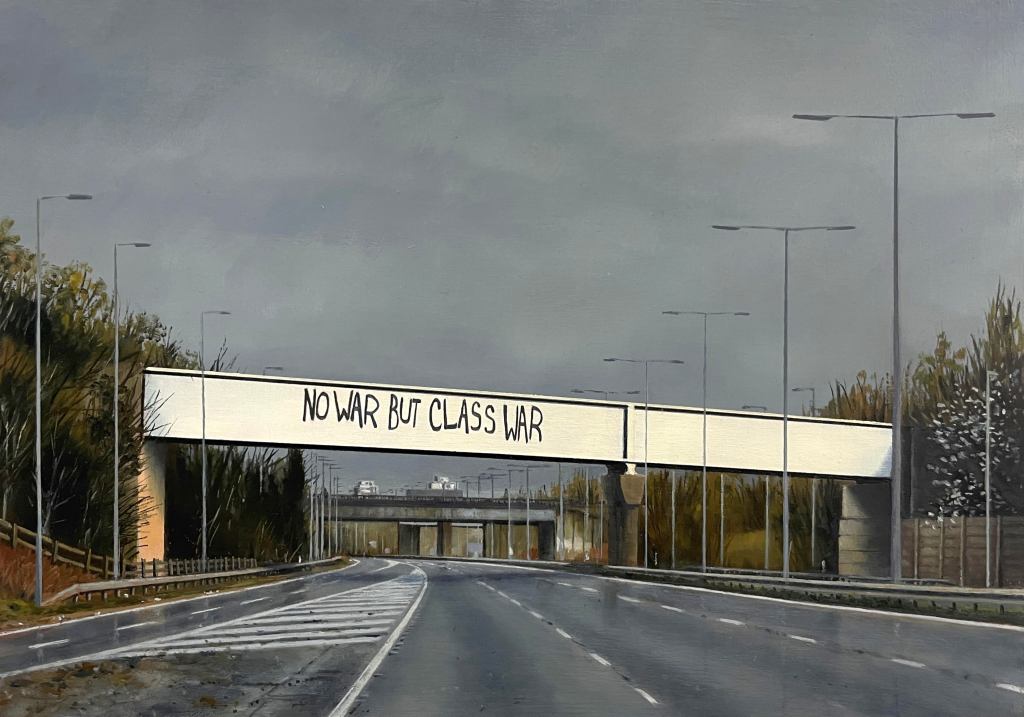
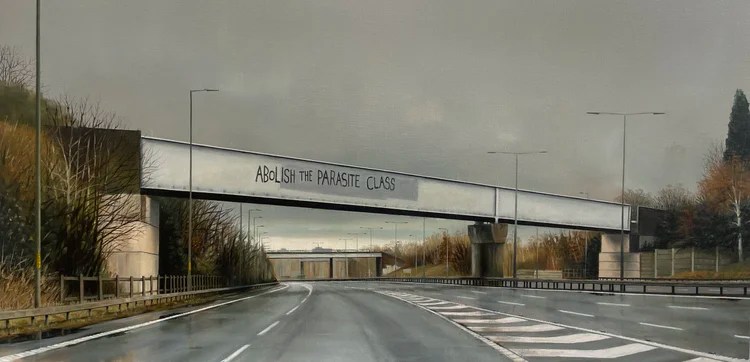
Speaking of reading and graffiti, I’m always drawn to graffiti: to the effort and risk it takes, the beauty of working quickly and secretly, the choice of what images and letters to share with the world, and the idea that it’s all impermanent by nature, that it will be covered over by more graffiti or whitewashed or torn down. Your paintings make something fleeting into something permanent; they’re a record of something in flux. Your paintings become almost a testament to what we leave behind, the landscape we create and abandon, the vestiges of our humanity that we trace on that landscape. Does the writing or art on the overpass motivate your decision to paint it? Do you ever sneak messages of your own into the words or images on the walls of the overpass?
I LOVE graffitied bridges! I agree with everything you’ve said and I feel the same way about them. They are like a timestamp and by putting them in my paintings, I guess I’m kind of providing a social documentation of them, of the time and place — just like the old masters used to paint the landscapes of their time. I made a painting of a bridge over a motorway that circles Manchester with the slogan ‘No War But Class War’ on it — this piece was acquired by Manchester Art Gallery and currently sits amongst paintings of Manchester by Lowry and Valette. This slogan has now been painted over with ‘Abolish The Parasite Class’. The motorway as a platform for protest, I think is really interesting. There’s a captive audience, a blank canvas and someone is willing to hang over a bridge and risk their life for something they believe in, to make a statement, that’s really something. I will take any opportunity to paint a protest slogan, political statement or graffitied bridge. I’ve painted quite a few commission paintings for people, gifts for loved ones and if there’s any graffitied areas in the scene, I try and sneak in the names of the people involved. I recently painted a birthday present from a father to a son, it was of a heavily graffitied underpass walkway so I put the son’s name in as a surprise, they both loved it!
Some of the structures in your paintings have such personality. They seem like big ungainly-limbed giants straddling the landscape, some chunky, some sturdy, some sinewy. Do you start to think of the bridges and ramps as creatures in their own right?
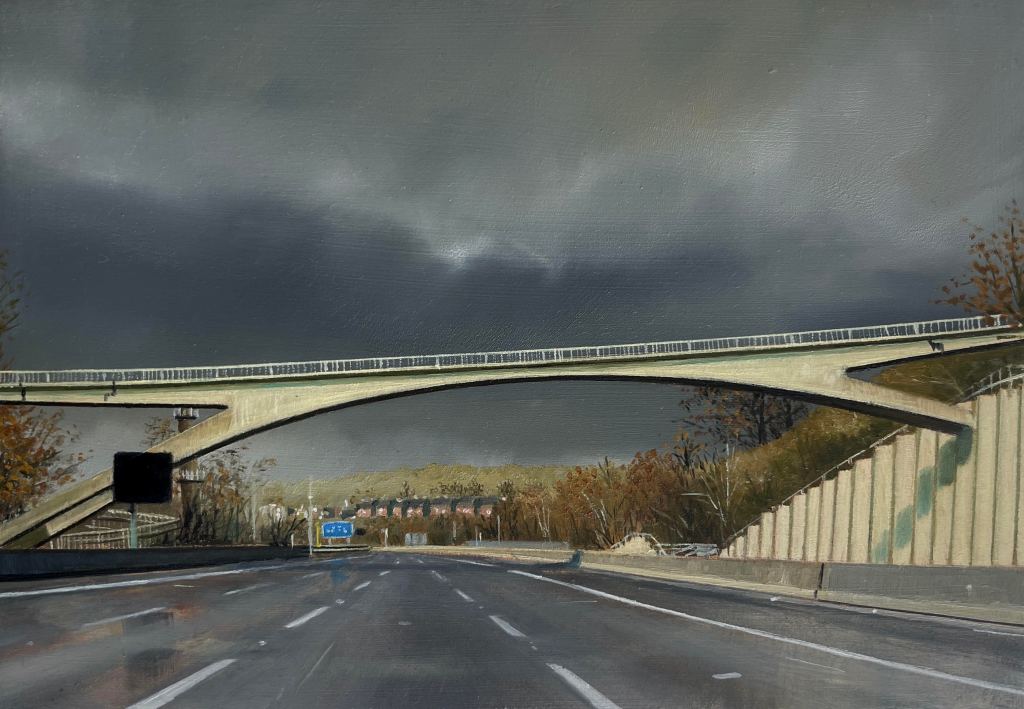
In a way, I see the paintings as me making portraits of these structures — just like a painter of people would want to capture the personality of a sitter, I want to do the same. I want to capture their beauty, stature, sturdiness, weight, function and form and how they sit in their environment. There are a few bridges I’ve painted that look like animals leaping from one side of the road to the other, there’s one in particular that looks a bit like a horse in full stride, I called this painting ‘The Leap’.
Jen Orpin (born Surrey, England,1974) lives in Manchester. She studied at Manchester Metropolitan University (BA 1996) and has had a studio and full time painting practice with Rogue Artists’ Studios since 2000. She is also a Member of Manchester Academy of Fine Art. She co-founded Rogue Women in 2019 and has organised and curated four survey exhibitions of its members and invited guest artists from around the UK. This year sees her organise the fifth iteration of Rogue Women, following this with a stand at the Manchester Contemporary for the third year. She is also the founder of A Small Space Artist Collective based in Manchester and has organised and curated exhibitions for the group in Manchester, Stockport, Macclesfield, London and Bali. As well as being invited into exhibitions across the UK and abroad, she’s also shown in open exhibitions including the Jackson’s Painting Prize, The New Light Art Prize, The ING discerning Eye Exhibition, The Wells Art Contemporary, The Wales Open, The London Group open and the first and second HOME Exhibitions where she was shortlisted on both occasions. She’s also exhibited at art fairs in Manchester, London, South Korea and has been selected on three occasions for the Royal Academy Summer Show. Her motorway paintings have featured in several publications including the Guardian online and twice in the Observer’s New Review and on BBC Radio 6music and ITVX. Jen has had six solo shows including an international solo show in Seoul, in London and a solo presentation at Art Busan, South Korea. Her work is held in private collections both in the UK and internationally and is also held in two public collections including New Art Gallery Walsall and Manchester Art Gallery where she hangs in the Lowry and Valette Room. This year sees the publication of her first book of paintings, spanning 8 years of work made from 2018 to 2025. See more at Jen Orpin Paintings and on Instagram @jenorpinpainter.