

By John Wreford
I emerged from the metro. It was early evening — or was it late afternoon? I’m not sure. I do remember thinking that something didn’t feel right, that something was off. You know, too quiet. The security guards were not at the metro scanner, and security had been increased over the last year.
Since Syria, I had been saddled with an increased sense of paranoia. The simit seller at his cart seemed reassuringly grumpy, as usual. I went home.
Harun, my flatmate, was in the kitchen making tea. He had his mind map to attend to, and I had been invited to a birthday party. Was it a Friday? Looking back, I only remember fragments of those hours.
I had been reluctant to go, but it was Zeynep’s birthday. She was a journalist for the BBC in Turkey and a good friend, so I grabbed my favourite Adidas from the shoe pool by the door and headed out towards Cihangir, a 15-minute walk away.
Three years previously, I had been living in Damascus — a decade of the surreal that ended badly. It’s no exaggeration to say I barely made it out alive. I had come to Istanbul expecting a somewhat quieter life. In my Damascus courtyard I had read Orhan Pamuk and thought, Istanbul is going to be boring in comparison, which, you know, would be a good thing.
I arrived at the bar at around 9 pm, or thereabouts. It was surprisingly sparse: a huddle of people in the corner scrolling through their phones, and Zeynep standing alone, equally preoccupied with hers. Not the vibe I was expecting.
I hugged Zeynep and wished her happy birthday.
‘It’s a bloody coup. It’s my birthday and it’s a bloody coup!’
I smiled — that stupid smile I do when I know it’s a joke but I don’t get it.
‘An actual coup,’ she said.
‘An actual coup?’ I replied, none the wiser.
Typically, I had no data on my phone, so I went to the bar for a drink and the Wi-Fi password. As I waited for my Twitter feed to update, I looked over my shoulder. The bar was now empty.
I looked back down at my phone and saw images of tanks blocking the bridge connecting the European and Asian shores of the Bosporus.
‘Crikey,’ I said, or something to that effect.
I left my drink on the bar (I know) and headed home. I wasn’t sure what I was going to do, but I knew I needed my camera.
The streets were emptying, shops closing. A couple were loading the boot of their car with shopping, blocking the traffic and not caring who they pissed off. There was no panic, just a sense of urgency, faces set with quiet concern.
Harun met me as I arrived home.
‘What’s going on? Have you heard? It’s a coup. Is it a coup?’
I didn’t take my shoes off. Harun was looking at my feet as he peppered me with questions. I grabbed my camera and checked my phone again, suggesting he buy water, or anything else he might need, before the shops all closed.
Minutes later I was striding along an eerily deserted Istiklal Street, usually crowded long into the early hours. At Taksim Square there were a handful of police and a cordon of soldiers, sparsely spaced around the outer perimeter.
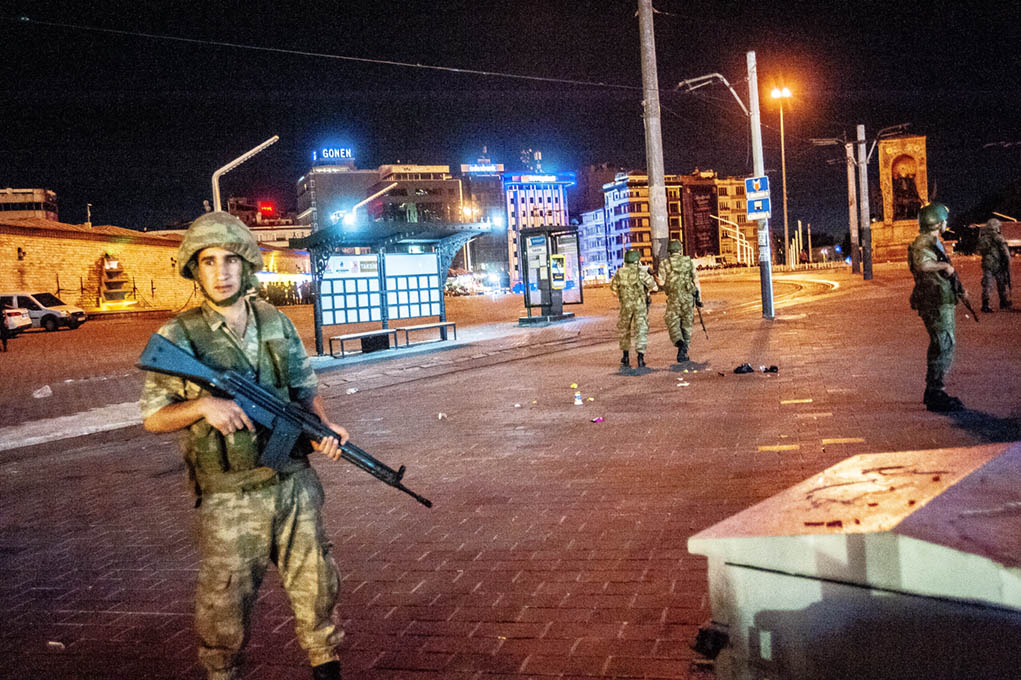
Taksim is symbolic. At its centre stands the Republic Monument, its founding fathers silhouetted against a darker-than-usual sky. A place with a long political history, it had been the scene of the Gezi Park protests only three years earlier, arguably a defining moment in the ruling party’s authoritarian turn, and now it seemed to be on the cusp of another.
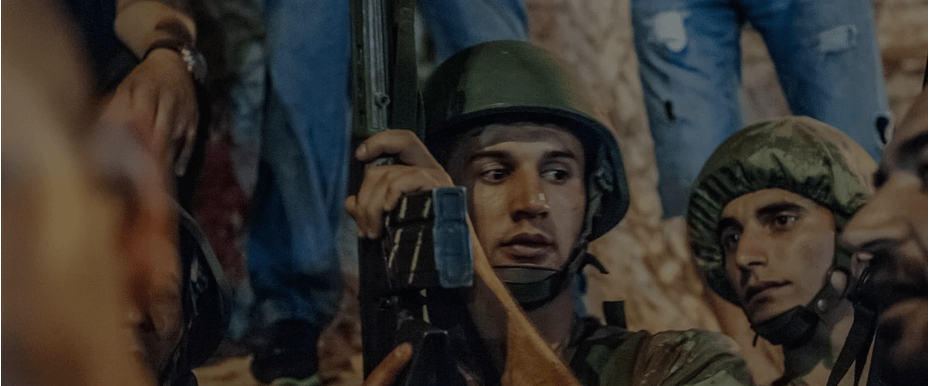
There were very few people around, some clearly journalists. Nobody seemed to know whose side the soldiers were on, or even what was happening. The soldiers looked young, confused and nervous. I could hear the sound of a helicopter in the distance.
I hung around, unsure whether I should stay. I made a few grab shots of the soldiers and decided perhaps I should file the images as breaking news. I’m not really a breaking news kind of guy, but when in Istanbul…
Back at the flat, after taking off my shoes, Harun was eager for an update.
‘Is it a coup?’
‘It could be,’ I replied. ‘A strange one, though.’
I caught up on the news elsewhere. Things seemed to be moving quickly, and it wasn’t easy to separate what was real from what was speculation.
At the back of my mind, the screen flickered: Tahrir Square in Cairo. Hamidiyah in Damascus. It was too early to make predictions, but I also needed to consider the implications and the possible scenarios.
For the tourists who had been taking selfies beside the toy-town tram only a few hours earlier, this must have come as quite a shock. But the previous three years had been one headline after another. The leftists, the separatists and the godless had all had a pop. And when it comes to coups d’état, Turkey has a habit of them occurring roughly every decade: May 1960, March ’71, September ’80, and February 1997.
I headed back to Taksim Square. Harun was not convinced it was a good idea.
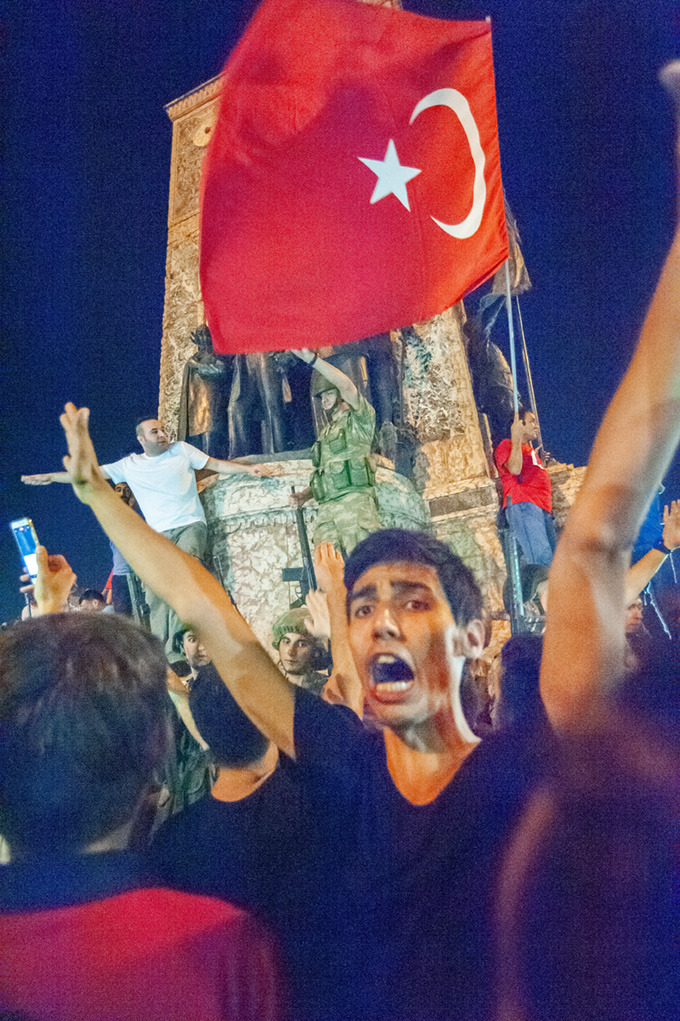
By now a large crowd had gathered. The soldiers had backed off and were surrounded, their backs against the monument. The President, who had seemingly just survived an assassination attempt, had taken to the airwaves, and the call from the minarets was no longer to prayer but to the streets. It really is very easy to whip up nationalist fervour.
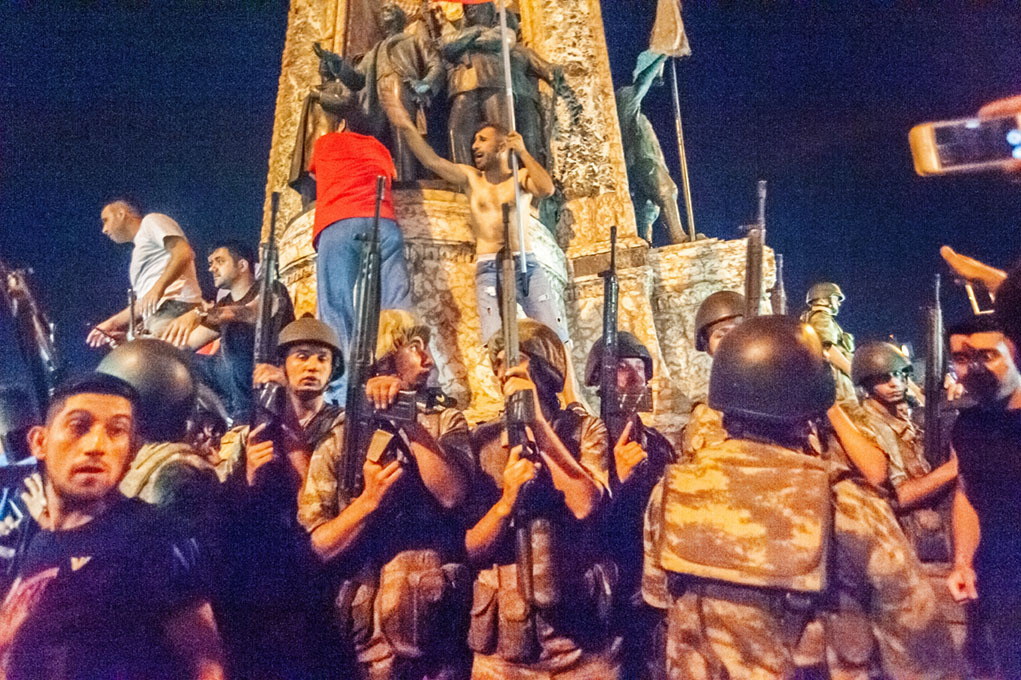
Among the crowd were men with walkie-talkies, wearing the familiar uniform of the plain-clothes policeman: black T-shirt, jeans and trainers. If this had been a nightclub, they wouldn’t have been getting in.
The crowd pressed in around the monument. The frightened-looking conscripts had nowhere else to go, clinging to their rifles as though they offered emotional support.
As a photographer in situations like this, you’re not just looking through the lens but beyond it and behind it, constantly gauging the mood. Who’s paying too much attention to me? I moved through the crowd, never staying in one place for too long, sometimes retreating to the edge of the mob before pushing my way back towards the statue. I locked eyes with a soldier. I leant into the crowd, trying to hold steady in the failing light, pressing the shutter during those fleeting moments of stability and clarity between jabs to the ribs and stamps on my feet.
From the corner of my eye I saw a military truck reversing towards the crowd. As the pressure from behind increased, I decided not to stand my ground and calmly shouldered my way backwards as more bodies pushed past me.
Now standing a short distance away, on the corner of Istiklal Street, I heard shots being fired. Instinctively I moved against the wall and crouched. I guessed the shots had been fired into the air, but I couldn’t be sure and didn’t hang around to find out. I slipped down a side street, avoiding the main roads on my way home.
Crack. Crack. Again. The sound reverberated through the otherwise quiet streets.
At home, Harun asked if I’d bought water. I held up a black plastic bag, smiled and said I hadn’t, but I had bought beer.
‘It’s going to be a long night,’ I said.
And it was.
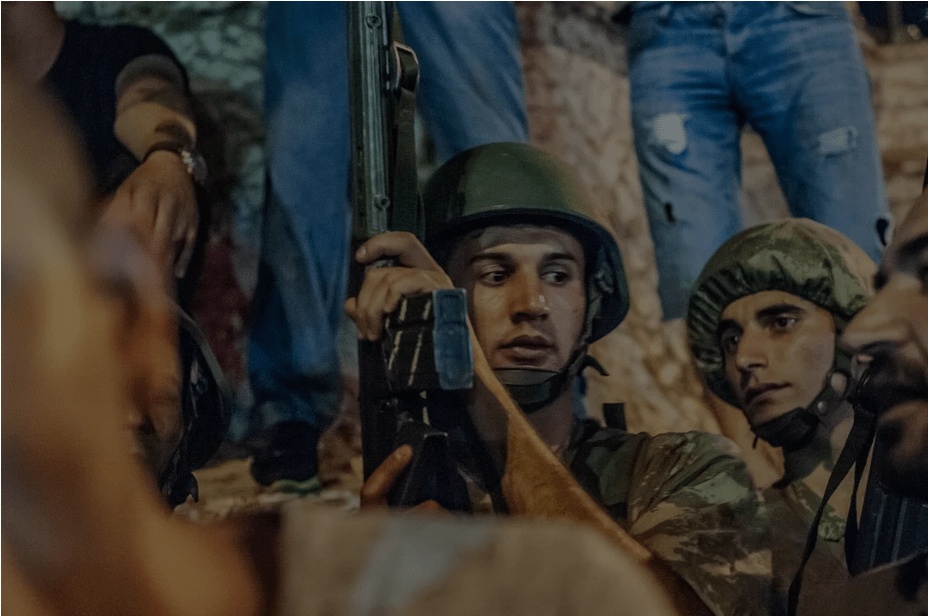
It was a long night of sporadic gunfire. Soon jets were flying low over the city, breaking the sound barrier. The crack rattled the wonky windows. Different versions of the news filtered through despite the intermittent internet connection: stand-offs on the Bosporus Bridges, bombing in Ankara, television stations commandeered, and theories multiplying by the minute. Needless to say, very few people in the country slept. Many were terrified that the sonic booms from the jets were, in fact, missile strikes.
Then, in the morning, it was all over.
Relative calm after an almighty storm. Hundreds had died, more than half of them civilians.
A country traumatised. Again.
Far away in Saylorsburg, Pennsylvania, Fethullah Gülen shifted uneasily in his high-backed leather Chesterfield, his tulip-shaped glass of tea going cold, the first draft of his denial of culpability on his lap. Probably.
Gülen had been in a long-running situationship with the Turkish President. Living in exile but still pulling the strings of his extensive organisation, he must have known he would be the first to be accused. Indeed, the Turkish government was quick to make the accusation. And while everyone—from foreign powers to the dishevelled Turkish left—spoke out against the attempted coup d’état, only the state claimed to possess proof that FETÖ was behind it.
The following day, and for the rest of the week, the city became the stage for a long, government-orchestrated celebration. Crowds waving flags and banners filled the squares. Slogans were chanted, anthems sung. I went each day and night to witness the continuous, galvanising display of unity. Good had triumphed over evil, as it should. The democratic process had been preserved.
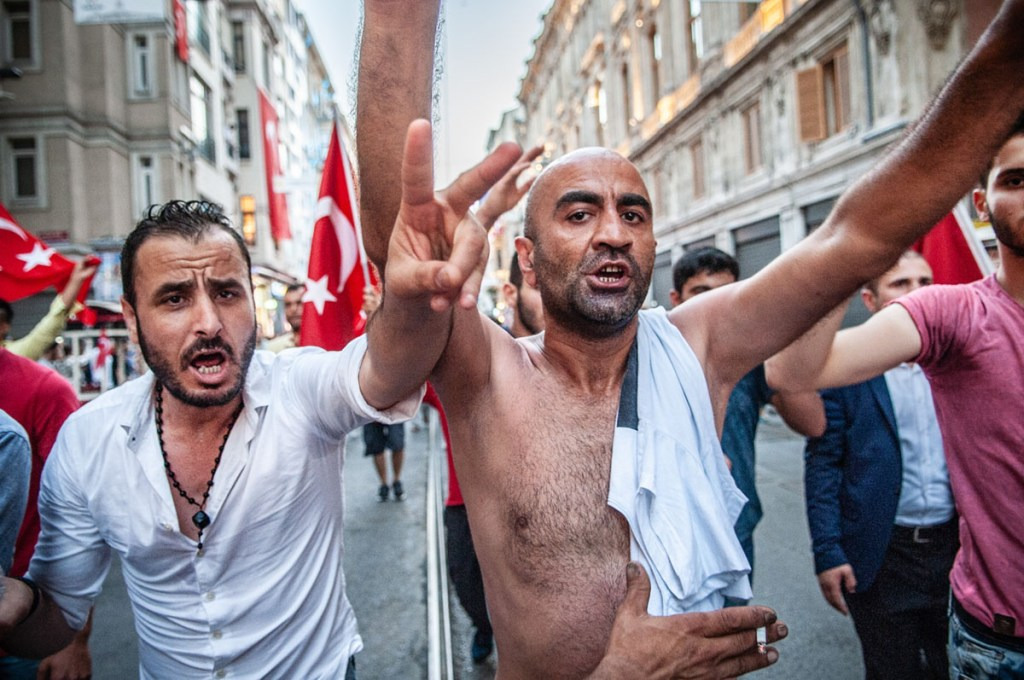
And, as President Erdoğan succinctly put it, the failure of the coup was ‘a gift from God’.
An unprecedented purge followed. The military, teachers, police, judges, civil servants—hundreds of thousands of arrests and dismissals, reaching far beyond known FETÖ collaborators into a system of profiling that removed almost any potential opposition.
In the history of coups d’état, this was a particularly incompetent one. Had it succeeded, it would have been disastrous for Turkey. Its failure, arguably, has proved no less so.
Pointless loss of life and livelihood in the name of political posturing.
Categories: featured, memoir, photography, Travel


