

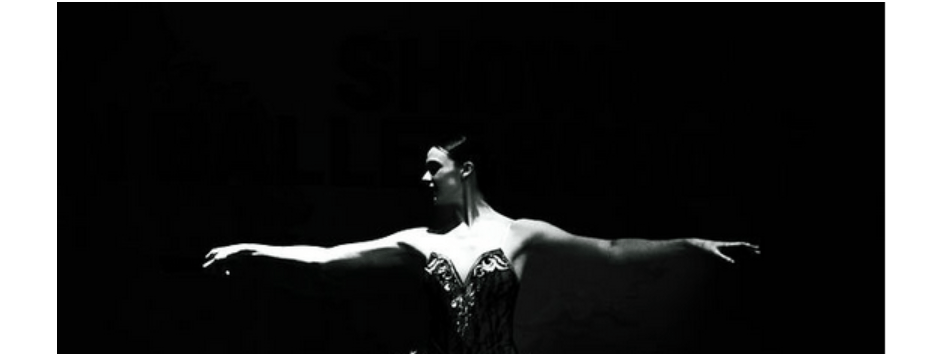
By Chimezie Chika
Dancing is memorising. The mind notes the deliberate movements of the limbs. Each twirl or twist of the torso reaches beyond the immediate surroundings to touch a natural essence that can only be described as beauty. The dancer could start out with a performance of uncertainty; but the mind’s eye roving, as if in a dark room, steadies the body’s position by sheer echolocation. What the dancer sees is not merely what his audience sees; the dancer allows himself to live in a visual world where he tries to become the very images he wants to create. Each image is a path on which he steps, and each step draws the dancer ever closer to a set pattern, which begins to make sense after he has danced through the self-created paths and patterns. The dance itself—as a collective improvised whole—sinks into memory and is regurgitated whenever the dancer needs it.
Vaslav Nijinsky, the great Russian ballet dancer—whom Peter Claudel once wrote of his performances as representing “the possession of the body by the spirit …For a second the soul carries the body… this vestment becomes a flame, and matter has passed,” constantly characterized himself as God. In an essay in The New Yorker, Joan Acocella wrote of his dancing style: “In Nijinsky’s ballets, the dancers turned in, not out. They hunched over; they bunched their fists. They moved in stiff profile, slicing the air like knives.” Beyond the underlying schizophrenic narcissistic patterns evident in Nijinsky’s rather sad life, one can associate how he sees himself with the spiritual force of his dancing (a further association with the general spiritual and sensual suggestiveness of dance as an art).
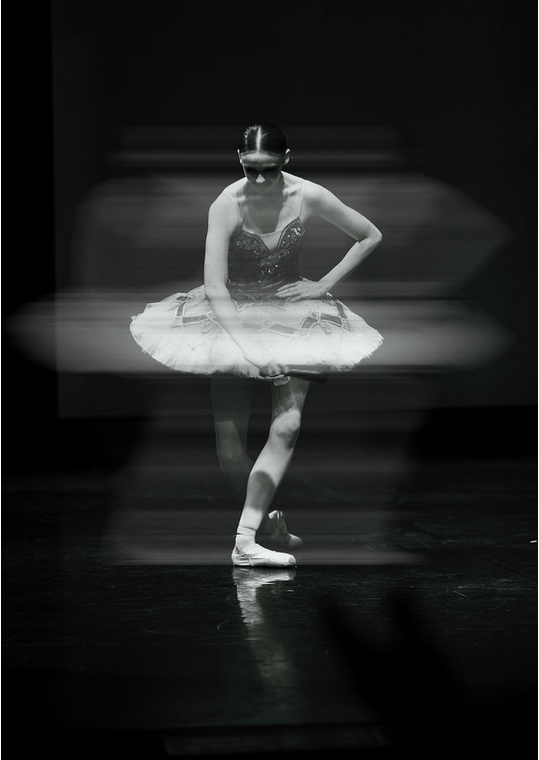
The Nigerian photographer Oluwapelumi Fagbemi’s monochromes of ballet dancers in motion evoke these kindred feelings. The series of pictures of interest to us here is collected under the title of “Balance” on his website. In the first of the series, the ballerina is caught mid-motion in a move that seems to root her legs aground in an almost impossible position (that her gaze is also downward tells us where the focus of the movement is). One leg is in front, but the toes are pointed sideways; her hands have more logic to their posture: the left one is held akimbo on her waist, the other is delicately touching the hem of her tutu—though we cannot be sure of this, for here the camera blurs what can strictly be seen. The blur, in short, is not merely a lack of clarity in the camera’s lens, it is the haze of the ballerina’s movement caught as though it has been light-painted into existence. But the dancer here, as she is captured, does not appear to be free. All we can see is the difficulty of the creation, for both dancer and photographer.
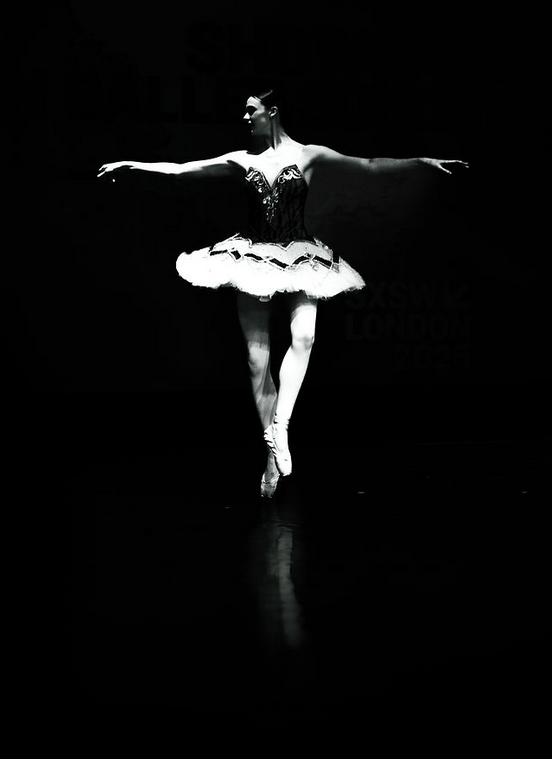
In the second photo, freedom is already apparent in the ballerina’s position. Her hands are spread out, and the hem of her tutu imitates that spreading out. Her legs are the real focus of creativity here: they are poised, at the point of becoming. The toes of both legs are pointed downwards, shod in pointe flats: one already touching the floor en pointe, the other about to. The dancer, for all we can see, is now in the middle of her dance, expressing the body-centric beauties of her art.
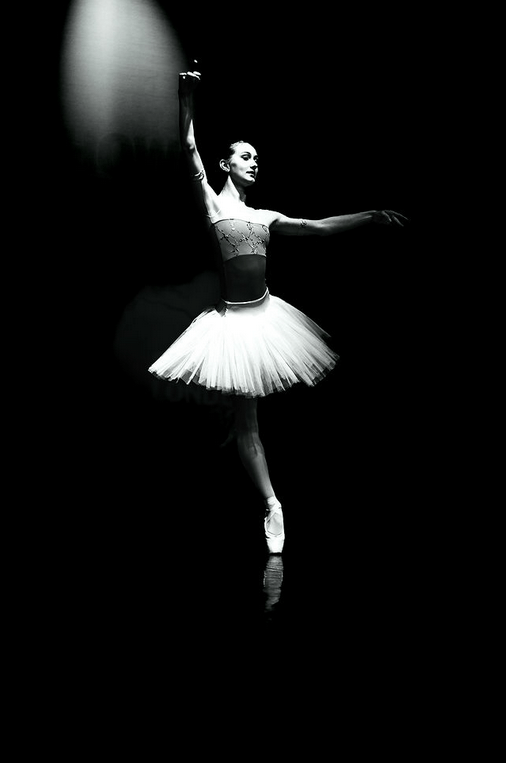
A third photo shows us a different ballerina, arms spread, gaze straight and beatific. In the pose, we do not see one leg (we can presume it is raised right behind her). Her body is propped astonishingly on one leg en pointe. Beyond this, we are also not to be astonished by what the combination of light and photography has done with this image. Above her right raised right arm, there is a halo-like shaft of light; under her en pointe feet, a translucent mirror reflection of the feet can be seen, giving the effect of a wild stunt of standing on water.
It is possible that Fagbemi had imagined these ballet moments as epitomes of the beauties of movement. That understanding, in its relationship to the human body, is constantly affirmed by dance (and no less by ballet), as the human attempt to cartograph stories and emotion, and transmit cultural memory as well as mediate personal ones.
It is the nature of humans to move, to enact movement in all its ramifications. Away from the scientific acknowledgment that movement boosts cognitive function, movement harkens to our most primordial instincts: that of migration and progress. One of the earliest pieces of evidence of our species’ intelligence is our propensity towards movement. Early human hunter-gatherer populations had to move in order to get food and shelter, changing locations and meal types as the seasons changed. That same instinct orchestrated the first mass migration out of natal Africa, a movement that further determined ethnic variations in language and adaptive physiological features. Today, movement remains one of the primary drivers of culture and development.
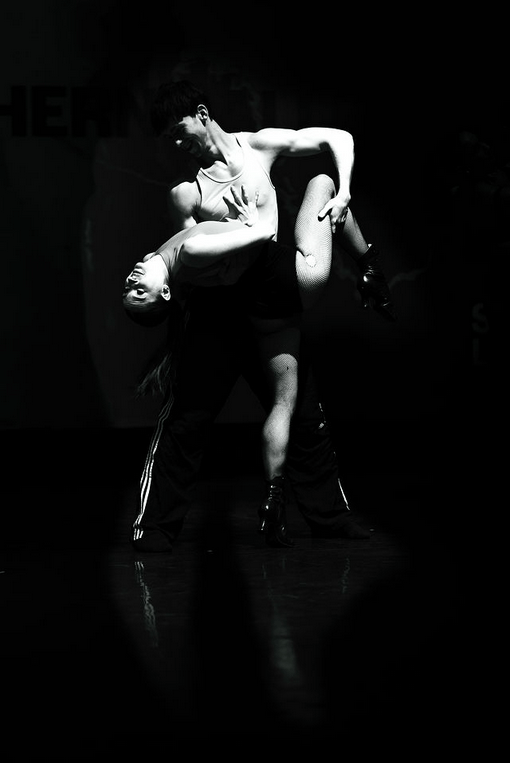
In the only photo where Fagbemi captures two people, we see two ballet dancers, male and female, in a typical sweep-her-off-her-feet pose. The man is comfortable, legs spread apart, so that when we look at him, we think of how balanced his posture is. This is clearly what allows him to hold his companion in the way that he does. One arm beneath her bent-over back, the other holding the crook of her raised right leg, her other leg firm upon the ground. The synergy between the two bodies is marked by the muscularity of their frames: a mutual rhythm can be found in their arms, legs, and shoulders.
The final tranche of three photos in “Balance” is of one ballerina. Tall and muscular in a white tutu with a layered hem, her hair possibly blond, she’s dancing against the selfsame dark background, her feet touching the translucent floor and reflecting it. She is the brightest point in the picture, as white as it gets in bright monochrome, an otherworldly aura about her, almost like a nymph. The second picture of her, where she is poised en pointe, her arms raised, her white hem down, a halo of blur defining her figure, defining her previous movements, as if before we are seeing two other spirit versions of her, flanking her corporeal body.
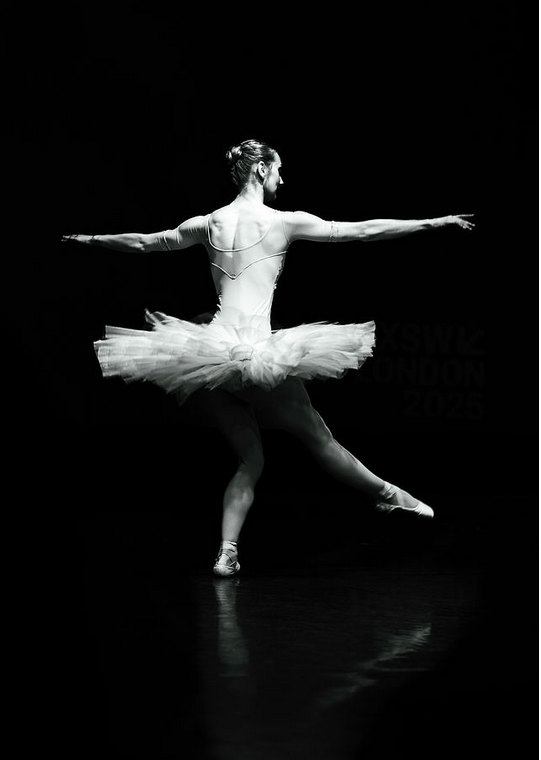
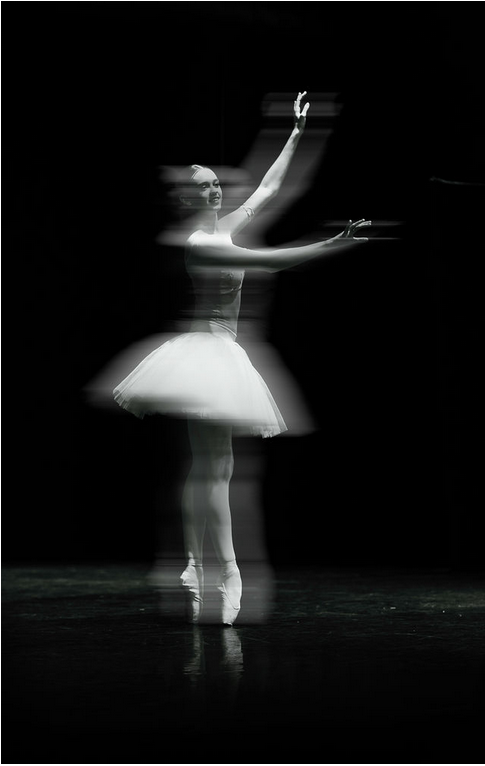
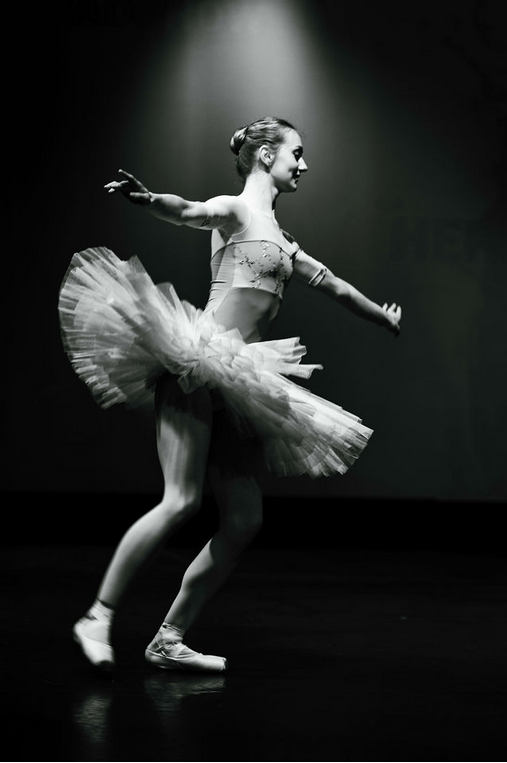
The blur pushes reality, her existence, her dancing into a liminal space. She must be mid-twirl in the final photo, arms spread, neck elongated, legs positioned as if they are about to lift off the floor. Is she about to levitate? This is for sure a moment of transition, when one movement is about to flow into another. The photographer has frozen that moment for us, storing it in the literal realm of photographic memory.
There is another kind of movement associated with dance. The artist as dancer is a medium primed for spirit possession. The artist must dance until they are transmogrified from one form of existence into another, until they can access one realm while remaining in the other. The highly spiritual efficacy of dance is recognised in most indigenous religions in Africa, where a medium performing a ritual must first enact dance to invoke the ancestors or the desired deity. At that point, the physical and the metaphysical are merged in one person.
The substance of existence becomes evident in the ability to move with fluidity between two worlds. Whether this movement is the careful pattern and madness of dance, the search for meaning, or the apotheosis of the human as spirit, the essence is always the act of becoming.
Chimezie Chika is an essayist, fiction writer, and art critic. His writings have appeared in The Republic, The Iowa Review, Afrocritik, and elsewhere.
Categories: featured, featured photographer, photography


