

On a walk through the hot streets of our summer town, I caught a glimpse of a tattered flier on a telephone pole. It was for an event in June; read by the ghosts of June people, early-summer people, ghosts who danced for free. (I remember being intrigued by it the first time I saw it. Why couldn’t you dance for free? Any time, anywhere? But I never stopped long enough to read the details.) When I saw the flyer today, half-hanging off its mooring like another ragged ghost, I realized that I am, absurdly, made sad by outdated fliers. I also feel a twinge of sadness when I see a sign in a store that they will be closed for vacation for a week or two in a week or so. What a poem to expectation and regret or fond memories or disappointment. What an ode to time passing. Maybe especially in summer. Absurd.
Summer comes in waves these days. Waves of suffocating heat, waves of drowning rain, waves of birdsong and fireflies and hot sidewalks, and lots of nothing and ripples something, waves of worry, waves of joy. Waves of strange smoky amber air from forest fires far away, a beautiful and dangerous glowing light. Strings of staring hot days and thunder-shook mosquito-cool glowing evenings. Waves of flowers blooming and growing and withering as others take their place. Now, at the beginning of August, the waves are calm, and we’re floating, just floating and rising and falling and rising and falling again. (It might not feel like it’s passing at all, but it’s still passing too fast.) Now it’s an unexpected spitting drizzling rain like sea spray coaxing the maddening smell out of summer-burnished grass. Now it’s cicadas just starting, just starting their rising and falling song that tells you it’s hot, it’s summer, now. Now it’s only robins singing all the day with their ringing cheerily cheerilo, the only birds to brave summer afternoon. Sounding like childhood, sounding like every summer. If you live in the same place long enough, you feel flickering ghosts of yourself and the people you love everywhere you walk. I see ghosts of our past summers everywhere I go.
Our yard is full of babies. The human neighbors must have grandchildren visiting, and it’s early morning shrieks and laughter. In the yard beyond that, the fish crows gather, their beautiful, comical, conversational voices echoed in the persistent calling of their children, following them through the thick hazy air from tree to tree through the neighborhood. In the trees above my head the never-ending cycle of cardinal chicks keeps its chattering chattering chattering as their parents lose all the feathers on their heads trying to keep up.
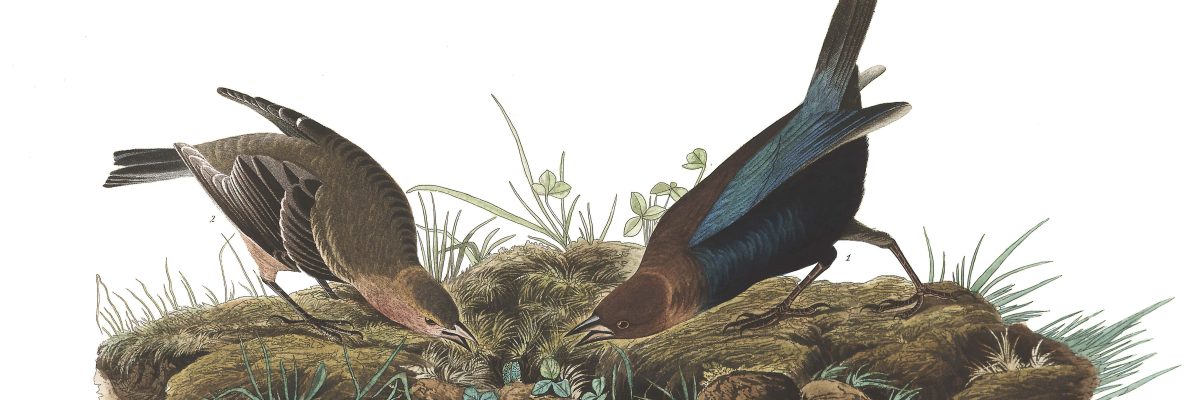
Outside our back door one morning, appeared a big lumpy dryer-lint grey collection of feathers and beady eyes and indignant chirping. When we saw a song sparrow a fraction of its size feeding it, we realized that it’s a cowbird. A cowbird is a brood parasite: The mother lays an egg in another bird’s nest, and the other bird, out of kindness or ignorance or instinct, raises the baby. For reasons I can’t quite explain, I couldn’t stop thinking about this needy baby, and about the little sparrow caring for it. The baby calls incessantly; its little ringing cry of hunger is a constant in our yard these days, and the sparrow, who must not be used to feeding such a large and frantically hungry child, diligently flits around the yard, chirping some sort of assurance to the fledgling that she’s still there, she’s still caring for it.
I don’t know why, but the sight of all of this breaks my heart a little. (I’d be lying if I said a million things aren’t quietly breaking my heart right now. Just the state of the world, the working of evil men, the small inevitable blows, the passing of time with all of its hideous crimes.) I think about the sparrow’s own children; I wonder where they are, I wonder if she has the wherewithal to feed them. I think about the cowbird’s mother. Somewhere along the way she lost the ability to make a nest, and this is the best that she can do. Apparently they hang around and keep an eye on their young. Apparently, cowbird babies will leave the nest at night and fly to fields where flocks of other cowbirds rest, and here they learn to be a cowbird. Here they learn the wistful cowbird song, which some have described as a song like drops of rain echoing in still water. I think about the fledgling itself, so ungainly, so needy, such a strange pile of fluff and hunger and tiny beating bird heart. It doesn’t know it’s a cowbird, I’m guessing. It didn’t ask to be raised this way. But when it’s older, will it do the same?
Anyone who has a niece or a nephew or a pet or even just a friend will tell you that you don’t need to give birth to someone to care for and about it. I don’t know, maybe the story of the sparrow and the cowbird is one of ideal empathy and compassion, a tale of a society working as it should to protect all young. These past years have been a challenge for me, for, I imagine, anyone who tries not to give in to anger and hatred. The cowbird had me thinking that even for these men I’m trying not to hate, who seem so evil and hurtful and self-enriching — these men and their sons and daughters — I suppose that we should have empathy even for them. They didn’t choose to be who they are or raised as they were. But what a sad shame that they haven’t risen above that. That their experiences haven’t taught them empathy rather than selfish greed, that they haven’t learned from the mistakes of their parents.
Whether you’re a parent or not, it’s hard to be strong and just and mature — to be worthy of a child’s love; to be a good example for them; to give them some core of conviction and kindness. And sometimes it feels as though all of that can fall away in a moment — not in a bad way, but in a way that makes you feel more awake, more keenly aware of the tender power and privilege of being important to someone. It doesn’t take much to leave you feeling raw — a gesture, a memory, a needy cowbird. It’s such a strange world! It’s such a sad shame that instead of realizing the privilege of caring for children, people are working to actively hurt them and to separate them from people who care for them. It’s such a sad shame that they have less understanding than a song sparrow.
But a bird’s life seems so fast. The cowbird will grow and fly away, and the sparrow will have more chicks. And fliers will be hung and dances will be danced, and the fliers will be papered over with other fliers till the pole is coated in chainmail of rusting staples, in a cycle of hope and anticipation and memory. The cicadas will sing the heat, and when summer rolls in waves to autumn, the crickets will take over their song and sing the cooling air.


