

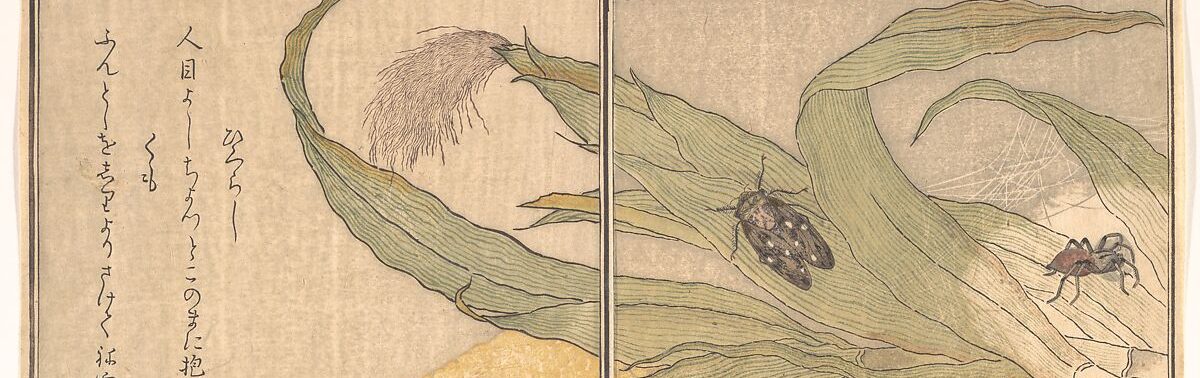
The shell of a cicada;
It sang itself
Utterly away.
-Basho
“But nothing happened until his needle drove too deep, and transfixing the creature, he took away its life with its voice.”
– Galileo
A Polaroid.
It’s not twilight yet but it feels like it is because the storm came, because it was unseasonably hot all day but it’s cooler now. The storm wasn’t much and our house isn’t much cooler, but the windows are squares of golden green light against a darkening room. Someone I love is sitting against the glowing light, framed in a square of window, (“I’m by the window, where the light is”). Someone else I love is sitting behind me in the shadows.
In the morning, the air is cooler outside, and smells like rain and damp earth, the sunlight is so bright in the puddles that it is blinding, and all the springtime smells are mingled and discombobulating. I keep getting flashes of what it feels like to have too many flavors of Halloween candy in your mouth all at once, or the smell of an elementary school hallway at the beginning of the year.
The storm happened a few days ago, and would I remember it if I didn’t write about it? Probably not. But it meant a lot to me at the time, in a deep and resonating way that moments can hit you and then leave you.
You have to leave a shell behind to mark how far you’d crawled with your skinny fragile arms.
A Wedding Portrait.
30 years ago, on this day, cicadas came to our wedding. It was a brood, I think, a 17-year-brood, though I don’t remember the name. They were, suddenly, everywhere. We had to sweep them off the sidewalk so they wouldn’t be crushed, and they climbed up through the layers of my wedding dress, with their tiny grasping hands. We didn’t know they’d be there, we didn’t expect them, but I loved to have them there. As a self-centered human, I felt their presence as a blessing. Their hum was our wedding DJ.
Certainly there are probably no other wedding guests who can arrive en masse and so clearly speak to you about the fleeting quality of life, the bewildering speed of time passing. They are the memento mori-est of visitors, these bright singing creatures who crawl from their slumber in the awakening earth, live on sap and dew, climb up a tree, mate, and die. I didn’t have such serious thoughts about them on that day, they just seemed part of our round glowing hum of happiness. They became a part of our mythology as they have been part of so many others.
For John Berger, they are “… the souls of poets who cannot keep quiet because, when they were alive, they never wrote the poems they wanted to.” For Socrates it was the opposite, and they were the reincarnation of muses who couldn’t stop creating: they were so overcome with delight that they sang and sang, forgetting food and drink, until at last unconsciously they died and were resurrected as creatures who didn’t need to eat or drink but would sing continuously until they died. Socrates warns his pupil not to be lured to a dazed sleep by their buzzing song, but to remain sharp and questioning and eloquent. A reminder to write all the poems that you want to so you aren’t left eternally disatisfied.
In our mythology they are a reminder of that one day and of all the days since, all the days that made us who we are. There’s another type of cicada, not the 17-year brood, but the cicada that comes every year, and they sing a song that, to my ears, sounds like memories of summer, sounds like the heating of the day, the staring blue sky, the smell of dry grass, and cooling evenings. It tells me it is summer, now, and it recalls all the summer days of my childhood and my children’s childhood. But they are not singing to tell me that.
A wedding day is one you remember: You remember what you were doing every hour of the day, big details and small. You don’t need to write it down or take a picture to keep it with you — although, of course, there are always pictures. An anniversary can be a strange day, a day when you run through those memories and reflect on how all the vivid joy of the day that you can’t forget has followed a meandering path of days you can’t remember, though they are full of joy as well, and though they will always be part of you. From a distance of several decades, when you look through the photos, you realize that the children in them have grown and followed their own paths and might have children of their own.
It’s so strange to think that your own children aren’t there, that there was a time before they were born, before they became your world.
You realize how many of the people we love we have lost along the way.
It’s discombulating, bewildering. Bewildering, apparently, (delightfully) comes from words meaning wandering lost in the wilds, lost in a land inhabited by untamed beasts. Untamed beasts like strong memories, lost memories, strange dreams, love, loss, worry, decisions made, unexpected joy and sorrow, hopes dashed, and hopes fulfilled. These untamed beasts are everything you understand but can’t explain, you feel but don’t understand, you know but can’t express.
Galileo had a story about cicadas, too, which he shared with the pope. It’s a fable of a man who has great curiosity. Not a scientist, just a fellow living in a hut somewhere who raises birds because he likes their songs, he likes that they can “… transform at will the very air they breathed into a variety of sweet songs.” He follows them into the woods and hears a strange song he can’t identify. “I say, this man believed he had seen everything, he suddenly found himself once more plunged deeper into ignorance and bafflement than ever. For having captured in his hands a cicada.”
In his desire to know how the creature sings he tries to stop it from singing, though he can’t. “At last he lifted up the armor of its chest and there he saw some thin hard ligaments beneath; thinking the sound might come from their vibration, he decided to break them in order to silence it. But nothing happened until his needle drove too deep, and transfixing the creature he took away its life with its voice, so that he was still unable to determine whether the song had originated in those ligaments. And by this experience his knowledge was reduced to diffidence, so that when asked how sounds were created be used to answer tolerantly that although he knew a few ways, he was sure that many more existed which were not only unknown but unimagInable.” (We now know how the cicadas “sing,” but we still don’t know why some of them wait 17 years to come out of the ground. There are some things we will never understand.)
Well, Galileo thought the story proved that scientific experimentation is needed so we can understand how nature works, and the pope thought that it proved that we should trust in God and not question things. Then, with a deadly sort of intolerance, he had Galileo (who was his friend) killed, to stop him from asking questions. It is a sad story for all involved, but mostly, I think, for the cicada. As humans, our desire to understand and control the world means that we can’t live comfortably with it, that we destroy it. We try so hard to understand everything, but we fail to even grasp that we are not the center of it all; it is not ours to destroy or to ruin. We are a small sour note in a bigger song we will never comprehend.
To me, there has always been a great beauty in things that exist that are not only unknown but unimaginable.
With all respect to John Berger, maybe the poems don’t need to be written, maybe the poem is in the living of it, in the singing of it, the poem is in the not keeping quiet. I think the cicadas themselves are the poets, and they aren’t disappointed with their own poem. I think the poem is in the song we can’t understand, in the song of not understanding. The song of moments we can’t remember, moments we can’t forget. A bewildering memory of a life being lived, unfolding in our memory and our future, a bewildering acknowledgement of time passing: all of this is the very air that we turn into a variety of sweet songs. We don’t need to understand them, but we can hold onto them with our fragile small claws as we climb, unknowingly, where we need to go.


