

By Jim Hauser
“I AM A MAN.”
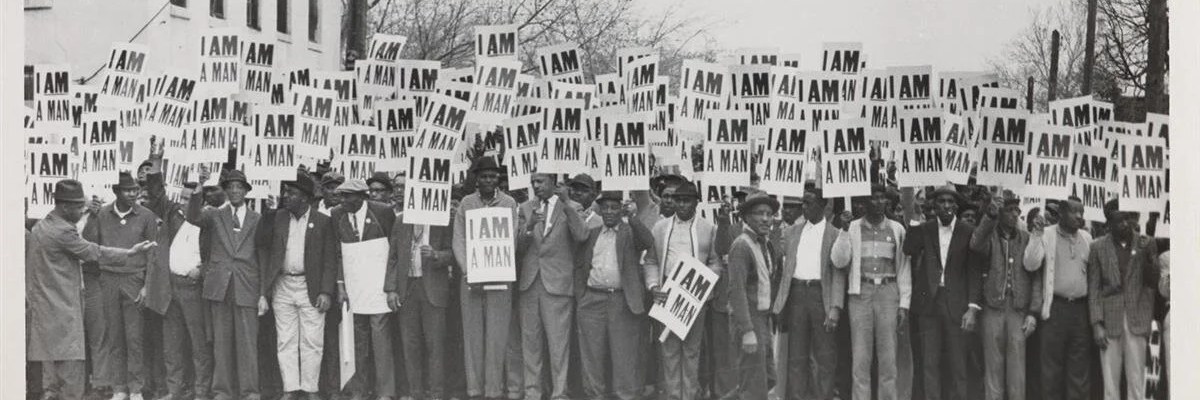
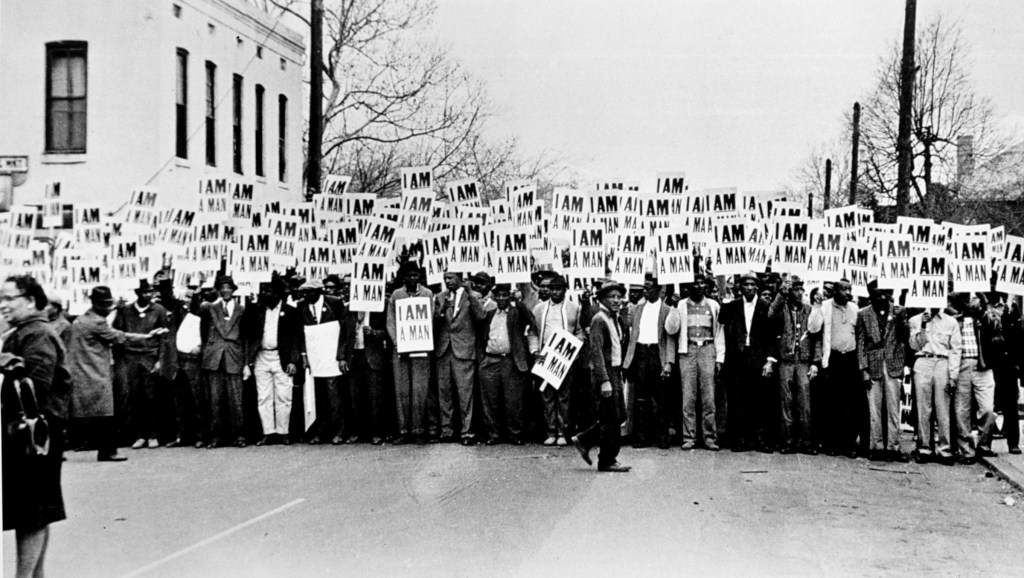
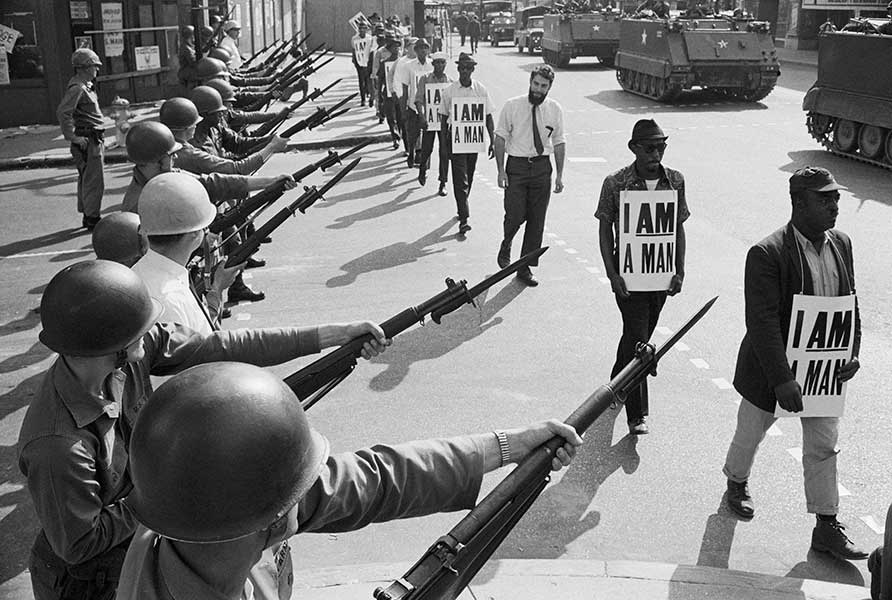
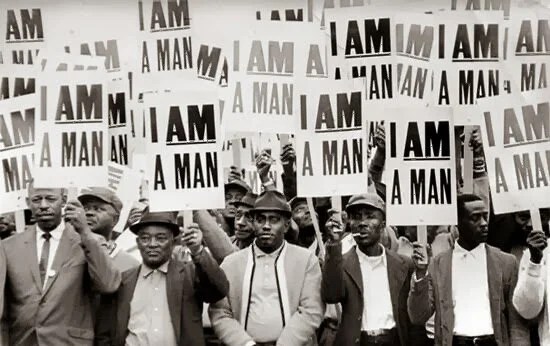
Those four short words printed on signs held by over 100 black city of Memphis sanitation workers hover strikingly over the workers’ heads in what is one of the most iconic photographs from the civil rights movement. With all the letters capitalized and the word “AM” underlined for emphasis, this brief statement served as a defiant response to white supremacy and the racial epithet “boy.” On April 4, 1968—seven days after the photograph was taken—Dr. Martin Luther King, Jr., was shot and mortally wounded in Memphis while standing on the second-floor balcony outside his room at the Lorraine Motel.
King had come to Memphis to support the cause of the sanitation workers, a group of 1,300 men who had been on strike against the city since February 12. The strike involved several issues, including low wages—so low that many of the workers qualified for welfare and food stamps—overtime pay, and labor union recognition. Unsafe and inhumane working conditions were another major issue. Those conditions had recently resulted in two black workers, Echol Cole and Robert Walker, being crushed to death in the compactor of an old, dilapidated garbage truck.
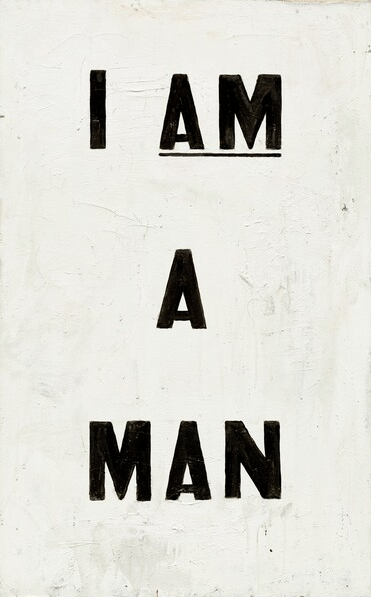
The “I AM A MAN” signs were undeniable evidence of deep racial tensions that existed in Memphis, and the point at which the strikers began to display them signaled a turning point. As documented in Michael K. Honey’s book Going Down Jericho Road, the signs were taken up by the strikers—almost all of the men who hauled garbage were black—after a press conference in which their spokesman, Reverend James Lawson, highlighted that the strike involved a struggle for black manhood, a fight for recognition of the humanity of the workers. He stated, “the heart of racism is the idea that a man is not a man, that a person is not a person,” and he emphasized to the workers that they were human beings and deserved dignity. He went on to explain that what he was saying “is rooted in the Negro spirituals, and in the slave preachers telling their people, ‘You’re not a slave, you’re a man.’”
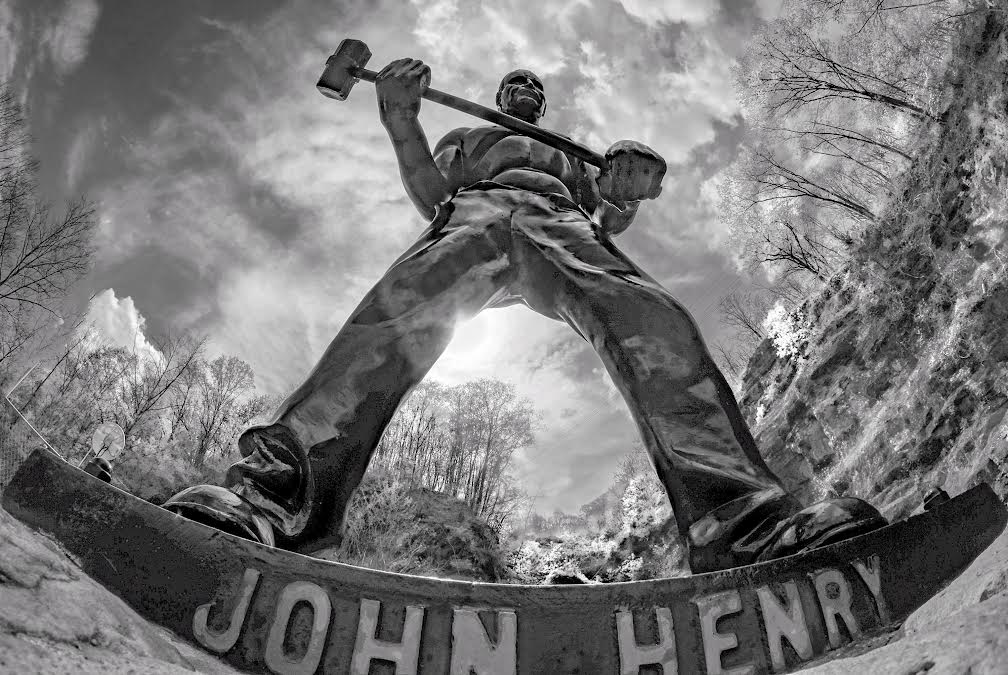
The strikers’ signs had musical roots in not only the spirituals, but also in black secular folk songs, and, perhaps most important, in “John Henry,” the blues ballad about a legendary black steel driver who worked in railroad tunnel construction. In part, the typical ballad text tells the story of a steel-driving contest between John Henry and a mechanical steam-powered drill. John Henry emerged as the contest’s victor, but the great effort he had put forth caused him to collapse and die. Beneath this tragic story of man versus machine lies another story, one that carries the same message of black manhood and racial equality as the “I AM A MAN” signs. That message is in the ballad’s key verse:
John Henry said to the captain,
“A man ain’t nothin’ but a man.
Before I let that steam drill beat me down,
I will die with a hammer in my hand.”
The second line of the verse—“A man ain’t nothin’ but a man”—spoken by John Henry to his captain, a white boss, contains a hidden meaning. On the surface, he is saying, I am just flesh and blood, not a tireless, unfeeling machine like my opponent, the steam drill. This is the meaning that comes from considering the line within the context of the story of John Henry’s race against the mechanical drill. But by considering that line in relation to the world of racial oppression in which John Henry lived, the deeper, covert meaning of the line comes into focus. On this deeper level, John Henry is laying claim to his manhood, his humanity. He is asserting racial equality. He is declaring, I am a human being! My black skin does not make me inferior and subhuman. In effect, he is telling his captain, You are not superior to me! So, singing about John Henry declaring, “A man ain’t nothin’ but a man” was a way for Jim Crow-era black musicians, while in the presence of whites, to say something they could not say otherwise.
African Americans clearly used this key phrase and variations of it such as “A man ain’t but a man,” to assert equality with white people. For example, bluesman John Lee Hooker used the variation “A man is just a man” to declare racial equality in his 1963 recording “Birmingham Blues,” a song he wrote in response to events that occurred during the 1963 Birmingham, Alabama civil rights demonstrations:
I feel so bad, I read, read about Birmingham
I do know one thing: A man is just a man
And God made everybody equal, equal, equal.
Another variation appears in the black folk song “De Black Jack and de Tall White Pine.” It was collected by Willis Laurence James, an African American musicologist, and published in his book Stars in de Elements: A Study of Negro Folk Music. In this song, a conversation takes place between two trees, a black jack and a white pine. The white pine thinks it’s superior to the black jack because of its height—and more important, its color—and the black jack responds by proclaiming its equality with the assertion “Trees ain’t nothin’ but trees.” The key verse from the song is below, exactly as it appears in James’s book, including the parenthetical definition of the word “biggity”:
De black jack said to de tall white pine,
Just ‘cause you high in de breeze,
You needn’t talk so biggity (bigoted),
Trees ain’t nothin’ but trees.
It is clear from this verse that singing “Trees ain’t nothin’ but trees” was not only an assertion of racial equality, but also a challenge specifically directed against the concept of white supremacy. The similarly worded “A man ain’t nothin’ but a man” must have signified that same challenge.
African Americans also challenged white supremacy with expressions similar to “A man ain’t nothin’ but a man,” including “just a man” and “only a man.” For example, the first of these appears in an old black folk song titled “How Long Brethren” that was collected by Lawrence Gellert and appears in Steven Garabedian’s book A Sound History: Lawrence Gellert, Black Musical Protest, and White Denial. It contains the lines “White folks ain’t Jesus, he just a man / Grabbin’ biscuit out of poor n****r’s hand.” The second appears in Ralph Ellison’s novel Invisible Man. In it, a black character tells the novel’s protagonist, a naïve young black student who has internalized white supremacy, that his school’s rich white benefactor—a man whom he sees as a godlike force—is “only a man.”
* * * * *
On July 5, 1968—just three months after King’s assassination and the April 16th settlement that ended the strike—blues musician Furry Lewis was quietly shedding tears while entertaining friends at a party in his Memphis home. A retired sanitation worker himself, Furry had good reason to be emotional. The previous day had marked the nation’s first Independence Day since King’s death, yet for many black Americans in 1968, the Fourth of July offered little cause for celebration. That was especially true in Memphis, where the memory of King’s murder and the struggle that had brought him to the city remained painfully fresh.
Just how unfit the 4th was for celebration was articulated in a speech made over a century earlier by Frederick Douglass, a former slave who had escaped to the North and freedom. On July 5, 1852, exactly 116 years before the day Furry shed his tears, Douglass stated his and black America’s feelings about the Fourth of July in a speech to a crowd of white abolitionists in Rochester, New York. His speech was the keynote address at an event commemorating the signing of the Declaration of Independence. Douglass told his audience, “This Fourth of July is yours, not mine. You may rejoice, I must mourn.” And he went on to say:
“What, to the American slave, is your Fourth of July? I answer: a day that reveals to him, more than all other days in the year, the gross injustice and cruelty to which he is the constant victim. To him, your celebration is a sham; your boasted liberty, an unholy license; your national greatness, swelling vanity; your sounds of rejoicing are empty and heartless; your denunciation of tyrants, brass-fronted impudence; your shout of liberty and equality, hollow mockery….”
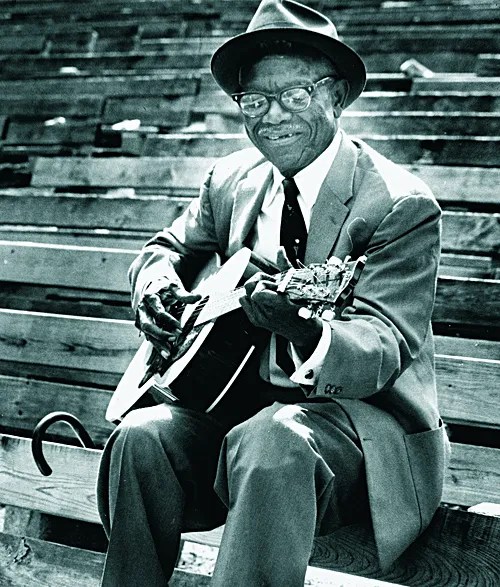
Douglass’s words would certainly have rung true for many black Americans—including the sanitation workers—had they heard them on July 4, 1968. And on July 5, they would also have rung true for Furry Lewis as he entertained his friends and as the tears flowed down his face. Although Furry had retired two years before the strike, he must have closely identified with the workers. He had worked for the sanitation department himself as a street sweeper. For 44 years, he swept the Memphis streets on a wooden leg, having lost his left leg to amputation in 1916 after an accident involving hopping a freight train.
Furry’s house party tears began to flow while singing “John Henry,” a song that was very dear to him. He had performed it hundreds of times and recorded it probably at least a dozen times over the course of his musical career. But, overwhelmed with emotion on this occasion, he cut the song short and did not sing the ballad’s key “A man ain’t nothin’ but a man” verse. Possibly because it may have caused him to lose what composure he still had left inside him. Singing John Henry’s declaration of racial equality may have been too much for him, may have taken him back too close to the sanitation strike, the “I AM A MAN” signs, and the assassination of King.
But the omission and abrupt ending did not matter. Furry was among friends, friends who must have felt and understood the emotional weight of the moment. They offered words of comfort as he tried to hold back the tears. During Furry’s performance and those moments of consolation that followed, the steel driver who proclaimed, “A man ain’t nothin’ but a man” was more than a long-gone legendary folk hero: he was someone real and close, a reflection of black working men in Memphis–especially the sanitation workers and what they had been going through.
However, a key verse which Furry did sing that day was one of the ballad’s traditional “complaint verses.” In these verses, John Henry complains to his captain about his wages or accuses him of unfair treatment. Possibly, Furry sang it to express solidarity with his former sanitation department coworkers:
John Henry told his captain one day,
“You can give me my time.
I can make more money on that C & O
Than I can on that IC line”
The above verse has a strong element of racial resistance and protest as John Henry clearly makes no bones about showing his captain that he is unhappy with the wages he is paid and announces that he is quitting the job and going to work for another railroad. He does not act in the indirect and deferential manner that was expected of a black man during the times in which John Henry lived. He does not play the part of the happy-go-lucky, docile, “contented Negro.” Far from it. Instead, he is quite blunt and makes no attempt to soften what he is saying. And considering the way black people were expected to conduct themselves, John Henry’s demand for his wages—“You can give me my time”—would likely have been viewed by his captain and employer as an act of racial impudence. In this verse, and, as we shall see, in certain other verses of the ballad, the legendary black steel driver clearly does not abide by the traditional Jim Crow customs that acknowledged white supremacy; this is one of the keys to understanding what John Henry meant to African Americans. And what he meant to Furry Lewis.
The discussion above highlights the fact that, in order to fully understand what the John Henry ballad meant to black Americans, we need to put it in the context of their lived experience. Specifically, that experience as it was during the days the ballad originated and flourished: an approximate 90-year period following the Civil War that lasted from the 1870s (the latter years of Reconstruction) until the end of the Jim Crow era in the 1960s. During those days, and in that context, John Henry was not the race-neutral working-class hero who is currently embedded in America’s national consciousness. Instead, many nineteenth and twentieth-century Black Americans viewed John Henry specifically as a race hero. For them, he was a towering figure of black resistance and a source of racial pride. The multiple aspects of his heroic appeal included his shattering of racial stereotypes, his overcoming impossible odds, and his symbolizing the strength and fortitude of black people in the face of overwhelming adversity.
That adversity included African Americans being exploited for their labor to an often incredibly inhumane extreme. Many who sang about and idolized John Henry were forced to work in unspeakably brutal chain gangs, prison farms, and convict lease camps. The exploitation included the widespread practice of debt peonage, and this resulted in the entrapment of black sharecroppers in what amounted to a new form of slavery. Peonage was also used against laborers in levee construction, lumber, turpentine, mining, and railroad work camps. Many African Americans worked from sunup to sundown, doing backbreaking labor under terribly difficult, unsafe, and often life-threatening conditions. Even those free to leave their work situations were keenly aware of the grim, racist maxim: “Kill a mule, buy another. Kill a n****r, hire another.” It meant that the life of a black worker was worth less than that of a mule. And that was because the worker could be replaced with much less of an impact on the employer’s bottom line.
These black laborers projected what they experienced in their work lives onto their hero, John Henry, creating verses in which he was portrayed as a victim. For example, the verse below, because it was adapted from the prison work song “Go Down, Old Hannah,” suggests that John Henry and his fellow steel drivers were victims of some form of incarcerated forced labor:
John Henry looked at the sun one day,
And the sun had done turned red.
And he looked back over his shoulder, Lord,
And he see’d his partner fallin’ dead, dead, dead.
Furry sang the above verse on several of his “John Henry” recordings. Although he never experienced incarceration himself, he was likely aware that a man dying from being worked to death was not an infrequent occurrence on prison farms and chain gangs. It also occurred among convict lease laborers, men who were hired out by state prison systems to perform forced labor for private contractors.
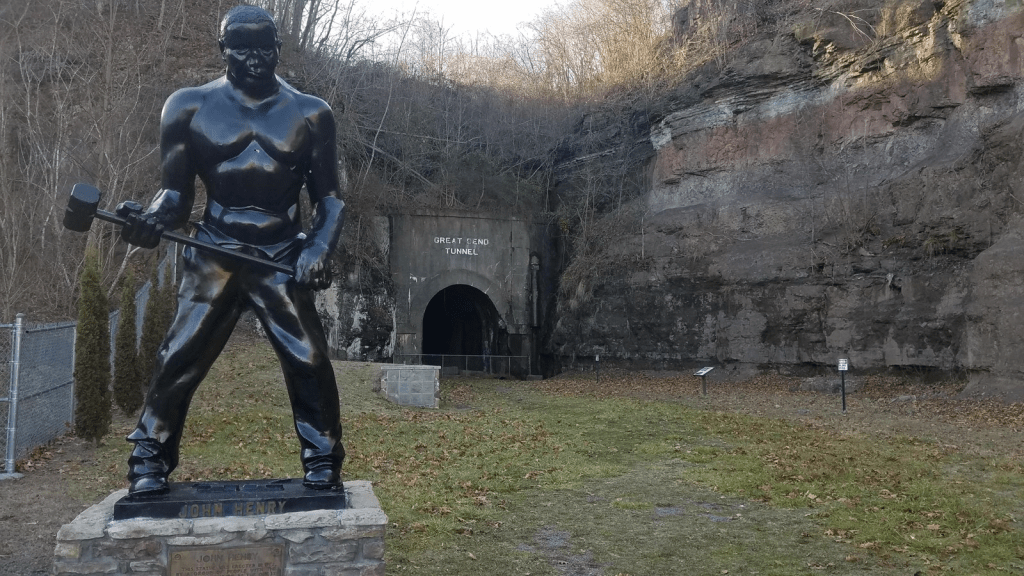
John Henry’s work of tunnel-building involved using a sledgehammer to drive hand drills (long, chisel-like steel rods that were sometimes called pikes) into solid rock. A man called the shaker (or piker) held the drill in position against the rock surface. Hammer songs (rhythmic work songs referencing the tool used by steel drivers) were sung to set the pace of work and prevent accidents by coordinating the hammer blows with the positioning of the steel rods. After being driven into the rock, the rods were removed and the holes were filled with explosives to blow away the rock. This process was repeated over and over until a tunnel passed completely through the mountain. It wasn’t until the 1870s that steam drills began to replace this hand-drilling method; therefore, folklorists believe the ballad originated during the late 19th century.
Tunnel work was extremely difficult and dangerous, and it was performed under inferno-like conditions. The shifts were long, the heat was oppressive, the lighting was dim, and the air was often filled with smoke and rock dust generated by the shattering blasts of dynamite. Many workers were killed or injured by falling rock or cave-ins. The deadliest of the tunnels were those that passed through sandstone, a sedimentary rock composed of sand-sized silicate grains.
Exposure to fine silica dust in these tunnels caused workers to develop silicosis, a debilitating lung disease that was incurable and could kill a worker in less than a year. For the companies under contract to build the tunnels, meeting deadlines and maximizing profits were a bigger priority than the health, safety, and comfort of their workers. Dust-control machines and special breathing equipment or masks were safety measures that could be ignored in favor of completing the work more quickly and at lower cost.
Considering the above, Furry’s recordings of “John Henry” are quite fitting. They are dark and brimming with racial resistance and protest, containing verses filled with death, defiance, and rebellion. They portray John Henry as a man who sees himself as a victim, and who fights back against being victimized. For example, Furry highlighted this in several of his recordings through a variation to the “A man ain’t nothin’ but a man” verse. In it, rather than declare his intention to defeat the steam drill, John Henry instead directs his challenge at his captain and his tool of exploitation—the tunnel work gang:
John Henry told his captain one day,
“A man ain’t nothin’ but a man.
Before I be beaten by your steel drillin’ gang,
I’m gonna die with this hammer in my hand.
In the above verse, John Henry is declaring his will to survive and triumph over his exploitation. He is telling his captain that he and his spirit of resistance will not be broken. He is insisting that he will prevail physically, mentally, and spiritually. Or die fighting back.
In some recordings, Furry sings of John Henry’s victimization through a verse in which he rejects his hammer and his occupation of steel driving. He does this by taking a traditional verse in which John Henry tells his son that he wants him to be a steel driving man and subverts it by singing of John Henry telling his son to not become a steel driving man or to “never take no pattern after me.” Also, John Henry’s victimization is pointed out in some of Furry’s recordings through a traditional verse in which John Henry is taken to the mountain, and, upon seeing how its enormous size dwarfs his own body, he “laid down his hammer and he cried.”
Furry’s recordings lead us to the dark side of the John Henry legend; they help us see the ballad in a quite different way. And they lead us to question the commonly held notion that John Henry raced the steam drill in order to save his job from being replaced by it. Furry must have seen in the ballad something quite different from that notion. The verses of resistance that he sang suggest that he saw John Henry’s real struggle as a struggle not to save his job but to survive it. It was a struggle faced, in one way or another, by many African Americans in the Jim Crow South.
Furry’s recordings are part of a long tradition of black performers loading the ballad with racial protest and resistance. Protest was expressed through not only the declaration of racial equality in the phrase “A man ain’t nothin’ but a man,” but also through, among other things, John Henry challenging his captain by refusing to be physically beaten, mistreated, underpaid, or overworked. In issuing these challenges, John Henry stepped over the boundaries established by the white power structure for black men in the Jim Crow South. In those days, acts of resistance such as the ones by John Henry against his captain—by a black man against his boss or some other white authority figure—amounted to acts of defiance and rebellion against the existing racial hierarchy. John Henry’s challenges to his captain cast him clearly in the role of a race rebel.
A good number of these challenges appear in the third and fourth lines of the “A man ain’t nothin’ but a man” verse, including a challenge in a version collected by folklorist Bruce Jackson from a performance on a Texas prison farm:
John Henry told-a the Captain,
He said, “A man ain’t nothin’ but a man,
And before I’ll stand to let you drive me down,
I will die with the hammer in my hand.”
Other versions contain essentially the same verse, except the key third line is a line such as “Before I take any abuse from you” or “Before I work from sun to sun.” Through these challenges, John Henry is not only asserting equality with his captain but also warning him that if he mistreats him, he will resist and fight back to the death if necessary.
A key aspect of the ballad that has been overlooked by researchers is that there are a substantial number of versions in which John Henry’s challenge to the steam drill includes a challenge to the captain himself. And, as pointed out earlier, a black man challenging his white boss in the Jim Crow South amounted to him also issuing a challenge to the established racial hierarchy. This two-pronged challenge is made in a good number of versions of the ballad (documented in musical recordings, books, and articles) in which John Henry challenges the drill while referring to it as belonging to the captain: “Before I let your steam drill beat me down / I’ll die with a hammer in my hand.”
A particularly defiant version of this two-pronged challenge can be heard in a recording made at the Mississippi State Penitentiary. It appears on the album Jailhouse Bound: John Lomax’s First Southern Prison Recordings, 1933. In it, a large group of convicts sings of John Henry committing an extraordinarily audacious act of defiance: taunting his captain after defeating his steam drill—and thereby defeating the captain himself. And it was even more audacious for the convicts to celebrate that defiance in song while confined in a prison work camp under the constant supervision of armed white guards. Here is that verse:
John Henry said to his captain,
“Look yonder at what I see.
Your steam drill is broke, and your hole is choked
And you can’t drive steel like me.”
For black Americans, a people who were denied their manhood under slavery and Jim Crow, John Henry was a powerful symbol of what had been denied them. In his foundational 1968 essay “Through the Prism of Folklore: The Black Ethos in Slavery,” African American professor Sterling Stuckey has even referred to John Henry as the black man’s “greatest symbol of manhood.” If John Henry truly occupied that symbolic role, wouldn’t this big, proud, and mighty steel driver have stood up for himself and fought back against being whipped, overworked, underpaid, and other forms of mistreatment? Of course he would have! And, as pointed out in the examples above, that is exactly what he did. And, through fighting back, he also served as a figure of wish fulfillment, symbolically doing for African Americans what they themselves desired to do but could not.
As a symbol of manhood, John Henry must have also been a potent symbol of freedom. Manhood and freedom have been inextricably linked for African Americans. Martin Luther King pointed this out in his writings and speeches. For example, in his August 1967 “Where Do We Go from Here?” speech, he stated that for the black freedom movement to be successful, “the Negro must rise up with an affirmation of his own Olympian manhood.” He went on to state that no document, such as Lincoln’s Emancipation Proclamation and no civil rights legislation, could bring true freedom to black America, and then declared, “If the Negro is to be free, he must move down into the inner resources of his soul and sign with a pen and ink of self-assertive manhood his own emancipation proclamation.”
Sterling Brown made this same connection between black manhood and freedom in his 1932 poem “Strange Legacies.” Brown, an African American poet and folklorist whose work was peopled with black characters courageously struggling against racial injustice, makes that connection through two great symbols of black manhood: John Henry and Jack Johnson. The poem pays tribute to John Henry by describing him as a model of courage, strength, persistence, and pride. Also, it praises him for showing black Americans how to “go down like a man,” praise that signals that the race with the steam drill involved something of much more importance than a simple sporting contest. A clue as to what that “something” was appears earlier in the poem as it praises Jack Johnson, the first black boxer to win the heavyweight crown. It describes Johnson standing “like a man” in his title fight against the white boxer Jim Jeffries, a match that was billed as “The Fight of the Century.” Prior to the bout, Jeffries had stated, “I am going into this fight for the sole purpose of proving that a white man is better than a Negro.” In a later verse, Brown’s poem goes on to declare that John Henry “had what we need now” and asks him to “Help us get it.” Of course, what Brown was getting at in his poem is black manhood, and the crucial and necessary part it played in fighting for and attaining black freedom.
The symbolism in the man-versus-machine contest and the racial significance of “A man ain’t nothin’ but a man” have been recognized by Bob Dylan—hardly surprising, given that he is one of our greatest poets. In a speech he delivered upon receiving the 2015 MusiCares Person of the Year award, he pointed out that the ballad inspired him to write the opening line to “Blowin’ in the Wind,” one of our greatest civil rights anthems:
“These songs didn’t come out of thin air… If you sang ‘John Henry’ as many times as me – John Henry was a steel-driving man / Died with a hammer in his hand / John Henry said ‘A man ain’t nothin’ but a man / Before I let that steam drill drive me down / I’ll die with that hammer in my hand.’ If you had sung that song as many times as I did, you’d have written ‘How many roads must a man walk down?’ too.”
* * * * *
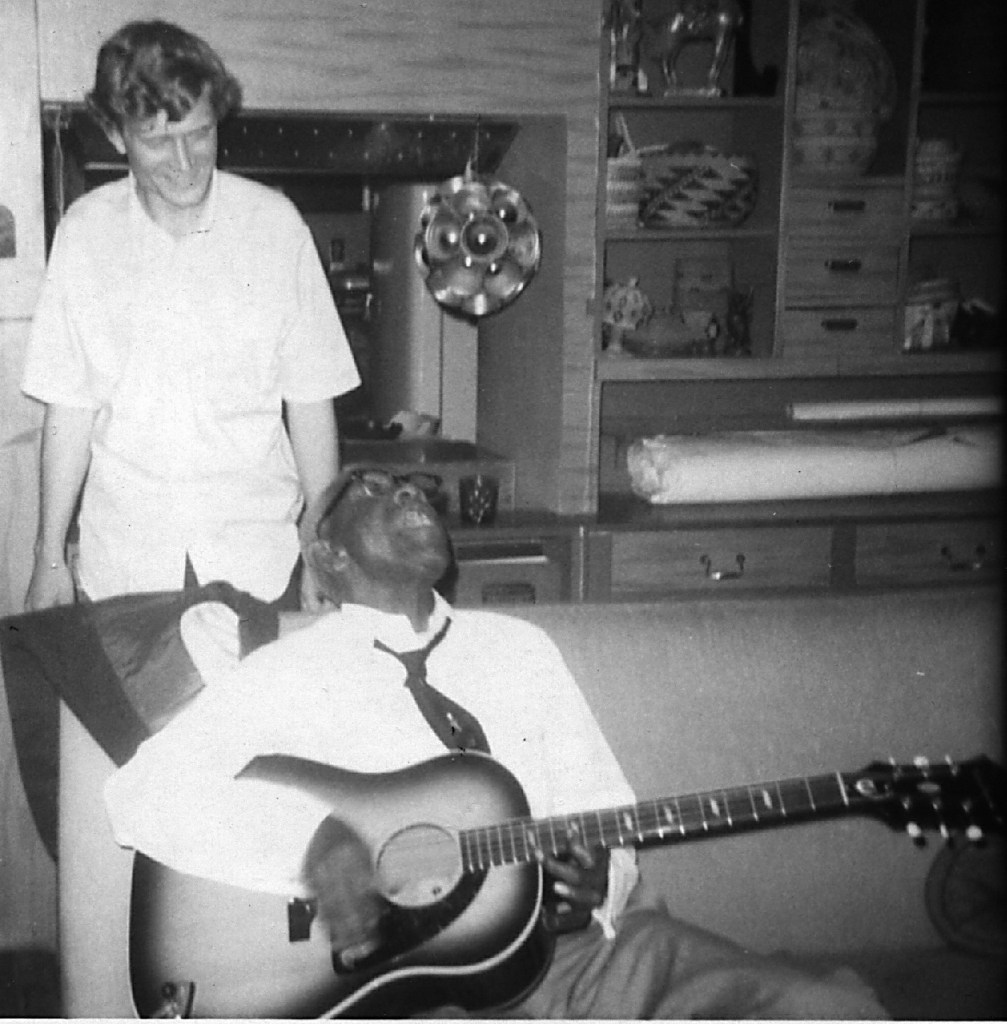
A closer look at Furry’s Independence Day weekend performance of “John Henry” (Friday, July 5, 1968):
The man with the guitar is Bukka (Booker) White. According to the liner notes, Furry is holding a quart bottle of Stag beer.
Furry’s teary-eyed performance of “John Henry” took place in his Memphis apartment, located on the corner of Fourth Street and Beale, the street W.C. Handy immortalized in his “Beale Street Blues.” Just over half a mile away stood the Lorraine Motel, where King was shot while standing on the balcony outside his second-floor room. As noted earlier, Furry’s house party performance took place on July 5, 1968, just three months after King’s April 4th assassination. His murder sparked a wave of riots that swept across the United States.
Bob West, a disc jockey and record producer, recorded Furry’s house party performance and released it on his Arcola Records label under the title Furry Lewis, Bukka White & Friends: Party! at Home. West points out in the album’s liner notes that he and Furry went to a Beale Street pawn shop on July 3rd to get his Gibson guitar out of hock. He noted that the shop and the surrounding stores still had their windows boarded up due to the riots after King’s assassination. Furry’s friend and fellow musician Bukka White also performed at the party.
One thing that is striking about Furry’s rendition of “John Henry” on that Independence Day weekend is that four out of the five verses he sang dealt with death. (The non-death verse has already been discussed above; it’s the one in which John Henry quits his job.) For example, he opens with a verse that appears in many versions of the ballad, a verse in which John Henry—while still a baby—foresees and announces his tragic fate:
John Henry said to his mama, while sitting on her knee,
That big bend tunnel on the YMV is gonna be the death of me
How might a young African American mother in Jim Crow America have heard the above verse? She likely would have thought of her own son and the fact that he shared a similar fate with John Henry: a life of exhausting labor simply to survive and the high possibility of an early and violent death. Many black mothers and fathers would have recognized in the verse a fate that seemed fixed from birth—not only for their sons, but for their daughters as well. There is a protest hidden in that line in which John Henry predicts his death, a protest that he makes for all black children and all their parents.
Another death verse Furry sang at the party is one of the most intriguing of all the traditional verses of the ballad:
When John Henry hammered in the mountain
‘Til the head of his hammer caught fi-i-i-ire.
He cried, “Y’all just pick ‘em up and let ‘em down again
Just give me one cool drink of water ‘fore I die, Lord no
Just give me one cool drink of water
The request for a cool drink of water before dying is part of the black oral and literary traditions. In these traditions, it’s a plea for a small comfort made by a dying black man after having engaged in battle with a white adversary. Often, the dying man directs the request to his opponent, hoping for a single act of kindness from him. In the book Miscellaneous Topics of the Active Mind (published in 1898), the black writer Samuel Walton Walker describes the request in terms of a black Union soldier dying on the battlefield. His plea to a rebel soldier for a cool drink of water is denied, and “the butt-end of the gun or hot lead is given instead.” In some versions of the black ballad “Po’ Lazarus,” Lazarus makes the request to a sheriff or deputy after having been mortally wounded in a shootout with the law. The plea is also made in Sterling Brown’s poem “The Ballad of Joe Meek” as Joe lies dying from wounds incurred after an incident of racial injustice triggered him to go on a rampage.
Knowing that the dying request for a cool drink of water traditionally appears after a black man has done battle with a white opponent, what are we to make of its appearance in Furry’s July 5th performance of “John Henry”? If we interpret the request as having been made by John Henry after he defeated the steam drill and collapsed, then the drill was most likely a symbolic substitute for a white adversary—possibly the captain, the Jim Crow system, or some other element of the white power structure. Or could it be that John Henry made the request after doing battle not against the captain’s drill but directly against the captain himself? Specifically, could it be that John Henry, after having been mistreated by the captain, made good on his threat to resist and fight back to the point of dying with a hammer in his hand?
In the third verse, Furry sings of going to the location where John Henry fell dead, repeating the line “I’m goin’ where John Henry fell dead” over and over again. And, in his final verse, he warns his piker (the man who holds the steel drill/pike in place for him) of the possibility that he might miss the drill and kill him. He introduces this final verse by again singing, “I’m goin’ where John Henry fell dead,” and, with that line, he is on the verge of breaking down. Listen closely, and you will hear the emotion in his voice, especially in the word “Henry.” He ends the ballad, cutting its story short, with, “If I miss this steel with this 10-pound maul, tomorrow’s goin’ be your buryin’ day—God damn!”
In the moments that follow, it becomes clear that Furry had been silently shedding tears while singing. Several wet coughs are clearly audible, along with some less audible very brief instances of him sniffling back tears. Furry expresses some embarrassment over his crying and states, “I’m just as good a man as you’ll see.” He goes on to explain, “Sometimes, somethin’ just tetch (i.e., touch) you. One friend responds, “Oh yeah, that’s what it takes to fix those blues.” Another friend adds, “That’s right.” It must have been quite a touching moment for those who were there.
Death must have been on Furry’s mind as he sang the death verses. Not just the steel driver’s death, but also the death of King. He must have sensed that King’s assassination would also kill off the civil rights movement. And he was probably thinking about his own mortality. While introducing the next song, Furry tells his friends that he is 75 years old and states, “I’m just lucky to be livin’.” The day before his assassination, King delivered a powerful and now-famous speech that seemed to foreshadow his own death, much as John Henry had foretold his fate as a baby. In the speech, King declared, “I’ve been to the mountaintop … and I’ve looked over. And I’ve seen the promised land! I may not get there with you.” At his advanced age, Furry may have imagined that with King gone, there was now an unscalable mountain between himself and that promised land. A mountain that he’d never get a chance to cross over. These are the types of things that must have been going on in Furry’s mind as he sang about John Henry. And as he sang about death. And as he shed those tears.
* * * * * *
The sanitation workers’ strike ended on April 16, 1968. King’s assassination and the subsequent intervention by President Lyndon B. Johnson’s administration created overwhelming pressure that forced the city to break its stalemate with the strikers. Under the terms of the final settlement, the city officially recognized AFSCME Local 1733 as the workers’ bargaining representative, breaking Mayor Henry Loeb’s previous refusal to grant union recognition. Additionally, the agreement granted the strikers an immediate 10-cent hourly wage increase followed by a 5-cent raise later that year, and promised improved working conditions through fair promotion policies, grievance procedures, and better employee treatment.
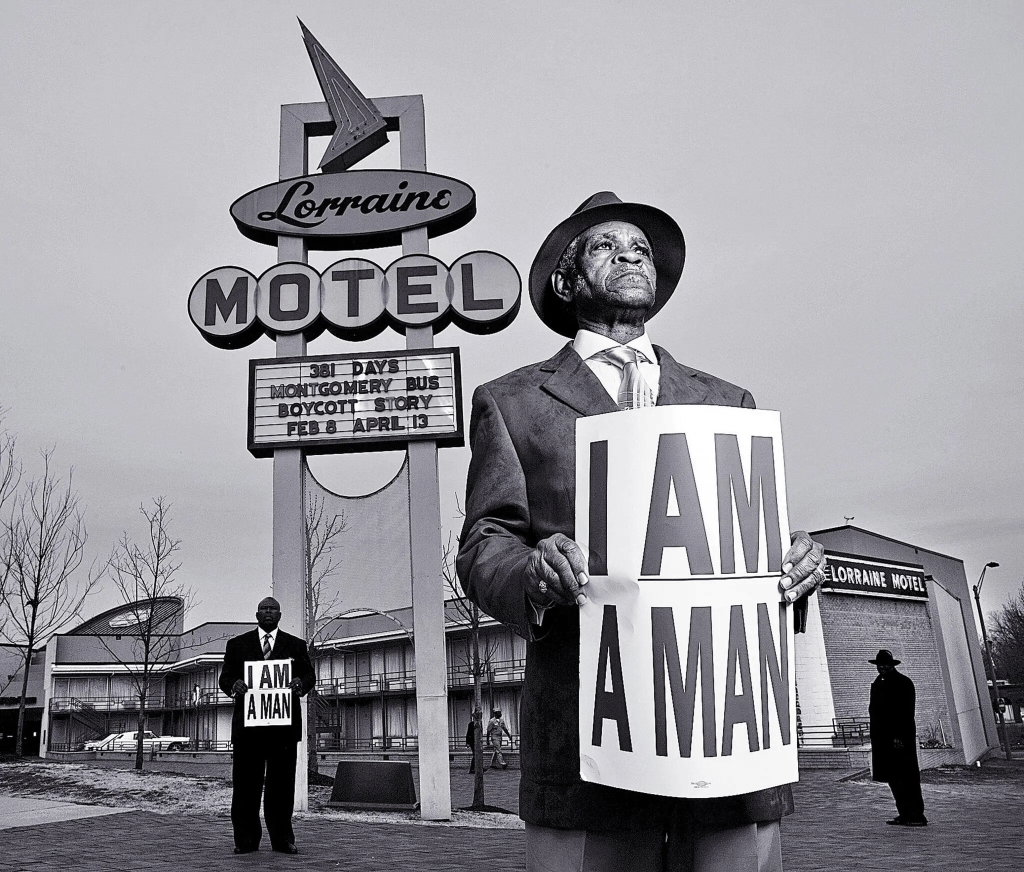
On April 5, 2018, the city of Memphis officially unveiled its I Am a Man Plaza, a civil rights memorial honoring the striking sanitation workers. The Plaza is a series of linked sculptures which, at its center, features a sculpture of 12-foot-tall stainless steel and bronze block letters forming the phrase I AM A MAN. The letters are laser cut with the text of King’s “I’ve Been to the Mountain Top” speech—the speech he delivered on the day before he was assassinated. The Plaza also features a Dedicatory Wall etched with the names of all 1,300 workers who participated in the strike. The ground upon which the Plaza sits served as a gathering place for those strikers.
The men whose names appear on the Dedicatory Wall did what King said was necessary: each reached inside and rose up “with an affirmation of his own Olympian manhood.” Given the nation’s long and brutal history of race relations—its insistence on the black man’s inferiority and its ruthless punishment of those who dared defy the white power structure—carrying an I AM A MAN sign was no simple act. It took courage. The words on the sign asserted a truth that many citizens of Memphis, and millions of Americans, violently rejected. As Taylor Rogers, one of the sanitation workers who helped organize the union, later said, “I AM A MAN meant freedom.”
By carrying that sign, the strikers did what King had called for: they issued a black Emancipation Proclamation, an African American counterpart to Lincoln’s. And they signed that proclamation. Not with a pen but with what King called the “pen and ink of self-assertive manhood.”
The name Furry Lewis is not etched on the Dedicatory Wall; since he had retired two years before the strike, Furry was not an official participant. Yet his spirit inhabits the Plaza. He may not have carried an “I AM A MAN” sign, but he did carry his own version of it: the John Henry ballad. He carried it with him throughout his adult life, and every time he sang that ballad, he sang it with conviction. With his voice and his guitar, he lifted that ballad—that sign—high for the world to hear and see. Through it, he raised his own freedom cry, signed his own Emancipation Proclamation: “A man ain’t nothin’ but a man!”
Coda: The Promise of July 4, 1776
We should, of course, celebrate our nation’s 250th anniversary. But before the parades, backyard barbecues, festivals, and fireworks begin—or after the smoke from the fireworks clears—we might also spend some time in honest reflection: looking at how far we’ve come as a nation, recognizing and confronting our shortcomings, and recommitting ourselves to the work that still lies ahead if we are to fulfill the promise of July 4, 1776.
“We hold these truths to be self-evident: that all men are created equal; that they are endowed by their creator with certain unalienable rights; that among these are life, liberty, and the pursuit of happiness.”—Thomas Jefferson, The Declaration of Independence, July 4, 1776
“In forming our union, the founders fell terribly short of the Declaration’s promise, leaving slavery intact, allowing states to restrict the franchise to white men who owned property. But in drafting a Constitution and a Bill of Rights, they did have the foresight, the genius, to provide us with a framework that allows each generation to make our union more perfect.” —Barack Obama, keynote speech at the opening of the Obama Presidential Center, June 18, 2026
“I like the dreams of the future better than the history of the past…I will dream on…” —Thomas Jefferson, Letter to John Adams, August 1, 1816


