Dad walked ahead with the laundry bag. In a rage. I had to trot to keep up. Usually I carry half the laundry in one of those big grocery bags, but today dad wouldn’t let me near it. I could see the strap digging into his shoulder, through his burnt grey coat, but he wouldn’t let me catch up so I just lagged behind. We jumped back an hour last night, and the early November dusk washes over everything like dirty water. The chill wind feels like an ill wind. But it’s probably just my mood.
My feet go slower and slower; it’s not my fault, they won’t listen to me. We’re entering the outskirts of town. The sky is rosy pink somewhere but it’s hard to see it through the grey buildings. Through all the grey. I have words stuck in my head – I will like and love you till your dying breath. I don’t think it’s a song but it might be. We pass a small row of first-story businesses, with windows above – apartments, maybe. Even in this weather, some of the windows are open, with curls of cigarette smoke and toddlers both snaking out their skinny arms.
A damp cool weariness creeps in at the edges of my brain. Last night was a long night.
I’m not even trying to catch up anymore. I know where he’s going, I’ll meet him there. I walk slower and slower, looking in the windows of the shops I pass, watching the people like they’re in an aquarium, like they’re swimming in the strange neon lights. The cobbler’s shop is closed but there’s a rectangle of blue light beyond the dark shadowed dustiness, a light coming from where he must be sitting in his back room, winding down the hours, thinking about how strange it is to be a cobbler in this day and age.
In the sub shop, teenagers are pretending to be up to trouble in the corner, stupidly excited. The man at the counter feels wronged by the amount of onions on his sandwich. In the Chinese restaurant there’s a skinny woman with a crying kid pulling on each arm, and she’s screaming, “Speak English. Speak English,” at the woman behind the counter. The woman behind the counter is laughing. And her kids are taking orders on the phone and ringing people up. Speaking English. Your order will be ready soon soon. My heart stutters and stops and races. (Lilly. Lilly so fast and cheerful behind the counter goes to my high school, and I can tell she’s laughing inside, though she looks so serious, so careful. Lilly Lilly.) Big men sitting at the small chipped Formica tables by the door are drumming out the time with plastic soy sauce packages. Just got off work, waiting for food to take home. Just got off work, waiting for food. Just got off work, waiting for food.
The light is golden and honeyed and slow in the ballroom dance studio. People with perfect posture and perfect smiles glide against black walls through the thick light, to music I can’t hear. Sequins and feathers sparkle and flutter in their wake. There’s a tall skinny kid sitting poker straight in a chair, hair slicked like shellac, pale face fervent. He’s watching another man turn slow dipping circles, alone, hands in the air as if palm to palm with an invisible dancer. Know him from around town, but I’ve never talked to him. He carries a transistor radio playing a Christian station, holds it before him like a holy relic. And he smiles all the time. I’ve seen him on the porch with his mom and she’s always reading the bible to him. He turns to the window as I pass, and as his eyes meet mine, his Jell-O smile falters into a look of fear? Judgement? And then it sets again, and he turns away, with a graceful curling dismissive wave of his skinny arms. His god is my dad’s god. The weight of his glance is strange to me. Suffocating.
Across the chainlink overpass where the town is sliced in two by a highway (trying to catch up to my dad with dream-slow footsteps). Tattered pennants hang ragged in the cooling breeze, and cigarette packets and plastic bottle lids form constellations in the dry trashy dust. The cars pass below in the failing light, back and forth, some with lights on, some with windows cracked for cigarette smoke, some with windows darkened from prying eyes. I wonder where they’re going, these twilight drivers. I wonder if they have headaches or sour stomachs and they’re worried about returning home, or if they have hopes for a warm dinner, or if they have a long sighing journey ahead of them where they do not know.
At the end of the bridge there’s a cluster of men, two or three, it’s hard to tell in this light. The old familiar fear tying the old familiar knots in my gut is only intensified when I see they’re wearing black vests and fatigues. As I get closer I see the sunset reflected in their stupid metallic glasses, and they cluster together to block the exit of the overpass. A long sighing journey ahead where I do not know. They ask if I have my ID or proof of citizenship.
“I’m doing laundry. Why would I … ?”
“Bro, what laundry? You’re not carrying anything.”
Fair point.
I reach into my pocket to pull out my wallet and, instantly, hands on guns. I’m a skinny kid shivering in sweatpants and a hoodie. I can only laugh, which I do, which they don’t like. I notice there’s blood on my sweatpants, and that’s not good.
Of course I don’t have my wallet. Why the hell would I? But I do have two oranges. Two blood oranges. I pull one out and it has a rare glow in the dim light.
I wonder where these guys are from. I wonder if they’re far from home. I wonder if they have kids or wives or parents or dogs who miss them. Or, maybe, who are glad they’re gone. Which would be worse?
In my head I have a speech prepared in which I thank them for their service to our fine country, the country of my birth. In my head I thank them for keeping us all safe from hordes of undesirables. I want to tell them I speak English better than they speak American. I want to tell them I take honors classes. With Lilly. I want to tell them about Lilly, stupidly, but I don’t want to get her in trouble. But I’m feeling really tired. It’s been a long night.
[Mom was scared to go to the hospital because of you.]
I press one orange into the hand of the man closest to me. He’s got thick rough gloves, and he smells like cologne and fear, with maybe a hint of diesel and shit. But maybe, too, the smell of a person who has been outside all day, when the season is changing and rain might be on the way, a person who wants to bring that smell inside to the people he loves. That strange smell that clings to your clothes and your hair.
I say, “Dude,” I speak their language though they don’t speak mine, “Dude,” I say, “My mom gave me this, it’s very special.”
I snake through them to the other side. I walk fast, but I know not to run. I don’t look back. Never look back, never look back.
In the next block is the smallest park. The city kind. Rusty swingsets and slides between tall buildings. It’s nearly dark, now, and the park shows as just patches of green and dusk and dusty green and shadow, with children running around like strange screeching beacons of bright-colored clothes and light-up sneakers and end-of-the-day exhausted excitement. In their bright dimming faces I see the ghosts of the lost children, lost hopes falling faintly into the dead dusty leaves.
I think about my mom buying blood oranges. I know we can’t afford them. I know she knows I love them. I love them. I think about her running them over with her hands, giving them a squeeze. You never know, with an orange, how sweet it will be inside. You never know how disappointing. I regret giving my orange to that guy so much it’s like a heavy painful weight behind my eyes. Regret it like a blood orange purple bruise Fuck them Fuck them Fuck them. Fuck this time of day. Fuck this time of year.
Would you believe I am the cheerful one. It’s hard to be the cheerful one. It’s hard to be the one who lives. But here we are. Here. we. are.
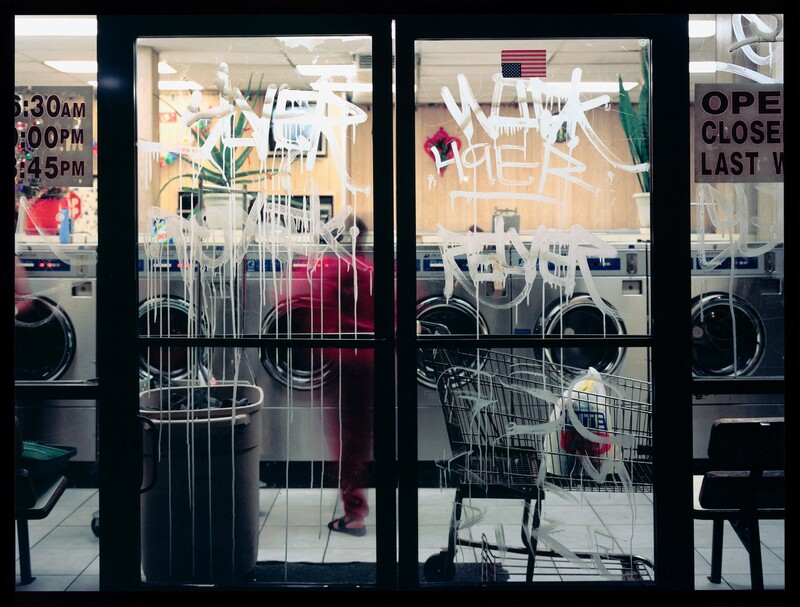
Outside the laundromat, long-dead late-summer insects flutter lifelike in the spiderwebs, and inside, the light is beautiful. Flickering pale underwater green. My dad sits on a blue plastic kid’s chair, laundry sprawled in a mess in front of him, elbows on knees, head in hands. He doesn’t look up when I sit next to him.
I start to sort the clothes, it’s time to get them in the wash, we have to get home to mom. I’m ready just to pile them all in, and why not?
“Blood. Blood!” She’s a million years old, not much taller than our pile of laundry, but she’s smiling, as she rubs her hands together and says, “Blood, blood.” She stoops, pulls the bloody clothes, the bloody sheets from the pile, and she sets them aside. She takes them to some deep sink and starts the water running. She says, “Cold, cold!” She pours some thick liquid on them and turns to me with a beaming face, rubs her hands together, and says, “Rub rub!” And she does. With strong, slow, important movements, she rubs the bloody sheets together, and the water flows over them. Flows over them. Her face is crumpled in concentration. And the blood red water runs down the drain.
I carry the sheets, dripping, heavy in my arms like a corpse, to the washer, and pile everything else with it too. All at once, then done, then go home. Can’t sort this.
I’ve always liked to lean against the washers, I’ve always liked the hum and rumble, the familiar cycle that moves like the ocean, washing and rolling and back again and back again, washing and rolling and back again back again. But not today. With my sour stomach and aching head, I am seasick.
When I sit by my dad, on the small blue chairs, we’re so close we’re touching. When he slowly leans against me, just a slight pressure of his shoulder against mine, his rough coat pressing into my arm, a small feeling of warmth, I want to cry. He puts a hand on my knee.
[In the evening, when the day is hot, and I move from sunshine to shadows, maybe it’s a small thing. In the morning, when the air is cold, and I walk from shadows into sunlight, maybe it’s a small thing.]
It’s fully dark outside, now, and someone closes the door, which had been open for the noise of exhaust and heat and the warmth of people, someone closes the door against the darkness and the November cold. Dad and I sit in a lint-filled stillness of our own, not moving, not talking. All around us is a whirl of people doing the things they do every week, washing and rolling and back again, washing and rolling and back again. Sorting and folding and waiting to get home, until they have to come back and do it all again, until they do it all again.
A small strong hand on my other knee, and children running all around us in the fluorescent humming humid air.
The million-year-old lady is sitting next to me, and her kids or grandkids are flying around like unloosed balloons. November laundromat stir-crazy. She has a wrinkled and worried face, she has good intentions that make me surprisingly angry. She just nods, and when she takes her hand away from my knee, the cold is brutal.
A child lands, fluttering before her, leaning against the million-year-old lady and looking at me weird. She says. Close your eyes. Close your eyes. And I do, and the world is a lint-grey sparking of sad lights. When I open my eyes I’ve got seven tiny oranges in my hands, and the child is gleeful laughing. The million-year-old lady says, “For your mom. For mama.”
Then she takes a tiny orange out of her pocket, rubs it in her old fingers, and pops it in her mouth, skin and all. Nodding and nodding for me to do the same. The sweetness, the tartness, the unexpected everything. The sour inside the sweet outside, the what the fuck am I doing eating this. All of it. The million-year-old lady puts another in my hand and says, “No. Rub, rub! Sweet sweet!” And she rubs her tiny orange with her old hands and pops it in her mouth. “For your mama.”
I have a blood orange in my hoodie pocket, and I want to give it to the million-year-old lady, but more I want to save it forever and ever. Till it rots and turns green and velvety in my pocket.
The washer has slowed to a stop. My dad is sitting very quiet and warm, but I know he knows. The million-year-old lady gives me a chuck on the shoulder and gathers the 6 tiny oranges left in my hands and drops them in my dad’s surprised hands.
A tiny child in a blue dress and red sneakers, one of the million-year-old lady’s minions, shrieks and stamps her feet. Her feet are the size of a peanut. I could fit them in my heart and carry them around with me. Her shoelaces are in a tangle, and the puzzle of it has brought her to tears. I feel the same way, I feel the same way. The million-year-old lady has a basket in her hands and she’s headed to our washer. I am torn. Rended like cloth. But I kneel before the tiny girl and stop her angry shoes from kicking. She smells like a different kind of outside, a kid’s outside, and her knees are scraped and green like grass, even in November. My fingers hurt as I undo her knots and untangle her laces, but when I tie them tight again, she kicks her peanut feet against her chair, with a sad, considering look on her tiny tear-stained peanut face and in her dark peanut eyes, and she pats me gently on the head. She says, “There there. There there.” How stupid am I to love her like this? And why am I so fucking angry I could burst?
The million-year-old lady is at our washer, pulling out long wet sheets with a serious face. Together we carry the clothes to the dryer, and I want to scream to her go go away and not look at our sheets and our underwear. But I don’t. She has her basket, and we pile it in and carry it together. I sit back by my dad, and the washers hum, and the dryers sing their dusty purring song, and the lights are weird, and the old lady and her demons straggle out with tired squeals and bags of clothes. My dad’s head falls in slow twitching sleeping dreaming motion onto my shoulder, and he smells so familiar and so strange. So sad and so home.
The walk home is dark and cold, but he lets me carry half the laundry, half the load.
The apartment is quiet and dark and not-quite clean. Light leaking in through windows and you have to wait for your eyes to adjust. Scraps of onion and lettuce in the sink-drain from last night’s dinner, attracting flies: the smell is strong and sad and strange. (I will never forget it.) There’s a light on in the bathroom, but the room where we left my mom is dark except for the square of green flickering light in the window from the stuttering streetlight, humming like a weird bright insect.
My dad goes in first because I’m scared and he can’t wait. He helps her to the bathroom and I put the lamp by the bed on, the one with chipped and painted children bowing to each other and giving each other pinecones that my mom found at the flea and she loves so much. Ten dollars, half price.
Stripped sheets, blood on the mattress. I float the clean and wrinkled sheets over it, crawling on the sheets I’m trying to spread, trying to reach the corners and tripping myself up. I meet them in the doorway and my mom is so beautiful and at the sight of me it’s tears like drops of rain, unstoppable, though I know she’s trying.
Dad sits on one side and I sit on the other, the tears stream from her eyes but the only sound she makes is laugh, a strangled laugh. She can bleed on the sheets again, and dad and I will wash and dry and back again. But sitting next to them, when I take the blood orange out of my pocket, I let the dark bright juice land on my bloody sweatpants. I pass the segments across, and we sit and suck on them, the pretty bruised red sweet tart juice.
In the flickering darkness mom leans on my shoulder and weeps relentlessly. Nothing has ever been or will ever be as warm as my mom’s hand. The night passes in strange pauses and jumps. We drift in and out in turns, like we’re guarding each other from something in the darkness. Towards morning a small rain falls. The light seeps through the curtains like dirty water. We’ll rise and wash and sort and wash and wait to go home again. We’ll do it all again.