

By Michael Ladd
(Images used by courtesy of David Kerr, Pearl Austin, and the estate of Ann Newmarch.)
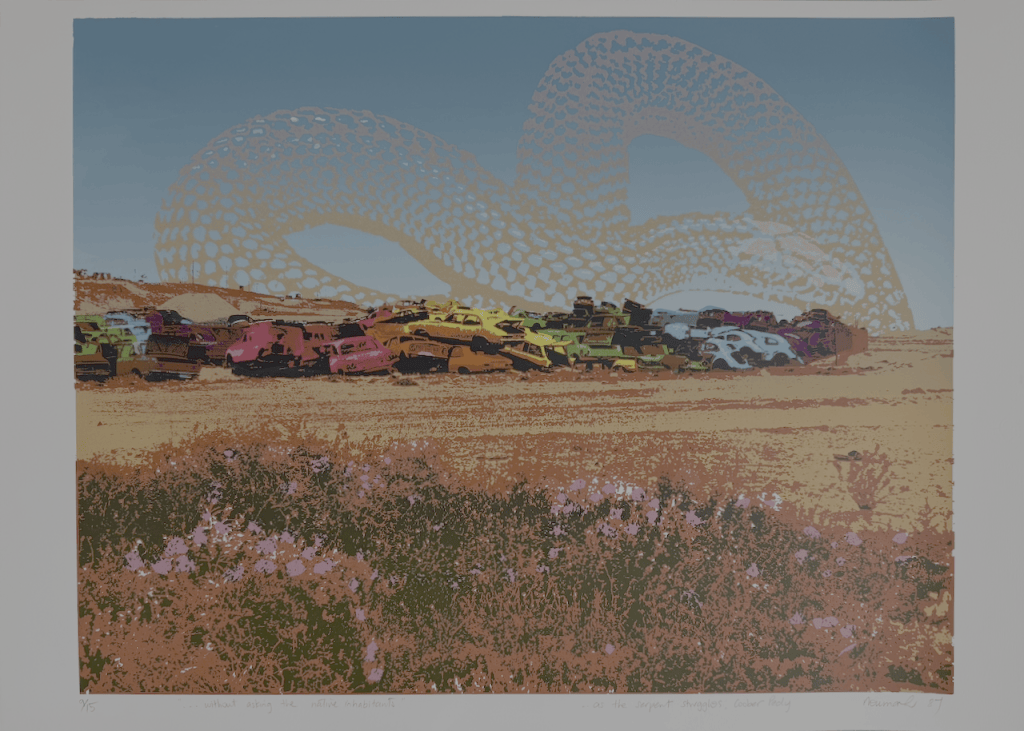
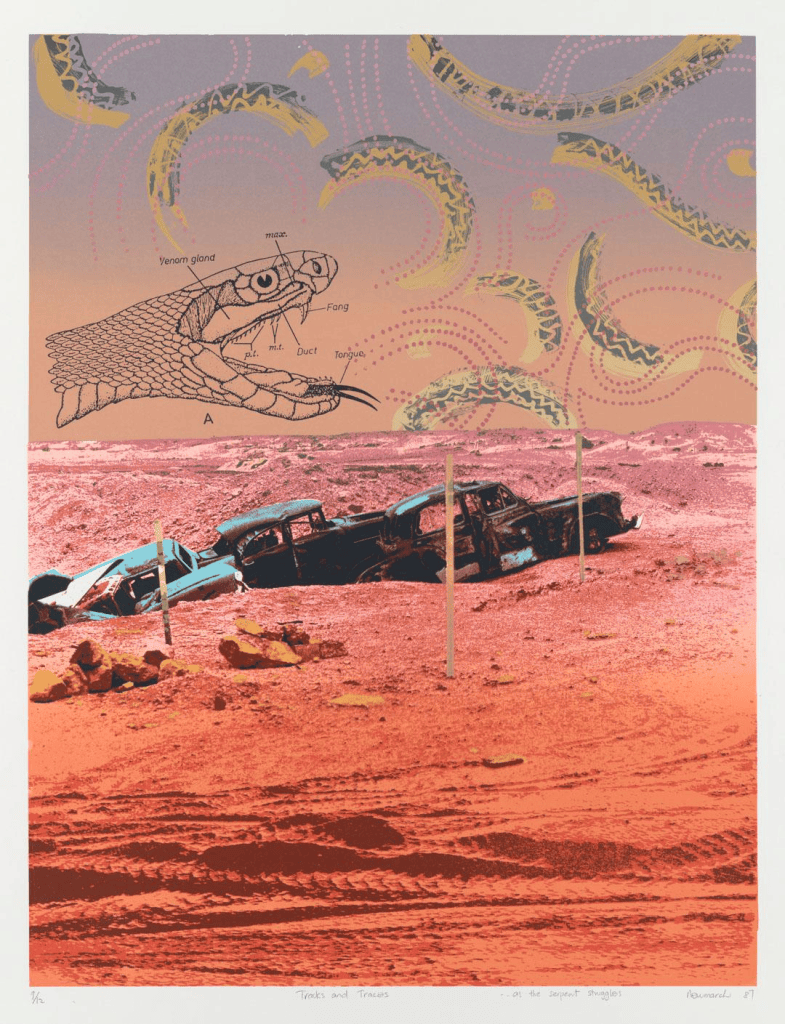
‘Where to next?’ I wonder as I lie on my bed, thinking about possible places to visit and artworks to explore. The answer is staring me in the face. Looking past the bedroom door, I can see Ann Newmarch’s screenprint ‘…without asking the native inhabitants… as the serpent struggles, Coober Pedy,’ hanging in our hallway.
Transparent snake in the sky
A rainbow of wrecked cars
The questions remain.
I knew Ann made this print after a research trip to Central Australia in 1987 with the sculptor David Kerr (her partner at the time). I could go back to Coober Pedy, find the same hills, maybe even the same stack of wrecked cars.
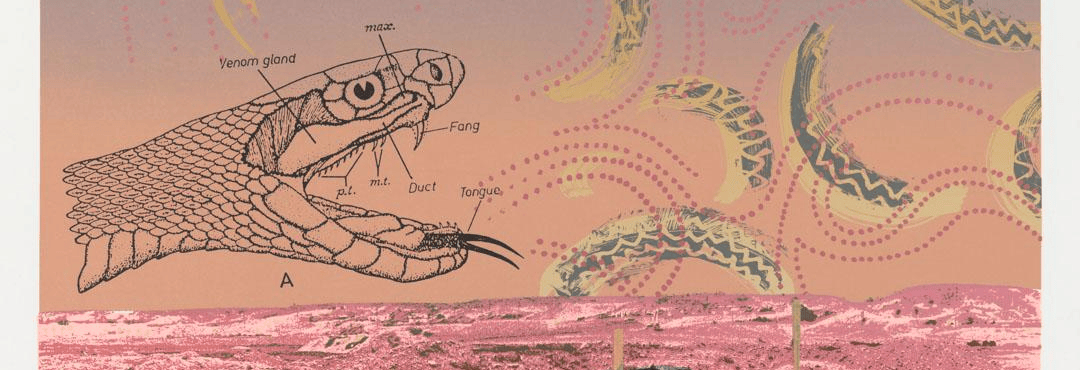
I bought the print from Ann when she held an open studio in her workspace, an old factory in Beatrice Street, Prospect. She shared that studio with my artist wife, Cathy Brooks, and what a great space it was, full of two-dimensional and sculptural works in progress, but also cabinets with drawers packed with interesting things: marbles, feathers, shells, skins, little bottles of glitter and seeds and glues and pigments. There were hubcaps and snake posters on the walls, and a sad-looking mannequin was stationed at the door. Not long before she died, I interviewed Ann about her life and the serpent struggles series.
*
Ann was born in Adelaide in 1945. She told me her father was a strict Methodist and her mother was an atheist. Ann showed early promise at painting and drawing and her father (who doted on her) bought her art materials and painting books. Ann said, ‘I guess I was a recluse in a way. I just liked staying in my room and drawing.’
She wanted to finish high school and go on to study art, but her mother had other ideas. ‘My mother sent me out to work at fifteen. All my teachers were sorry to see me go. Mum’s plan was that I was to earn money and buy makeup to look pretty. Because I was the plain girl. And find an accountant and marry him and have four children.’
Ann’s first jobs were working in a camera shop and a pharmacy. ‘My father died of a haemorrhage when I was eighteen. So I stopped believing in Christianity and started thinking about other things.’
Her difficult relationship with her mother got worse after her father died. ‘We argued a lot. She said you’re not going to be an artist. It was very hard living with my mother because she was frightened of me and couldn’t stand me. And because I actually did the opposite of what she wanted. But, in looking back, I think she was proud of me in the end because after her death I discovered she’d made a scrapbook of all my newspaper interviews and she made so many pieces of work for me. Her crocheting and tapestry and stuff, and that was the only way she could show her love for me.’
Ann left her mother’s house and went back to school to matriculate, then onto teacher’s college. She graduated in 1966 and began teaching art, becoming a lecturer at the South Australian School of Art in 1969.
In the early 1970s while studying philosophy at Flinders University, she met Professor Brian Medlin and co-founded the Progressive Art Movement with him. They had two sons together, though Medlin was married to another woman.
It was at this time that Ann expanded her interest in screen printing and poster art. It was a political decision for her to turn away from painting and the gallery system of selling expensive unique works, towards making prints in multiple copies. ‘I always thought I was apolitical, but I found I was political, and that’s when I was involved with Professor Brian Medlin, who got caught up in the Vietnam War protests and got his ribs smashed in and he was jailed and had his hair and beard cut and looked horrible. That’s when I found out I was pregnant to this strange-looking man.
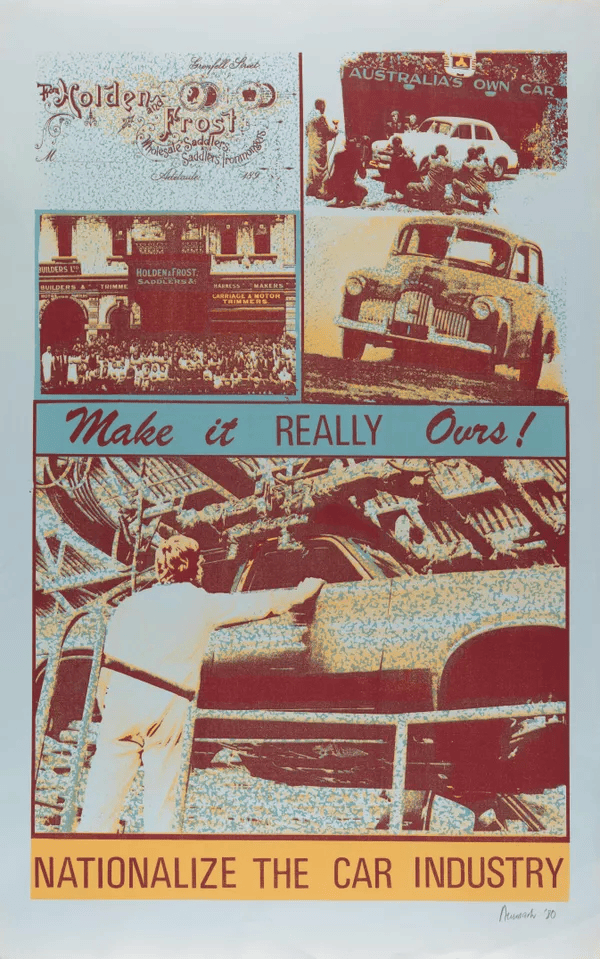
There were so many things happening in the seventies, and there was so much to do, and I took up screen printing because that was more for public use and the streets and for campaigns. I was very involved with working with working-class people and, yeah, making a lot of protest posters about what was happening with General Motors Holden and the car industry especially, and also at the same time with women gaining strength and being able to break the bonds that created things like domestic violence.’
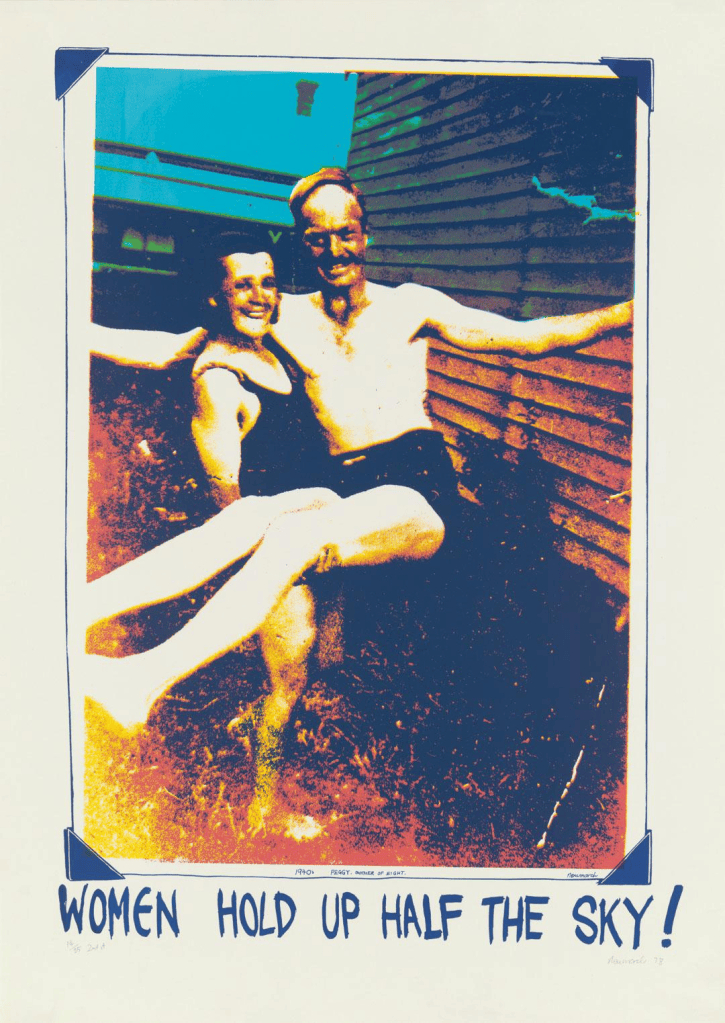
One of Ann’s most famous prints is called Women Hold Up Half the Sky. ‘Well, I guess I was obviously a feminist and working on images to give strength to women and I found my Aunty Peg was someone who worked two jobs with eight kids and she came home at night and she used to make concrete bricks herself and she built her own house brick by brick. She had a bit of help when the windows had to go in, but basically Peggy built the house.
I was talking to her about her life and I looked at the photograph album and there was a little screwed-up picture in the corner. She’s holding up her husband. And I said oh, bloody hell, can I use this in my work? Her husband, he used to beat her, go to jail, come out of jail, beat her again, go back to jail. Anyway, she was challenged at a beach picnic. You couldn’t hold up Cyril. He was a big man and she just said, here we go and she held him up.’
After Ann broke up with Brian Medlin, she began a long relationship with David Kerr, a sculptor and museum exhibition designer who was an ex-student of hers. As David put it to me, ‘We got together in 1980. And we had similar sensibilities, like-minded about a number of art issues. And I fell in love with her, her hand, the way she could draw. It was extraordinary. But as a whole person. Interesting person.’
They had a daughter together and David and Ann worked on community projects from their Beatrice Street base, including public murals. They also wanted to make connections with the Aboriginal history of Australia. David recalls, ‘There were issues in the wind that we were both interested in. And a particular one was colonisation and what effect that had had upon Indigenous people, the Indigenous people’s voice, and we had worked on the History of Australia mural on Prospect Road, which looked at a black history and a white history of Australia.
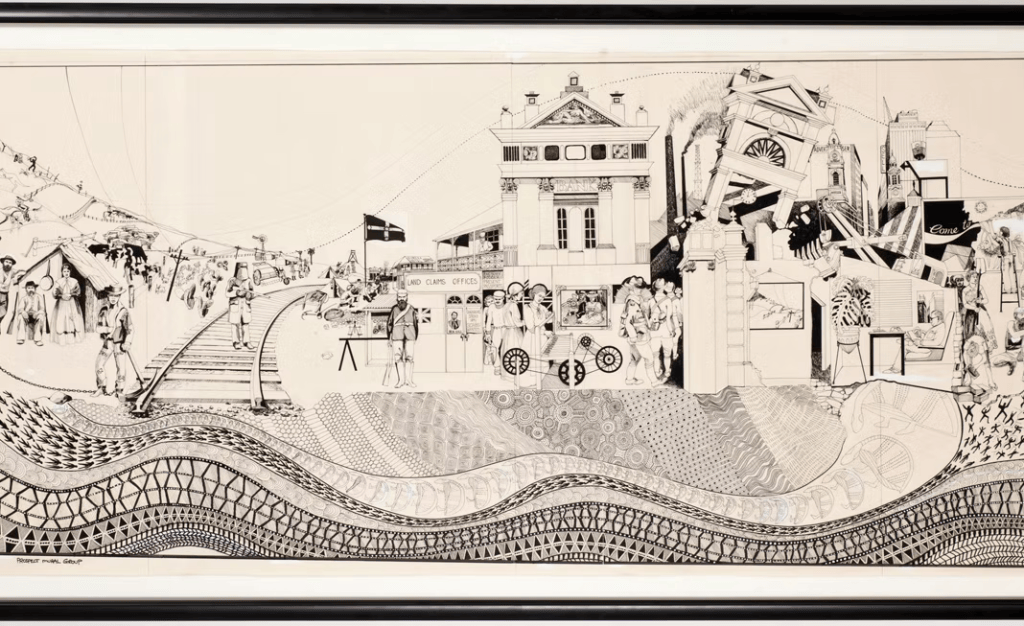
But we found difficulty getting access to the black history or even getting permission from people about how to include it. There was just no clear avenue to get someone who would speak from that perspective. In the end, we decided to push ahead. I did some research through the South Australian Museum, looked at visual imagery. We came up with a way in which we could represent the Aboriginal history as an underground part of the mural, using generic patterning. And found somebody that would say, what you’re doing is a good idea, you should go ahead, which was an Adnyamathanha man, as it turned out. So, I mean, there was something in that project that led to other things we wanted to do. And we decided that we needed to travel to Central Australia.’
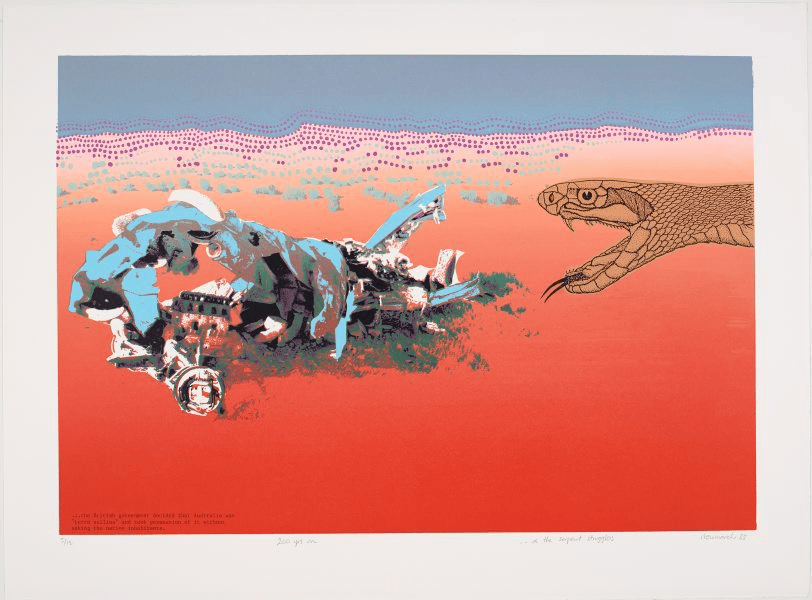
They first went to The Centre together in 1984. Ann told me about how she had become fascinated with snake imagery. ‘I was very interested in The Serpent and in fact I used to have a pet python that I called Eve. On the trip out of Alice Springs to one of the gorges, we had a snake in our path and we let it pass before we continued on. But out there I stepped into the campfire inadvertently. We took a long trip back into Alice Springs Hospital and when I got to hospital and looked at this burn it was shaped like a snake right up my leg.’
Ann eventually got a tattoo of a snake where that burn was. This chain of events coupled with her understanding of the significance of The Rainbow Serpent to the creation beliefs of Aboriginal people meant the snake image became very important to her.
‘For Aboriginal people and their culture, The Rainbow Serpent made the land and I was very concerned about the land and so I used that as an image with the smashed cars and the rubbish that white people had left on the way up to Alice Springs and so it was the serpent struggling to keep the earth for Aboriginal people.’
*
At David Kerr’s house, he and I are looking at Ann’s as the serpent struggles, Coober Pedy print and discussing the various layers in it. We agree the lucid, desert blue of the sky is exactly right. There is great ambivalence in the image, which works through the juxtaposition of opposites – damage, culture collision and disrespect of the land, but also, as David points out, the wrecked car is a resource for Aboriginal people, a repository of spare parts. The car was what came and took the children of the stolen generations away, leaving only tracks in the sand, but it was also a means of connection to family. The snake is a powerful presence in the sky, but it’s transparent, ghostly, as though struggling to exist. The car dump is printed in a spectrum from violet through blue, green, yellow, to red. It makes an ugly pile of wrecks into something beautiful and references the rainbow serpent without trying to appropriate a very sacred creature.
I feel the image is optimistic. Yes, the serpent is struggling, but it is still there and it’s not going away. This beautiful being in the sky – it’s like it can’t be touched by the junk of so-called civilisation. David adds, ‘This is stuff that’s not really talked about easily. And it needs to be spoken about, and that’s what I think Annie was engaged with, saying, well, how do you talk about this? And she wanted to make beautiful images, even though they’re talking about horrific things. I think the beauty that she was creating was the optimistic part of it, saying, well, we’re going to talk about it. It’s ugly, but we’ll get through it and it’s going to be fine.’
The language of the screen print, the dot matrix, is another reference to Aboriginal dot painting. But this image feels thoroughly Western. That subtitle ‘without asking the native inhabitants’ can be read two ways. Clearly, it’s referring to the forced confiscation of the land by the colonists, but it’s also talking about the artistic tightrope Ann herself was walking. Though she tried, she couldn’t find a pathway to get cultural permission from First Nations people for this image. It’s something you would need to do now.
David responds, ‘A difficult thing in all the pieces that she made around that theme was how not to appropriate Aboriginal culture. But to be able to reference it. She knew the whole time it was on shaky ground as to how far she could go, making images and referencing the dot matrix that makes up an image in Western culture that also is very similar to Aboriginal dot paintings. Or the use of the serpent in the sky as a symbol that’s an Aboriginal Dreamtime symbol. A creation story. It’s tricky, but she decided that she had to go there to make it unambivalent that she was talking across cultures here and trying to find some sort of common ground. Aboriginal people are speaking for themselves now. But at the time, it was a way of engaging in a discussion that was not being had, I think.’
*
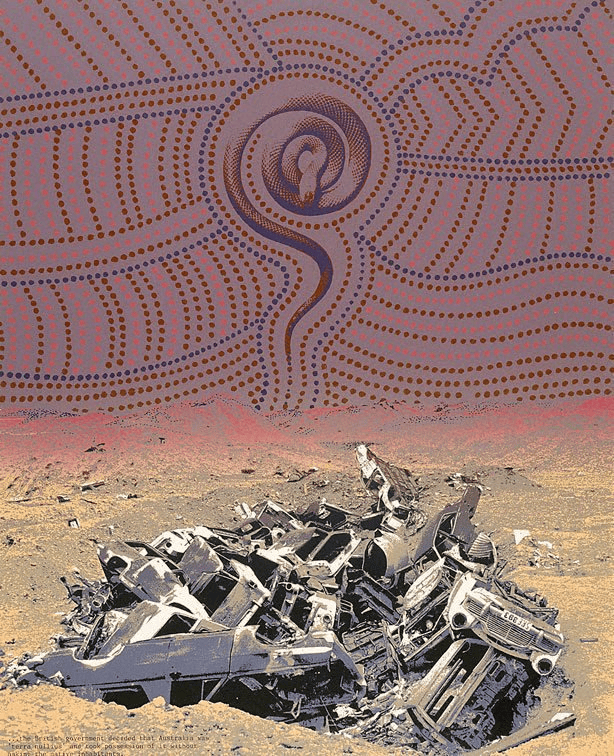
In 1987 David and Ann began working on a project together that would culminate with a joint exhibition of prints and sculptures at the Experimental Art Foundation in Adelaide. David explains, ‘In Annie’s case, as the serpent struggles. And in my case, I was thinking about similar things with Attitudes to Landscape – the colonisation process and making some inroads into a reconciliation with Aboriginal culture. So we decided to do a trip to Central Australia and Coober Pedy and the surrounding areas, Oodnadatta. Just to go and gather information, imagery, objects, with the purpose of making a joint exhibition. We met people, interviewed people. Annie collected images. Lots of sketches, lots of photographs. We hired a ute to go up there, so we took lots of stuff from the side of the road. I was making sculptures, so I was keen on getting objects to work with.’
*
Today, Cath and I are going to Coober Pedy in our old Commodore Station Wagon, retracing Ann and David’s journey, looking for the site of the serpent struggles. Starting on Kaurna land, we will pass through Nadjuri, Nukunu, Adnyamathanha and Kokatha country, to the lands of the Antakirinja Matu-Yankunytjatjara people.
It’s August, early morning. On the bright grey horizon are high, wispy rainclouds. Speeding along the Northern Expressway, the dump theme is already present. The crenelated sides of the Wingfield landfill make it look like a Middle Eastern castle, complete with palm trees growing on the artificial ridge. In the distance, the stacks of the Torrens Island Power Station tower over the cement and chemical factories of Port Adelaide.
A winter’s day
Cloudy mirrors of the salt ponds
Such a long way north
Between Saint Kilda and Dublin, are olive groves and battered greenhouses. Plastic caught on a barbed wire fence, shredded over the years by the wind, is an evil gossamer. Winter creek water. The first wattles out, chilly gold. Lower Light. Lambs huddle in sweet grass. Bowmans, Port Wakefield. Stone and tin houses. Struggle towns.
Into this frugal, low rainfall, mallee country came Cath’s grandparents Jimmy and Elizabeth Cunningham in the late 1920s. They met on the boat voyage out from Scotland. Jimmy had come to work on the construction of the Sydney Harbour Bridge. He was escaping a future in the coalmines or on the fishing boats, neither of which appealed to him. Elizabeth had left her hometown of Dumfries with the promise of becoming a housemaid, working for the wealthy Hayward family who owned John Martins department store. Jimmy and Elizabeth were headed for different states, but we think they jumped under the lifeboat covers together one night. Later Elizabeth discovered she was pregnant and sent word, somehow, to Jimmy in Sydney that she needed him to come to South Australia and marry her as soon as possible. He did the honourable thing.
Now as we drive through this starve-acre landscape, I’m trying to imagine him back then, heading up to Port Wakefield with his pregnant wife, wondering how he was going to support a family. We don’t know why he chose to come here. A cheap house, maybe. What we do know is that he bought a shaver and some cut-throat razors and taught himself to be a barber. At first, he simply rode around the town on his bicycle with his hair-cutting equipment in a wooden box. Later he had a shop and, with the Great Depression under way, often took payment in rabbits or fish. We still have the wooden box, with the hand-painted initials J. C.
This is family country. Cath’s dad grew up at Bowmans in a mud-floored house, the son of a fettler. Cath’s mum (the second daughter of Jimmy and Elizabeth) grew up at Port Wakefield. My mother had her first teaching job further north at Redhill. My great-grandfather, a jeweller and watchmaker, emigrated from Kirkwall in the Orkney Islands to Port Pirie.
A planet of sticks
In a diminutive tree
Crows’ oversize nest
We pass a sign to Bumbunga. I have seen that sign often and thought, ‘one day I’ll go down that road and find out what’s there.’ Never have (and possibly never will.) Bumbunga remains a ‘one day’ place.
We reach the Lochiel salt-lake, pink against the emerald of the winter paddocks and canola’s acid yellow. A reminder of the serpent: in the middle of the lake is the Loch Eel Monster. There’s another Nessie too, further along, a folk sculpture made of rubber tyres arranged in the salty pink mud.
I love the galvanised iron out here. Sheds made of weathered tin as if designed by Mondrian. Ruined rain tanks. Then the wind farms loom.
Against the skyline
Giant, slow-turning flowers.
Calm winter’s day
We pass the turn off to Crystal Brook (the brook once was crystal.) Then see the smokestack of Port Pirie’s lead smelter on the left, the blue rising of the southern Flinders Ranges (Ikara) on the right. On a plain of red samphire there’s a car dump next to the Port Pirie substation. We travel on to Port Augusta with its crops of solar panels. The petrol price is climbing and we see the first signs of the mulga trees. The ‘desert’ thought gets stronger.
Concrete water pipes
Rusty valves in a cage
A strange animal.
Red soil begins. Mesas loom in the distance. They are the stumps of something much older. Seabed pushed up, then ground down by time.
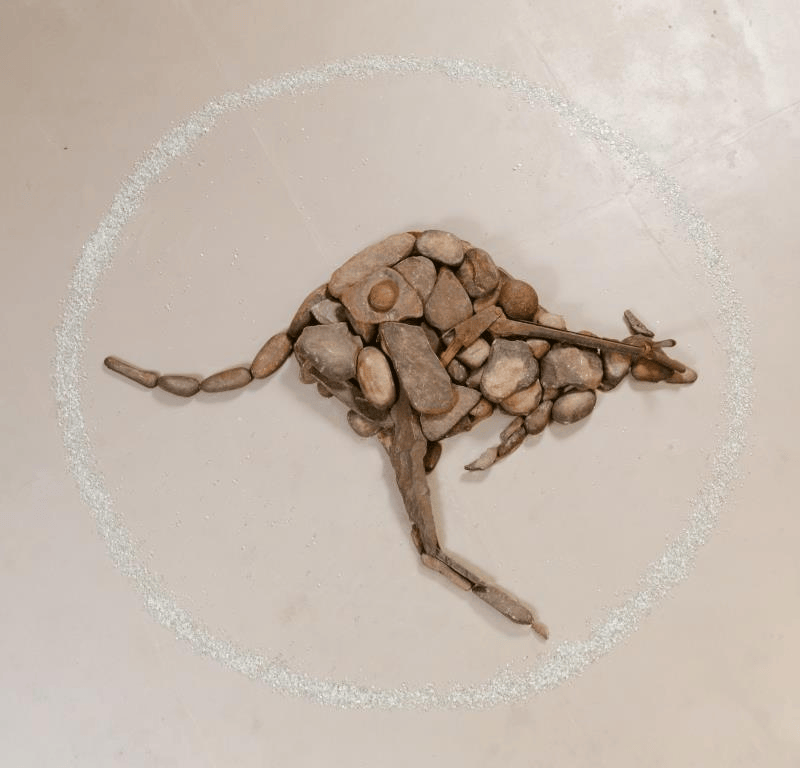
There is carnage of kangaroos beside the highway. This hasn’t changed since Ann and David’s time on the road up here. For his hybrid animal/mechanical sculptures David Kerr collected bones, hubcaps, tyres, broken glass, car doors and bonnets, to make pieces that were all about collision, damage and survival. One of his works was called resting place of the unknown kangaroo and was made from river stones and an old brake lever that became part of the kangaroo’s body.
Now we’re travelling through lonely country. Near the top of the gulf, we turn High Violet up loud. The car flies over the Ghan Line that goes all the way to the Timor Sea.
Overtaking lane
Truck wheels up close
Spinning bolts
Out of Pimba, it’s a moonscape. No plant higher than our shins, no place to hide from wind or rain or horizon. But even here, there is multiplicity. All the subtle colours of the small plants, the shades of browns and purples and greens in the succulents. And life we hadn’t seen comes out of the distance.
Alone on the plain
Under endless sky
Five emus arrive
As we pass Woomera Test Range, a mushroom cloud suddenly erupts from the plain. That can’t be a fire. It’s a bomb. The black smoke balloons into the air, then dissipates and is gone.
At Lake Hart we stop for a rest. The desert and the recent big rains have combined to create a vast, multi-bloomed bouquet. In the red soil are clusters of crimson hop bush, feathery purple Ptilotus, and yellow and white Poached Egg Daisies. The air smells delicious, like golden syrup on hot buttered toast. The source — a bush with yellow, bell-shaped flowers — Desert Cassia.
We pull into Wirramina Station to sleep for the night. I tell our host Stacey about the explosion we saw earlier on the Woomera plain. ‘That’s them disposing of ordinance’, she says, ‘when they set them off, they shake the windows here. Even as far away as Roxby.’
Stacey has set a campfire for us and after dinner we sit beside it, staring into the flames.
Fire is so utterly other, the way it dances, elemental, existing in between solid and air, breathing. Fire is a sacred breath. Fire is beautiful, even when it is burning down the house. I have no right to say that, unless it’s my house. Fire is beautiful, even when it is burning the body. I have no right to say that either, unless it’s my body. I say it anyway.
*
Next morning, out of Glendambo, we are travelling through a garden — the slatey grey-blue of the saltbush contrasted with the bright buttery yellows of the acacias: thorny wattle, witchetty bush and dead finish. There are scarlet eremophilas, purple Swainsona peas, mauve noon-flowers, yellow and white sunrays and everlastings.
Animal wreckage.
So many dead kangaroos
Small hands outstretched
It seems the bodies of dead kangaroos are splayed every few hundred metres beside the highway. They sometimes look perfect; thick, smooth, winter coats, faces tilted up, not a mark on them. At other times they look like a butcher’s tray of rancid meat, ravens and crows picking at purple organs spread all over the road. There is other wreckage too, a burnt-out caravan, a mangled chassis, dumped fenders and differentials.
We pass the Buzzard iron-ore mine, a huge, black, artificial mesa of rock and earth piled up from the open-cut excavation. A hole you could hide a city in.
Not a cloud above
We travel under the great dome
Zebra finches heading north
As we near Coober Pedy, conical mounds appear on both sides of the road. The mounds vary in height from twenty metres to just one or two, and they range in colour, through ochres, pinks and whites. It feels like we have reached a land of giant ants. At any moment they will emerge from their great cone-shaped nests and swarm the highway. Ants as big as cars.
Driving into town, there’s something Egyptian Valley of the Kings about the place — the dugout entrances like tombs burrowed into the sides of treeless hills. Another comparison is to Göreme in Türkiye, where people have lived for centuries in caves dug into the sides of soft volcanic rock formations. The place also reminds me of the Valley of the Moon in La Paz, Bolivia, the dryness, but also the crater-like setting with eroded hills surrounding a central valley.
The names of Coober Pedy’s hills are atmospheric: Ice Cream Hill, with its melting white top. Venus Hill, not named after the planet, but a local called Michael Venus, who still lives here. Coober Pedy looks more like the surface of Mars than Venus, anyway. Tom Cat Hill, supposedly named after a cat called Tiger who belonged to Bill Oliver, an early postmaster. Flat Hill, German Hill, Hellenic Hill, Hard Hill, whose names are self-explanatory. Post Office Hill, where the first underground Post Office was located from 1920 to 1953. Boot Hill, Coober Pedy’s cemetery, is named after the 1969 Spaghetti Western in which outlaws didn’t die in their beds but upright, with their boots on.
The next thing I notice is the number of wrecked cars and the bricolage of junk in the town — it’s as though the detritus is a badge of belonging, created by the old-timers. What that badge means, I can’t say for sure. Whether it’s ‘don’t care about the environment’ Maybe? Likely? Or perhaps it’s a weird kind of memento mori: ‘everything comes to ruin in the end.’ Hard to say. The municipality has made some clean-up attempts in the past. A compactor was brought in to harvest all the scrap metal, but it doesn’t seem to have had a lasting effect. One local tells me, slightly ominously, ‘cars come to Coober Pedy, but they don’t leave.’ They become spare parts, shells, homes, and sculptures … The Downunder Café has a rusty old Ford Cortina full of plants out front and, in pride of place on the café wall, a picture of another wreck. ‘Is that a special car?’ I ask the café lady. ‘We just found it in the bush and we liked it. Lots of people collect them round here’, she says.
It’s not only car wrecks. These are just some of Coober Pedy’s folk sculptures assembled from scrap: a sand goanna, a spaceship, a kangaroo, a rocket, a steel tree, an alien, a giant winch, a beetle, a sailing ship, a termite mound, and more abstract creations as well, artistic assemblies of junk, car doors, old ladders, fly wheels and poles made into totems standing on the ridges against the skyline.
*
After looking around town, we move into our burrow at the Lookout Cave hotel, dug deep into the side of a ridge. The roof and walls of our cave are red and pink and white rock, ancient clay colours, showing the lines of gouge marks from the metal teeth of the excavator. The rock resembles medium-rare wagyu beef.
Silence in the cave
The winter day bright outside
Shadow among shadows
In a meaty, stony burrow like this, you have no idea what time it is above ground. No sunlight wakes you. You live in the circles of artificial lights and when they are off, how dark and silent it is, and how insulated you are from the world. It’s twenty-three degrees in here all the time, even when it’s zero or forty-five degrees out there on top of the hill.
From their burrows the locals send up snorkels to the surface for air and television and internet — these are the pneumatophores of Coober Pedy. The tops of the hills are spiked with them.
I push away claustrophobic thoughts and the idea of all this caving in. It’s impressive really, the sheer work of cutting out a cubic volume of rock to carve a room, and the skill to avoid having it fall in on you. Tasso Doumanis who owns the hotel, explains how it’s done. A machine like a big sit-on-top mower with a row of spinning steel blades in front, cuts into the rock, throwing the rubble behind into a catcher. (The job must be deafening.) Then the rubble is sucked out by the ‘blower truck’ parked outside. The rubble goes into the bin perched up high at the back of the truck, which, when full, tilts and dumps the rubble on the ground. These ‘blowers’ are a Coober Pedy invention and they are talismans of the town, their dinosaur silhouettes prominent against the skyline. Tasso came out from Lemnos in 1970 and at first went to Andamooka, mining opal. He did well and put his money into making this hotel. It took eight years to dig out the lobby and corridor and all the rooms.
*
An old, cold sea once covered this land when Australia was much closer to Antarctica. That sea was full of dagger-toothed hunters, Plesiosaurs and Ichthyosaurs, as well as giant Ammonites, and smaller scallops and cockles. Their fossils are found opalised today. The sea receded and the exposed limestone bed was penetrated over millions of years by rains that carried dissolved silica down into cracks, crevices, bones and shells, where it solidified into opal.
A shallow sea
One hundred million years
A flash of opal
The usual story is that opal was first found here by a teenager during World War One. Fifteen-year-old William Hutchinson was prospecting for gold with his father. While the party was searching for water one day in 1915, William saw pieces of opal lying on the ground. That chance find was what started it all.
But senior Aboriginal man and artist George Cooley, who has been living in Coober Pedy since 1958, says Aboriginal people had known of the opal well before white people arrived. In an ABC interview he is quoted as saying, ‘We didn’t value those things. Life was more valuable, food and those sorts of things were more valuable.’ But once mining began, Aboriginal people also got involved, including George himself. Many aboriginal people became ‘noodlers’ — workers who sort through the rubble on the surface, looking for opal missed by the initial mining underground. As well as being a miner and a musician, George is a senior artist at the Umoona Aboriginal Art Centre.
George’s art often depicts the Kanku Breakaways, to the north of Coober Pedy, those colourful mesa formations created by millions of years of ocean sediment followed by millions of years of freezing nights and baking days, eons of wind and rain erosion. He paints with a palette knife in thick impasto the vivid ochre, white and oxblood sacred formations of Papa Kutjara (two dogs) Ungkata (Bearded Dragon lizard) and Kalayu (Emu) and the surrounding country.
The Coober Pedy mines attracted people willing or desperate enough to work in extreme desert conditions: railway workers who laid down the Trans Australian line, ex-soldiers, European migrants escaping poverty and war. Here is the world’s largest source of white opal with seventy fields that have yielded many millions of dollars’ worth of gems. It’s a wild west kind of place, full of stories: a miner named Ron Gough who struck a rich seam when he dug out another room for his underground house, discovering he’d been living next door to a fortune all the time. There are other more sinister histories: unsolved bombings with sticks of gelignite, people who just disappeared into this landscape riddled with shafts.
Now, in the tourist shop, I look down into a glass case and ask myself, ‘is this what it’s all about? A century of tunnelling underground, all that metal and diesel and sweat, the landscape scarred and acned with mountains of potch and mullock – just for these shiny drops of milk with garish glitter stirred in?’ What a strange species we are, putting so much importance on these little sparkly things.
*
By showing a photo of Ann’s serpent struggles screen print to Jennifer Davison from the Coober Pedy historical society, we’ve been able to identify the exact location. It’s at the corner of Flat Hill Road and Seventeen Mile Road. Jennifer confirms that back in the eighties it was the site of ‘Ben the Wreckers’, a junkyard run by Ben Manndorf. The business is long gone, but this morning we make our way to the site to see what’s still there.
I hold up the photo against the backdrop of the low mesa we are standing in front of, and yes, the shape of the ridgeline matches, perhaps with one or two more buildings on it. The stack of cars is gone, but then I notice the bonnets of some wrecks and the rusted crane arm of an old blower truck poking up from behind a galvanised iron fence. As I’m contemplating the wisdom (or otherwise) of walking uninvited into an anonymous Coober Pedy junkyard, a battered white ute roars up out of the desert and stops beside us. Inside is a round-faced man in his fifties, sunburnt, with a short white goatee beard. In the car with him are two large mongrel dogs, a part rottweiler in the front seat and a part Staffordshire bull terrier in the back. ‘What are you doing?’ the man asks.
I show him the photo and explain what I’m writing about, fully expecting to be told to ‘fuck off.’ But he’s friendly. Says his name is Quentin. He’s an opal noodler and has a machine for sifting through the debris from the mines. He’s in partnership with the guy who owns the yard and the wrecks. Quentin lives in a demountable in the scrapyard. I ask him if he minds if we walk around and take a few photos. ‘OK. But I’ll keep the dogs in the car. The one in the back is a biter.’ With that, he heads back out to the mullock heap he’s working on in the distance.
Piles of wrecked cars
Grass grows through the chassis
A purple jacket
The yard is a sculptural paradise of wreckage, car models from the eighties and nineties, piled up against the sky at intriguing and precarious angles. On their sides are spray-painted words, ‘Now Wrecking’ ‘Loose’ and something much nastier, ‘Coon’. There are older trucks and pieces of mining equipment, a rainbow of colours and rust. The whole scene resonates and shimmers with connections to the serpent struggles. The sky is a powdery grey today, but it’s easy to look up and imagine that transparent snake dancing above it all.
Having successfully walked into Ann’s artwork we spend the rest of the day looking around Coober Pedy and its outskirts. There’s no escaping the weirdness of this place, and a vague sense of danger. Photographing the pink, beige and camel-coloured mullock heaps at the edge of town we mind where our feet go. There are open black holes everywhere. Thousands of unfenced test bores that are only a metre wide but often go down thirty metres. A nightmare to fall into one. If, by some miracle, you survived the drop, who would hear you call?
*
Young Mulga tree
Roots gripping the claystone
My passing shadow
To paraphrase the poet Basho, ‘go to the mulga if you want to learn about the mulga.’ So, I’ve come here to a young tree on the northern edge of town. Cars and trucks whistle past at 110 kmph on the Stuart Highway, then it’s quiet again except for the wind. A rainstorm is brewing up on the horizon, here, in one of the dryest places in Australia. The rising breeze sings softly in the fence wire nearby and sighs in the narrow, elongated leaves of the mulga.
I touch the young tree’s still-smooth bark. It’s just beginning its journey — if it’s lucky, isn’t cut down or consumed in a wildfire, it could live 300 years. Not bad for an acacia. It won’t even be fully mature for a century. By then, its bark will be rough and deeply fissured. Mulga is ‘Umoona’ in Muntunjarra, meaning ‘long-living’, and gives its name to the Aboriginal community and arts centre in Coober Pedy. ‘Coober Pedy’ itself is an anglicised version of ‘Kupaku’, a Muntunjarra word for ‘white man’ and ‘Piti’, an Antakirinja word for ‘hole.’
The slow growth of umoona means its wood is especially tight-grained, dense, and durable — good for carving spears, boomerangs, carrying bowls (pitis), woomeras, shields, digging and tapping sticks. At home I have a mulga sculpture of a wombat made by Anagu Pitjantjatjarra artist Polly Charra from Yalata. It’s surprisingly heavy and an effort to pick up. The colonisers used mulga wood for fences, crosses, lintels, axles and yokes. For both cultures, it provided firewood that burns clean and hot, ideal for desert nights.
Aboriginal people ground the seeds of the mulga tree into a nutritious paste. A lot of work, but worth it.
Whatever rain the mulga gets, it channels along its side branches to the central trunk, then to the main tap root deep down. Often the tap root goes three times deeper than the tree is high — like the town, most of the action is hidden underground. Land clearing and feral goats have reduced the prevalence of mulga and it’s much rarer across the outback now.
Umoona. Umoona. Umoona. I listen to that name in wind.
*
One important task remains. That subtitle to Ann Newmarch’s print ‘without asking the native inhabitants’ must be addressed somehow. I want to show Ann’s image to George Cooley, but he’s gone north to exhibit his Kanku Breakaway landscapes at the Darwin Art Fair. Via email, I get in contact with another Umoona artist, Pearl Austin. Pearl is an Antikirinya Matu Yankunytjatjara woman who has lived in Coober Pedy since 1977. As well as being an artist, she is an educator at the Coober Pedy area school, and chairperson of the Umoona Art Centre.
Over the phone, Pearl tells me her story.
‘I’ve got a family of six siblings. All of us were born in Port Augusta, except my sister. She was born out on country. We were taken away from our mother and father and put into foster homes. My youngest brother was six months. And I reckon I would have been about three years old. My sister remembers us being taken to the courthouse and rushed out the back and whisked away. And we were all split up. I ended up with my younger sister, down in the south-east, with a family down there. We came back when I was eleven or twelve. We were in Port Augusta at that time. And we moved up to Coober Pedy when I was thirteen.’
‘At the Umoona community, they used to have little tin shacks down there that we lived in when we first moved to Coober Pedy. And there was no air conditioning or anything like that. You just had to open up a window. There was a little fire area just out on the side where we cooked. I don’t remember it as being really bad. Maybe we just were resigned to that’s how it is. So yeah, we lived there in that space with my two brothers and three sisters. And then we eventually moved into town.’
Growing up in a foster family, Pearl missed out on learning Yankunytjatjara and connecting with her culture, but when she came back to Coober Pedy she could make those connections. She also began to paint.
‘When we came back to live in Coober Pedy, with family and community, a lot of us were a little related in some way. And a lot of us used to spend time, especially with my own family out in the creeks. Especially when there was plenty of rain. And we’d spend the majority of the day, we’d be out there cooking kangaroo, making damper, you know, mum telling us stories and things like that. And by the evening, the sun would set. That’s where my colours come from in my paintings and the colours of the landscape around Coober Pedy.’
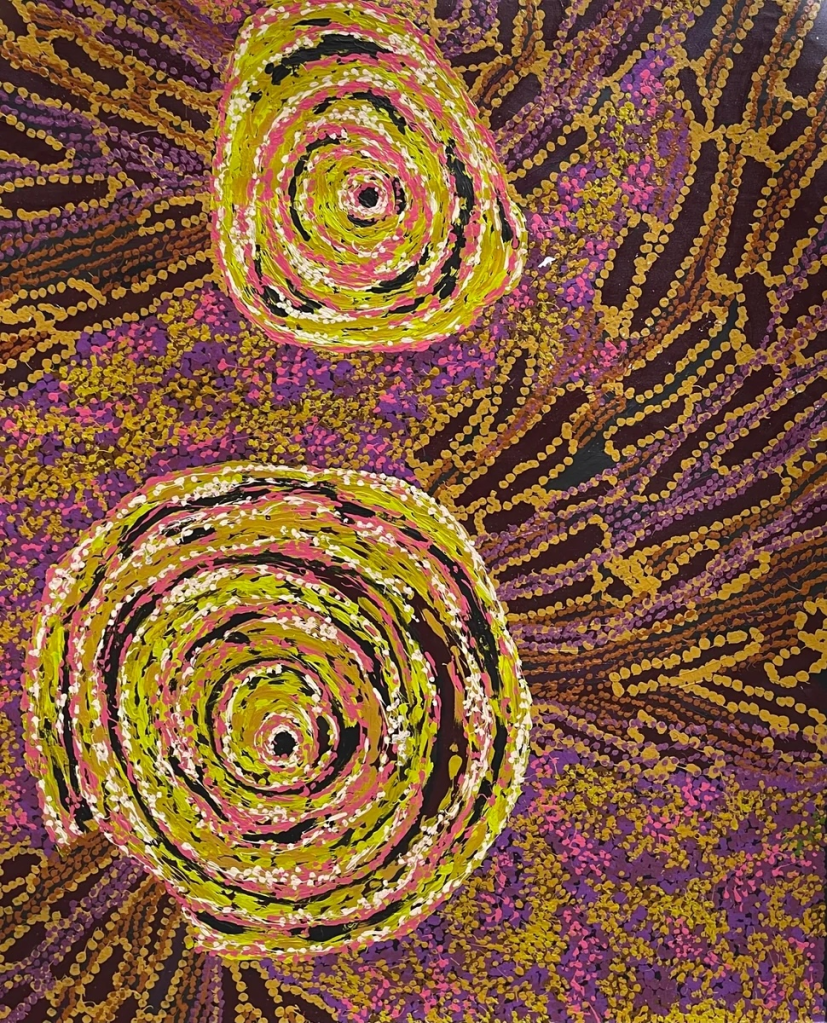
Looking at Pearl’s paintings, you can see the colours of dry desert country and shimmering heat, but also of times like now when the inland rivers are green with water and vegetation and the wildflowers are blooming in pinks and purples and yellows. And you can sense the importance of family sitting together in the circle patterns in Pearl’s art.
‘Yeah. It’s about family being together and enjoying the days that we were out there constantly, especially when we were young. My auntie first got me into painting, probably when I was in my early twenties, and especially dot painting, doing the Seven Sisters Dreaming paintings. And, you know, my auntie would always talk to me about my mum growing up and the family, because we missed all that. And so that was a great way to reminisce and learn something new. But we used to paint for the tourist trade, really, and that’s about it. And the paintings were completely different to the way I paint now. Back then it was very neat and set out in an order. And it was always around bush tucker, quandongs and lizards.’
A visit from the Anangu Pitjantjatjara Yankunytjatjara (APY) Art Centre Collective was the catalyst for a change in Pearl’s painting, and also the formation of the Umoona Arts Centre.
‘They brought some ladies from the APY lands who were part of the APY Collective from some of the art centres up in the lands. And when I saw the way that they were painting, it was so quick and so free. They just knew instinctively what they wanted to paint. And it just clicked in there. And I thought this is the way I want to paint. This is how I want to do it.’
‘That was around 2020. We always wanted a space where we could all come together us women, because we all had to get together and sit down and have a cup of tea and some biscuits and just paint and talk. And so that was one of the reasons, it’s that community togetherness.’
Out of this series of APY workshops in a variety of locations around Coober Pedy, grew the purpose-built Umoona Art Centre and Gallery, which was opened in 2024. It’s a space where about thirty Indigenous artists, male and female, come to work and show their art for sale in the gallery.
‘Having the Art Centre is one of the highlights of my week and the town’s, by bringing in the tourists. Also, I look forward to coming down here every afternoon for an hour to paint and to share my stories of my life growing up in Coober Pedy.’
I ask Pearl what she thinks of Ann Newmarch’s serpent struggles screenprint from 1987.
‘It does feel like the serpent is thrashing around above, it’s like a barrier that the cars have been put below him that he can’t get through. He can’t get through to the earth. He can’t lay the waterways, and he can’t bring the rain. So it feels like a blockage happening there. He’s above this man-made rubbish. And he can’t get through to do what he needs to do. It’s got a lot of conflict in it.’
I wonder if she thinks it’s still a valid image today.
‘I don’t know how other people would perceive it, but as an indigenous person, that’s how I see it. It’s a clash of two cultures. One culture is stopping the other culture from practicing what they need to do to keep themselves. Aboriginal people are very easy going and they love to share. We want to continue to work and share our culture, learn from it and teach our children – all children. There have been lots of barriers, but we can overcome those and painting has given us the opportunity to achieve this.’
I tell Pearl that I feel there is something optimistic about Ann’s picture, because even though the serpent is struggling, he’s still there, he’s not going away.
‘It does show that doesn’t it? It feels like even though back then we were told not to speak our language and practice culture, it’s still there. It’s still surviving.’
It’s heartening to know that Pearl is now helping to teach Yankunytjatjara language to kids in the Coober Pedy area school even though she herself was taken away as a child and blocked from learning her mother tongue. One of her hopes for the Umoona art centre is to engage a younger generation.
‘I would like our younger generation to paint and to express themselves. And to bring them together with our older artists. To learn from their culture. This is a really good way of doing it.’
*
Early next day it’s time to leave Coober Pedy. Wind whispers and moans in our burrow’s air vent. A gale is blowing over the town – the Sunday morning streets are empty, washed by rare rain. Goodbye to the caves and mounds and wrecks in this strange frontier – the implicit question in the serpent struggles, still hanging in the air.
Leaving again
Retracing our way south
Grass tussocks rippling
Mike Ladd is a South Australian poet, essayist and nature lover. He has published ten collections of poetry and prose, including the natural history Karrawirra Parri, Walking the Torrens from Source to Sea, from Wakefield Press. His most recent book is Dream Tetras (2022) an experimental collaboration with visual artist Cathy Brooks. Mike was the editor of ABC Radio National’s Poetica program, which ran for eighteen years and brought Australian and international poetry to a wide audience. His New and Selected Poems is available from Wakefield Press.


