

By Chimezie Chika
Raymond Darlington (b. Darlington Tochukwu Raymond) likes to play with pastels. There is often in his art a relational correspondence between the different colours on the canvas. In one painting, you are seeing perhaps seven or eight colours, which are only variations of one another. Take “The Weight of Tenderness”, a work he exhibited at Espacio Gallery in London. The work is achieved by layering eight shades of brown, stretching to borderline hues one might describe as pink-brown and brown-mauve.
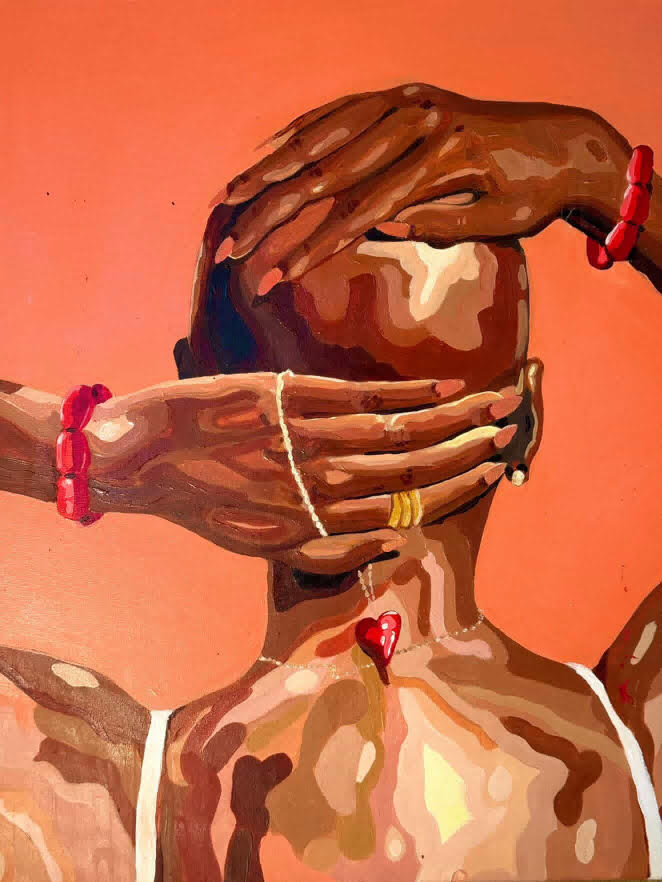
The painting itself captures parts of the torso of a woman from the back, including her head. Her hands are framing her bald head. Wrists are covered in red traditional bangles. One hand, the one on the crook of her skull, has a dangling necklace. Her back and shoulders is a relief map of brown shades. Her background is grey. The painting is, as a whole, almost hyperrealistic, and testifies to the idiosyncratic liberties Darlington takes with colours. He appears to imbue personal meaning into the way he cartographs colour gradations in his paintings.
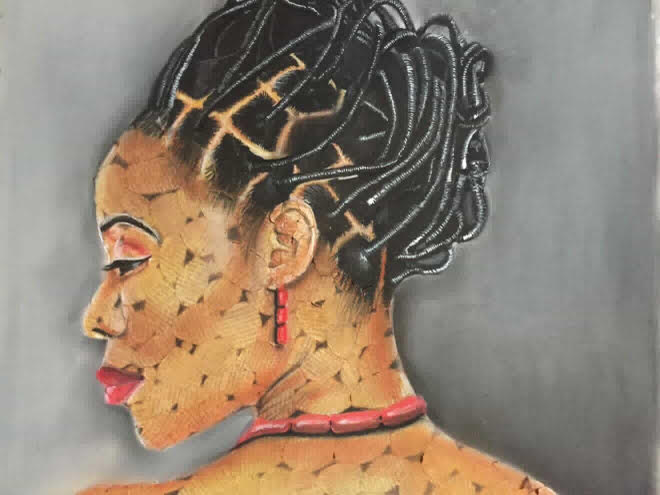
This is evident in two signal paintings: the one titled “Indigenous I” and the other titled “Untitled (2021)”. The first, “Indigenous I” is a classic example of Darlington’s style. The shades of colour used are grey, black, and brown. The painting is, again, of a woman’s (a woman judging by the accessories the artist bestows on her) head and shoulders, with the head turned sideways in profile. Two things are remarkable in this painting: the dark, shiny realism of the traditional isi owu plaits that the woman carries and the uli marks on her body, which Darlington captures with remarkable fidelity. The manner in which these marks are made is more Darlington’s own interpretation of them, rather than the real patterns in Igbo culture.
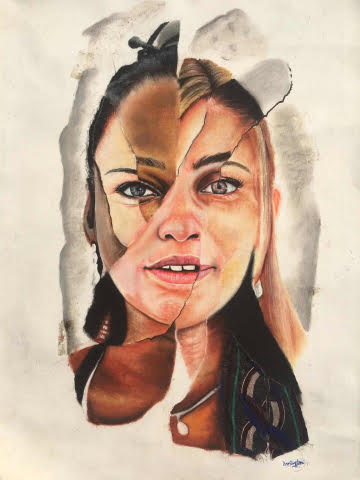
In “Untitled 2021”, the artist’s expressive idiosyncrasies come to a head. Achieved with shades of grey, brown, and caramel, the painting uses superimposition, mirroring, and a glass-shard effect to achieve its purpose of presenting seven or so complexions of seven different women. The painter does not merely show us these women in absolute realistic etchings as we might see elsewhere; instead, he presents them through abstract visual strips using the effect of water spill, mirroring, and others. The indefinite nature of the painting opens it up to a variety of views and perspectives; but it resides firmly in the subjective.
Darlington’s realism is a personalised vision of the world. This personality affectation takes his paintings into realm of impressionism, and because they are still visibly realistic, they can be best described as expressionistic realism. Although he personally describes his art as Afro-realism, when we look at it with historical circumspection, we will be more attuned to link it to the larger zeitgeist of a slew of known and unknown artists operating presently in the Internet and social media spaces, so that it almost feels like a movement.
Many of the paintings that now reside in those spaces are characterised by what can be called safe experimentation with feelings and perceptions. It might sometimes be incomplete in either direction—that is, either in the relative safety of realism or in the distorted projections of the artist’s uniquely expressed emotions—they are appendages of a social media culture that has become more intensely visual and that places great premium on self-defined orchestrations of curated images.
The connection between popular culture and abstract expression is extensively discussed in Gregory Gilbert’s essay, “The Intersection of Abstract Expressionist and Mass Visual Culture”. Gilbert argues in the essay that abstract expressionism has exercised strategic autonomy from mass visual culture, as a movement that offers a thoroughly avant-garde aesthetic. Yet, it positions expressionism as being situated at a vital crossroads between popular kitsch and high art. I believe that this crossroads was the foundation of the kind of realist expressionism one finds in Darlington’s art. His work embraces popular culture and its perceptions of trends and pop-cultural dynamism.
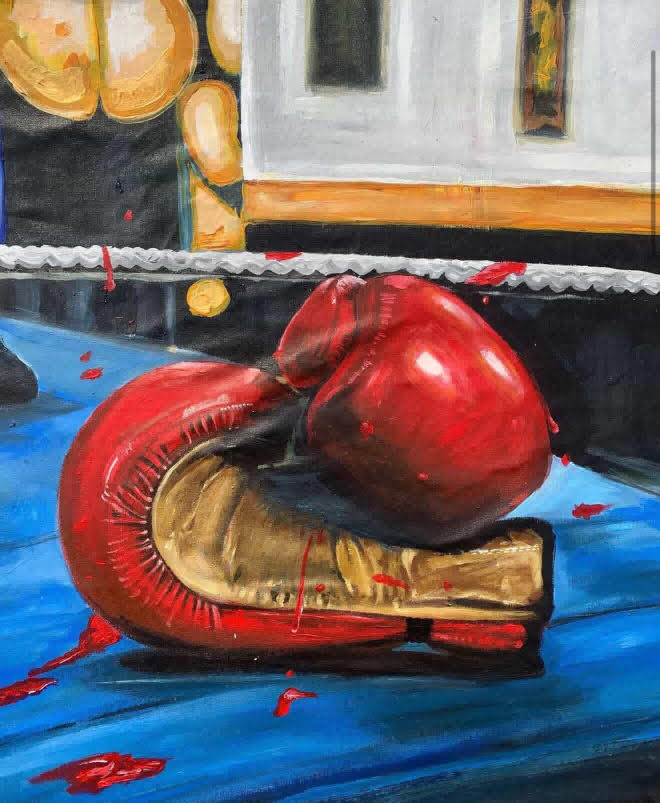
These are manifested in a number of his paintings that, while not created with some new-fangled application or other, still find a way to express within their uncluttered canvases pop-culture symbolism. The painting titled “Cost of the Count”, a picture of red boxing gloves in a background of blue, white and gold. The glove had been left in a corner boxing ring (most of the blue shows that), and its dripping red colour. Well, it’s dripping blood. The glove, to all conjectural intents and purposes, has just finished drawing blood. And whether in victory or otherwise, we cannot tell.
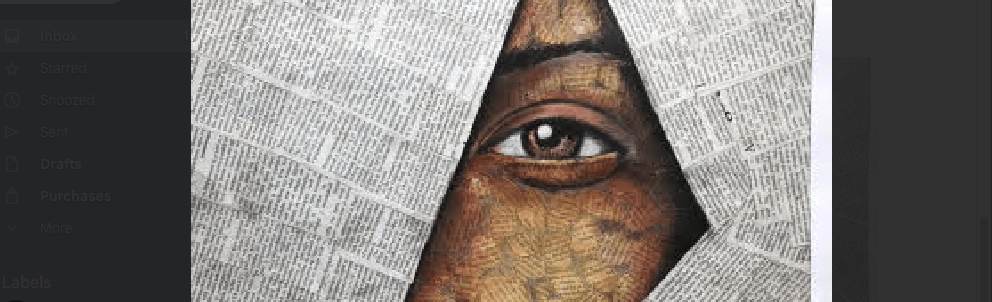
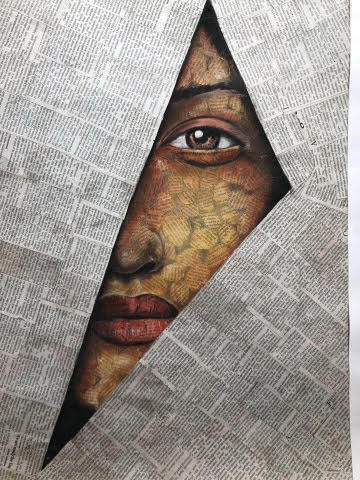
Another one, “A Thousand Words,” is the painting of a female face peeking through a frame of newspaper pages, as if she’s looking through a wall of news. This radical interpretation of a world in which most people now view the world through an avalanche of wanted and unwanted information—through a overwhelming cascade of online information jetsam—marks out Darlington’s expressionist realism as one way to respond to today’s world.
It does appear that he has found the right visual language for the times, while organically fine-tuning these ideas within his own artistic development, achieving a peculiar fusion between conventional technique and a tentative flirtation with pop-cultural elements. Throughout his work, we see the recognisable ways in which his pastellated canvases bring alive self-interpretive forms of dealing with contemporary human cultural existence. Their symbolism operate within the frame of this era, and the artist himself has chosen to see what he wants to, where he wants to.
Chimezie Chika is an essayist, fiction writer, and art critic. His writings have appeared in The Republic, The Iowa Review, Afrocritik, and elsewhere.
Categories: art, featured, featured artist


