

By Louise Miller
I’ve been keeping a secret.
For the past several months, every day, usually twice a day, I have been observing a nesting pair of great horned owls in a city park near my apartment.
It began in mid-October, when the days were furiously losing light, and my walks—both morning and evening—were often in partial to complete darkness. In the late afternoons, just as the sun slipped below the horizon line, I would hear the unmistakable song of a Great Horned Owl: hoo h’HOO hoo hoo. Sometimes one owl, sometimes two, singing in duet, one low, the other high. It is a sound that always stops me in my tracks. I would stand still, hairs on the back of my neck raised, ears reaching to hear everything, so that I wouldn’t miss the call. The sound alone fills me with a sense of awe, a gladness to just be sharing the same landscape as these magnificent creatures. I began to seek out the darkness, lingering under a favorite tree in hopes of hearing a single hoot before going home.
Great horned owls have a territory of over 1.5 -2.5 square miles, so if you see an owl in an area where you have been hearing owls sing, this is most likely the same owl (or its mate). This fact makes me incredibly happy. It feels like you are making new friends, getting to know a pair of owls—unlike, say, when you see a chickadee—where you don’t know if you are seeing the same chickadee, or the millionth chickadee—with owls, you actually have the opportunity to get to know the individual, in the brief moments when they are awake and there is enough light for you to see them.
In January, I attended an owl prowl—an organized, guided walk led by a naturalist—where you learn about owl habitat and behavior and then are led through the landscape in hopes of catching a glimpse of one. Now, even if you don’t see an owl, which, honestly, is most of the time, a walk with a group of nature lovers who are willing to stand in the waning light of a January evening and talk about our local apex predator is my idea of a good time. Everyone is bundled and excited and full of optimism. It is great to be outside in the darkest time of year (at least at the beginning of the walk, before the cold settles in your bones) and its thrilling when you encounter an owl in the wild.
It was on one of these walks that I was first introduced to the idea of ethical owling. Humans’ fascination with owls dates back centuries. There are cave drawings in France of owls that date back to over 30,000 years ago! But while we are fascinated with them, they are not fascinated with us—just the opposite. To survive, a great horned owl depends upon being completely camouflaged during the day, to rest up for a night of hunting. During nesting season, the owls are at their most vulnerable. It takes 30-37 days for a Great Horned Owl egg to incubate, and the owlets will remain in the nest for 6-8 weeks. The mom stays on the nest during this time, keeping the nestlings warm and dry and safe and fed (with the food that the father provides).Even after fledging, both parents and owlets will stay close to the nesting area as the fledglings gain confidence in their ability to fly. During this period, the owls and owlets are vulnerable to predators like red-tailed hawks, they are vulnerable to the elements, they are vulnerable to falls, and on the ground, to dogs and coyotes. They need rest, and calm, and privacy, like all new families. Birders who discover a nest are encouraged to follow these guidelines, to avoid causing any undue stress:
- Don’t get too close (if an owl looks at you frequently, you are too close)
- Keep your voice low
- Limit the amount of observation time
- Do not play recordings of other owls in an attempt to flush them out of hiding
- Do not share photos or location details of the nest site on social media
This was all good to me in theory, when I was out walking on a cold January night, but then I wasn’t thinking then of what the owls needed—I just really wanted to see the face of the bird I had been hearing for months.
January is mating season. Owls pair for life, and during this time the male will show the female the available nest sites he has found, like a human couple going to open houses they found on Zillow on a Saturday morning. They are opportunistic nesters, taking over a nest built by other large birds. The female gets to choose where they will settle down.
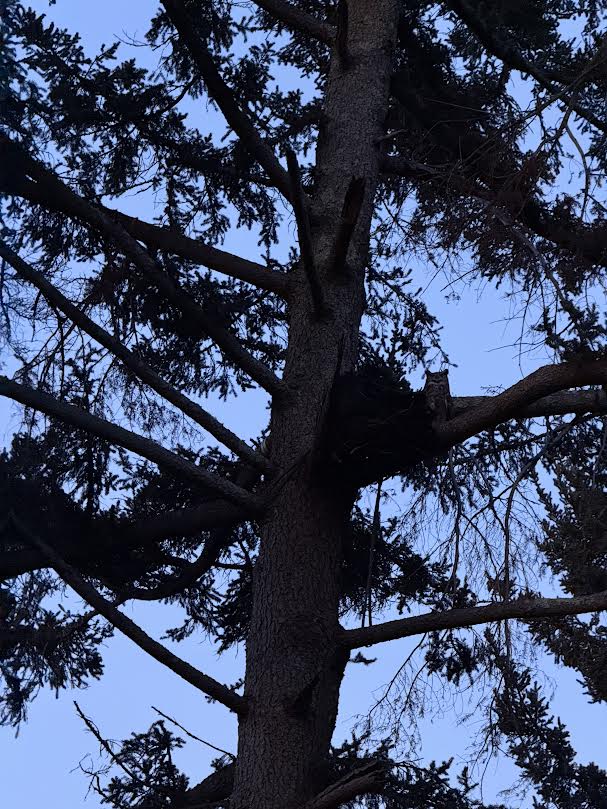
One of the birders on the prowl spotted an owl in a tree. As I searched the tree everyone had pointed their binoculars towards, and still not finding it, the owl swooped over our heads and across the meadow, landing on an open branch, where he stood for over ten minutes. We all marveled at our good fortune, to have such a clear view of this giant as night fell.
I lingered in the landscape while the others made their way over the frozen ground, wanting to see the full moon shine through the conifer trees and light up the snow. Hoo h’HOO hoo hoo, the male sang. Hoo h’HOO hoo hoo, the female answered. I stayed out in that frozen meadow until I could no longer feel my fingers.
I began to look for the nest casually, walking in the coniferous area where we had seen the owl, with little expectation. The truth is that while I am an excellent bird listener, I am hopeless at finding them in the landscape. But no matter, hearing the calls was enough.
One warm day at the end of February—it was one of those late winter days that offers a taste of spring, to help you keep going—when the snow had finally melted and a flock of robins appeared out of nowhere, looking for insects to eat in the newly thawed ground. I was following a group of them, enjoying the way they hop, enjoying the way the ground felt finally soft, enjoying walking in an area I knew would soon turn to wetland if there were any more rain and become impassable, when something light caught my eye. It was a large feather on the ground, pale golden brown, soft as down, but impossibly larger than my palm. I took a picture of it in my hand for scale and posted it to my private naturalist group chat. I received a private message back—it was from my owl expert friend. He said it looked like a down feather from a great horned owl—possibly plucked from the mother’s brood patch. The text came with a photograph—a nest, and in it, 3 perfect white eggs, the mother nowhere in sight. It also came with an invitation—would I like to see the nest?
In the following days I continued to walk in the landscape, my usual walk, listening for the owls, not really looking for the nest, knowing soon I would be shown the location, when another downy feather caught my eye, this time pierced onto a low branch of a coniferous tree. I looked up into the tree—nothing. Then I looked to the tree next to it. There, about halfway up the trunk, was a large man-made platform, constructed out of black gardening fabric and branches, straps holding it into place, and waving from the side of that platform, like a flag bearing a family crest, was another huge downy feather. I had found the nest.
My naturalist friend confirmed that was the location of the eggs. Always the realist, he reminded me that the nest could have been abandoned, but I remained hopeful. A few days later, peering up, this time with binoculars, I thought I saw an ear tuft, and possibly a single eye.
That was day one.
The first sign that a great horned owl has nestlings is that she begins to rise in the nest, as if she were sitting on a loaf of rising sourdough, growing taller as she hatches more owlets, and even taller as they grow. I began to regularly see her feathered ear tufts, the top of her head, and then her eyes. One day she sat like a perfect loaf, reminding me of a glass nesting chicken dish my nana kept our baby teeth in. I counted the days, and carefully watched her behavior on the nest, until one day, towards the end of March, I saw movement, and a flash of white.
The first time I ever saw an owlet, it was in the same section of the same park, maybe 30 years ago. Out walking with my dog Carver, I saw an older gentleman looking into the trees with a pair of binoculars. I asked him what he was looking at. He took a long moment to look at me, silently sizing up if I would be a threat to these owls, and then relented, handing me his binoculars and walking me though the visual directions that led me to find the perfect downy football with eyes and a strong black beak standing on a branch. I have never forgotten this moment, or this image, or the feeling of wonder and impossibility, and I’ve never forgotten the generosity of the birder who shared this moment with me. It was one of the best gifts I have ever received. This was in the days before cell phones, in the days before ebird (before e anything), the days before social media. And even then, the man was weighing the risk of sharing.
My life quickly fell into a new rhythm. I began to stop by the sight every morning at first light, when I could tuck behind one of the trees that hugged the top of the hill, and check on the progress of the nest. One flash of movement became two, and a third emerged, always behind the mom. Just the pale gray tops of downy heads, and the mom readjusting her body and wings, keeping everyone warm and safe in the ever-changing, unstable weather of early spring. Some mornings I would hear dad call from the tree I was leaning on. Some mornings I watched him arrive on the nest with something for breakfast. Most days mom would be busy processing whatever the dad had brought—usually a rabbit or a squirrel—feeding the nestlings one by one.
I marveled. And I worried. My mind kept wandering to what I had learned about ethical owling—how to observe without impact—how to love the owls without loving them to death. I worried that my presence would cause stress to these new parents, when they are at their most vulnerable, and I worried that my presence, looking up at the nest site with binoculars, would attract other humans. I made rules for myself—I would only stay for a few minutes—usually 5 or 10, I would watch from behind a neighboring tree and would leave if I noticed the mom looking over at me more than once.
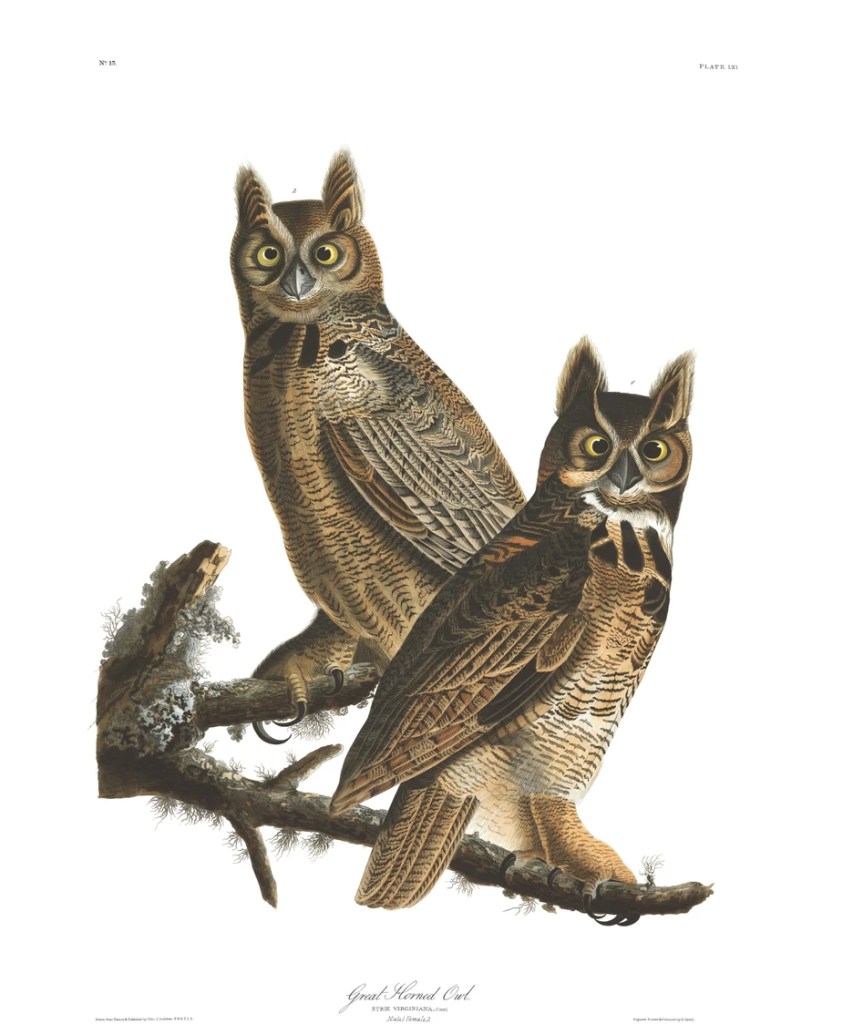
For weeks I watched the nestlings grow, from fuzzy little puffs with formidable black beaks to owlets on the edge of stepping onto the branches, stretching their newly feathered wings, plumage that mirrored their moms. I spent sleepless nights worrying about the strength of the nest during several windstorms, waking before dawn to run up the hill to make sure that the owlets had made it through the night, scanning the ground, to make sure no one had fallen. I made a plan with my friend about what I would do if I ever found on owlet on the ground. I made it a practice to monitor the area under the nest every morning. Many days I ended up late to work, having found the nestlings alone, and couldn’t pry myself away until mom had returned. The act of checking on the owl family daily anchored me in a way I hadn’t expected. I never questioned whether I would go, regardless of the weather, or how busy my life was. It felt like a commitment. It felt like my duty. It felt like my life’s purpose. It felt like my heart was up there in that man-made nest. I don’t know when it happened, but at some point, quietly tucked behind some spruce tree branches, I had stopped being the neutral science-minded person I like to pretend to be and had become deeply, whole-heartedly invested in the well-being of this little family. My nestlings.
But I wasn’t alone.
Word about the nest was already spreading.
The first people I encountered at the nest-site were lovely—respectful, knowledgeable, generous wildlife photographers—much like the birder I met 30 years ago—who shared their love and understanding of the owls with me. But the peace didn’t last. Some birders camped out all day with large camera set-ups in the open. It felt as if every day the number of birders and photographers doubled. A fence was put up around the nesting area and some neighboring trees, but I wished it covered more ground. Signs were put up reminding birders to think of the owls needs, and to follow the guidelines of ethical owling. One afternoon I found a man had hung his jacket on one of the signs, two large camera set-ups aimed at the nest while he stood out in the open, loudly talking on his cell phone, yards away from the nestlings.
The evenings grew longer, the days finer. The nestling’s plumage morphed from their downy gray to golden brown like their moms. The older two owlets stretched and flapped their wings, showing off their new flight feathers that had just come in. I wondered how long it would be before the owlets would start to explore the branches, the first step towards fledging. I wondered what I would do when they were gone.
On a perfect sunny afternoon, from across the park, I heard the dad calling, an urgent series of hoots that flooded my body with anxiety. I raced to the nest site. There I found a dozen photographers, all hugging the fence line, out in the open, talking loudly. The three owlets and mom were all low in the nest, obviously stressed, while the dad continued to call out his warnings. I stood behind the crowd, furious. I felt like the owl mother to the whole family. I wanted to spread my wings and cover the whole nest, and the father in the neighboring tree as well. To keep them safe and protected, from predators and bad weather and falls, and from us. For the first time, I longed for the owlets to fledge, for the whole family to melt into the treetops, out of sight, even if it meant I would never see them again. It was the last time I went to the nest site in the daylight, not wanting to be part of the problem, unable to hold back my feelings of frustration towards the people who only seemed to care about their own wants, and disregarded the owls’ needs.
I knew I would miss seeing the owlets becoming fledglings and the family leaving the nest. My partner and I were going away for 10 days, and already the oldest owlet was stepping out to stand on the branch right next to the nest, flapping its wings, looking as if it might take flight at any second. Half of me felt heartbroken to miss it, but the other half felt relieved that I wouldn’t have to face that moment of finding the nest empty. At sunrise on the day of our flight I stopped by to say goodbye. The two eldest were next to each other on the branch, the youngest still in the nest, everyone flapping their impossibly large wings. Mom arrived shortly with something to eat. Before I left everyone had crowded back in the nest, cozy together, sharing breakfast. The morning was fresh and clear and full of birdsong. I didn’t see a soul, not even an early morning runner. It felt like a gift.
The owlets did fledge while I was away, but I got to see both parents and all three owlets several times in trees close to the nest when I returned. And then, one rainy morning, thick with fog, as I was walking towards the nest area, I noticed something different—the fencing had been taken down. I leaned on my favorite spruce tree and surveyed the landscape. Song sparrows, Northern cardinals, cat birds, chickadees, all singing to greet the dawn. Empty nest. Not an owl in sight. It felt as if it had all been a dream. It felt as if the past six weeks had never happened. I stood, binoculars in hand, feeling completely lost.
I stopped looking for the owls that day. The birders and photographers moved on to a barred owl nest in another park. It’s been a few weeks now, and I still feel a little lost. I walk through conifer trees in the morning, as I did before the nestlings, and I still try to be out walking before dawn. Spring has unfolded at a furious pace, leaves unfurling, fruit trees flowering, trillium and columbine blooming, the air full of birdsong, songs unheard since last autumn. One morning, as I stopped to admire the golden morning sunlight illuminating the bark on several snags, I caught sight of one of the owls sunning themselves, their chest rosy and glowing, their eyes closed, at rest—at last—in the early morning light.
Louise Miller is the author of The City Baker’s Guide to Country Living and The Late Bloomer’s Club. You can find her at https://www.louisemiller.net. To read more of Louise’s nature writing, subscribe to her nature newsletter, Red Tails on the Fire Escape here: https://redtails.substack.com/about


