

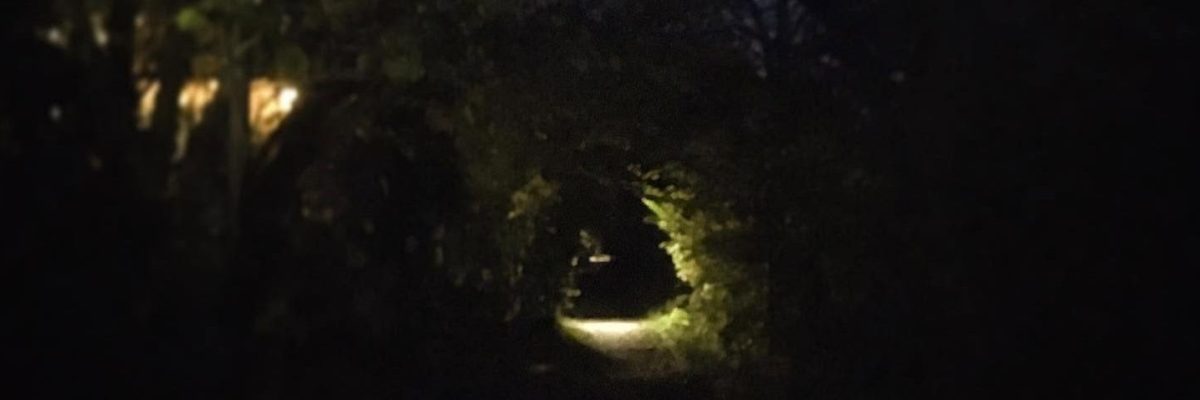
In the small hollow of the middle-of-the-night the light is slight and underwater-blue and the silence settles like dust. The kids rend a jagged gash through the stillness, thrilled at their unsettling power, shouting, laughing, grinding the wheels of skateboards and bikes. They come to roost under a disused railway bridge that stretches over the disused canal. They perch in the shadows, they raucously squawk, they flap their ragged wings, they peck at each other’s eyes. They climb the banks onto the bridge and walk across the rotting gap-toothed ties, pretending to fall or nearly falling, relishing the echoes of their disruption, thrilling to a brush with death by drowning. Cigarette smoke vies with the sharpness of nettles and the sweetness of honeysuckle and wild roses.
The moon-bright water quietly laps against the wet weedy banks in glowing waves: Here long before them, here long after them. Here long before them, here long after them.
In the pigeon-scented shadows under the bridge one boy tags the wall, rapt, wrapped in the silence and stillness of his own vision, working like a glowworm in the darkness. The light from his painting illuminates his fervent face, and he’s deaf to the chatter around him as his friends shake their cans of paint like rude noisemakers and trace dicks and fucks on the cobbled wall until they grow bored.
*
The houses in Dedmans alley—small, shabby, semi-attached—have seen few changes since the town’s late-70s renaissance (and subsequent decline). Mud-brown aluminum siding, or bad-news-beige, or mildew-dripping-gold, all covered with the silt of the latest flood. The small porches careen into one another—drunks outside a bar at closing time, small support, confused commiseration.
Edith Lerner is often wide awake at 3 am, with her mind marching through her regrets like a politician glad-handing bystanders at a small-town parade, but she’s not usually out of the house at this hour. Her dog, Scruffers, got into something, and he’s been awake all through the night needy as a newborn baby, asking to go out. It always surprises her, in the middle of the night, to see that other people are awake and getting on with their lives. Headlights of cars stir up the dust in the street. Tail lights cast everything in a strange red light, pulsing with the brakes. Where are they going, at this time of night?
Scruffers pulls her down Dedmans alley. He’s very strong for a small, sick boy, and she follows him, but she doesn’t particularly want to go down Dedmans at this hour. It’s not like it was when she was a girl—a lively little neighborhood full of young families. It’s mostly old men now, and vacant spaces with the windows and doors boarded up. Some foreigners, of course. Turning the town upside down. Shady dealings. The stories she’s heard!
Of course Lester still lives there, just as he’s always done, and he’s a cop, so there’s a little sense of security there. The lights from his dirty window cast a deep ochre circle across the porch and onto the sidewalk. She likes when the lights are on but the shades aren’t drawn; she’s always liked a little peek in other people’s homes. There’s Lester, slumped in a big tatty armchair, staring intently at a painting on an easel. That fella with the big curly hair is on the television doing the same painting, and Lester is slowly looking back and forth between the two. Tinny music wafts through the window (and the door—wide open, at this hour!) with the thick musty smells—Lawrence Welk, she thinks. She’s always loved some Lawrence Welk. So much more calming than the nonsense they listen to today.
Lester has a whole plate of snacks next to him. It’s one of those yellow plates with the brown trim. They all had them back in the day. He’s got cubes of food on toothpicks. She wonders if it’s pineapple and cheese. She’s always loved some pineapple and cheese. With a little pale pickled onion. Fancy him making a fancy plate of food like that, a bachelor as he is. The thought of it makes her sad, and she doesn’t know why. Lester hovers his hand over the plate, choosing the perfect one, then nearly chokes as he eats it all in one bite. She’s a little shocked at how old he looks, though she sees him often enough. They went to high school together after all, and she’s never that old.
Not that she remembers him, or much of anything else about high school, for that matter. A scrap of song lyrics, afternoon sunlight on the parking lot out back, one of those algebra formulas she’ll never use, that one time she told Alice Camerano she’d have fat kids. Why would she do that? She was never mean. Was she mean? And Lester, he was just a big stooping kid. Quiet. With thick glasses. And he used to stare. Not at her, just…stare. Out the window, or into the empty space in front of him. What was he seeing?
Now he’s looking back and forth from his painting to the TV, the flickering blue reflecting in his glasses. He’s frowning. He applies a thick dab of white to the sky, to the clouds. The painting is of a snowy mountain landscape, cool, pale, quiet, and a million miles from his room, which is so dark and cluttered. Fake wood paneling, dim lights, his mother’s knickknacks falling off every crooked shelf. Macrame tangled with cobwebs, the spiders adding their skills. It looks like it would smell like old onions, thinks Edith. Onions smell like poor people, her mother used to tell her. And why was that? What would that mean?
She nearly jumps out of her skin at the ringing of the alarm clock, and feels as if she’s been woken from a dream, like swimming up from deep dark water. And how long has she been out here, looking in? When Lester slams his hand on the clock, sighs, and laboriously lifts himself to his feet, her heart races like she’s been caught in a crime. Lester wipes his brushes carefully with a rag and places them in a box. Edith pulls frantically at Scruffers’ leash, desperate to escape before she’s seen, and he looks up at her with surprise and hurt in his small dark eyes.
Lester pulls off his big paint-smeared smock to reveal his cop’s uniform, and Edith feels her heart in her throat, and a cold prickling down her arms and legs. He disappears from view, carrying his plate, and she hears water running, a toilet flushing. She tugs harder at Scruffers’ leash, and he sneezes emphatically, twice.
Lester reappears from the gloom and stares at his painting for a moment, then grabs his hat, his belt, his gun, his…Edith doesn’t know because she’s pulling so hard on Scruffers’ collar that he chokes. Lester’s shadow looms in the open doorway and stretches through the dusty thick yellow light. Scruffers takes a couple encouraging steps and then stops, plants his skinny legs, arches his back, and starts the heaving and thunderpumping. It’s in the mail, and there’s no hurrying him now. Lester lumbers onto the porch, his face in shadow, his head in a halo of porchlight and frantically circling bugs. Scruffers looks up at Edith, drooling and sorrowful, and launches his bellyful of kibble onto the sidewalk, where it lies in a small neat pile, resplendent under the streetlight.
Edith has an odd compulsion to put her hands out, waiting for the cuffs, like they do in the movies. Instead she laughs nervously, her mind reeling. Does she pick it up? Does she pretend it didn’t happen? But Lester barely sees her. He doesn’t seem to see much of anything through those thick glasses. His face in shadow, his glasses reflecting a light Edith can’t see, he has the look of a man wrapped in a thick white cloud, tangled in a skinny pine tree, on the top of a tall mountain.
He climbs awkwardly into his car, heaves a great sigh and drives off, with barely a glance in Edith’s direction. His brake lights turn the wet street red when he hits the corner, and then he’s gone, and everything is quiet and dark, and Edith suddenly feels very alone and lost.
At home she opens all the windows in her small room, and a rising breeze stirs the thin curtains. There’s a storm coming, she thinks. But it can’t blow the room clear of the thick fug of her guilt and misgivings and Scruffer’s worrying sick-dog foul-smelling gas.
**
At the turning of the stairs, hovering two feet off the ground in the cracked and dusty plaster—below knee-height for an adult, but just in the eyeline of a child–a somber little gentleman doffs his cap, mid-twirl. In the flickering light of the television, he finishes his twirl, he spins, and he winks at Sophie, who perches at the top of the stairs, staring into the shifting blue darkness below. But he doesn’t smile. His face is as serious as hers, and she loves him for that. Dust and wear and Sophie’s hands have dulled his sharpie-formed frame. She stoops to pass her palm over him every time she walks by. He’s one of her best friends.
She sits beside him now, on the top stair of the first flight, and waits and waits for him to talk to her, as she waited when she was small. She sat beside him during all the yelling, and crying, and door-slamming, and worse-than-noise-silence, and waited for him to talk to her. In her dreams he does, he still does.
In her good dreams he has Sam’s voice, because he is her favorite human, and because he drew the little man. In her nightmares it’s her father or her biology teacher, or sometimes her mother.
The picture isn’t finished. The hand he’s waving is just a stump, a ragged stump, with the sharpie line trailing off to nothing, where they noticed Sam drawing on the wall and stomped up the stairs, bringing the yelling with them. And then he looked at Sophie, huddled in the shadows behind the bannister, hugging her legs to her chest, tasting the scraped scarred boniness of her knees. He touched his hand to his head and then jumped up and pulled her into his room with a slamming of the door.
They hid under the covers with a flashlight and the hide-and-seek thrill of fear. But they knew nobody would take the time to come looking or talking. They were too busy yelling, as though they had a rare perverse pleasure in it. Sophie would fall asleep in Sam’s bed, and he would slip out the window, slide down the tree, and run off into the night. No matter how long he’d been gone, she felt the warmth of him on the bed next to her when she awoke, and his smell–grass stains, tree bark, and moonlight.
He’s gone again tonight, and Sophie, as always, feels his absence as a jagged emptiness rusted with worry. The stairs descend into an ocean of darkness, waves of dusty gloom swimming with strange sea creatures—regret, worry, confused memories of dreams—rise and fall with the lights and sounds of the television. Her mother will be asleep in the depths, in her chair, jaw slack, socks and shoes in a pile on the floor before her, glass of wine within reach. The TV will be playing the news. All middle-of-the-night-bad news, neverending wars, explosions, traffic accidents, petty crime, loneliness, sadness, desperation, want, need: all gulping in the waves of deep silty light.
***
All he can see is colors. Probably shouldn’t be driving. He’s painting-blind, from working on his art. The thoughts so bright they drown everything else out, like when you come in from a bright-snow day all you can see is white. The oil slicks in the street are a brush through thick globs of paint, the stars are a spattering of pale against a dark background, the pines, the dark shadowed pines, are sharp jabs of the brush. Ptchchchch ptchchcch ptchchchch. The dispatch radio wakes him from his visions, and he’s in the dreary town where he was born, after a late rain, in the dark wet forsaken middle of the night. He’s humming his favorite song, and the lyrics to it are strong in his head, so he can’t focus on the dispatch. “And though it’s always sweet sorrow to part, you know you’ll always remain in my heart, Good night, sleep tight and pleasant dreams to you, Here’s a wish and a prayer that every dream comes true.”
Every dream come true every dream come true. He hasn’t had a dream in a long time, other than of painting, and those are often nightmares because it so often goes wrong. It never goes right. The car is reeking of onions, and why would that be when it’s only him who drives it? It’s so dark inside with so much gear. It usually smells like oil and dark gear and responsibilities and maybe some vanillaroma. But these onions … for Pete’s sake. They’re on his pants, his thick, blue, government-issued polyester pants, in a slick of mayonnaise. He must have dropped a glop, not of paint, not of paint, of his cocktail snacks, which he loves to prepare. And now he would live with this smell for the rest of the night and as far into the future as he could imagine. Every dream come true. He might have had this dream, this worrying dream. He might have had this regret.
He startles at the sight of a ghost. A thin pale creature with wispy hair and long white limbs, running with surprising awkwardness along the damp sidewalk. When he slows it turns to stare at him, and he knows of course he knows who it is. It’s just a girl, the sister. She has the camera that she always has, and she takes a picture of his car. But it’s so dark, the photo will never come out. But the thought of her startled eyes staring at him with … amusement? Anger? (Scorn? She knows that he can’t paint. That he can never create the perfect version of the vision in his mind. She knows how flawed his talent is, how lacking.) He’s past her now, she’s a vague blur in his rearview, and of course, none of this is true. She doesn’t know. She couldn’t know, and why would he think that?
He drives on, slowly. He’s on the smaller roads now, traveling along by the dark shadowed canal. Across the water, he sees the old blue train car sitting stark on the tracks like a haunted skeleton carriage. (They drank beer there as boys, and smoked cigarettes they stole from their dads’ jackets. The smell of smoke in the damp night air, stale beer, dust, and fear. Every time they heard a flutter of leaves or a twig crack or a siren far off somewhere in town, how his heart raced and how he wanted to run home and lock the door and pull down all the shades.) Now, he stops and watches for a moment, and his heart races again at the sight of movement in the car. The icy panic of a reluctant teenager trying to pretend he’s not afraid. But a mottled pale and dark bird flies out the bare window with a fluster of wings. So he drives on, slowly.
There’s that sound on the dispatch, the one they do in all the movies, the papery, electric crackle. And he’s called to a place he doesn’t want to go because he wants to go there too much. He doesn’t turn the lights on. He pulls in slow, but the gravel is loud, and he knows it. He’s counting on it. He’s counting on all of them, almost all of them, all but one of them, scattering in the dark like frightened birds. And they do, according to the script, laughing and yelling and running as if they’re chased, which he is in no mind to do. And he sits, as he has, so many oh so many nights, and he watches the one boy who remains. This boy. This boy. He doesn’t care he doesn’t question or doubt or wait. He’s not watching someone else who is telling him what to do. He is. He is. He has a vision in his head and he paints it. It’s not high art. It’s not Bob Ross. But it is perfectly painfully poignantly perfect. Every time. And the kid fucking knows it. How Lester hates and loves and hates this boy.
The boy finally looks up, surprised and blinking, as if waking from a dream. He doesn’t even glance at what he’s been painting. He yawns and stretches and turns towards Lester. He slowly smiles. The punk. The goddamned punk. Lester wants to fly at him in a fiery rage, but all he can do is swing the car door open and hoist himself out, drag his heavy old bones out of his seat and head towards him, running, feet dragging him back to the dark black earth with each plodding step. The kid doffs an imaginary cap, he waits an infuriatingly hanging moment before he twirls with aggravating grace, and takes off running flying over the old bridge in the dark like it’s nothing and disappearing into the darkness on the other side.
Lester stops and clutches his side, doubled over with a stitch.
The ghost shows up, quiet, not hurrying, not out of breath. She turns her face to him, but in this light it’s just a pale oval, a brushstroke of pale paint. She raises the old camera hanging around her neck and a flash goes off like a tiny electric shock in his brain, a tiny firework, and she takes a photo of him, like this, here.
Once she’s gone it’s just the night insects and the water and the voices of his visions and disappointments lapping quietly quietly quietly in gentle waves.


