


On the Qualities of Revelation in Cinema
By Amir Zadnemat
Cinema can be understood through a foundational metaphor of revelation: light rendered through a cinematic apparatus makes an image perceptually present, allowing what is absent from the spectator’s immediate environment to appear before them. To speak of revelation in cinema, then, is to speak of something more fundamental than a narrative device or a plot twist. It is to speak of a condition of the image itself, a moment when the screen ceases to function merely as a surface of representation and becomes a permeable boundary between the seen and the unseen, the known and the intuited. To analyze cinematic revelation is therefore to investigate how the image confronts its own limits and, in doing so, reconfigures the spectator’s activity, making interpretation rather than mere reception central to the viewing experience.
Revelation is not a singular phenomenon. For the purposes of this essay, I propose four analytical modes: revelation as epistemological clarification, revelation as psychological rupture, revelation as ontological fissure, and revelation as cinematic reflexivity. Epistemological clarification occurs when a narrative disclosure resolves an enigma and restores a degree of intelligibility. Psychological rupture occurs when a disclosed truth destabilizes the subject’s perception of identity, memory, or reality. Ontological fissure emerges when the very nature of reality, time, or existence becomes uncertain or exceeds ordinary categories of understanding. Finally, revelation can turn reflexively toward the cinematic apparatus itself, becoming a form of medium self-awareness, or cinematic reflexivity: the moment when a film discloses the formal, technical, and spectatorial structures through which seeing has been organized.
These modes should not be understood as successive historical stages in which one simply replaces another. They are better understood as recurring and potentially overlapping possibilities of cinematic revelation. Classical films can contain psychological ambiguity; modernist films can still employ narrative revelation; contemporary cinema can combine ontological uncertainty with explicit reflexivity. The purpose of the model is therefore not to describe a linear history of cinema, but to distinguish different ways in which the cinematic image can disclose what was previously hidden.
I. The Intelligible Secret: Revelation as Narrative Clarification
Many classical narrative films treat mystery as a temporary epistemic disturbance that can, at least in principle, be resolved. The world of the film may be coherent and intelligible, yet temporarily obscured by a murder, a hidden identity, a secret motive, or an unknown past. Revelation in this context functions as a mechanism of clarification. It answers a question, fills an epistemological gap, and can produce narrative or emotional catharsis.
Orson Welles’s Citizen Kane (1941) remains one of cinema’s most sophisticated examples. The film is structured around an investigation into the meaning of a single word: “Rosebud.” The word becomes a central absence around which multiple accounts of Charles Foster Kane’s life are organized. At the end of the film, the spectator learns that Rosebud is the name of Kane’s childhood sled, which is burned with other possessions as his estate is cleared.
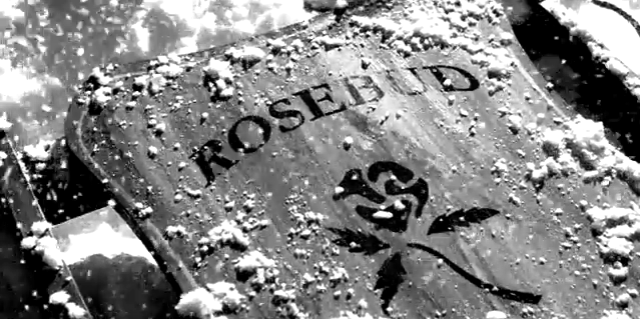
Yet the importance of this revelation lies precisely in the fact that it does not explain Kane completely. Rosebud provides a missing piece of Kane’s emotional history, but it does not reduce the character to a single psychological formula. The film resolves the literal mystery of the word while leaving the larger mystery of Kane’s identity irreducible. Revelation therefore operates here in an intermediate form: it produces knowledge while preserving a residue of unknowability. The spectator learns what Rosebud refers to, but Kane himself remains larger than the explanation.
This complication is important because it reveals a broader feature of classical disclosure. Narrative revelation does not necessarily eliminate ambiguity. Rather, it often establishes a structure within which ambiguity becomes manageable. It transforms an unidentified absence into a named object, a hidden event into a discoverable fact, or a series of scattered clues into a pattern.
A substantial strand of classical Hollywood cinema develops this logic under darker conditions in film noir. Its worlds are organized around concealment, deception, and incomplete knowledge. In The Maltese Falcon (John Huston, 1941), Brigid O’Shaughnessy is ultimately revealed to have killed Miles Archer, while the wider network of deception surrounding the Falcon is progressively, though only partially, clarified. The resolution does not create moral harmony, but it organizes enough of the film’s central mysteries to permit narrative closure.
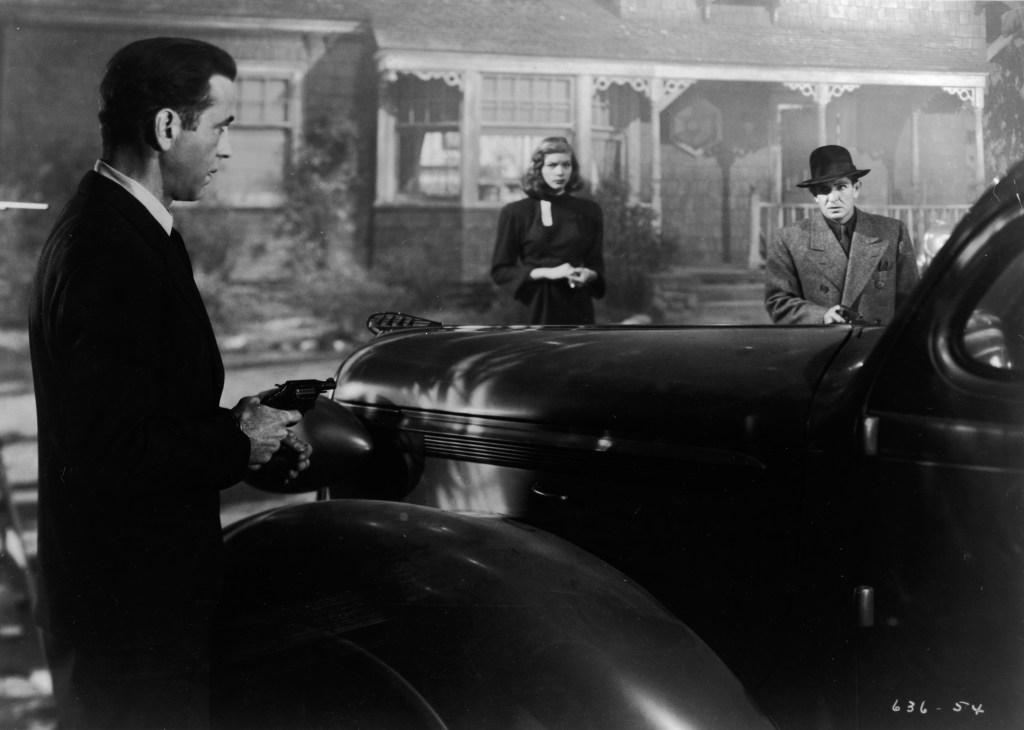
The Big Sleep (Howard Hawks, 1946) offers a more complicated case. The film’s investigation clarifies a number of relationships among blackmail, murder, disappearance, and deception, yet its final theatrical form also leaves important questions unresolved. Most famously, the circumstances surrounding the death of the Sternwood chauffeur, Owen Taylor, remain less fully explained than the film’s other major mysteries. The film’s intricate plotting and the removal of some explanatory material contribute to its notorious opacity. It therefore occupies a useful position at the boundary between epistemological clarification and persistent narrative uncertainty.
Thus classical narrative revelation should not be defined as perfect closure. A more precise claim is that it tends to treat mystery as potentially intelligible. The world may be dangerous or corrupt, but the act of investigation assumes that hidden relations can, at least to some degree, be brought into a meaningful pattern.
This logic receives an especially refined form in M. Night Shyamalan’s The Sixth Sense (1999). The disclosure that Dr. Malcolm Crowe has been dead since the opening shooting retrospectively reorganizes numerous earlier scenes. What had seemed to be unanswered questions or strange encounters can now be understood as signs of a different ontological situation. The satisfaction of the revelation comes from its retroactive explanatory power: earlier details acquire new meaning once the spectator possesses the missing information.
The key difference from Citizen Kane, however, is that The Sixth Sense much more strongly resembles the architecture of a puzzle. Its revelation substantially increases the coherence of the narrative world, even though it does not erase every possible ambiguity. In this form, revelation is an affirmation that the apparent disorder of the story has been governed by an underlying structure.
II. The Fractured Self: Revelation as Psychological Rupture
If classical revelation often turns mystery into intelligibility, many modernist films complicate or reverse the movement. The central discovery is no longer simply an unknown fact about the world. It becomes an encounter that destabilizes the subject who perceives it. Revelation ceases to restore a stable reality and instead exposes instability as part of the subject’s condition.

Ingmar Bergman’s Persona (1966) is exemplary of this mode. The film places the actress Elisabet Vogler and the nurse Alma within an increasingly ambiguous psychological and formal relationship. Their identities appear to overlap, and the film repeatedly complicates the distinction between one woman’s subjectivity and the other’s.
The famous composite image of the women’s faces crystallizes this process. Rather than establishing a single hidden fact, the image stages the possibility of an increasingly unstable boundary between identities. The viewer is invited to consider whether the women’s relationship should be understood as psychological identification, doubling, projection, or some unstable combination of the three. The film does not definitively settle the ontological status of this relationship. Its revelation is therefore not the disclosure of a secret solution but the visualization of a problem: the stability of the self itself has become uncertain.
Michelangelo Antonioni’s Blow-Up (1966) pushes this crisis toward the problem of the image. Thomas, a fashion photographer, believes he may have accidentally photographed a murder in a London park. He repeatedly enlarges his photographs, searching for evidence. The more he magnifies the image, however, the less securely it yields a stable truth. Shapes and grains of photographic material seem to disclose a body and a weapon, but certainty continually recedes into abstraction.
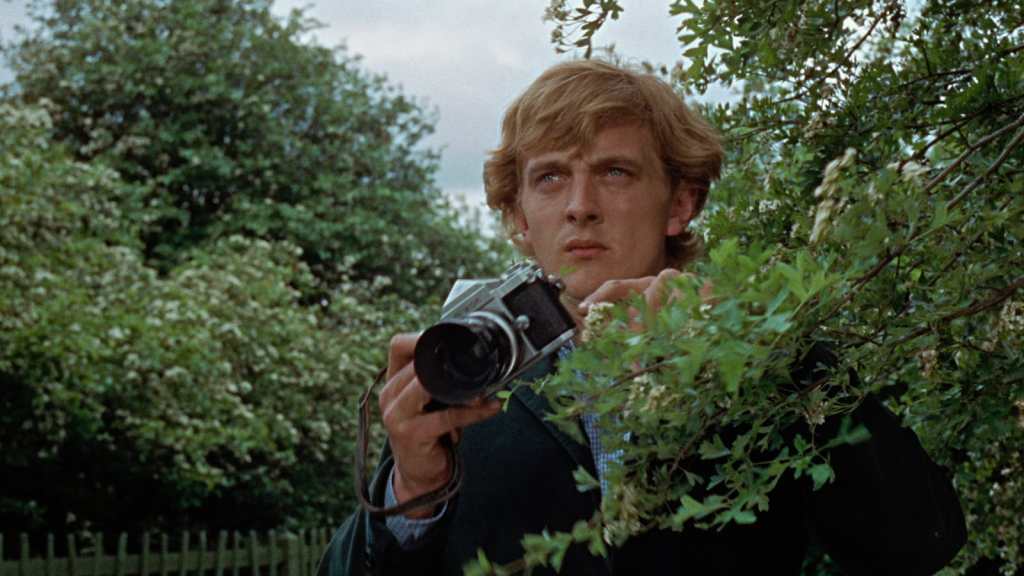
The crucial revelation of Blow-Up is therefore not the discovery of the crime but the fragility of the act of photographic knowledge. The image appears to promise objective evidence, yet its enlargements increasingly expose the dependence of seeing upon interpretation. When Thomas returns to the park and the body is gone, the physical world can no longer guarantee what the photograph seemed to show. The film concludes with the famous imaginary tennis game, in which the protagonist eventually participates in a reality whose boundaries between the tangible and the illusory have become impossible to secure.
David Lynch radicalizes this logic in Mulholland Drive (2001). The film strongly invites a reading in which its earlier narrative is reconstructed through Diane Selwyn’s fantasy, allowing characters and events to be recontextualized after the blue box sequence and its aftermath. What first appeared to be a strange but coherent narrative can then be read as a psychic construction through which guilt, jealousy, desire, and failure are transformed into an alternative reality.
Yet Lynch does not provide a single officially authorized explanation. The Diane-as-fantasy interpretation is best understood as a powerful and widely adopted reading rather than as an unequivocally established diegetic fact. Revelation is therefore better understood not as the delivery of a final answer, but as the production of a new interpretive regime through which the earlier film is perceived differently. The “truth” of the film remains inseparable from the instability of the distinction between fantasy, memory, desire, and reality.
In this mode, revelation no longer heals the world. It reveals that the subject’s access to the world was fractured all along.
III. The Cosmic Abyss: Revelation as Ontological Fissure
Beyond the instability of the psyche lies another possibility: revelation as a disturbance of ontology itself. Here the question is not simply who knows what, nor even whether a subject can trust perception, but what kind of reality the image is disclosing. These revelations confront the spectator with the sublime, the metaphysical, or the cosmological, often at the limits of language.
Stanley Kubrick’s 2001: A Space Odyssey (1968) remains one of cinema’s defining examples. The film is structured around the recurring appearance of the black monolith, which the narrative repeatedly places at moments of transformation and evolutionary change. Yet the film deliberately refuses to explain the monolith through conventional exposition.
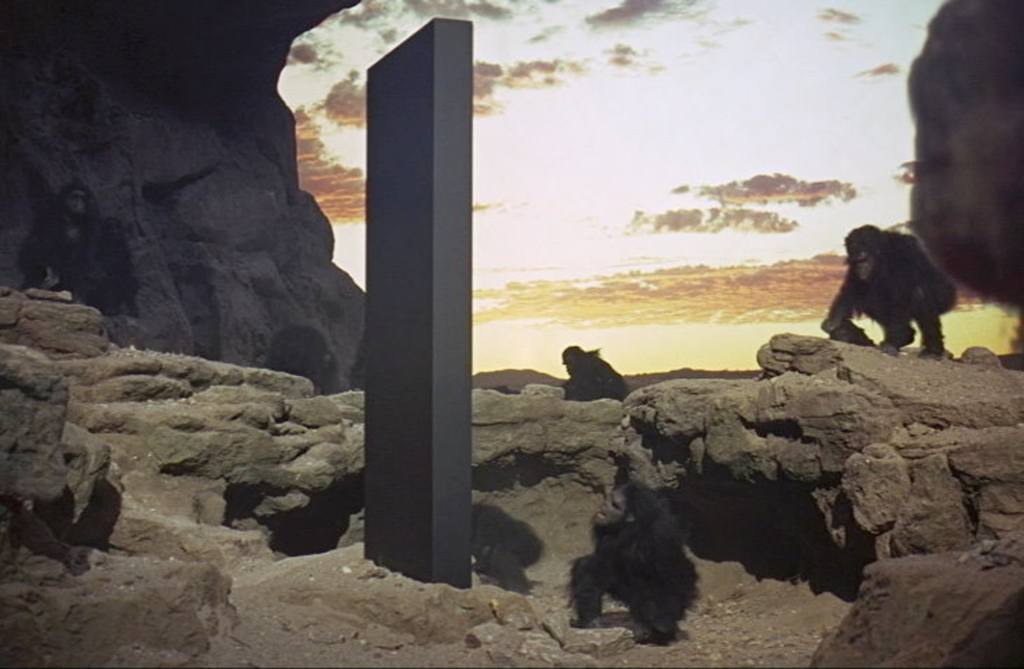
After disconnecting HAL 9000, Dave Bowman proceeds toward the monolith near Jupiter and enters the Star Gate sequence, a prolonged audiovisual passage of extraordinary color, motion, and abstraction. Narrative explanation yields to cinematic experience. The sequence does not simply communicate information about another world; it subjects the spectator to a form of perception that exceeds ordinary representational logic. Kubrick’s method treats the sequence less as a conventional explanation than as a visual and experiential event.
The transformation into the Star Child can therefore be read as suggesting that humanity is not the endpoint of evolution but a transitional form within a larger and incomprehensible process. This is an ontological interpretation rather than a proposition explicitly stated by the film. The ending remains deliberately open to interpretation; its power lies partly in the refusal to translate the transformation into a definitive verbal explanation.
If Kubrick approaches the ontological through cosmic sublimity, Andrei Tarkovsky approaches it through spiritual immanence. In Stalker (1979), three men enter the Zone in search of the Room, a place believed to fulfill a person’s deepest desire. The Zone remains mysterious and seemingly responsive, but the promised destination is never converted into a conventional revelation.
The men reach the threshold of the Room but do not enter. The Stalker’s faith, the Writer’s cynicism, and the Professor’s intentions contribute to the film’s refusal of an expected resolution. The film thereby shifts revelation away from an externally verified miracle and toward the interior condition of the characters.
The final sequence involving the Stalker’s daughter, often called Monkey, intensifies this ambiguity. She appears to move glasses across a table without touching them. Rather than explaining the Zone, the scene introduces a small and enigmatic disturbance into ordinary domestic reality. The moment can be read as relocating the possibility of the supernatural from a distant sacred location into the everyday itself.
Terrence Malick’s The Tree of Life (2011) develops a different form of ontological revelation by interweaving private memory with cosmic history. The film follows Jack, whose grief over his brother becomes inseparable from memories of childhood, while the narrative expands outward into sequences depicting cosmic formation, prehistoric life, and the development of life on Earth.

The film’s revelation is less a single disclosure than a mode of seeing. The intimate and the cosmic are placed within the same perceptual field. The “way of grace” associated with the mother and the “way of nature” associated with the father become dimensions of a larger meditation on existence rather than merely opposing moral positions. The final reunion on a dreamlike shoreline functions less as a literal solution than as a poetic form of reconciliation or acceptance. This reading treats the sequence as symbolic and spiritual rather than as a straightforwardly established representation of an objectively defined afterlife.
In these films, revelation no longer means that the viewer learns the hidden rule governing the world. It means that the world itself becomes strange.
IV. The Machine in the Ghost: Revelation as Cinematic Reflexivity
A particularly reflexive form of revelation occurs when the object of disclosure becomes cinema itself. Here a film ceases to function as an apparently transparent window onto an autonomous world and begins to expose the formal and technical processes through which that world has been constructed. The question shifts from “What is being seen?” to “How has this seeing been organized?”
Jean-Luc Godard is one of the central figures in this transformation. In Pierrot le Fou (1965), abrupt cuts, radical ellipses, intertitles, shifts in sound, discontinuities, and moments of direct or quasi-direct address weaken the expectation of seamless continuity. Such devices remind the viewer that the film is an artifact assembled through formal decisions rather than an unmediated reproduction of reality. Godard repeatedly interrupts the transparency of conventional cinematic language in order to make the act of representation itself visible.
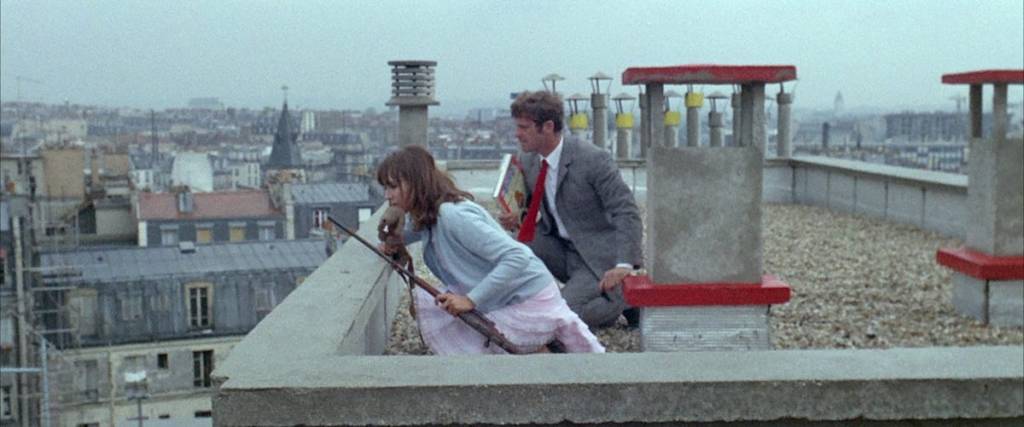
This can be read in Brechtian terms. The point is not simply to destroy pleasure or identification, but to interrupt the automatic conditions under which spectators forget that they are watching a constructed image. The revelation is therefore reflexive: cinema discloses some of its own codes.
Abbas Kiarostami’s Close-Up (1990) develops a more ambiguous and humane version of this self-awareness. The film reconstructs the real case of Hossein Sabzian, who impersonated filmmaker Mohsen Makhmalbaf, while incorporating real people and staged or reconstructed events into a form that continuously unsettles the boundary between documentary and fiction.
During the encounter, the sound recording becomes unstable and much of the conversation is difficult to hear. Although the disruption appears as a technical failure within the film, critical accounts indicate that much of its audible effect was shaped or intensified in post-production. The precise production history of the sequence is therefore more complicated than the apparent breakdown suggests. What matters aesthetically, however, is that the compromised soundtrack makes the material conditions of cinematic mediation perceptually palpable: an apparent failure of recording becomes part of the film’s construction, reminding the spectator that access to reality is always mediated.

The sonic imperfection does not necessarily make the event more “real” in any simple sense. Instead, it reminds us that access to reality is always mediated – and that even an apparent failure of mediation can become part of a cinematic construction. Paradoxically, the audible instability may intensify our sense of intimacy because we become conscious of the material conditions through which intimacy reaches us.
Michael Haneke pushes this reflexivity into direct ethical confrontation in Funny Games (1997). Two young men terrorize a family, and the film repeatedly frustrates the spectator’s expectations of conventional thriller structure. At one crucial moment, after Anna appears to gain control of the situation and kills Peter, Paul finds the television remote and rewinds the action, effectively undoing the family’s brief victory. The film then resumes from an earlier point, with Paul preventing Anna from repeating the act.

The device is not simply a formal joke. It exposes the power of the film itself to determine what can happen inside the story. Haneke thereby directs attention toward the spectator’s expectations of suspense, reversal, punishment, and revenge. The remote becomes an emblem of mediated power. The film confronts the spectator with the possibility that the desire for suspense, retaliation, and cathartic violence is itself implicated in the pleasures of genre entertainment.
Revelation here is no longer simply about the story. It is about the ethical relationship between image, spectator, and desire.
Conclusion: The Persistent Unveiling
The range of cinematic revelation cannot be reduced to the moment when a secret is explained. It can function as narrative clarification, psychological destabilization, ontological disturbance, or reflexive exposure of aspects of cinematic mediation.
The four modes proposed here are not a linear historical sequence. Rather, they describe different ways in which cinema can make the hidden visible.
In its restorative form, revelation transforms mystery into intelligibility. Citizen Kane demonstrates that even a powerful disclosure may leave the central person unresolved, while film noir often turns concealment into a partial but usable structure of knowledge. The Sixth Sense offers a more concentrated form in which revelation retrospectively reorganizes the narrative and intensifies its coherence.
In psychological revelation, the problem changes. Persona destabilizes the boundaries of identity. Blow-Up exposes the fragility of photographic certainty. Mulholland Drive turns interpretation itself into part of the mystery. Here the revelation does not close the world; it destabilizes the subject’s confidence in how the world is known.
Ontological revelation moves toward the question of reality itself. 2001: A Space Odyssey confronts humanity with a cosmic process that exceeds ordinary explanation. Stalker relocates transcendence from a mythical destination to an ambiguous disturbance within everyday life. The Tree of Life places individual memory inside a cosmic and spiritual scale that makes ordinary biography appear simultaneously fragile and immense.
Finally, cinematic reflexivity turns revelation toward cinema itself. Godard makes formal construction visible. Kiarostami exposes the material fragility – and the constructed nature – of mediation. Haneke reveals the spectator’s expectations and participation in the economy of screen violence.
What unites these forms is not that they all withhold answers. Some revelations do provide answers. Rather, the more enduring distinction concerns what kind of thing is transformed by disclosure.
Sometimes an unknown fact becomes known.
Sometimes a subject discovers that the self was never stable.
Sometimes the world itself becomes uncertain.
And sometimes the spectator discovers that the image through which reality appeared was never transparent in the first place.
In this sense, the word “apocalyptic” is useful in its broad etymological sense of unveiling or disclosure. I use the term here deliberately to recover this older semantic association with disclosure, rather than using it in the narrower modern sense of apocalyptic cinema as a genre concerned primarily with catastrophe, end times, or eschatological judgment. At the same time, the term should not be detached from the longer history of apocalyptic discourse, in which revelation is often connected to transcendent, cosmological, or eschatological visions. The apocalyptic image need not depict the end of the world. It can instead enact the end of a world of perception: the end of a previously stable explanation, identity, ontology, or relation to the image.
Some of cinema’s most enduring revelations may be those that deepen rather than resolve the questions they raise. They remain in memory because they do not merely complete a narrative thread; they alter the conditions under which the spectator interprets what has already been seen.
Cinema conceals as much as it reveals. It frames, edits, selects, magnifies, interrupts, and organizes. Revelation becomes most radical when this duality itself comes into view: when cinematic light illuminates not only the world represented on the screen, but also the structures through which that world has become visible – and, finally, the darkness in which we, as spectators, sit and watch.
Amir Zadnemat is an Iranian writer with an MA in Literature from the University of Gilan, Iran. His writing engages with cinema as a poetic language shaped by light, shadow, and narrative.


