

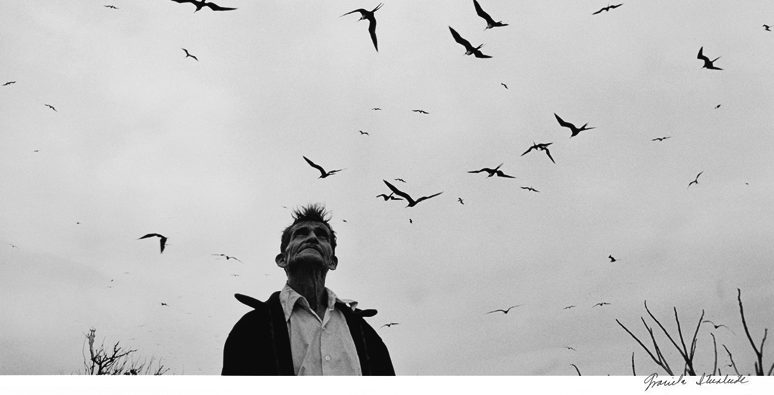
Graciela Iturbide: Photographs from Colecciones Fundasción Mapfre
by Cornelia Feye
Thirty-one years ago in 1995, I first saw Graciela Iturbide’s strikingly intense black and white photographs in the exhibition Espíritu at the California Center for the Arts Museum, Escondido. The work had a deep impact on me until today. When I heard that an Iturbide exhibition was coming to the Museum of Photographic Arts @ The San Diego Museum of Art (MOPA@SDMA) from the International Center of Photography in New York on its way to the San Francisco Museum of Modern Art (SFMOMA), I knew I had to see it and write about it.
“She is considered Latin America’s best-known living photographer, and her images portray a unique and moving perspective on her homeland of Mexico, the Indigenous peoples of Mexico, and her worldwide travels,” said Roxana Velásquez, Maruja Baldwin Executive Director and CEO of The San Diego Museum of Art.
Iturbide’s (b. 1942) vision is so enduring because she sees Mexico from the unique viewpoint of women and indigenous communities, people celebrating ceremonies and rituals, or dealing with death in a haunting, intimate manner. She began her career in the late 1960s while she was studying filmmaking in Mexico City working with legendary photographer Manuel Álvarez Bravo (1902–2002). Like Álvarez Bravo, she focused on capturing Mexico’s rich interweaving of cultures.
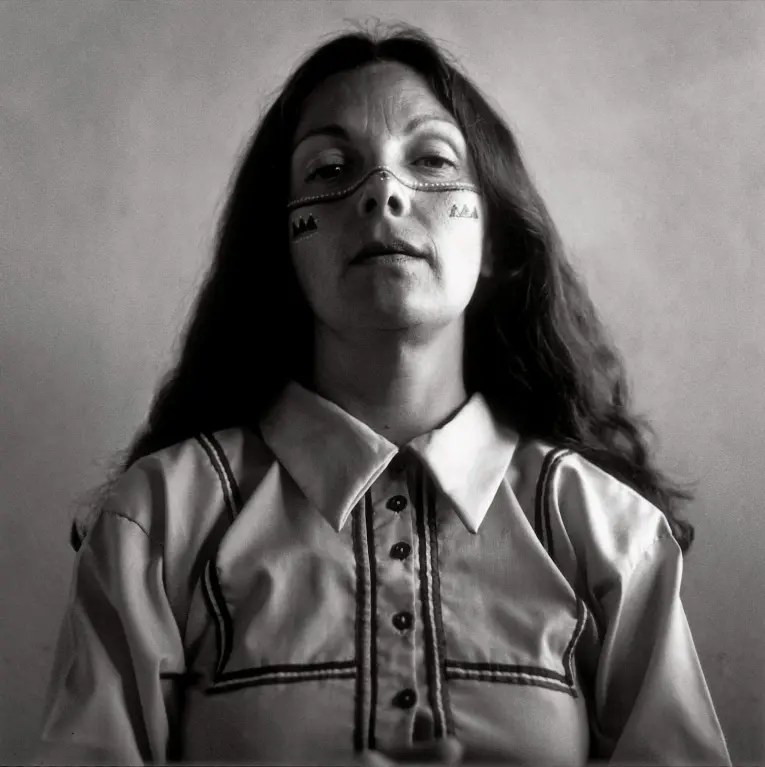
For a Self-Portrait with Seri, Iturbide worked with the anthropologist Luis Barjau and spent months immersing herself in the Seri community. Seri call themselves Comcáac and are a semi-nomadic hunter-gatherer culture, living in the Sonora desert and along the coast. Iturbide participated in the rhythm of their daily lives and even dressed up as Seri woman, at their invitation, as seen in this self-portrait. Commissioned by Mexico’s National Indigenous Institute, she earned the Seris’ trust, so she could photograph them in a nuanced way for the collection Seris: Those who Live in the Sand. By adopting the Seri’s tunic and face painting with its traditional ritualistic markings tied to protection and celebration, Iturbide demonstrates she wasn’t just a journalist, but a participant.
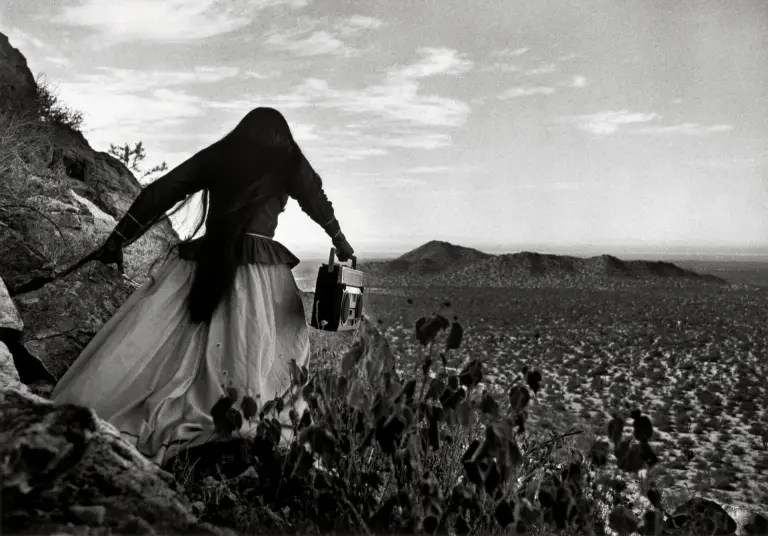
Angel Woman, may be one of the most iconic photographs in Mexican history. It straddles the intersection between ethnography, surrealism, and the border between two worlds.
A Seri woman is walking into the desert landscape carrying a heavy, 1970s-era boombox. To Iturbide she represents the Seri’s pragmatic relationship with modernity—they were nomads but traded their traditional crafts for modern goods that made life in the desert more bearable.
The woman’s flowing hair and traditional dress give her the appearance of taking flight or maybe fleeing from an unseen enemy.
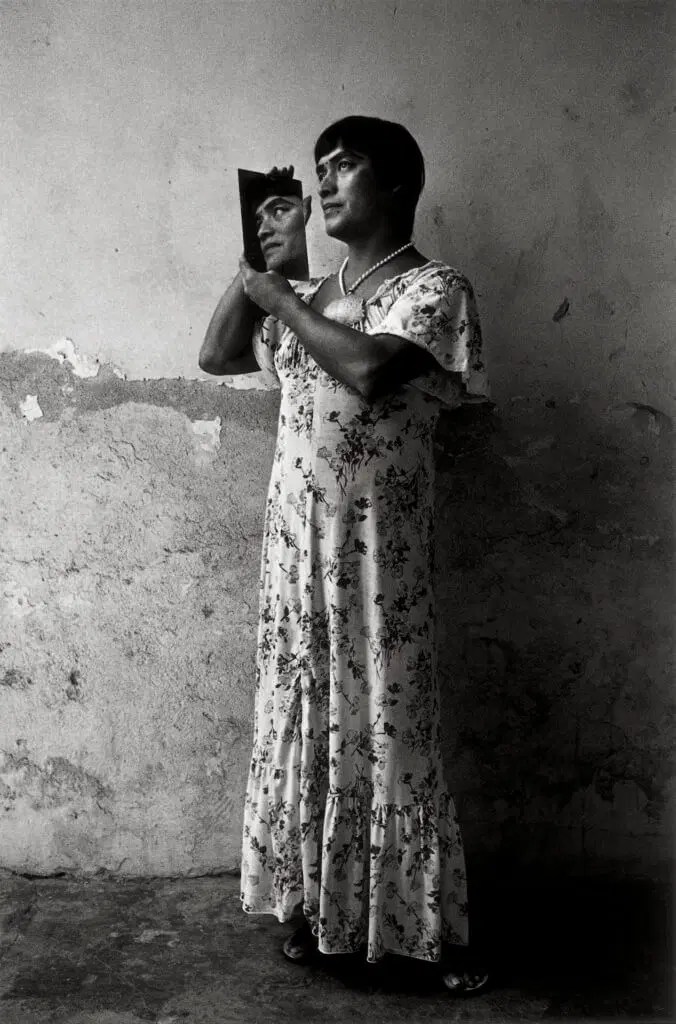
Also caught between two worlds are the muxés (people with fluid gender identity) of Juchitán. Iturbide was invited to this small Oaxacan town by the artist Francisco Toledo. Juchitán is a bastion of Zapotec tradition where women and muxés hold significant political, economic and spiritual power. Iturbide formed deep ties with the inhabitants to be able to portray their distinctive cultural customs truthfully.
Magnolia is another inhabitant of Juchitán. She is standing in front of a rough wall, wearing a floor length flowered dress, a pearl necklace and a flower brooch. Magnolia is looking into a small hand-held mirror, reflecting the right side of her face back at the viewer, revealing the gender ambiguities of her face. Her expression in this intimate moment is neutral and accepting.
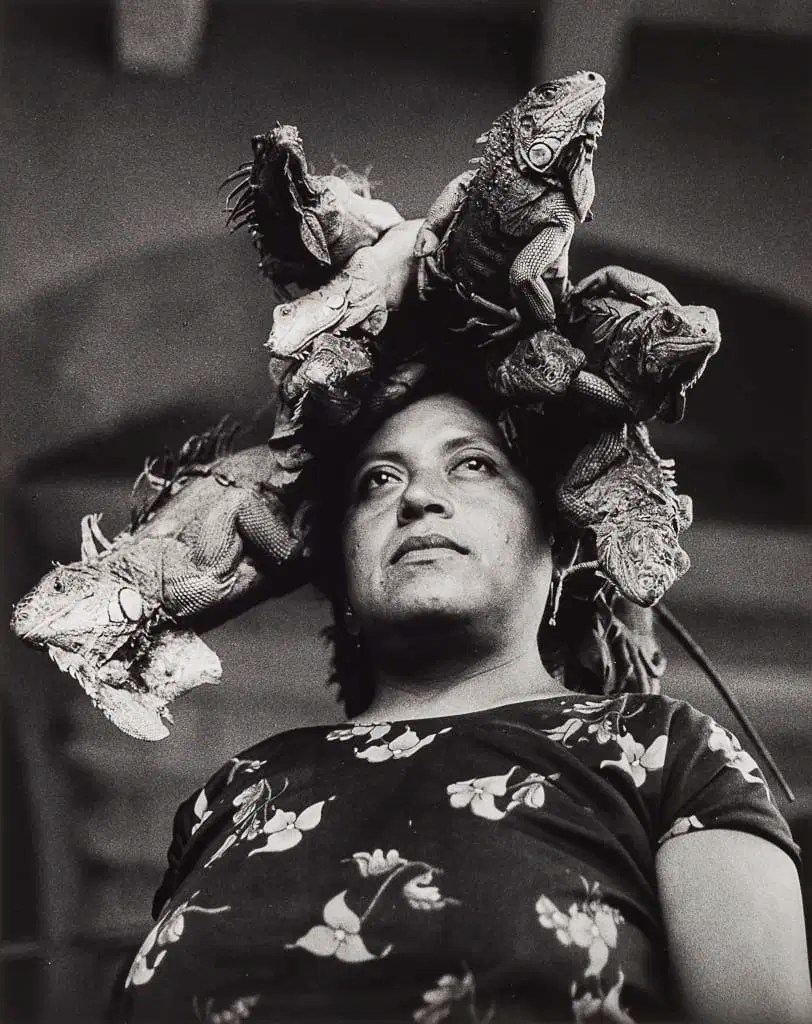
In Our Lady of the Iguanas, Iturbide caught the Juchitán woman Zobeida Díaz on her way to market wearing a crown of live iguanas who are believed to have healing properties. Captured from below, she appears like a scared figure, combining the Catholic connotation of her title with the magical Zapotec healing power of the iguanas.
In Juchitán, as with her Seri images, Iturbide deeply immersed herself in Mexico’s indigenous communities, often highlighting women’s experiences and bringing a more balanced and sensitive portrayal to marginalized groups. She said about her collaborative photographic practice, “I need to be close to the people … I need their complicity.”
She is not photographing from the outside in, but as an insider.
Iturbide has spent more than fifty years exploring indigenous communities in Mexico and other countries to capture their rituals of celebration and death. Her travels abroad to India, Italy, Meso-America and the United States resulted in images of botanical gardens, landscapes, objects, and self-portraits.
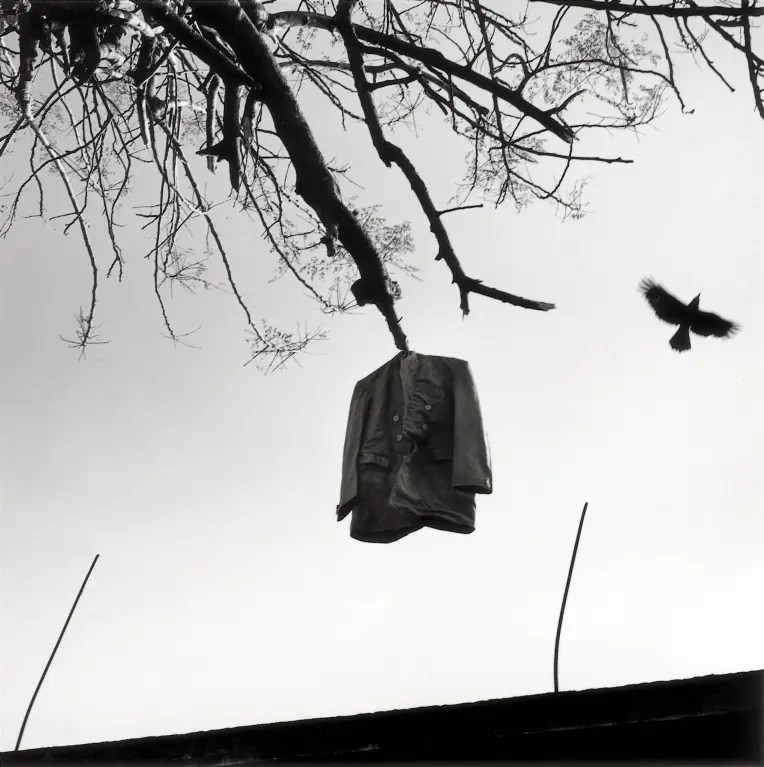
Her work possesses a surreal quality infused with dreams and mortality as seen in a photograph taken at a cemetery in Khajuraho, India. An empty shirt hangs on bare tree branches before a white sky with a circling black bird. The shirt comes to symbolize desolation, and the absence of its former owner. The bird turns into a messenger of death, or a carrier of the soul. Such is the power of Iturbide’s images that as a viewer, I could personally feel grief and a heavy heart in this scene, as if we were there, even though it was captured over twenty years ago in a place far away in India.
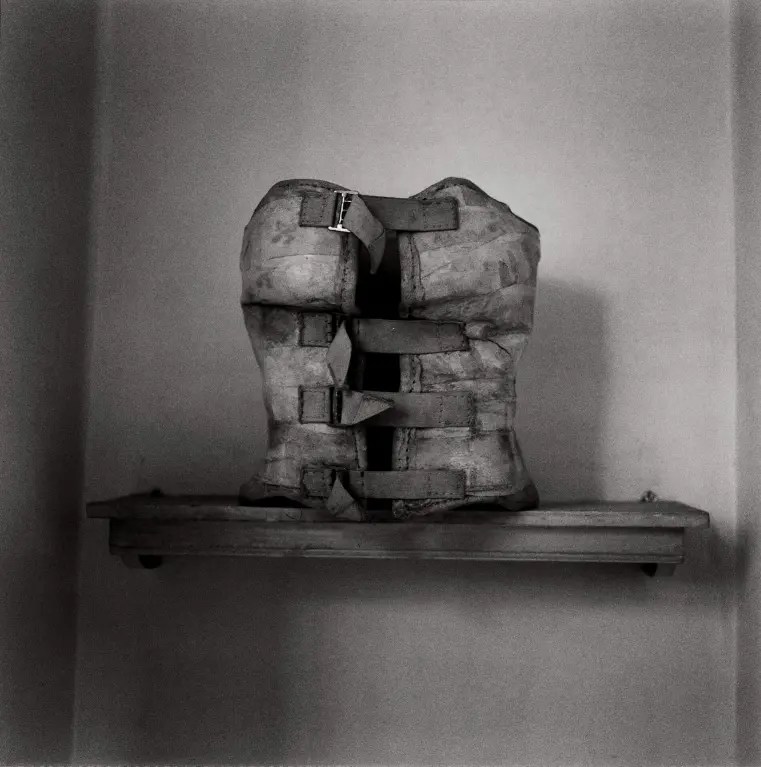
Iturbide often photographs the traces left behind by iconic figures, much like she does with marginalized living communities. A section of the exhibition displays Iturbide’s photographs of Frida Kahlo’s bathroom, which was sealed following Kahlo’s death, and only opened fifty years later. Iturbide provides intimate glimpses into Kahlo’s life. Frida Kahlo’s corset is a haunting, painful reminder of the suffering the beloved Mexican artist had to endure most of her life.
Iturbide’s ability to find the surreal quality in both a crowded market in Juchitán and a quiet, sealed bathroom in Frida Kahlo’s home is what makes her work so powerful.
When I stepped out of MoPA@SDMA onto El Prado after viewing the exhibition, I suddenly saw Balboa Park with different eyes, Iturbide’s eyes. The contrast between the bright stuccoed buildings and the dark green of the trees was starker. The shadows of bare tree branches and ironwork of lamps was sharper. The black and white patterns of the speckled sunlight filtered through the leaves of the Eucalyptus trees looked more intense.
Visitors have until June 7, 2026 to see over 100 photographs by Graciela Iturbide from the Mapfre Foundation, including several from MoPA’s collection. They will experience one of the rare exhibitions that can transform the way we look at the world.
February 14 – June 7, 2026
Museum of Photographic Arts @ The San Diego Museum of Art (MOPA@SDMA) 1649 El Prado, Casa de Balboa, Balboa Park, San Diego, CA, 92101
Members receive complimentary admission; Museum general admission tickets are required for nonmembers.
This article first appeared on Vanguard Culture.
CORNELIA FEYE arrived in New York City from Germany thirty years ago with two suitcases and a typewriter. Since then, she has tried to combine her background as an art historian – she holds a M.A. in Art History and Anthropology from the University of Tübingen, Germany – with her experiences travelling around the world for seven years, and her love for writing. After a career in museum education, she founded Konstellation Press in 2016, an indie publishing company for genre fiction, to give a voice to independent writers and create a supportive community for local authors. Feye’s first novel, Spring of Tears, an art mystery set in France, won the San Diego Book Award. During the pandemic she finished her fourth novel Death of a Zen Master, a mystery set in a remote Zen Monastery. Cornelia lives in Ocean Beach, where she finds inspiration in her garden and always looks for the green flash.
Categories: featured, featured photographer, photography


