

By Isaac Adas
Matte black, a drafty darkness so devoid of features that if you told me it stretched eternally I would believe you unquestioningly. That’s how I would describe the subway tunnels that haunted the corners of the Philadelphia Race-Vine subway station. I had found myself sitting on one of its grungy metallic benches scouring its many recursive details by mistake. My choice of classes meant that twice a week, every week, I would have to make a trek to a new corner of Philadelphia’s sprawling corpus for an on-location art class.
Today’s destination was the Cathedral Basilica of Saints Peter and Paul, a Catholic church built in the mid-1800s that has maintained its function to the modern day. I had made plans with my classmate, who for the sake of the story I will be calling Joe, to make the short trip there together, meeting at the Cecil B Moore station at 2:40. But in my rush to get there on time, I accidentally got on the wrong train. So I waited for him to get to the station, watching the void of the subway tunnel for any hint of the warm headlights of a subway car. There was a profound emptiness to the station, even as the tracks behind me roared with the occasional express train, or commuters waited for the northbound line to arrive, no amount of occupancy could ever make this place feel inhabited.
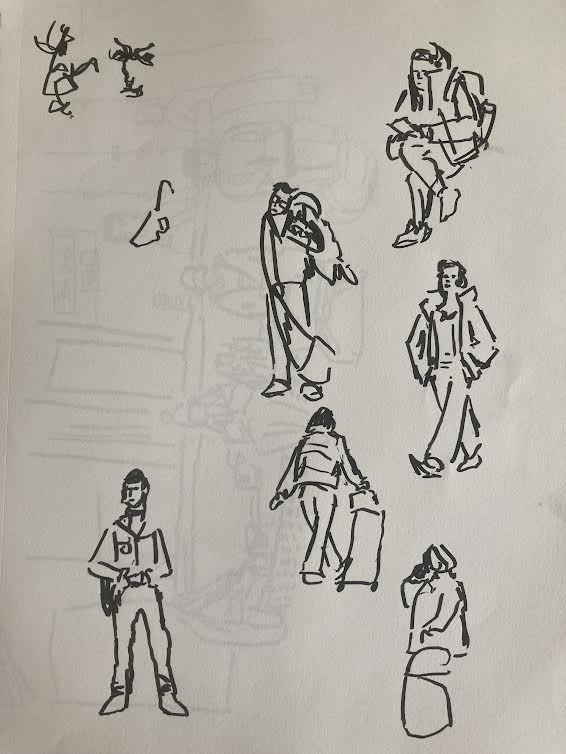

Eventually, I felt a soft rumble in the floor, and the darkened subway tunnel was clarified by an orange glow as the train rattled past me. I watched the windows scroll by, searching each one for my friend before the train slowed to a stop. The hiss of its doors opening sounded like an exasperated sigh, and behind the door directly in front of me was not the classmate I had planned to travel with but another person from my class, Sarah.
“Hey,” she walked up to me, “are you lost?” she asked, noting that I wasn’t moving towards any exit.
“Yeah, no, um … it’s kind of a long story. I’m waiting for … “ As I was struggling to explain my situation, I caught sight of Joe walking over from behind Sarah. “Ah, him,” I said, “I was waiting for him.”
We emerged from the urine-scented staircase of the subway station onto the brisk streets of Philadelphia. I spotted the corner 7-11 that marked the direction we needed to go, and we set out towards the cathedral. Wind poured through the street like a raging wave, ebbing for a moment before crashing back into us with a chilled embrace. I could feel it sculpting my hair above me, doubtless into a deranged wiry mess, but we pressed on regardless. The exterior of the cathedral was almost geographic, as if a Mesa plateau had shot up in the middle of Philadelphia, complete with its own brass canopy. I had admired it from the artificially widened lens of Google Maps while preparing for the trip, but in person, there was a beauty to the impossibility of fitting all of its warm earthy columns and ornate weathered teal domes into your frame of vision at once.
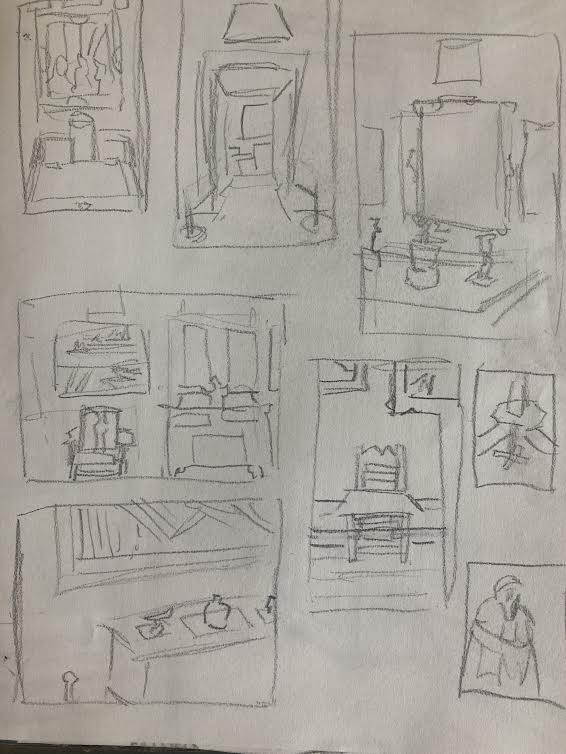
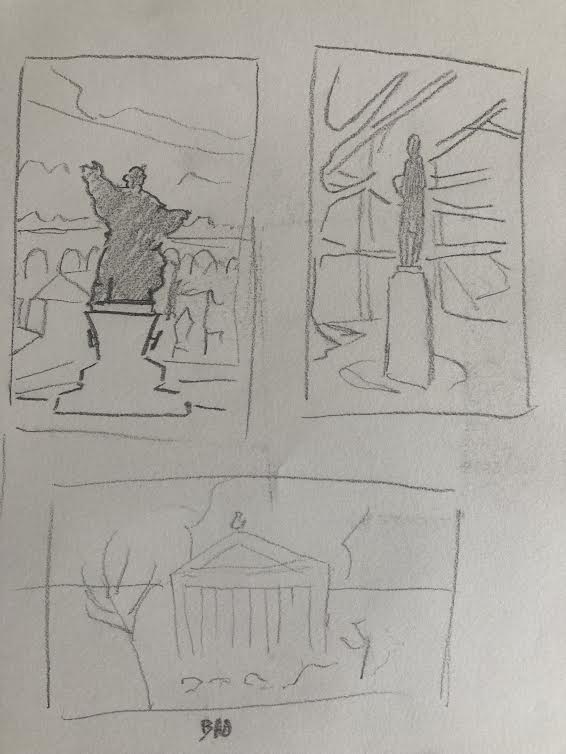
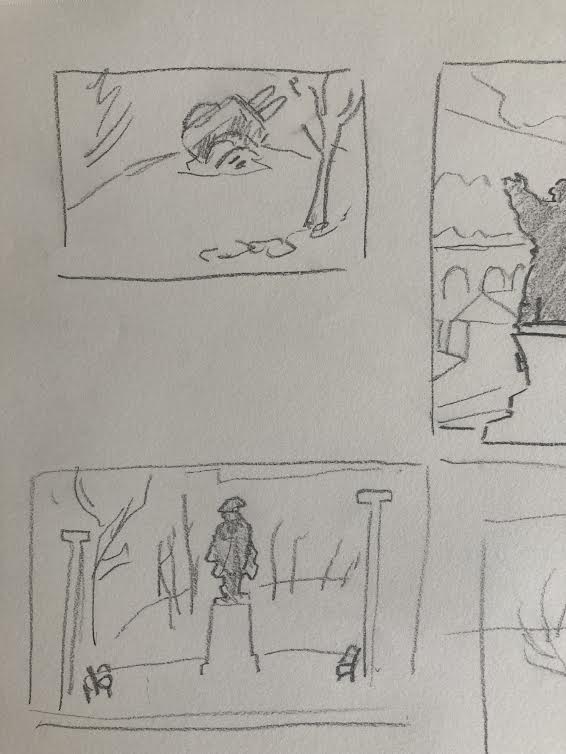
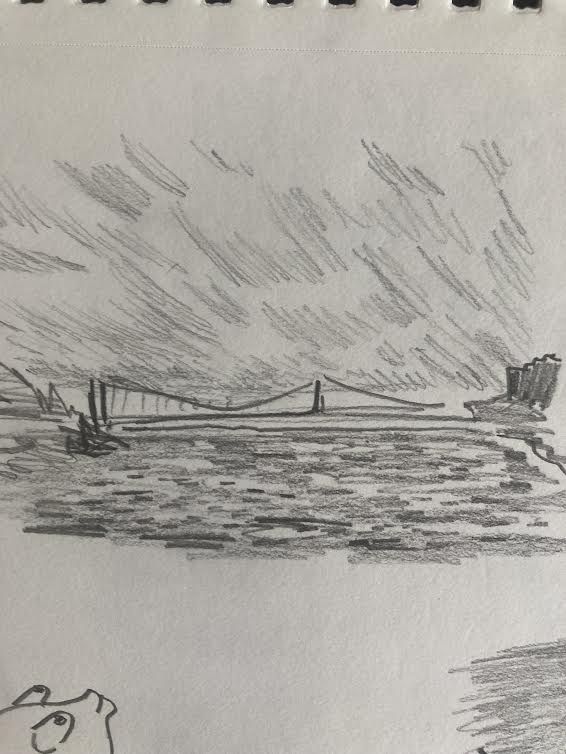
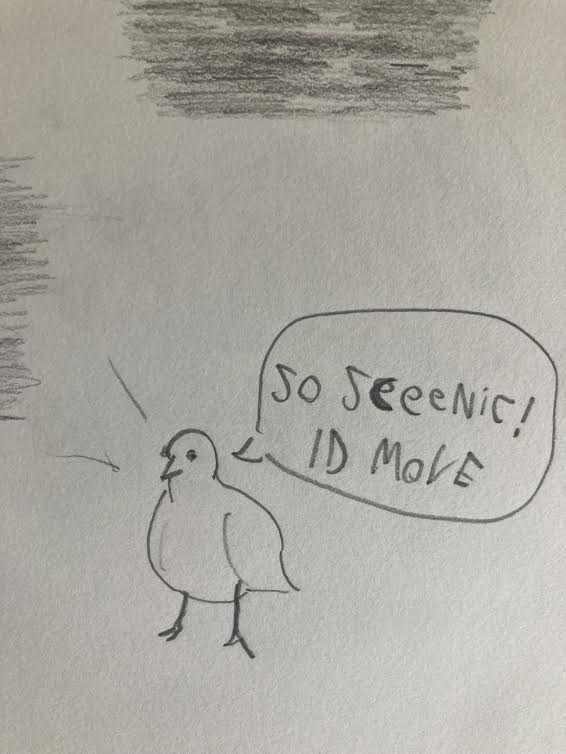
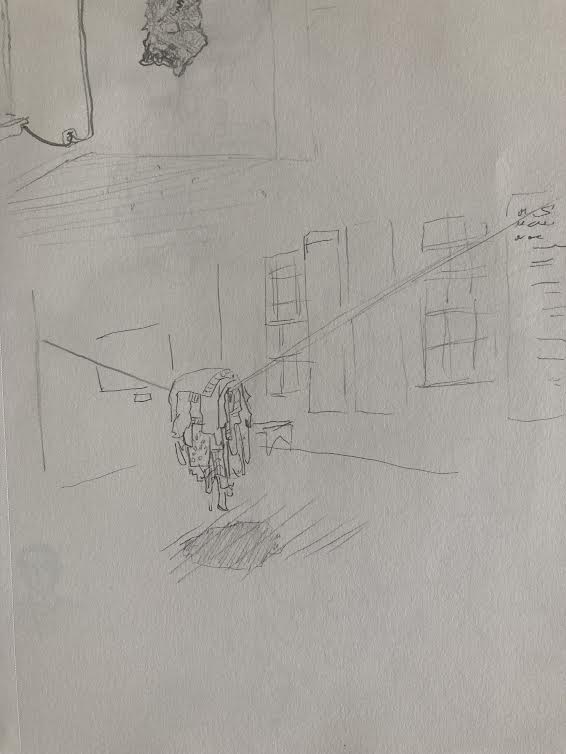
We met with the rest of the class in the front of the building. A group of my classmates had huddled into the space behind one of the columns of the facade to escape the tide of wind. I craned my neck up to try to take in all of the intricate details of its design but found that it was simply too large and ornate to do so. A plaque on the front detailed the construction and dedication of the church, revealing that it was almost 200 years old. In a small entrance hallway, our professor told us the day’s assignment. We were to cut out a hole in a piece of paper and use it as a viewfinder, replicating what we saw onto a page as if it were a window. I wondered what kind of view I would try to replicate, settling on the idea of focusing on something with large defined shapes.
This idea would be immediately dispelled upon entering the main body of the church. Large bone-white columns stretched halfway up the massive room, flanking the piers on either end before melting into a massive geometric web of masonry that coated the domed ceiling. Arches towering above me framed glowing murals of biblical figures, each molded facet of the ceiling painted in rich greens and reds and gilded. It was as if the entire interior of the building was one massive ornate picture frame designed to display the countless fully detailed paintings that covered every wall and ceiling. Large golden chandeliers hung through the air like floating halos.
My immediate, almost involuntary reaction was to say holy shit. I stopped myself, I had never once in my life practiced any religion but it felt wrong to violate the Catholic standards of regulating speech in a place of worship, especially this one. I walked through the piers with my head fixed above me, taking in the almost absurd level of grandeur. I began to wonder what I was meant to feel in this space. All art serves the purpose of communicating a feeling, and this building was certainly art, but what was it supposed to mean? Was I supposed to feel small, with the towering gilded shapes above me representing the might of god? Was I supposed to feel pride in the beauty of the building’s construction? Were the ivory pillars and intricate paintings supposed to make me feel closer to Christ?
I’m sure to a more experienced churchgoer all of these questions would have been answered by idle thoughts in the pews long ago, but I had no such history and I certainly didn’t find myself feeling closer to any kind of divinity. I felt intensely biological, like a ball of spit besmirching some Renaissance masterpiece, the undeniably intentional design of the church making me reflect on the thoughtlessness of my own. I could feel every organ in my body, the tubes and veins that connected them, and the cacophony of fluids that pulsed through them. My stomach hurt, my skin itched, my spine ached under the weight of shoulders it was never intended to bear.
Humans’ bipedal anatomy is built on the literal bones of our four-legged ancestors, and not perfectly; the universality of back pain as we age is a clear message from all of our vestigial structures and misappropriated vertebrae. If a god did ordain us to exist, our decision to stand tall with our head atop our shoulders must be one of defiance.
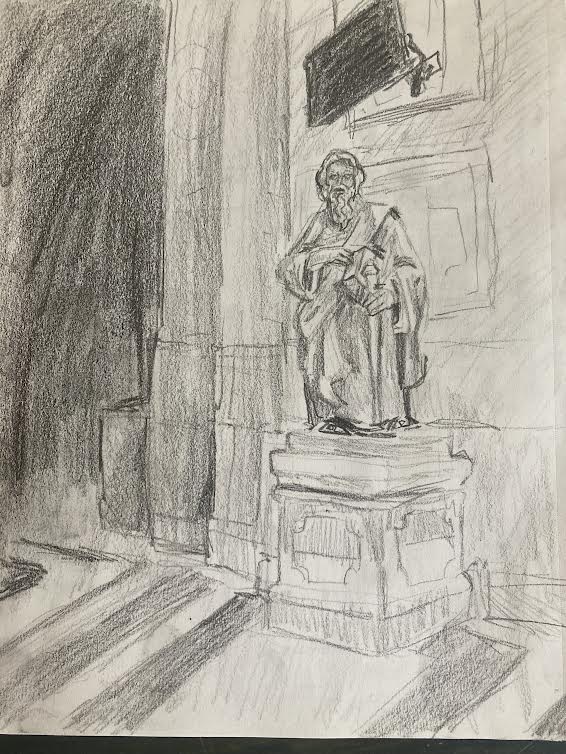
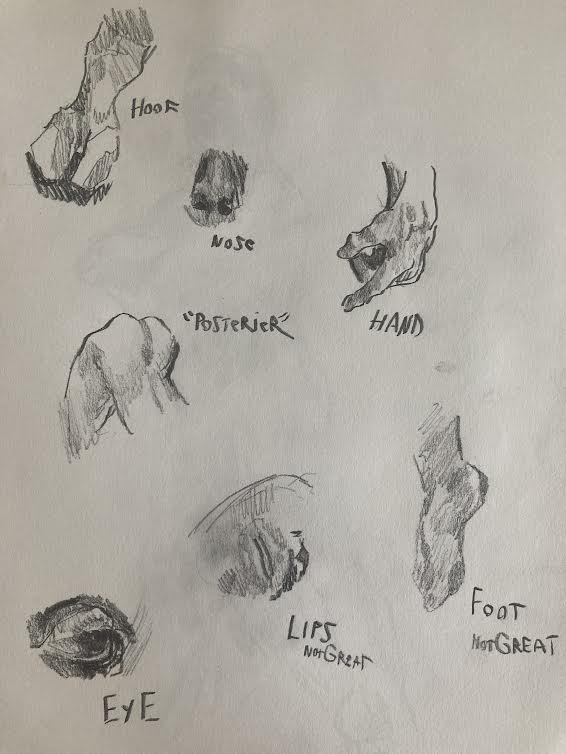
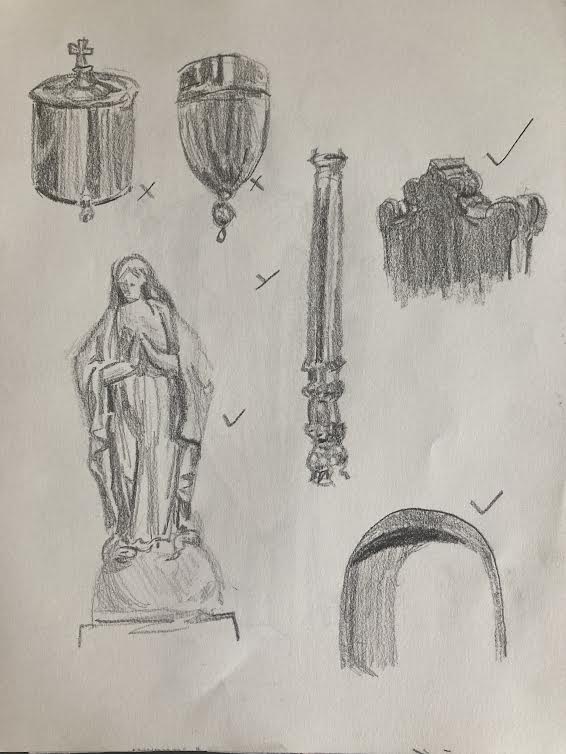
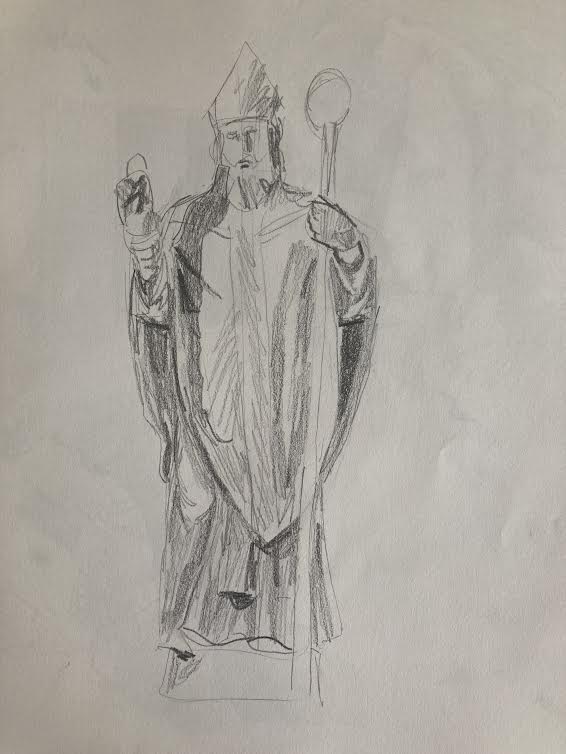
Clearly, on a physical level, I don’t understand churches. I did my sketches avoiding the most detailed parts of the building that were too difficult even to attempt to represent, settling on a view of a statue next to a pillar. The TV screen bolted above the statue provided a nice contrast I thought. I finished my sketch as the class came to an end and the church closed. I regrouped with my classmates and we found a subway back to campus. As I joked with my classmates though, I couldn’t get the way I felt in the church out of my mind. It may not have been the intended reaction but I felt something in those halls.

 magpiesmagazine.com