

By Mike Ladd
Tessellations of colour
Trees hang into sheer air
Mountain becomes mosaic
Utagawa Hiroshige’s woodblock print showing the Hakone pass on the old Tokaido road comes from his series The Fifty-Three Stations of the Tokaido, circa 1833. The series features the post towns and famous views on the imperial route between Tokyo (then known as Edo) and Kyoto. Although Hiroshige often relied on local gazettes and guidebooks to draw his various landscape series without personally visiting the places depicted, some sources say that he did in fact walk the whole Tokaido, a journey of about 500 kilometres one-way. Most of the Tokaido road now lies under highways and Shinkansen tracks, but at the Hakone pass it’s still possible to walk a preserved section of the old stone-paved road. Artist Cathy Brooks and I are on our way to Japan together, to walk into Hiroshige’s print.

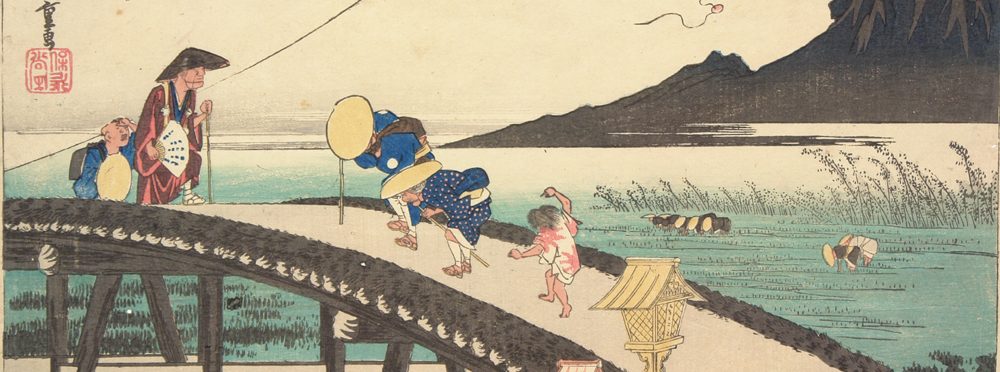
Hakone was, and is now, a tourist destination southwest of Tokyo. Hiroshige’s picture is like a composite postcard highlighting the attractions of the area: Lake Ashi, Mount Fuji, the Hakone Shrine and surrounding mountains, and this is exactly what these woodblock prints were intended to be, a cheap, mass-produced image showing the romance of travel to the Japanese public. In Hiroshige’s time, the price of a single print was about the same as a bowl of ramen.
Beyond the lake
A conical patch of white
Ghostly Fuji
Hakone is the eleventh print in the Tokaido road series. If you only took a cursory glance, you could be forgiven for thinking it was a landscape without people. On the lower right, a thin line of ant-like humans makes a diagonal downwards march between the mountains. The procession of porters, retainers and two daimyo, or lords, distinguishable by their blue coats and taller position mounted on horseback, is seen from above and defined by the round headwear of the figures descending the pass. They are barely more than a line of circles. The whole composition emphasises the insignificance of the humans as the mountain looms over them. The daimyo are pulled forward by gravity, you can see them leaning back in their saddles against it, heads down and straining.
A line of circular hats
Mountain travellers seen by a hawk
Scree of river-worn stones
Cath and I will be taking our time getting to Hakone, visiting other parts of Japan first, then working our way along the Tokaido road in the opposite direction to Hiroshige, from Kyoto back east to Tokyo.
After a four-a.m. start and ten hours in the air, we arrive in Osaka as the rain and wind lash the darkness, the edge of typhoon Hagibis swirling up from an overheated sea. We flew here from Australia, so we are part of the climate problem. I wonder if riding my pushbike to work every day compensates for this journey? A quick calculation. Each traveller on a round-trip flight from Australia to Japan produces about two and a half tonnes of CO2, provided the plane is full. I save about 220 grams of CO2 per day by cycling five kilometres to work and back. That means it would take me more than six years to ‘pay off’ the CO2 of my overseas trip…
From Osaka airport we take a night bus through the endless tangles of concrete, docks and cranes and lonely toll booths, red lights smeared through the streaming window, and still the rain intensifies, and the wind thrashes the few trees in this overbuilt landscape. Finally, we arrive in Nara. Standing on the dark, rainswept pavement we juggle a map under an umbrella blown inside-out. We walk right past our hotel two or three times, saying ‘that’s a nice-looking place’ not realising it’s where we’re staying as its sign is in Japanese characters we can’t read and the little cardboard notice in English has blown away. Slanting rain and figures crouched under wind-torn umbrellas – very Hiroshige, I’m thinking. At last, while sheltering below a railway overpass, a friendly local recognises our pronunciation of the hotel name and leads us back to the right door. We pull off our wet boots, are given a bowl of hot salty ramen, then take a steamy bath in the outside onsen, separated into male and female sections, with the rain falling through the slatted roof. By now it’s midnight.
Drops of autumn rain
Fall into the steaming pool
Naked with strangers
It’s possible to travel and feel like you have not even left. The same brands, the same processes, the same look. But now, with the taste of seaweed and smoky bonito flakes on my lips, bathing at midnight in the rain and the steam and the quiet murmurs of Japanese, I feel like I’m really somewhere else, well out of my depth, but loving it.

So, who was the man who signed his drawings as Hiroshige? He was born in the Yayosu firefighter’s barracks in what is now the Marunouchi district of Tokyo. His birth name was Ando Tokutaro and he came into the world in 1797 during the Tokugawa Shogunate, a time when Japan was locked in feudal class structures and still closed to the West except for limited trade with the Dutch. Hiroshige’s father was from the lower ranks of the Samurai class, and he held an official post as a fire warden. His mother was from the more prestigious Ando family and his father adopted the Ando name after their marriage. Hiroshige had three sisters. His oldest sister died when he was three years old, and both his parents died by the time he was twelve. Just before his death, Hiroshige’s father passed on his hereditary post to his son and so, not yet a teenager, Hiroshige found himself in charge of a group of burly tattooed men who fought fires in the mostly wooden city with only hand-pumped water wagons.
Like many Samurai at the time, Hiroshige supplemented his modest salary with another income source. He created illustrations for books and prints. Drawing, painting, and poetry were part of his education as a member of the Samurai class, and he had a natural flair for art. His official post was to prevent fires at Edo castle, which gave him plenty of free time to pursue his drawing. He studied with Toyohiro of the Utagawa school and as was traditional, took the art-name of Utagawa, with ‘Hiroshige’ being a combination of the characters in his own name and those of his teacher. At the age of fifteen he was permitted to begin signing his drawings. His job on the side became his true passion, though every so often he would have to battle a fire. The Ando family history records that in 1818 he was commended for fighting a blaze on a winter’s night.
Sparks fly to the moon
Snowflakes fall on dancing flames
Flowers of Edo
Under Toyohiro’s instruction, Hiroshige drew the traditional subjects of ukiyo-e (the temporal or ‘floating world’ of pleasures) including kabuki actors, geishas and women in beautiful attire, in effect, the pin-up posters of the time. Toyohiro also had a penchant for landscapes and you can see his influence when Hiroshige eventually went in the direction of meisho, the depiction of famous places. At the age of twenty-four, Hiroshige married the daughter of a fellow fireman whose family name was Okabe. They had a son Nakajiro and the family continued to live in the firefighters’ barracks at Yayosu, Hiroshige earning extra money drawing illustrations for novels, fans, and posters while still putting out the occasional fire.
Hiroshige came into his own as a landscape artist in the 1830s. At that time, although the Tokugawa Shogunate still closely monitored travel, more merchants and middle-class people were taking to the road to visit shrines, view blossoms, look at famous views, soak in hot springs, and take part in festivals. There was an internal tourist boom and a rising demand for landscape art to memorialise these journeys. From 1830 onwards, Katsushika Hokusai, then in his seventies, had great success with his landscape series Thirty Six Views of Mt Fuji, including the iconic Great Wave off Kanagawa. This motivated other woodblock print publishers and artists to get in on the action. Hiroshige’s first landscape success was his Famous Views of the Eastern Capital, published in 1831. The next year, his son Nakajiro took over Hiroshige’s position as fire warden, though Hiroshige continued to live in the barracks and to work as an auxiliary firefighter. This gave him more time to focus on his art and to travel. Hiroshige’s first biographer, Iijima states that the artist was part of an 1832 official pilgrimage on the Tokaido road, taking the symbolic gift of horses from the shogun Tokugawa Ienari in Edo to emperor Ayahito in Kyoto. Although the shoguns were the real power in Japan, they still needed to show religious respect to the emperor.
Crossing the estuary
Prize white horse on the beach
Artist stops to sketch
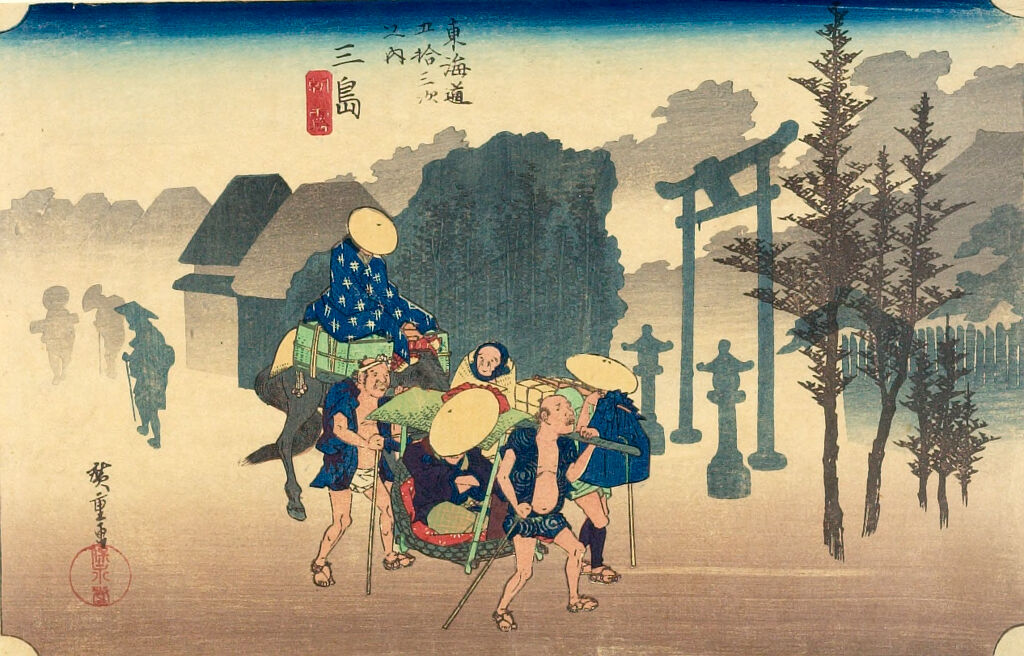
On his return from Kyoto, Hiroshige partnered with the Hoeido publishing company to produce his great series The Fifty-Three Stations of the Tokaido. It was a huge popular success, selling thousands of prints over the years, and Hiroshige revisited the idea again and again in many versions and editions, though to my mind, the original Hoeido edition is the best. There are actually fifty-five prints in the series. As well as showing the fifty-three stations of the Tokaido, Hiroshige depicts the official starting point at Nihonbashi Bridge in Edo, and the end of the journey, the Great Bridge of Sanjo in Kyoto. With the success of the Tokaido series, Hiroshige’s position as an artist went from precarious to assured.
Frottage of trees
Porters lift the morning weight
Ghost prints in mist
Walking around the cobbled streets of Nara, Cath and I try to get an early sense of Japan. Firstly, there is the delicious food. Mochi, a traditional sweet made from pounded glutenous rice, is warm, soft and springy at the same time, like a breast in the mouth. There’s black and purple rice cake grilled on the coals and served with smoky, aged, pickled cucumber. Another favourite is deep fried silken tofu in a ginger and seaweed broth. All of the dishes are presented immaculately. It seems to be a culture that pays great attention to detail, focusing on perfection of join and line and finish, as demonstrated by the beautiful obsessive packaging, with sweets and fruit gels, pastries and chestnut cakes wrapped as miniature art works.
Another feature of society we notice immediately is the automatic and structural courtesy. Thankyous, welcomes, acknowledgements, bows, patient help with ticket machines and directions. Next to the Japanese we feel rough and slapdash, in other words, barbarians. Cath and I speculate on what we are missing underneath all this politeness, aware we are just skimming the surface.
Japan also seems extremely neat. No rubbish on the streets or in the parks, yet everything comes double wrapped in plastic. I’m told the mountains of waste are burnt in special high-efficiency incinerators which capture the toxins.
Then there is the owl shop. We stumble across it in one of the main tourist streets of Nara. At first, I think the birds are taxidermies, but to my horror I see one blink, and another move its head. Cath looks closely through the shop window at the still white barn owls, and gasps when she realises they are breathing in and out. The poor creatures are all alive, chained to perches. People pay by the hour to pet these once wild birds.
From Nara we catch the train to Kyoto, the end point of the Tokaido road. Apart from the vibrancy of paddy fields (that special green of young rice) the landscape rushing by is a uniform whiteish grey, the apartment blocks and factories and shopping centres the same colour and shape as the tombstones. Suddenly there’s a flash of bright orange. A solitary persimmon tree beside the tracks, heavy with brilliant fruit.
From the train window
Autumn mist blurs the sun
A ripe persimmon
The first place we visit in Kyoto is the emperor’s palace, the supposed delivery point for the horses Hiroshige had accompanied all the way from Edo. We enter through the massive framing gates and crunch around on the gravel paths, looking at the dark cedar buildings, but their interiors are off limits. Next, we go to Nijo Castle, built for the first Tokugawa Shogun, Ieyasu. I’m particularly keen to record a special sound inside – the famed ‘Nightingale Floor’. This is a set of floors around the shogun’s quarters designed with clamps that move against the joist nails when anyone walks on the boards. They squeak and chirp like a flock of birds, apparently a way of preventing assassins from sneaking up at night in their stockinged feet. No cameras or recorders are allowed, so Cath keeps a watch while I quickly record the sound of tourists walking over the Nightingale Floor. They do indeed sound like a tree full of songbirds. I look at a portrait of Ieyasu in my guidebook. He sits on a tatami mat, enrobed in solemn black with red flashes, the soles of his feet pressed together underneath him. He holds a closed fan and his other hand rests on the sheath of his sword.
Sitting in state
Powerful in red and black
Imperious toad
Within the palace grounds are the Honmaru and Ninomaru gardens of maple, plum and cherry trees and manicured hedges and lawns. And I mean manicured literally. We watch a worker snipping each blade of grass with a pair of scissors:
Down on her knees
Beheading each blade of grass
in the Shogun’s lawn
Japan’s economy still seems to have lots of jobs like that, people who open doors all day, press buttons in lifts, cut grass by hand, wear white gloves and wave cars into parking spots. I wonder how it all works. Cost efficiency and time and motion studies appear to have been bypassed. It’s endearing in a way, but how boring is it to perform these tasks and do people get paid enough to make a decent living? Perhaps it’s also a matter of a different way of thinking, distinct from Western egotism? A way of being quietly dedicated to something humble and helpful?
Old people chatting
A supermarket called Life
Free green tea
The next evening, we visit the Sanjo bridge, the site of the last picture in The Fifty-Three Stations of the Tokaido. We walk along the concrete embankments of the Kamo River as the lights come on in the terrace restaurants above. The modern bridge is a concrete-pillared affair, not the long, curved, wooden arch of Hiroshige’s time. Instead of horse traffic, it carries two lanes of cars with pedestrian footpaths on each side. Despite these differences, the bridge preserves the look of the wood and copper railings and onion-shaped finials on the posts of the Tokugawa period. One of the posts still bears sword slashes from a battle between rival samurai groups that happened here towards the end of the Shogunate.
Just before the bridge, the river falls over a wide apron of stone and we see white egrets and Japanese grey herons watching for fish at twilight. Kyoto’s peak hour traffic crawls over the bridge above, and hordes of tourists on the footpaths file into the nightlife of Gion. We climb up to the roadway, and I see a Japanese woman driving a camper van over the bridge. The van is packed with chattels and in the back window is a very fat man wearing only a G-string. He’s stretched out on a couch illuminated by a red lamp and he’s drinking something from a gold cup. It all looks like some bizarre kind of male odalisque. What are they up to? More images from the floating world.

I’ve been thinking about what makes Hiroshige’s art so attractive. There’s something deeply appealing about the way he frames and crops an image, foregrounding objects and ‘shooting’ through them to the scene beyond. It’s almost as if he had a camera. Photography arrived in Japan towards the end of his life, but I don’t think Hiroshige was influenced by it. Yet his compositions often have the spontaneity of a snapshot. He also regularly takes an aerial view, as though he could see the world through the eyes of birds. Edward F. Strange in his 1925 book The Colour Prints of Hiroshige speculates that the artist’s position as a fire warden who could climb the watch towers of Edo may have influenced him in this regard.
Hiroshige had a fine hand for drawing birds, fish and flowers, but his populated landscapes are what brought him ongoing fame. These landscapes are not so much nature art as the art of human culture in idealised nature – not wilderness, but settled areas in which natural cycles still play a large role. In these settings his people are sketchy, almost cartoonish, yet they feel real and relatable. Pipe smokers lean together. You can imagine one of them has just asked the other, ‘Got a light?’ A figure points to something happening out of view. A woman inveigles a man toward her establishment. Hiroshige often seems to be inviting the viewer to invent a possible narrative for his characters.

Downstairs food
Upstairs sex
Akasaka inn
I also like the way he uses diagonals to create balanced dynamism: sight lines, the angles of sticks and poles, road gradients, rain slanting down in fine black streaks.
His pictures are full of stopped motion, dynamic figures caught in the act, freezing time. A bonito is tugged up the side of a boat and a fisherman’s hand reaches for it. A hat blows away in the wind, a fisherman’s net is caught mid-throw, and a kite escapes its tether and flies towards the mountains. Just as Hokusai’s great wave is freeze-framed about to break, so too Hiroshige’s falling blossoms on the Oi River are suspended in mid-air. Unhitched by a breeze, they arrest time, letting us feel the beauty and sadness of transience, but mostly the joy of being there in the first place to witness it.

On the slow river
Ferrymen guide a smoking raft
Fallen blossom drifts
Hiroshige can get bustle too. Markets, theatres, promenades and processions. Porters, tea sellers, fishermen, samurai, lords and prostitutes. Multiple head angles, connecting sight lines of conversations we can’t hear, but imagine. A silent hubbub. And life, always life, the un-pompous view. The way the western entrance to Tokyo is seen through the back legs of a horse, dung on the ground, or the foregrounded hairy legs and arms of a ferryman frame the view of a shrine to Benten the goddess of water, writing and music. If there is music in Hiroshige, it’s a popular tune hummed by a worker waiting at a crossroad. Although the artist was born into a class above the labourers, we get the sense that he is deflating the high and mighty with a gentle irony and an awareness of who really has the skills and does the work in this world – the servants, not the masters.
Coolie’s calculation
To be carried across high water
Fat men cost more
After the big success of his Tokaido road series, Hiroshige turned his attention to another of the five imperial roads of Japan, the Kisokaido, which also ran between Tokyo and Kyoto, but took a longer, more inland and mountainous route than the mainly coastal road of the Tokaido.
The publishing firm Hoeido co-commissioned Hiroshige and the older artist Keisai Eisen to produce The Sixty-Nine Stations of the Kisokaido. Stylistically, the two have much in common as landscape artists, though Eisen had been mainly known for his drawings of beautiful women in gorgeous clothing and as a maker of shunga, or erotic prints. Shunga means ‘spring pictures’ or ‘laughing pictures.’ They were sexually explicit and exaggerated genitalia to a degree that does seem laughable. These elephantine penises and vulvas were not some sort of pornographic boasting, but rather to highlight the sexual power of the body – almost a second personality in the drawing – the huge erection the double of the man, the swollen labia the doppelganger of the woman. The lovers in shunga are mostly clothed, only their genitals exposed. This is because nakedness was seen as normal in a bathhouse culture and not especially erotic. But pubic hair seen in a parting of a fabulously patterned kimono – now that was exciting!
Eisen and Hiroshige commenced the Kisokaido series about 1834. There is no evidence that they walked the road themselves, instead relying on gazettes and earlier prints. Someone who did travel part of the Kisokaido in 1688, and the Tokaido four years earlier, was one of my literary heroes – Basho. The peripatetic poet invented the form I’m writing in now, the haibun, or travel diary in prose combined with haiku. Basho used the roads of Japan as prompts for his writing, discovering poetry in the small, every day and random events of his footloose journeys.
‘Let’s head off now
Though we must eat green barley –
Grass for our pillows’
Basho, Journal of Bleached Bones in a Field, 1684.
Cath and I catch the train to Nakatsugawa, then a bus to Magome, to walk part of the Kisokaido. We stay in Magome Chaya, an eighteenth-century wooden inn with tatami mat floors, very similar to the inns seen in Hiroshige’s prints. The whole town of Magome is preserved as an old post station with its dark cedar houses, stone footpaths and water channels and the lovely relaxed acoustic that results when there are no cars.
The next morning, we start walking on the original Kisokaido between Magome and Tsumago. In The Sixty-Nine Stations series, Eisen draws Magome and Hiroshige draws Tsumago. In the Eisen print, the trees look like they are beginning to lose their leaves. A carrier with an empty palanquin is on the left, while his partner bends to tie up his sandal. On the road rising above, a man rides an ox past a small waterfall. No oxen around today, we head uphill out of town under a glorious late autumn sky, the maples splashing orange and crimson against the evergreens.
In his Sarashina Journal, Basho wrote of the Kisokaido, ‘it had so many twists and turns we felt as though we were wandering in the clouds.’ Deep, shaded valleys make it difficult to raise crops here and the main income in Hiroshige’s time was lumber from the prized cedar and birch trees that grow in these mountains. Because of the cool, shady, high-altitude conditions, the trees grow slowly, and their wood is especially hard and so was used for important buildings like shrines.
The original road we walk on is made of crazy-paved stones, all fitted together like a long garden path. We climb up to the Magome Mountain Pass, through cedar woods and bamboo groves and little hamlets of old houses. A neighbour on one side of a small stream helps a woman on the other side harvest her persimmons by knocking them off the tree with a long bamboo pole. She holds up her hands ready to catch the orange globes. With those diagonals in play, it would have made the perfect Hiroshige drawing.
We pass an abandoned house, the garden rankly overgrown. Very unusual for Japan, where every bush seems to have been shaped and primped.
Propped on wooden legs
Scarecrow in a ruined garden
Owner, a skeleton
After crossing the Magome pass, we start on the downhill run into Tsumago. Before long we come to the Tateba Tea House, smoky and dark and built in Hiroshige’s time. Out front is an old weeping cherry tree. Inside, a kettle hangs on a chain above an open fire in a sunken hearth. Shafts of sunlight radiate through the gently rising smoke. The proprietor Mr Akihiko Matsubara pours us a smoky green tea, served with a side dish of pickled onions. It’s a free service for hikers of the Kisokaido. Refreshed and bowing our thanks, we head back to the trail which soon begins to run beside a little stream.
Maples turning scarlet
A north wind in young bamboo
Feet cool in the stream
It’s quiet down in the cedar forest except for the sound of running water and very occasionally the clanging of other hikers ringing bear-scaring bells. I question how many bears are in these woods to hear them.
On this walk between Magome and Tsumago, there is always the sound of water, as if the whole landscape was an elaborate water clock. Water rushing in the river or over falls, in streams, rills, freshets, trickles, soaks. Water channelled in bamboo and plastic pipes, in stone ponds, in tipping bowls and wooden wheels. At night, in Magome, all other voices silenced, only the hubbub of water running in stone channels by the road is constant. It sounds like heavy rain that has been falling for a thousand years.
Come back little bird!
Eating the last autumn seeds
My noisy camera

As the day goes on, we pass ancient cedars, waterfalls, and a strange little shrine ‘for ambushed souls’, built to appease the spirits of a lord and his entourage who were attacked and slaughtered on this path in the sixteenth century. We come to the Tsumago bridge over the Araragi river. Here, just south of Tsumago township, is the site of the Hiroshige drawing in which he shows a decrepit old man heading one way, passing a pilgrim carrying a portable shrine on his back, going the other way. Up above, a woodcutter with full baskets heads off to the east on a side road. Cath and I continue to Tsumago and catch a bus home to Magome Chaya for dinner and sake.
Next day, we head further north, on the Japan Railways Chuo line, going through the Kiso River gorge to Narai. The rail line follows the Kisokaido which today is occupied by factories, co-ops, baseball fields, and hydro plants. The train snakes up the side of the valley with its autumn yellows, ambers and tangerines daubed amongst the pines. The Kiso River below runs fast on a bed of great white boulders, the water the colour of light green jade.
Kiso pilgrim
Writes ‘I was here’ in a shrine–
Rain washes out the world

A traditional Japanese woodblock print is a three-person collaboration, four, if you count the publisher. Firstly, the artist draws a picture, usually commissioned in advance by the publishing house. If the publisher approves it, the master drawing is then sent to the woodcarver. The carver pastes the drawing upside down to a tile of mountain cherry wood. Using a special sharkskin tool, the paper is sanded away to make the lines appear from underneath. Then, following the lines, the carver carefully slices away all the wooden spaces that are not to be printed, making a negative of sorts. This produces the key block that will give all the black and white outlines of the picture and in the process the master drawing is destroyed. It’s why we don’t have many of Hiroshige’s original drawings, only a few that for some reason were never carved.
Once a proof from the master block is approved by the artist, the carver makes the separation blocks for all the different colour areas in a print. There can be up to a dozen blocks for a deluxe print. Next, all the woodblocks are sent to the printer who is responsible for aligning them correctly to the thick, handmade, mulberry-bark paper, selecting the colours in consultation with the artist and publisher, inking the blocks, and achieving the shading effects known as bokashi. If the artist is not available, the printer or publisher chooses the colour themselves. For this reason, there are many variations in editions of the same image. My contemporary print of Hiroshige’s Hakone pass is a luminous green and the bokashi makes the sky glow with an unearthly intensity. Mount Fuji is so white that in the light pink gloaming it could easily go unnoticed. Other prints of the Hakone Pass I have seen are much bluer or browner or darker, all depending on the printer’s choice. Thousands of prints were run from the same woodblocks and once the blocks began to crack and their useful life for printing was over, they were tossed in the stove to warm the studio. This is why it is rare to find original woodblocks from Hiroshige’s time.
Outside, snow on bare trees –
In the printer’s stove
Landscapes turn to ash
So, while Hiroshige’s prints were loved and appreciated in his lifetime, he was not put on a pedestal as an artist or revered in the way we tend to now. In the 19th century he was considered to be an artisan working in a team. The other team members, the wood carvers and printers, were craftsmen whose names have often been totally forgotten. The publisher however is remembered because his seal is there on the print, usually in a red character block.
It’s time to head back south to the Tokaido road and finally get ourselves to Hakone. We make our way to Nagoya then jump on board the sleek, white, sunken-eyed serpent known as the Shinkansen Kodama. We are excited by its high, smooth, electrified squeal as it does 300 kilometres per hour on what used to be the old Tokaido Road. Factories, signs, power lines, greenhouses, rice paddies, wind farms, cooling towers, derricks, cranes, flash by. The sound of the rushing wind goes up an octave when we pass another bullet train firing into the opposite horizon. Toyohashi, Hamamatsu, Tenryu River, Kakegawa, Oi River, Suruga Bay, Abe River, Shizuoka, Shin Fuji, Mishima, Atami, Sagami Bay – names and places, many familiar from The Tokaido Road series, pass in a blur of speed.
Shinkansen windscreen
Above the driver’s peaked cap
Grasshopper remains

We fly through a conglomerated urban landscape coloured grey, cream and white. Glimpsing paper kites from a festival somewhere, I think of Hiroshige’s drawing of station twenty-six at Kakegawa. Amongst the industrial zones and petrochemical plants there is remnant rural activity, rice planting, and tea cultivation, the plots neatly arranged into parquetry strips. There are the low gravelly rivers, and ever-present, the sea.
Under her shield of long black hair, a young woman on the seat next to us does the marketing figures for Kirin Beer company. She has false nails with bubbles and pearls set into them, making her hands emerging from her corporate business suit look like the lilac claws of some exotic crab. Phone held up to her face, checking the spreadsheets, she doesn’t glance outside once on the whole journey.
Cath and I get off at Odawara, the ninth station on the Tokaido. Here, with the Hakone mountains rising in the background, Hiroshige drew a group of half-naked porters wading in the Sakawa River, carrying various passengers across – an upper-class traveller in an enclosed palanquin, a lower status one on a plank, and the lowest of all, by individual piggyback. It seems to me the woman on the train was enclosed in a virtual palanquin.
Scenic train ride
Beside the autumn bays – she
only sees her phone
From Odawara we catch the bus to Hakone, and the first time I see the location of Hiroshige’s drawing is when the Hakone pass looms into view over the bus driver’s head, right next to a strange sign showing a smiling fish with the words ‘Emergency Route. Road Closed In Case Of Major Earthquake.’ Why a fish? Why smiling? I later find out the fish is Namazu, the mythological giant catfish who lives under Japan and causes earthquakes by thrashing around. And the smile? Well, that’s Japan for you. If you need an earthquake logo, it should be cute.
We’re staying up in the hills at Miyanoshita and by the time we check into the hotel it’s dark. After dinner we go for a walk by the river, which we hear more than see, a rushing sound in the dark caverns below. We come to a part of the hillside that has collapsed after the torrential rain of typhoon Hagibis. It’s a mysterious patch of earth from which sulphurous steam emerges in little vents. Caught in the light from the lanterns by the path, the whisps of steam add to a certain ‘noir’ feel of the town.
Appropriately enough, our walk the next day to explore the Hakone area begins up a lane by the Miyanoshita fire station. Just as we go past, the station sounds its siren, as though the ghost of fire warden Hiroshige was greeting us. We leave the town and climb up into the forest. The path has been washed away in places or is a spongy green carpet of fallen cypress needles knocked down the week before by Hagibis. It feels like no one has passed this way in a while.
The one in front
Wipes spider web from his face
Sorry for the destruction
Going past the Kumano shrine, whose Shinto deity guards the local hot springs, we head over mount Sengen, then down past Chisuji waterfall, named for its thousand threads. At Horai-en we catch the bus to the township of moto-Hakone on the shore of Lake Ashi, its waters ruffled today in an autumn breeze with some bite. Hiroshige’s mountains are mottled green and brown in a lozenge pattern, just like in his print. Hakone shrine with its bright scarlet torii gate standing in the water is on the right bank. While you can see the shrine in Hiroshige’s print, there is no torii gate in the lake, because the gate was only constructed in 1951 as a peace memorial.
The ubiquitous easy jazz of Japan is playing in the cafes by the waterfront. One hopeful kid is fishing on the dock where the tourist boats come in and out, including a kitsch pirate ship. The boarding pontoons groan in the chop of the lake. An ancient Shinto stone lantern is juxtaposed with a plastic sculpture of an ice cream. Local and foreign tourists drift past, wondering how to see Fuji like it is in the brochure. But Fuji is hiding today behind high cloud, just like it was when Basho came through the Hakone checkpoint in the autumn of 1684. In his haibun journal titled Bones Bleaching in the Fields, he wrote:
‘On the day I passed through the barrier, rain was falling, and the mountains were obscured by clouds.
Misty rain showers.
A day not seeing Fuji
Has its own appeal.’
The Hakone checkpoint on the old Tokaido Road is preserved as a museum. The purpose of a sekisho (a checkpoint or barrier station) was to control the movement of people and search travellers for weapons or contraband, protecting the Tokugawa military regime from rebellions. Daimyo, or lords were required to visit Edo periodically and stay there to demonstrate their loyalty to the shogun. When the lords went back to their home territories, they had to leave their wives and children behind in Edo as hostages. The sekisho at Hakone shows what it would have been like inside in the 1800s. Dark and smoky (the fire in the open clay-floored central hearth kept burning.) Cold in the outer rooms, and horsey (the stable close by.) Woody (the hand-adzed beams.) Low. Don’t forget to duck. Here travellers like those shown going down the mountain in Hiroshige’s print would have to present their paperwork to officials of the Shogunate and have their baggage searched by guards.
Grey mannequins
In the checkpoint museum
Look like Border Force
From the barrier station we head back north, walking through an avenue of mighty four-hundred-year-old cedar trees towards Mt Futago and an original stone-paved section of the Tokaido. As we start the climb into the Hakone pass, we are literally walking on the same stones that Basho and Hiroshige did. The stones are mossy and there are some wash-aways making the path slippery and rough to walk on. I’m amazed that we have such a famous road to ourselves, not a single other tourist in sight.
One obvious difference from Hiroshige’s time is that there are now microwave towers on the summit of Mount Futago, but down on the path through the forest it feels as if you could be walking during the Tokugawa Shogunate. Some of the forest is not actually wild but was planted long ago. The embankments at the side of the cobblestone path were stabilised with pine and cedar trees when the Tokaido road was first built.
After going uphill through dense forest, we take a small detour to the left to Otama-ga-ike pond. There’s a story behind this place. At first the pond is a little hard to find, obscured by a field of flowering pampas grass growing in front of it, but eventually we break through to discover a still, green pool reflecting the reeds at its edge.
Otama was a poor young girl from a fishing village south of Hakone. Her family could not afford to feed her and in the winter of 1702, she was sent to a cousin in Edo to work. Here she was treated like a slave, and, desperate to escape, she tried to walk back home. But in those days women and girls were not allowed to travel through the Hakone barrier without a permit. Otama attempted to walk around the back of the checkpoint through the mountains but was caught near this pond. The penalty was death, and she was locked up for two months before being beheaded and her head put on public display. Some stories say that she haunts the pond, and locals renamed it Otama-ga-ike or ‘Otama’s pond’ to appease her spirit.
This site features in a 1960 Japanese horror film called The Ghost Cat of Otama Pond, which tells the story of a young couple lost in the forest who find themselves mysteriously trapped at the pond by a supernatural female being, half human, half cat. Otama-ga-ike does have a strange, melancholy feel. That odd sense we get when we know something bad happened where we are standing, as if the energy of it could be physically held in the surrounds. It’s very quiet today, just the electricity lines on the ridge above, emitting a low buzzing.
Power pylons
Beside the silent pond
The desperate girl
Returning to the Tokaido road, we walk downhill through a gloomy section of pines. Beside the path is a small memorial stone incised with characters and green with moss. I find out later the characters mean ‘White Water Slope’ and the stone marks the site of some battle of long ago. Is there anywhere on this earth that hasn’t seen human mayhem?
We next arrive at Amazake Chaya, a tea house standing by itself in a clearing. The building with its a pyramid-shaped thatched roof dates from the seventeenth century and the tea shop has been run by the same family for thirteen generations. We are the only customers this late in the day. Amazake is a cloudy, fermented rice drink, served hot. It reminds us of congee, but sweet, not salty. Designed to revive tired, cold travellers through the Hakone pass, it seems to work. While I sip the Amazake I’m thinking about the things shown for sale along the Tokaido road in Hiroshige’s pictures: soft and chewy mochi, soba (buckwheat noodles), tea, yam soup, souvenir prints, fabric, ornamental hair combs and sex – signified by the powdered white faces of prostitutes. The white lead face paint was poisonous and caused the premature death of many women working in the travellers’ inns along the road.

Full moon faces
Beside the stony road –
Night coming fast
After our tea break, we walk on towards Hatajuku. As the shadows are closing in, we encounter the only other traveller on the Tokaido we meet that day, a Japanese guy scurrying in the other direction towards the lake. He is hurrying uphill before the light goes. Then it’s all quiet again apart from our footsteps. Somewhere in the forest I hear a high-pitched squeal, perhaps a deer calling. At Hatajuku we catch the bus back to Miyanoshita ready for a soak in the hot, volcanic waters of the local onsen.
After the Tokaido Road and Kisokaido series, Hiroshige threw himself into ever more work as an artist, drawing multiple series of famous views of Osaka, Kyoto, Sixty Provinces and other series with such titles as Jewel Rivers, Harbours of Japan, Twenty-Eight Views of the Moon, Four Seasons in Famous Places, Seven Hot Springs of Hakone, as well as making comic drawings, and illustrating a History of Japan and The Fifty-Four Chapters of the Tale of Genji. He was extremely prolific, and some sources estimate he made approximately 8,000 drawings for prints in his sixty-two years on this earth. Around 1839 Hiroshige’s first wife died and his son Nakajiro died in 1845. In 1847 Hiroshige married again, to Oyasu, a farmer’s daughter and the next year he moved out of the fire fighters’ barracks to Kano Shinmichi, another part of Edo, not far away. He also adopted a daughter, Tatsu. Hiroshige was not a famous teacher, but he did have at least two pupils, Hiroshige the second, and Hiroshige the third. Tatsu married the second, then divorced him, and married the third. In 1856, Hiroshige became a Buddhist monk, shaving his head and simplifying his life.
Hiroshige himself wrote travel diaries on earlier journeys he made to Kofu and Koshu. He talks about the weather, the good, bad and indifferent food in the various inns, and sometimes the landscape: ‘the mountains of Kai were running far and near, some very lofty with deep valleys, the stream of Katsuragawa was pure and clean. The view changed every ten or twenty steps. The charm of the views inexpressible, beyond the brush’s attempts.’ We get the impression of a humble but artistic man who liked intelligent company, but not too much of it. He enjoyed good cuisine and a cup of sake or two. He also wrote the occasional comic poem, including this one about his own shaved head:
How delightful it is to live roundly
With a head more round
Than a dumpling
The day after our big walk, we stay in Miyanoshita to look around the town. We go into a modest shop called Yamatoya Antiques. Its proprietor is Mariko Takase, an expert on ukiyo-e. She has whole sets of original Hiroshige prints from The Fifty-Three Stations of the Tokaido and the One Hundred Famous Views of Edo series. She lets us hold them and look closely at them. The mulberry paper is in excellent condition and the colours fresh with lovely bokashi shading. The price of a fine quality original Hiroshige is a lot more than a bowl of ramen these days. More like several hundred bowls of ramen. A bit out of my range. Mariko also has some original wood blocks. These are quite rare. She shows us a key block and two of its colour separations for yellow and green. I love the smooth feel of the old dark cherry wood, rippled with carved sections, the lines softened by all those prints.
Further along, past a hairdresser and a pie shop is another antique dealer, ‘S.M. Shiba. Inspection Welcome.’ Looking around in the back of the shop I find a black and white drawing bearing Hiroshige’s signature whose characters by now I recognise. It’s a proof pulled from a key block. In the drawing, it’s early spring. The trees are still bare but there’s a suggestion of buds on the twigs which are wonderfully drawn as a free tangle of vee shapes. Under them a person sitting side-saddle on a horse is smoking a pipe and looking straight at us. The only one in the picture to do so. The horse is looking down at the ground, absorbed in its own horsey business. A woman tea seller holding a tray on her head with cups and a kettle, looks to the right. With her free hand she holds the hand of a child whose own free hand is pointing straight up. What is the child pointing at? Is that a tiny bird shape on a lower branch? Perhaps something in the sky unseen beyond the edge of the painting? Perhaps the first blossoms on the trees? A little mystery. Something must be imagined here, which is part of Hiroshige’s poetic genius.
As usual, all the sight lines in the picture are crossing or unconcerned with each other. Different people with different agendas. Also characteristic of Hiroshige is that the drawing feels like a moment in time, just before something else is about to happen. You imagine the child is about to get the attention of the mother, she will either look up herself and pause, or drag the child on to her own purposes. After all, she has tea to sell. Will she spare herself a moment to register that it’s spring, and enjoy the beauty of the blossoms? Or will she hurry on with business? A still point in a dynamic moving scene. The horseman, tea seller and child are on a rough country track from one hamlet to the next. The horseman is going one way, the woman and child the other. Pines in the distance are silhouetted against the slope and below them two farmworkers till a field, oblivious to the fates of the travellers. I love this drawing. It’s classic Hiroshige.

Later, in Tokyo, I show a photo of the print to a ukiyo-e dealer. He confirms it is by Hiroshige. Its title is Blossoming Plum Trees at Sugita. It was drawn around 1834 or 35 and comes from a series called Intermediate Stations on the Tokaido and Views along the Narita Highway. For unknown reasons this series was never printed in Hiroshige’s lifetime. It wasn’t until 1919 that the S. Sakai publishing house learned of a cache of Hiroshige drawings belonging to a collector by the name of Takahata Kazuwo who lived in Yokohama. The publishing house then made the only edition of the series ever released, cutting the woodblocks more than sixty years after Hiroshige’s death.
This little print I found is very rare, but because it’s only a key block proof it’s not particularly valuable. When I see the full colour Sakai print, the white plum blossom is much more noticeable, and I think this is what the child is pointing to. Interestingly, in the back of the picture a blue mountain has appeared which is not in the black and white drawing. This makes me think my print is an early proof of a composition that was deemed to need something else, and the mountain was added later.
Now it’s time to leave the Hakone mountains and go back east to Tokyo, to finish at the beginning of the Tokaido road. There are a few more Hiroshige destinations I want to investigate before we depart from Japan: Nihonbashi bridge, Ueno, and not least, I want to find the Marunouchi fire station where he was born.
Basho and Hiroshige
In simple robes and sandals
Get on the Shinkansen
The Tokaido Shinkansen speeds into Tokyo – flashes of impressions, the Sagami River, Toshiba sign, golf practice range netted up high, Yokohama port, darkness of underpasses, giant NEC plant, Tama river, gathering conglomerations of the corporate city, Sony, Yamaha… too fast to sketch. What would Hiroshige have drawn if he was sitting here now, on this train? Possibly the two old men sitting across the aisle, laughing and eating crackers, and down the carriage, on the other side, a young woman handing her ticket to an inspector. Of course, some famous view out the window, not the focus, but there for the noticing, the red and white of the Tokyo Radio tower perhaps. Oh yes, and a bird way up high, going the opposite way to the train.
The next day, at Nihonbashi bridge in central Tokyo, the pigeons go wheeling. Where there are bridges, there are always pigeons. It’s a cool, calm, autumn day. For a megacity, Tokyo is surprisingly quiet without much traffic in the central streets. Nihonbashi bridge today is nothing like the wooden hump-backed structure shown in Hiroshige’s first print of the Tokaido series. The stone bridge we’re walking across now was built in 1911. The bronze dragons on its lampposts watch over smiling tourists boarding river cruises or taking selfies. On a plinth is the zero marker of the old Tokaido Road, the official starting point. These days the Nihonbashi bridge is dwarfed underneath a huge expressway raised up on pylons over the river. The river itself is artificial, an outer moat of Tokyo castle, made by re-channelling the Hira River in the fifteenth century.

Hiroshige’s drawing shows the bridge front on, framed by the posts of barrier gates. A group of pedlars are foregrounded on the left, some carrying fish from the market nearby. On the right, two dogs, one black and one white, sniff each other’s behinds. In the middle, coming towards us over the bridge, is the procession of a lord, perhaps starting out on the long journey to Kyoto. In front are two retainers carrying luggage boxes. Behind them are two spear carriers, and behind them another retainer holds aloft the lord’s battle standard. Then more ranks of retainers, only discernible by their hats. The lord, who is the motivation for the whole parade, is somewhere at the back, totally invisible. Again, I can only smile and agree with Hiroshige’s artistic priorities. And those bum-sniffing dogs, deflating any pomposity. Perfect!

Next, we catch a sequence of metros to Ueno to see the Moon Pine, featured in Hiroshige’s One Hundred Famous Views of Edo. He created this group of pictures in the last years of his life, and it is widely seen as one of his best series, his artistic powers still flourishing, his compositions even bolder than before. The real Moon Pine at Ueno was made by bending and binding the young limbs of the tree and gradually creating a full circle within, resembling the moon. Hiroshige’s image ‘shoots through’ the circle to look at a distant view of houses in Hongo across Shinobazu Pond. The original Moon Pine was blown down in a storm more than a century ago, but a new version has been created in the same place in the Ueno gardens. On the way there, under an overpass and in the garden itself we notice people sleeping rough, something that we have seen very little of here.
Homeless in Japan
Under bridges and in parks
Bundles neatly tied
Looking down from an embankment we watch the passersby on the central pavement of Ueno Park, framed momentarily through the circular window of the Moon Pine. Further along the pavement, easels are set up for a children’s drawing class. We observe a little girl called Mako draw a marvellous sketch of a man posing in sunglasses and a long yellow coat. A new generation converts their world to line and colour on a sheet of paper. In 1858 Hiroshige died from cholera which was raging at that time in Edo. He was buried in the inner garden of a Zen temple at Asakusa, now a suburb of Tokyo.
I have one more mission in Tokyo; to find the fire station where Hiroshige was born and grew up. We get ourselves to Marunouchi and walk around and around looking for the Yurakucho branch. ‘Leftto! Leftto! Leftto!’ says the local policeman. Google Maps goes berserk telling us it’s zero metres away, but it’s not there. It is. Behind a wall at the back of a bus station. I stand on a box and look over. Finally, we’ve found it, even if we can’t get any closer without a security pass into the fenced-off fire station car park. It’s enough to see the nineteenth century hand-pushed fire cart, painted bright red and parked outside the front door as a heritage display. It feels good to be in Hiroshige’s old neighbourhood where he lived as a fireman and made spare cash drawing pictures. Great pictures that lived on to influence Van Gogh and Monet and Whistler.
It’s time for a beer. Where better but in a little bar around the corner from the fire station, built into the arches of the Tokaido Shinkansen track, with the trains rumbling overhead and vibrating the roof.
Sources
The Colour Prints of Hiroshige, Edward F. Strange, Cassell and Company, 1925.
Utagawa Hiroshige, Juzo Suzuki, Nihon Keizai Shimbun, 1970
‘The Tokaido Gazed at by Hiroshige’, Shiori Maeda, in Utagawa Hiroshige’s Fifty-Three Stages on The Tokaido, Five Editions, ABE Publishing, 2017
‘Hiroshige Continuously Depicted the Tokaido’, Tadashi Kobayashi, ibid.
An Introduction to Ukiyoe, Kenji Hinohara, Bijutsu, 2015
Hiroshige Prints and Drawings, Matthi Forrer, Prestel, 2007.
‘Hiroshige in History’, Henry D. Smith II, ibid.
Pacific Journeys: Home and Away, Dennis Kawaharada
Mike Ladd is a South Australian poet, essayist and nature lover. He has published ten collections of poetry and prose, including the natural history Karrawirra Parri, Walking the Torrens from Source to Sea, from Wakefield Press. His most recent book is Dream Tetras (2022) an experimental collaboration with visual artist Cathy Brooks. Mike was the editor of ABC Radio National’s Poetica program, which ran for eighteen years and brought Australian and international poetry to a wide audience. His New and Selected Poems is due out from Wakefield Press in 2025.


