


Memphis Minnie tells us that she hates to see the evening sun go down, and I feel that, too. Dusk always makes me feel a little melancholy, particularly this time of year when it comes so quickly, earlier and earlier each evening. The songs of Memphis Minnie are remarkable. On her gravestone, it says, “The hundreds of sides Minnie recorded are the perfect material to teach us about the blues. For the blues are at once general, and particular, speaking for millions, but in a highly singular, individual voice. Listening to Minnie’s songs we hear her fantasies, her dreams, her desires, but we will hear them as if they were our own.” You do feel this way when you hear her songs. They have that element in them that I think is true of all enduringly beautiful art — that slight perfectly human strangeness that makes a common thing seem like a true thing.
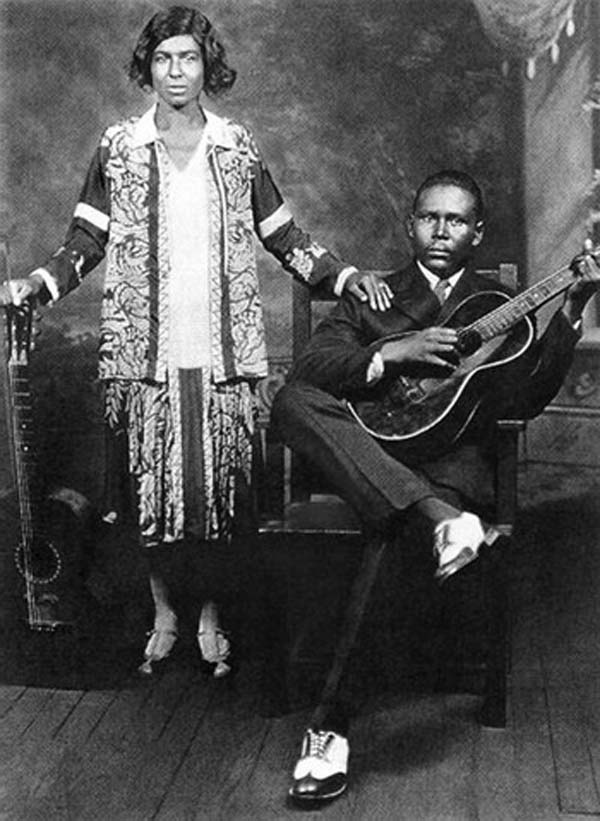
Her life was so different from mine – so wild and uncertain and vulnerable – and yet when I hear her songs I often think, “I feel that, way too.” Her words are so human and raw and honest and mysterious, all at the same time. The picture you form of her, from her songs, is of a woman who is strong and funny, empathetic but guarded, and who has been hurt and has known a lot of pain.
She, quite literally, rocks. She was born Lizzie Douglas in 1893. She learned very young to play guitar and banjo and ran away from home at thirteen to try to support herself as a musician. She landed in Memphis, Tennessee, and played in nightclubs and on the street. She traveled with the Ringling Brothers circus for a while, and eventually, she married and recorded with Kansas Joe McCoy. In the thirties she moved to Chicago, and formed a band with drum and bass, thus single-handedly inventing rock n roll. (What? what?) She went on to record during the forties, but her popularity and her health failed in the fifties. She died in a nursing home in 1973. She was a brilliant, inventive, and influential guitarist, and even male blues players of the time acknowledged this, with fellow-guitarist Willie Moore saying, “She was a guitar king.”
Though her guitar playing is notable, her lyrics are remarkable as well. Before I had access to all of her recordings, I would read her lyrics like poetry. They’re haunting, strange, relatable, with the same emotional impact of an early dusk in late autumn: moody, contemplative. Here’s I Hate to See the Evening Sun Go Down:
I hate to see evenin’ sun go down
I hate to see evenin’ sun go down
Cause it makes me think, I’m on my last go-roundSome people take the blues, go jump overboard and drown
Some people take the blues, go jump overboard and drown
But when they gets on me, I’d rather stay ‘n go sit downI been to the river, looked it up and down
I been to the river, looked it up and down
But when my mind never let me, to jump overboard and drown
There’s such a strange hopefulness in the lyrics, with the very blues that are bringing her down also buoying her up.
She has quite a few songs about prostitution, but I love the odd beautiful detail of Hustlin Woman’s Blues…
I stood on the corner all night long, counting the stars one by one
I stood on the corner all night long, counting the stars one by one
I didn’t make me no money, Bob, and I can’t go back home
New Dirty Dozen is a sassy, funny insult song, based on the game dirty dozens, which involves inventing increasingly hurtful insults about a person’s family, until somebody can’t take it anymore and gets angry…
Come all you folks and start to walk, I’m fixing to start my dozen talk
What you’re thinking about ain’t on my mind, that stuff you got is the sorriest kind
Now you’re a sorry mistreater, robber and a cheater
Slip you in the dozens, your papa and your cousin
Your mama do the lordy lord
Dirt Dauber Blues is a mythical, mystical dream-like tale of craving dirt dauber tea because dirt dauber wasps built a nest on her when she was sick as a child.
When I was down sick in my bed, blind, couldn’t hardly see
That dirt dauber flew down in my bed and built his nest on me
That’s why I say, “I’m crazy about that dirt dauber tea”
Ahw, dirt dauber’s a builder
Ahw, dirt dauber’s a builder
Dirt dauber is a builder, he built his nest on me
That why I say, “I’m crazy about the dirt dauber tea”
She has beautiful songs about rambling, about being cold and homeless, with sore feet and not enough to eat, songs about being treated cruelly by policemen and judges and doctors and boyfriends, songs about superstition, even a song about President Roosevelt and a mule, she has a lovely song of admiration about Ma Rainey, she has generous songs offering shelter and food to desperate men, she has saucy, sexy songs, songs full of hunger and pain, songs full of warmth and humanity. And she plays guitar like a mother-flipper!
Here’s a small playlist of her music:

 magpiesmagazine.com
excellent stuff! small historical footnote: while Led Zeppelin ripped off a lot of blues artists without credit, they did acknowledge Memphis Minnie in the credits when they took her lyrics to “When the Levee Breaks” and matched them to a different guitar part.
LikeLike
I know. It just didn’t feel necessary to mention Led Zepp somehow. Thanks for taking the time to read and reply!
LikeLike
absolutely. she does and should stand alone. I just liked the idea that even Willie Dixon wasn’t badass enough that his shadow couldn’t be ignored, but not hers
LikeLike
Yeah, it’s fascinating. I was thinking about Big Mama Thornton and Hound Dog, too. It’s an extra twist in the story when it’s a woman singing the original, somehow.
LikeLike