
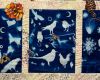
“Ellen Wallenstein found solace and strength in her art, continuing to create cyanotypes—ethereal blue shadow-grams on cloth—each sunny day,”

“Ellen Wallenstein found solace and strength in her art, continuing to create cyanotypes—ethereal blue shadow-grams on cloth—each sunny day,”
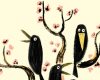
Some works from Calef Brown’s suite of poems in which the first words or lines are from traditional nursery rhymes, then they go off in different directions. Beautifully illustrated by Leo Espinosa.
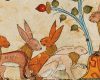
A collection of all the articles we’ve published over the past month, for those who like to savor their Magpies’ tidings as an issue.

The story of the remarkable Changing New York project in the context of Berenice Abbott’s career, by Bonnie Yochelson
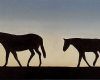
“Pigments from a rock collected under her horse’s hooves are woven together with ochre earth pigments from France, the same ochres used by Van Gogh in his paintings of sunlit fields.” An interview with Santa Fe photographer and painter Stella Maria Baer by Alice Courtright

That origin can be represented in no other way than through geometry, which is the primordial measure by which all visible forms are composed. Abstraction is the most faithful and evocative way to imagine the divine essence that makes up the world.

“We use our creative tools as extensions of ourselves; they help us understand and define our place in the world. For me, having a camera in my hand at all times helped me remember. You only get to do this once. We have to take time and see it, as clearly as we can.”
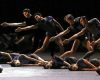
“The biography became, in effect, two stories: one, in which Harss deftly traces the formative patterns of Ratmansky’s distinctive and prolific career, and a second shadow story, in which Harss herself grapples with the unfolding conflict, the changing international landscape of the ballet world, and, most compellingly, the shifting identity of her subject.”
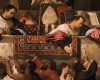
We make a connection between the religious-mathematical foundation of the Islamic form and its introduction into the Renaissance artistic world at a time when it seeks to develop geometric thought based on the new humanist mentality.

“How do visual representations of the past, or lack thereof, affect our perception of history? To what extent is our experience and understanding of the present shaped by a more intimate knowledge of past events?”

 magpiesmagazine.com