

“Night was come on, and the moon was overcast. But, as I climbed the moss, the moon came out from behind a mountain mass of black clouds. O, the unutterable darkness of the sky, and the earth below the moon, and the glorious brightness of the moon itself! There was a vivid sparkling streak of light at this end of Rydale water, but the rest was very dark, and Loughrigg Fell and Silver How were white and bright, as if they were covered with hoar frost. The moon retired again, and appeared and disappeared several times before I reached home. Once there was no moonlight to be seen but upon the island-house and the promontory of the island where it stands. “That needs must be a holy place,” etc. etc. I had many very exquisite feelings, and when I saw this lofty Building in the waters, among the dark and lofty hills, with that bright, soft light upon it, it made me more than half a poet.”
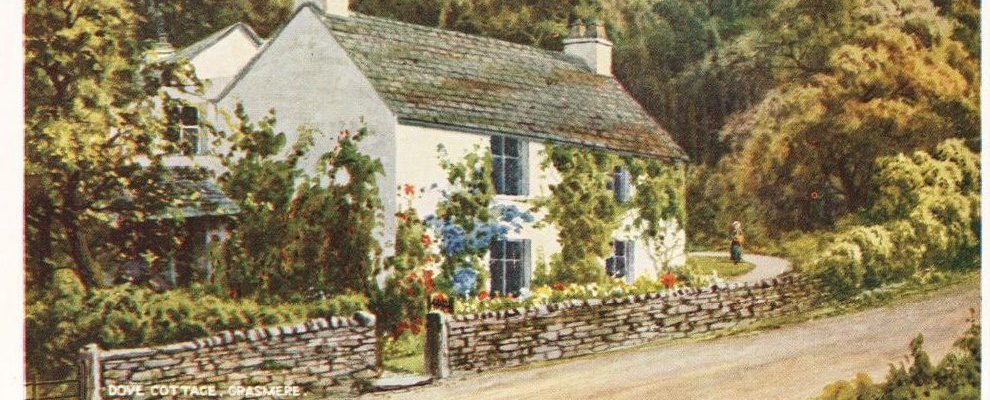
The time in Dorothy Wordsworth’s Grasmere Journals seems to travel to some strange rhythm, dictated by the weather and the seasons and her many sicknesses. Days are punctuated by walks and chores and visits and visitors and meals and reveries and bad headaches and bad bowels and sleeplessness. Dorothy and William will stay up till dawn talking or worrying, and sleep half the day away, only to wake for dinner and then walk for miles and miles. This was the way life passed for Dorothy and William Wordsworth at Dove Cottage in the Lake District between 1800 and 1803. This was a happy time in Dorothy Wordsworth’s life, and she kept careful track of all of it.
“The small birds are singing, lambs bleating, cuckoos calling, the thrush sings by fits, Thomas Ashburner’s axe is going quietly (without passion) in the orchard, hens are cackling, flies humming, the women talking together at their doors, plum and pear trees are in blossom—apple trees greenish—the opposite woods green, the crows are cawing, we have heard ravens, the ash trees are in blossom, birds flying all about us, the stitchwort is coming out, there is one budding lychnis, the primroses are passing their prime, celandine, violets, and wood sorrel for ever more, little geraniums and pansies on the wall.”
Dorothy’s mother died when she was six. She was separated from her brothers and sent to live with relatives, first with her mother’s cousin, and then with her ill-tempered grandmother, where she would sit “for whole hours without saying anything excepting that I have an old shirt to mend, then, my grandmother and I have to set our heads together and contrive the most notable way of doing it,” then with an uncle, then in various places with friends and family throughout the country. (It’s a reminder that when we wonder how women of this era — like the Brontes, for instance — could be so sheltered and yet so aware of the darkness of human nature, we can never know what they had seen, what they had done, or what had been done to them.) Dorothy must never have felt that she really had a home, and she must have been terribly lonely over the years. So the time at Dove Cottage, in a home and garden of her own, must have been blissful, and she seemed to be bursting with love for all of it — the flowers and trees and lakes and birds, and, of course, the time with her brother. At one point she falls asleep, saying “‘This is the spot’ over and over again.”
“A heavenly warm evening, with scattered clouds upon the hills. There was a vernal greenness upon the grass, from the rains of the morning and afternoon. Peas for dinner.”
“Wm. slept badly. I baked bread. William worked hard at The Pedlar, and tired himself…. There was a purplish light upon Mr. Olliff’s house, which made me look to the other side of the vale, when I saw a strange stormy mist coming down the side of Silver How of a reddish purple colour. It soon came on a heavy rain.”
He read me his poem. I broiled beefsteaks.
There is a sense that Dorothy kept the journal as a sort of reference for William’s poetry. She didn’t intentionally write poetry or think of herself as a poet, and yet, there is so much poetry in the journal, so much lyrical language and keen, odd observations and deeply felt emotion. Somehow, the fact that she recognized that feeling something deeply is, in itself, a sort of poem, puts her understanding of the medium perhaps above that of poets who have been revered and analyzed and annotated more. “I had many very exquisite feelings, and when I saw this lofty Building in the waters, among the dark and lofty hills, with that bright, soft light upon it, it made me more than half a poet.”
I am no scholar of William Wordsworth’s poetry, but from what I have read, the poetry he sweated and fretted and tortured himself to create didn’t hold a candle to Dorothy’s account of her quietly remarkable everyday life. She combines beautifully eloquent observations of the world around her with mentions of more mundane matters, that she baked bread and pies, that she mended stockings, that she had gingerbread for tea. The warmth of the everyday tasks and her affection for it, as well as her seeming lack of self-consciousness or pretension, makes the poetry of her words seem more important, more affecting, than many a more finely-wrought verse. This warmth is reflected as well in Dorothy’s fascination with the people who pass by her house or she passes on the road, with the beggars, peddlers, and mourners. She takes the time to talk to them and to learn — and be moved by — the stories of their lives.
I bought a pair of slippers from him, and we sate together by the road-side.
During W.’s absence a sailor who was travelling from Liverpool to Whitehaven called, he was faint and pale when he knocked at the door—a young man very well dressed. We sate by the kitchen fire talking with him for two hours. He told us interesting stories of his life. His name was Isaac Chapel. He had been at sea since he was 15 years old. He was by trade a sail-maker. His last voyage was to the coast of Guinea. He had been on board a slave ship, the captain’s name Maxwell, where one man had been killed, a boy put to lodge with the pigs and was half eaten, set to watch in the hot sun till he dropped down dead. He had been away in North America and had travelled thirty days among the Indians, where he had been well treated. He had twice swam from a King’s ship in the night and escaped. He said he would rather be in hell than be pressed. He was now going to wait in England to appear against Captain Maxwell. “O he’s a Rascal, Sir, he ought to be put in the papers!” The poor man had not been in bed since Friday night. He left Liverpool at 2 o’clock on Saturday morning; he had called at a farm house to beg victuals and had been refused. The woman said she would give him nothing. “Won’t you? Then I can’t help it.”
“The Cockermouth traveller came with thread, hardware, mustard, etc. She is very healthy; has travelled over the mountains these thirty years. She does not mind the storms, if she can keep her goods dry. Her husband will not travel with an ass, because it is the tramper’s badge; she would have one to relieve her from the weary load. She was going to Ulverston, and was to return to Ambleside Fair…. The fern among the rocks exquisitely beautiful.”
“I then went to a funeral at John Dawson’s. About 10 men and 4 women. Bread, cheese, and ale. They talked sensibly and cheerfully about common things. The dead person, 56 years of age, buried by the parish. The coffin was neatly lettered and painted black, and covered with a decent cloth. They set the corpse down at the door; and, while we stood within the threshold, the men, with their hats off, sang, with decent and solemn countenances, a verse of a funeral psalm. The corpse was then borne down the hill, and they sang till they had passed the Town-End. I was affected to tears while we stood in the house, the coffin lying before me. There were no near kindred, no children. When we got out of the dark house the sun was shining, and the prospect looked as divinely beautiful as I ever saw it. It seemed more sacred than I had ever seen it, and yet more allied to human life. The green fields, in the neighbourhood of the churchyard, were as green as possible; and, with the brightness of the sunshine, looked quite gay. I thought she was going to a quiet spot, and I could not help weeping very much. When we came to the bridge, they began to sing again, and stopped during four lines before they entered the churchyard.”
Throughout the journal, it is clear that Dorothy considers it her job to help William with his writing. She copies, edits, listens, makes sure everything is quiet and neat and conducive to his work. And when she shares her observations with William, it is understood that they are his to do with as he will. He can use her heart-felt descriptions of their time together in the world that she created for them and that she values to much to create poetry that the “real” world will see and acknowledge. “I happened to say that when I was a child I would not have pulled a strawberry blossom. At dinner time he came in with the poem of Children gathering Flowers.” But there is also a feeling that he recognizes that her words, in the freshness, warmth, and empathy, might have a value he can’t possess or steal.
“After tea I read to William that account of the little boy belonging to the tall woman, and an unlucky thing it was, for he could not escape from those very words, and so he could not write the poem. He left it unfinished, and went tired to bed.”
It’s a strange but probably not-so-strange thing that a beautifully-written account of the baking of bread, of illness and worry, of the beauty of the light on flying crows, the wind on the water, the glow through the mountains, would have such an enduring power to move us. It’s not strange that the warmth and empathy in Dorothy’s writing, and the small details she shares of real people’s lives, people we would never know about if she hadn’t taken the time to talk with them, that this warmth gives her unassuming journal a tenacious strength and a powerful hold on us. Dorothy may have thought of her journals as merely a means to help her brother with his creations, but it’s a lesson we can all learn. The value of noticing and caring about the stories of other people, and noticing and caring about the passing hours and weeks and months, the growing and dying ferns and flowers, and the shifting sunlight, the changing moonlight, can make all of us more than half a poet.
And here ends this imperfect summary….Now I am going to take Tapioca for my supper, & Mary an Egg, William some cold mutton. His poor chest is tired!
Categories: featured, literature, memoir, Nature

 magpiesmagazine.com