

By Chimezie Chika
I
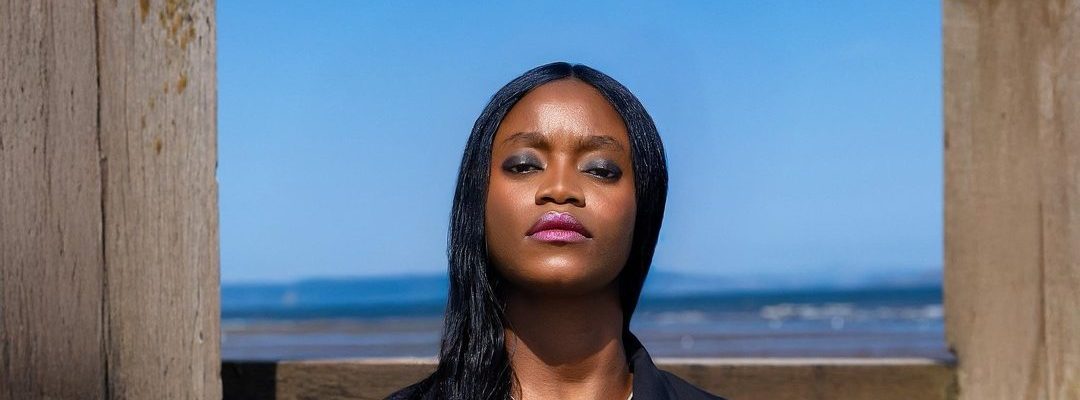
Esther Oladapo, creative director and fashion artist, insists that her body is a natural site of artistic expression and that, for this reason, the deliberate configurations upon which she places her body are not merely mannequin representations but carefully considered engagement with her convictions and the world around her. Her primary mode of making this body art is through images, pictures, storyboarded shoots, and the occasional fashion appearance. Her rigorous self-definition is what makes what she says about her work fascinating,
There is a particular image of Oladapo shared by the Scottish charity, Shelter Botanics. Seated between two other women (one in red, the other in a patterned dress), she is in a chequered black-and-grey suit and black jumper. The background is an exquisite old-fashioned wood-panneled office. Beside the three women, an equally old-fashioned billboard, like a clip from a century-old newspaper, hoisted on an easel says, “Teach Yourself Home Economics.”
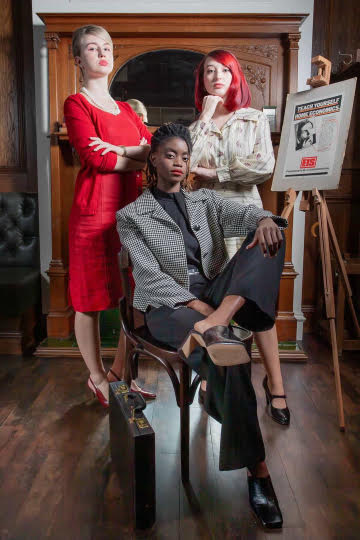
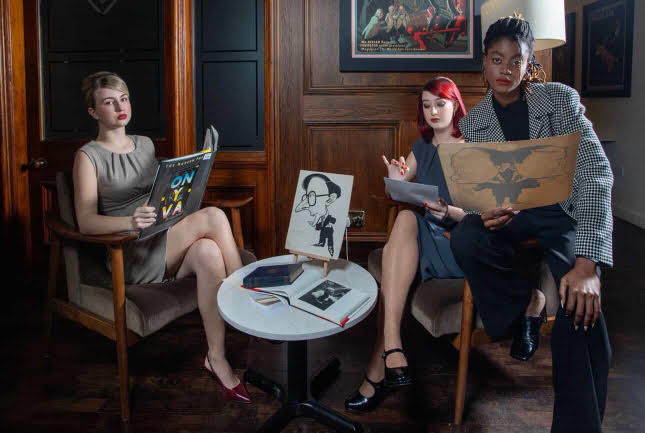
Much of this carefully created staging begins to make sense when one reads about Shelter Scotland, a charity geared towards providing shelter for the unhoused populations, the destitute, and people who are victims of class, gender, or racial discrimination. Shelter Botanics, its business arm, is used to generate revenue through sales of donated items such as clothes and other household goods. Oladapo’s involvement here was a fulfillment of her desire to feature in projects that highlighted the need to bridge social and gender disparities.
The function of her black body amidst those of the more conventional racial profiles projects zero discriminatory practices in the work of Shelter Scotland (since some of those populations are known to shy away from seeking help with the thought that it was not possible to obtain it). For precisely this reason, the Shelter Botanics project is classic image-making as a form of message bombing.
Oladapo’s creative directing as a person of colour in Scotland often takes these forms. In her opinion, she is seeking to create an image that exudes eminent visual power, to create an artistic identity that uses non-verbal means to amplify female agency and her cultural identity. She gives the example of the tech brand ASUS, which, even though it has nonphysical offices, has managed to build a strong brand image that continues to give it capital gains in a highly competitive market.
The point of fashioning art as Oladapo does is that it offers a wide range of platforms to use the body as a conduit to channel non-verbal programmes and messages. Such messages (which are doubtless dependent on creative posturings), if not properly interpreted, can be misconstrued for mere social media self-promotion. This has happened to Oladapo a few times in her career, particularly when she first began to post images on Instagram. Some of her erstwhile acquaintances thought she was leaning into the narcissism image manipulation that is the norm on social media. A wide berth of course, but one that may be potentially damaging.
The remedy for this, she explains, is to work with carefully created mood boards, which she excels in; although for the kind of art she engages in, improvisation is still important. Everything idea and its actualisation in photographs is resident in her ability to convey, through her body language and postures, what she is feeling at the moment. If the viewers of her shoots can feel it as she felt it, if they can describe exactly the pulses of her captured mood, her aim would have been actualised.
II
There is a thin line between Oladapo’s creative expressions of the body and the sleeze of fashion and commercial modeling. The pivotal difference is in the singular orchestration of her own creativity. That is, the careful messaging and creative direction of messaging. To further disambiguate it: she sees herself as a tool for social activism and what she does with this tool is to shape into images of self-affirmation. The body thus becomes the object of social programming, which changes as it is placed in different postures and environments. Appearance is the deal.
Across much of her features and shoots, Oladapo has curated striking appearances that speak strongly on social subjects, especially identity. Some of her curated appearances tell such stories a woman leaning into the regained agency of her own body, supremely comfortable in a skin that is often treated with the skewed moral biases of patriarchal societies: a serious woman in black suit standing in a library; a backless dress showcasing her birthmarks; an air-hostess look on a wet beach; flamboyant back-and-white fabric appearances in runways.
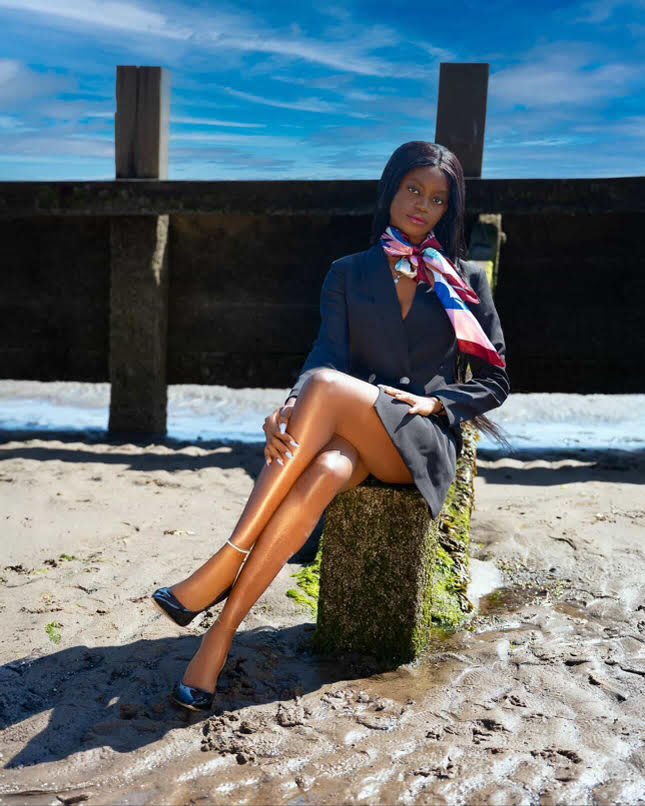

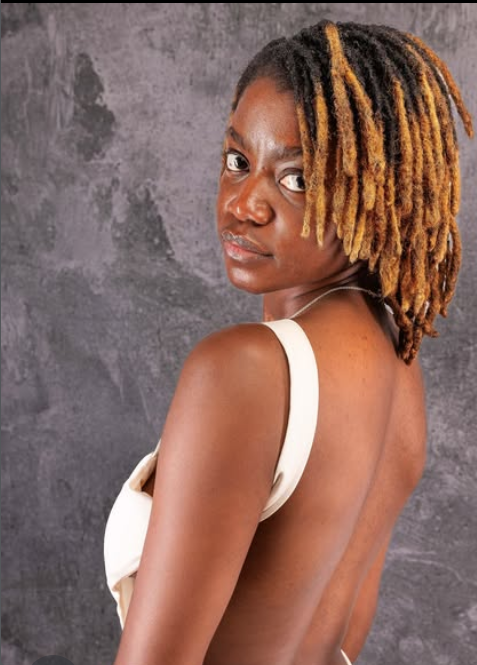
Many of these are self-funded and partly or fully self-actualised. This is put in perspective when one realises that her creative work does not yet pay for itself; that she supports it with earnings from a conventional job in finance, which is not surprising because many artists are condemned to this fate, at least in the initial stages of their career. But her work is majorly motivated by an avowed need to capture the resilience and hardiness of women in a society that puts women in choiceless positions.
The primary purpose of her work comes as well from some of the unaddressed moral issues she has encountered in the creative space, such as predatory overtures from photographers and some tokenistic service paid to black creatives in certain places (Do institutions and organisations want a black woman with locs to fill in a racial quota or do they really believe in her creative abilities?). In short, on a number of occasions during her shoots, leery propositions have brought home to her—in a more thorough manner—the need to make work that gives her racial and gender identity visibility and prominence.
She realises something peculiar in how much work is available to black female creatives like her as well as how she and her likes are treated: she has to deal with tricky racialised assumptions that can sometimes impede the ability of any creative individual to create and progress. The assumption she has encountered in which a black person being wrong is interpreted as being inherently cultural, while a white person’s wrongness is merely judged on moral grounds and not complicated by any perjorative notion of white culture, makes her resolve even more relevant.
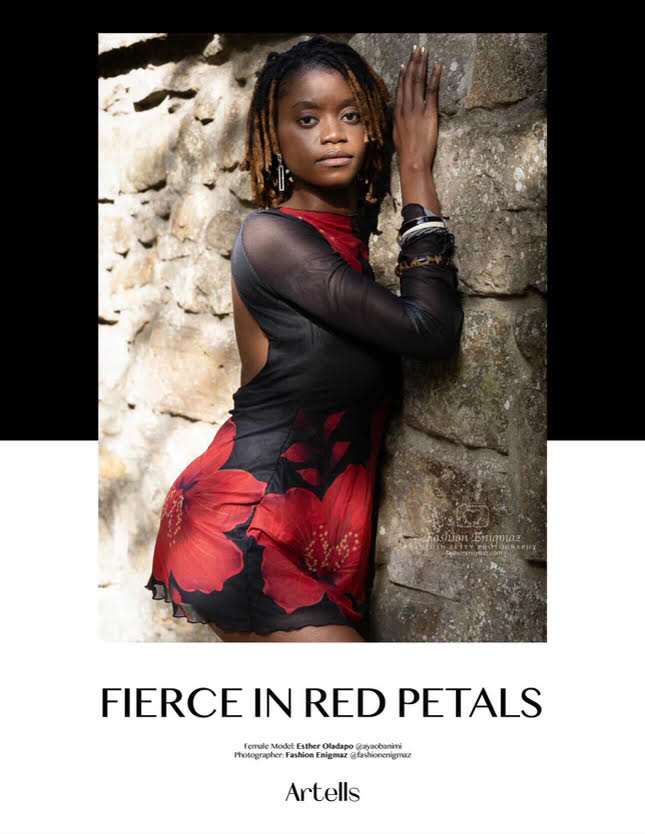
The complexes emanating from these issues endow Oladapo’s work with appropriate elan. She wants her body and images of it to tell the right kind of stories and she wants those stories to be straightforward and unequivocal. She essentially wants to see her work attest to the social importance of self-created image in a digital world that has increasingly associated images with power, identity, and relevance. In her featured images in Artells Magazine, themed around the sweet nature and simple charm of maturing girlhood, she bestows an ultimate feminine aura on her body.
These days, there is a tendency for body artists and creatives to make stringent demands of their bodies, either in artistic, economic, or social media terms. These demands into which the body is configured rise out of a need to maintain their socially relevant image, their convictions, or to secure their own vital sustenance. Esther Oladapo’s work as a creative features all these, rather, we can say that she is demanding a right to exist and survive. Her creative vision is firmly rooted, as she said, in an overriding need to tell stories of her identity as a black woman, an African, an immigrant, and a young woman in finance.
Chimezie Chika is an essayist, fiction writer, and art critic. His writings have appeared in The Republic, The Iowa Review, Afrocritik, and elsewhere.
Categories: featured, featured photographer

 magpiesmagazine.com