


By Arthur Davis
“Travel is fatal to prejudice, bigotry, and narrow-mindedness, and many of our people need it sorely on these accounts. Broad, wholesome, charitable views of men and things cannot be acquired by vegetating in one little corner of the earth all one’s lifetime.”
— Mark Twain, The Innocents Abroad, Chapter LXI (61)
John Steinbeck famously said, “People don’t take trips, trips take people.” More often, it is said, “It is not the destination, but the journey.” Basho himself, said as much, “Every day is a journey, and the journey itself is home.” (Introduction to Oku no Hosomichi, a journey into Japan’s northern interior). We attempt to set down roots, but in the end, we recognize we are all just traveling on. And the unknown final destination just a compass point.
A traveler with no home
a traveler with no home
has the heart of
a kotatsu
住みつかぬ旅の心や置火燵
sumitsu kanu tabi no kokoro ya okigotatsuMatsuo Basho, Kyoto, 1690
sumitsu (home) kanu (can’t, unable to) tabi (traveler, stranger) no (possessive particle)kokoro (heart, spirit) ya (emphasis) okigotatsu (kotasu, a table built over a portable warmer)
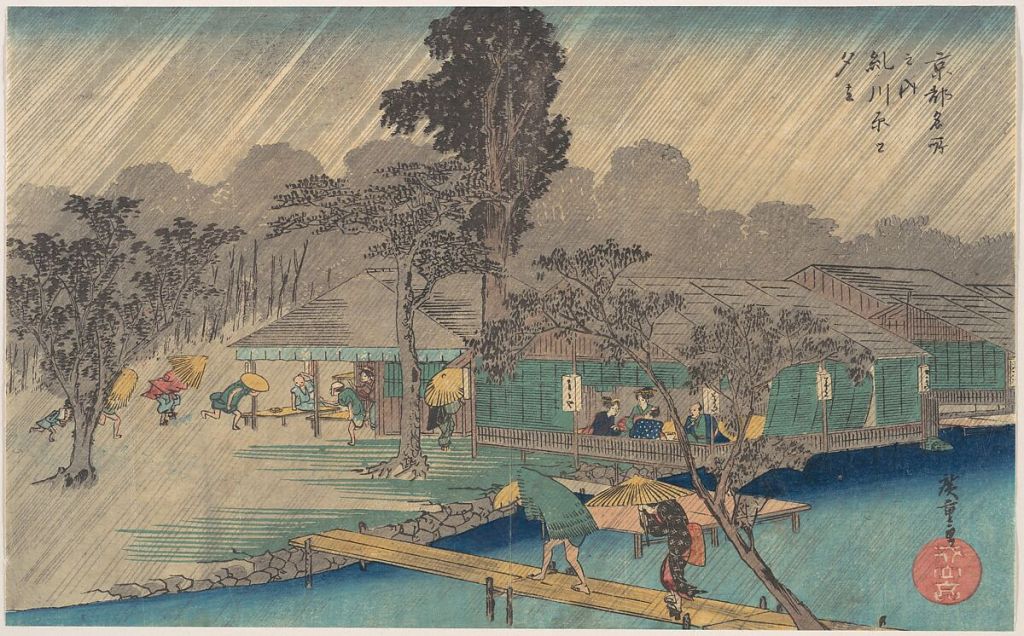
Son, servant, student, disciple, teacher, wanderer — the evolution of Matsuo Basho. Following in the footsteps of Saiygo (西行, 1118-1190), making his own path.
“月日は百代の過客にして、行かふ年も又旅人也。舟の上に生涯をうかべ馬の口とらえて老をむかふる物は、日々旅にして、旅を栖とす。古人も多く旅に死せるあり。
“The days and months are eternal travelers. So too are the passing years. Those who steer a boat across the sea, or drive a horse over the earth must endure the weight of years, spend every minute of their lives on the road. A great number of ancients died on the road. I myself have been tempted for a long time by the cloud-moving wind — filled with a strong desire to wander. And wander I must. Alone…”
Matsuo Basho, Introduction to Oku no Hosomichi (paraphrased)
“It was early on the morning of the 27th day of the 3rd lunar month (March 27th) that I took to the road.“
Traveling by foot, by boat, by horse, Matsuo Basho and his traveling companion Sora made and epic journey along Japan’s “narrow roads into the back country” (奥の細道, Oku no hosomichi). Along the way, they visited shrines, saw historical battle sites, watched the moon and sun, observing, seeing friends, and making new acquaintances. The trip lasted five months, about 156 days and nights, a journey of almost 1,500 miles, ending at Ogaki where Basho’s friends rejoiced at seeing him again.
Oku no Hosomichi, as the book would become known, was published in 1702.
Matsuo Bashō, the 17th-century Japanese haiku poet, didn’t directly write about Daoism. But he did dabble in Buddhism. And he traveled, one imagines, searching for the Way. He died, on November 28, 1694, on the way to the Grand Shrine in Ise, but got no further than Osaka. He was only 50.
Way beyond words, go —
All things arise from one source,
Travel and behold.The Dao, as One
Kyoto, 1690
In one sense, Kyoto, 1690 was the end of a circle. It was where young Matsuo began his life as student. It was where he ended the epic journey we know of as Oku no Hosomichi. It was the point from which Matsuo, the traveler, would continue on for four more years, until wanting to complete his journey, returned to his final destination, nearby Osaka, on November 28, 1694.
By the summer of 1694, Basho was not feeling well and he knew the end was near. As if to sum up his life, he wrote this haiku.
making my way in life,
in a small rice patch,
back and forth
.
世を旅に代かく小田の行戻り
yo o tabi ni shiro kaku oda no yuki modoriMatsuo Basho, late summer, 1694
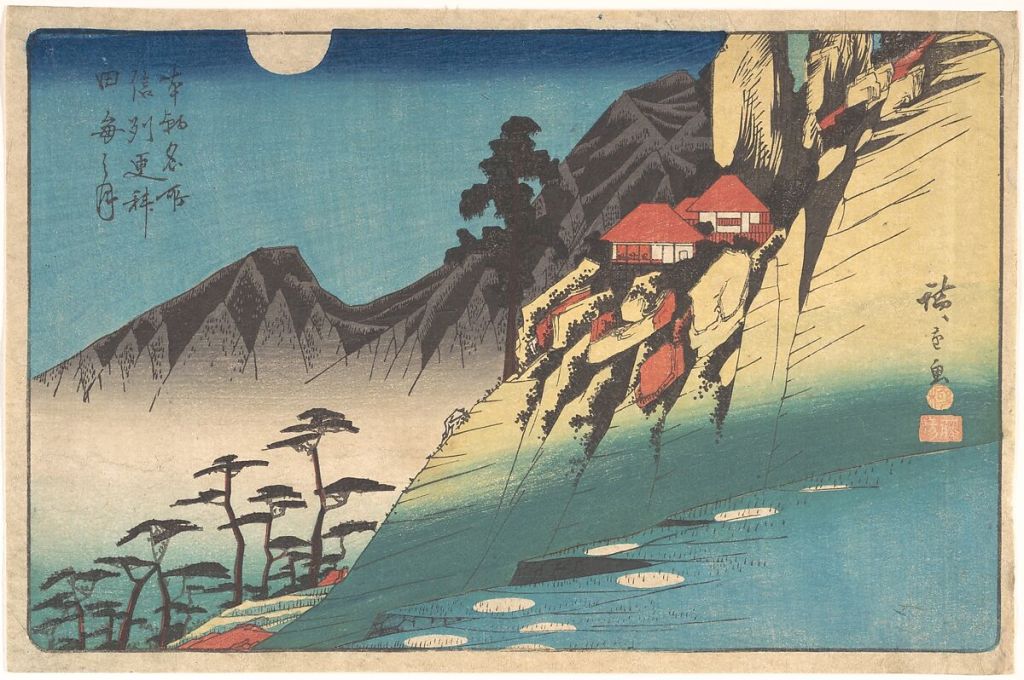
It was in the spring of 1689 that Matsuo Basho began his adventure. On the 27th of the third lunar month, not March according to the Gregorian calendar, but near May the 14th.
[Basho used the ancient Japanese lunar calendar as an occasional reference. In terms of the Gregorian calendar, Basho began in May, dates vary according to scholars from the 6th to the 27th. Let us split the difference and choose May 14th.]
| Start | Edo, Adachi Bridge |
| End | Ogaki, |
| Start date | 27th day of the 3rd lunar month, ca. May 14th |
| End date | ca. 6th day of the 9th lunar month, ca. October 17th |
| Average daily distance | 10 miles |
| Distance | approx. 1,500 miles |
| Days and Nights | ca. 156 days and nights |
The Beginning
So begins Matsuo Basho’s departure on his journey that was to be called, “Oku no Hosomichi.” Translated into English, the Journey into (Japan’s) Northern Interior. It was interior in name only, as, for most of the trip, Basho skirted the eastern and western shores of Japan’s Honsho island. The trip lasted some five months, beginning in March, according to the ancient Japanese calendar, and therefore ending in late July or August.
Prologue
- Departure, Adachi Bridge. On the twenty-seventh day of the Third Month (May 14th, 1689).
- Soka, from Adachi Bridge to the fish market at Soka was all Basho went. Five miles is all one can go, one gets used to walking, to carrying a backpack with needed things, and things given as gifts, things one hates to throw away, but should.
- Muro no yashima, a Shinto shrine (now Ōmiwa Shrine) in Tochigi. Basho and Sora have traveled 60 miles in three days. The route takes them on a gentle incline.
- Nikko, On the 30th day (May 17th), Climbed Mt. Nikko. At the inn where he stays, his host Honest Gozaemon (whose name means both “doorway” and “to protect”) told Basho “to sleep in perfect peace on his grass pillow.”
- Nasu, Basho had intended to arrive in Kurobane where a friend lived, but on entering Togichi Prefecture (then still a province) and the district of Nasu, he and Sora found the way blocked by an extensive grass field, and rain began to fall. They put up for the night at a farmhouse.
- Kurobane, Basho’s friend was Joboji who looked after a large mansion. Basho and Sora lingered there several days, taking in the Hachiman Shrine, the tomb of Lady Tomano, and the Komyoji Temple.
- Unganji
- Sesshoseki
At the Barrier Gate - Shirakawa, at the Barrier Gate, the high point on the first leg of the trip at 900 meters. There is an 800-year-old cedar tree here that dates to Basho’s trip.
- Sukagawa, crossing the River Abukuma, Fukashima Prefecture.
- Asaka, passing through Hiwada, staying at Fukashima. Roughly 160 miles from Edo (Tokyo). A steady climb the first half of the trip to roughly 900 meters high before
- Shinobu
- Satoshoji
- Iizuka
- Kasajima Province, stopping at Iwanuma.
- Takekuma no Matsu, and its famous pine tree, cut down before Noin Hoshi (988 – c. 1051) visited, then regrown.
The Eastern Coast - Sendai, crossing the River Natori. Basho has reached the eastern shore.
- Tsubo no Ishibumi, a stone monument erected in 762 to commemorate the site of the ancient Taga castle in the village of Ichikawa. An inscription gives the distance to the ancient capital of Nara.
- Shiogama, along the coast, north of Sendai. Basho is a little more than one month into his trip. He notes that it is May and the curfew bells are ringing as he enters the town.
- Matsushima, from Shiogama, Basho has gone only 6 miles to Matsushima, famous for its pine trees that dot the shoreline and cover many small islands.
- Ishinomaki, Basho notes that he left on the 12th of May, heading back into the interior in the direction of Hiraizumi, but he lost his way and arrived instead at Ishinomaki. He stayed in a miserable house and suffered an uneasy night.
- Hiraizumi, some 50 miles north and west from Matsushima, where three generations of the Fujiwara clan passed away, snatched away, and now an empty dream.
- Dewa Province (Dewagoe), Basho stayed at the village of Iwate. Basho now turns west.
- Obanazawa, Basho stayed with a good friend and rested.
- Ryushakuji, Yamagata Province. Basho detours to a temple south of Obanazawa.
The River Mogami and Detours - Oishida, Basho goes back north to Oishida on the River Mogami.
- Mogamigawa, an exciting ride down the River Mogami heading west.
- Hagurosan, it is the 3rd day of June, two months into the journey.
- Gassan, Basho climbed Mt. Gassan on the 8th of June. Though it is summer, Basho must walk through the cold air and snow, “nearly frozen to death,” he exclaims, but greeted by the sight of a cherry tree about to blossom. Nearby is Mt. Yudono.
The Western Coast - Sakata, leaving Gassan on the 9th of June, Basho proceeded to Tsuruoka. His route follows first the Bonji River and then the larger Aka River. The downhill distance is roughly 30 miles which one can easily cover in a day. [Note. Basho says that he boarded a boat and went down the Mogami River, arriving in Sakata.]
- Kisagata, north of Sakata on Japan’s western shore. It is similar to Matsushima with its pine tree-covered islands.
Heading South, Towards Home — July (August) - Echigo, it was a long walk of a hundred and thirty miles to the capital of the province of Kaga. Basho was by now ready to get home.
- Ichiburi, another Barrier Gate.
- Kanazawa, on July 15 (August 29th by the Western calendar), Basho and Sora walked into the city of Kanazawa. Here Basho and Sora are joined by Hoishi, a disciple of Basho’s.
- Komatsu, it is less than 20 miles from Kanazawa to Komatsu. The walk is flat, along the coast, and in the afternoon one walks almost into the sun. Basho observed this in a haiku: “red, red is the sun, careless of time, the wind carries the hope of autumn’s cold wind.”
- Natadera Temple, six miles, a two-hour walk takes Basho to the Natadera Temple, a Buddhist temple built, it was said, to enshrine the goddess of Mercy, Kannon. She gives happiness, but that happiness comes at a high price. The stop is brief, it is only another two-hour walk to the hot springs of Yamanaka. Here Basho bathes in the mercy of the healing hot springs.
Parting is sweet sorrow. [August 5th (mid-September), according to Sora’s Diary.] Sora, however, is seized with a stomach ailment. He parts with Basho to Nagashima in Ise Province to seek help from relatives.
Not Quite Alone - Daishoji, the spirit is willing, the body is weak, loneliness his only companion. It is only a two-hour stretch downhill from Yamanaka to Daishoji and its Zenshoji Temple. Sora had preceded Basho here and left a note saying, “All night long, I listened to the autumn wind, as it howled on the hill.”
- Maruoka, an old friend makes for good company at the Tenryuji Temple in Matsuoka. Another friend (Hokushi) met on the way at Kanazawa departs. Then a short walk to Eiheiji Temple, the Temple of Eternal Peace standing among the tall cedars on the mountainside. The temple was founded by Zen Master Dōgen in 1244.
- Fukui, Basho chose not to stay at Eiheiji, but after supper walked on three miles in the darkening evening to Fukui. There he found Tosai’s humble cottage on a back street, met his wife, a sad-looking woman, and eventually, in town, found Tosai. Two nights with Tosai, then back on the road to Tsuruga, accompanied by Tosai.
- Tsuruga, imposing Mt. Hina, crossing the bridge of Asamuza, among the famous reeds of Tamae, through the Barrier Gate of Uguisu, over pass of Yuno, are all along the way.
The 14th of July. It rained the night of the 15th.
After dinner with wine at an inn, Basho and his host went to the Myojin Shrine of Kei, built to honor the soul of the Emperor Chuai. Ironohama, on the 16th the weather was fine and as it was his last day in Tsuruga, Basho went by boat to the beach far out on the bay to pick up colored seashells at Ironohama (Irohama 色浜). - Ogaki, it is less than 50 miles to Ogaki from Tsuruga. It was near the beginning of the 9th lunar month (October by the Gregorian calendar, somewhere near the first week).
Basho is now back on familiar ground, as he is skirting the north shore of Lake Biwa. Moreover, Basho is joined by Rotsu, and the two make a triumphal march by horseback into the city of Ogaki. Sora, too returns. And “Etsujin, came on horseback, and we all went to the house of Joko, where I enjoyed reunion with Zensen, Keiko, and his sons and many other old friends of mine who came to see me day and night.”
[Sora’s Diary says the date was September 3.] - Three days later, on September the 6th (late-October), Basho left Ogaki for home, but what is home to a traveler? Is it Edo, Kyoto, or Ueno? Basho went to see the Ise Shrine. A boat would take him there.
Postscript
Basho would not complete his book. By early summer of the seventh year of Genroku (1694), Basho’s health was failing and he asked Soryu, a scholarly Buddhist priest, to complete the task. Basho had but a few more months to live, as he died in November, on his way back to Ueno, to Kyoto, near Lake Biwa, to his final home. The publication of the book Oku no Hosomichi occurred some eight years later in 1704.
Since then, it has been read and read again.
Read more of Arthur Davis’ thoughts on Matsuo Basho’s poetry here.
Categories: art, featured, literature, poetry, Travel

 magpiesmagazine.com