

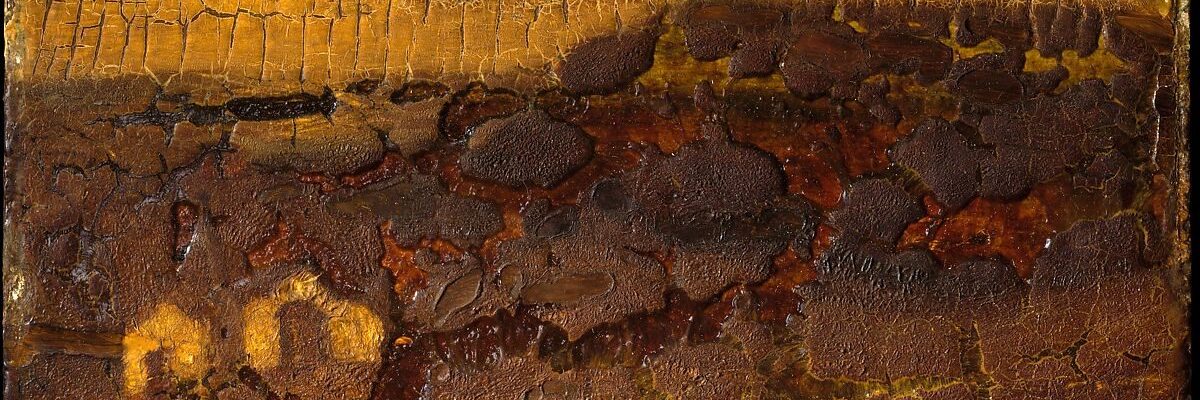
Sunday 18th. I have forgotten.
Complete entry from Dorothy Wordsworth’s journal, October 18, 1800.
This time of year always feels about loss. Leaves and flowers and the light dying, fruit rotting on the vines without ever really ripening. The sweet, sad smell of decomposing leaves reminding you of so many autumns past, and even the memory of those autumns is fading like a tender bruise, from purple, to yellow, to nothing. Even the beauty of the season — the crimson and gold and strange warmth and glowing shadows — is a bit heartbreaking, because it signals decay. Beautiful, but soon gone. The wild warm wind today will blow down all the leaves, and you sense the bronzing trees might all be stark bare branches tomorrow.
But in the evening, when the wind has more gentle fierceness and the sun comes out, that rare feeling of warmth and the sense of impending change feels almost like spring. Hopeful, anticipatory, conjuring memories of so many springs past, too. The change in season is always beautiful, and the season is always changing.
I’ve had a phrase in my head a lot these days. J’y tiens. It’s something Mr. Rochester says when he’s being willfully obtuse and trying to confuse Jane Eyre. Like many of the odd eccentric things in that odd eccentric novel, it’s on a loop in my odd eccentric head. J’y tiens is obviously French, and it means I care about it, I’m taking it, I’m holding it. It might be one of those untranslatable phrases that I might be misunderstanding, but this is how I take it and hold it.
If autumn has its own sort of melancholy, and it certainly does, it’s the sense that things are slipping away, and with that comes a strong desire to hold onto them. It’s a vague and tender melancholy, a nostalgia for times as they’re passing, before they’ve even passed. Not each falling leaf, each drawing-in evening, each departing summer bird, but all of it, even the melancholy itself.
So j’y tiens. I’ll hold onto the memory of this feeling, this moment in time, this changing of the year, this changing of my life, this auburn evening, this pink morning, the bright leaves floating past in the murky glowing green canal water — black as lacquer on a sunny day, the departing hummingbirds and the arriving juncos, the confused cold bees, the sunshine in the witch hazel, the sweet spice bush leaves in cold piles below bare branches, and the bugs crawling through them looking for a winter home, the memories of my childhood, my boys’ childhood. I’ll even hold onto my forgetfulness, to the moments I tell myself I’ll remember but I know in my heart I won’t. It’s all still there, still a part of me, that will be raised like spirits when I smell the decaying leaves or see the slanting light of an autumn evening, forever. J’y tiens. J’y tiens.
The word “tenet” has the same root as “tenir.” It’s the word for a strongly-held belief or principle, something you care about, something that guides your actions and thoughts. I care about this, now. I care about strongly-held beliefs of kindness, empathy, compassion. I see it slipping away, it’s all slipping away, and I know we need to hold onto it. Nous tenons. We maintain. In my foolishness, I care about caring about things. I care about wanting to hold onto these ideas, all of these ways of caring about each other and the earth and the world we share. All of it.
Categories: featured



Lovely! “this auburn evening, this pink morning, the bright leaves floating past in the murky glowing green canal water — black as lacquer on a sunny day, the departing hummingbirds and the arriving juncos, the confused cold bees, the sunshine in the witch hazel, the sweet spice bush leaves in cold piles below bare branches, and the bugs crawling through them looking for a winter home, the memories of my childhood, my boys’ childhood.” Wonderful!
I recently came across a quote from William Carlos Williams in which the phrase “witch hazel” enchanted me.
I hope you dont mind me leaving it here:
“Without invention nothing is well spaced,
Unless the mind change, unless
The stars are new measured, according
To their relative positions, the
Line will not change, the necessity
Will not matriculate: unless there is
A new mind there cannot be a new
Line, the old will go on
Repeating itself with recurring
Deadliness: without invention
Nothing lies under the witch-hazel
Bush, the alder does not grow from among
The hummocks margining the all
but spent channel of the old swale,
the small foot-prints
of the mice under the overhanging
tufts of the bunch-grass will not
appear: without invention the line
will never again take on its ancient
divisions when the word, a supple word,
lived in it, crumbled now to chalk.”
William Carlow Williams
Paterson
New Directions 1995
Pg 50
LikeLike
Thank you so much. I love William Carlos Williams, and this is beautiful.
LikeLike
thanks so much for this, Claire
LikeLike
Thank you, Louise!
LikeLike