

The first time I met Stalin was in an industrial estate outside Ulm in southern Germany. It was a grim day of drizzle and I was on a bicycle; his stone-grey eyes were peering over a hedge that separated the road from a car park. I continued on my way, somewhat confused, but curiosity being what it is, I had to go back and have another look.

It was October 3rd, a national holiday — the day the German people celebrate the reunification of Germany. I pondered the irony as I stood gazing up at the Red Army Commander-in-Chief — the tyrant, the man of steel wearing a concrete overcoat. What the hell was he doing here?
That brief meeting aroused my curiosity to such an extent that now, a year later, I find myself staring into the porcelain bowl of Stalin’s toilet.
I know. Not what I expected either. But here we are — the Georgian town of Gori, a hundred or so miles from the Georgian capital, Tbilisi.
Chernobyl blew up, the Berlin Wall fell down, and the USSR collapsed, and within a few years the map of Europe looked very different. The statues celebrating the Soviet legacy were pulled down; most found their way into museums of totalitarianism or suchlike. Except, that is, in Gori.
I met the first of the Giorgis near Freedom Square in Tbilisi. It was one of those random conversations you have when traveling; He thought I was lost — I wasn’t, I was just confused. Trying to get a basic grasp of Georgian history will often lead to a confused look, or so I found.
Giorgi was round-faced and smiled a lot, a cheerful chap in his late twenties. He wanted to know my favorite Georgian food and my favourite Georgian wine. I mentioned the khachapuri I’d had for breakfast and he congratulated me as though I had invented the dish myself. He then proceeded to suggest all the important cities I should visit — the churches, the hiking trails in the mountains, the beaches on the Black Sea coast. I glanced at the tourist office behind him and wondered what he did for a living.
“Work is difficult these days,” he said, brushing off my question.
“Georgia is beautiful, no?” he asked, with another big smile. His phone beeped and he said he had to go, but we arranged to meet again.
I went back to being confused about Georgian history. Freedom Square is a stage where the historical events of Georgia are regularly performed, known previously by various names including Lenin Square. It was the scene of a doomed assassination attempt on George W. Bush — an event that has absolutely nothing to do with the St George and Dragon statue that now stands at its center.

Stalin knew these streets well. As a youth his family had sent him to the seminary school just around the corner, and as an ambitious revolutionary he orchestrated the infamous Tiflis bank robbery of 1907. Scores died that day and the Bolshevik faction fractured. Stalin seems to have been credited with the plan, but his right-hand man Kamo was likely most responsible, and either I or the tourist office are standing on his former burial place — with the changes in Georgian history, things often get moved around.
It wasn’t just my incongruous meeting with Stalin that brought me to Georgia; I was also keen to learn something of the current political situation and knew local mayoral elections were due very soon. I also knew very well journalistic media attention was not welcome. Protests have been taking place for almost a year after what is claimed were fraudulent elections, followed by a suspension of Georgia’s application to join the EU.

The not-in-the-least-bit ironically named Georgian Dream Party is seen as pro-Russian and is, step by step, becoming more authoritarian. Activists locked up. NGOs closed down and foreign journalists arrested or denied entry to the country. And the all-encompassing Foreign Agents legislation — an arbitrary excuse for detention if ever there was one.
Shota Rustaveli Avenue, named — as all avenues should be — after a 12th-century poet, is an elegant boulevard that slopes up from Freedom Square for a mile or so, lined with fancy hotels, the National Gallery and opera, with café tables set on the wide pavement under the shade of oriental plane trees. A place to stroll, buy second-hand books and crick your neck craning at the architecture. And, of course, the Parliament building.

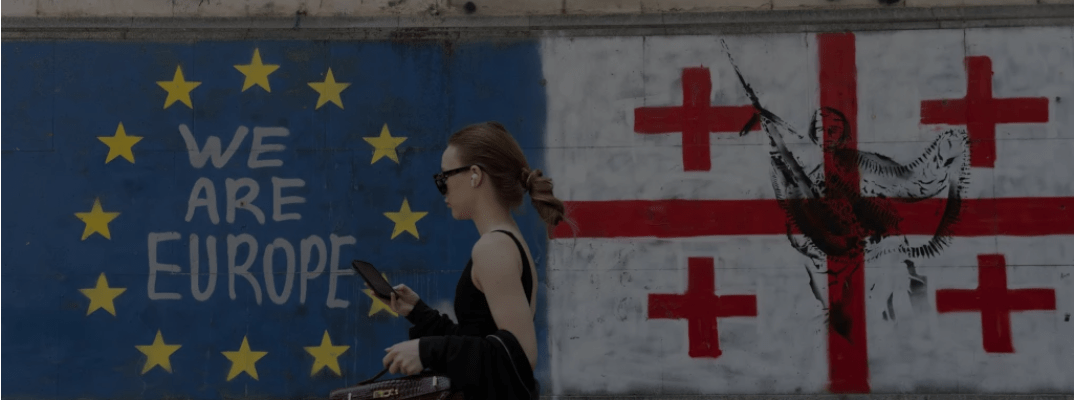
Rustaveli Avenue and the Parliament building have always been places to voice opposition, to renounce and remonstrate with authority. A small memorial sits, often surrounded by roses and candles, to remember those who died on the steps of the Parliament building, killed by the Soviet army for demanding independence. Every night for the last year protestors have marched peacefully along Rustaveli, waving Georgian and European flags, many wearing face masks to avoid facial recognition software used by the government to identify and vilify. The government is now trying to make the wearing of masks illegal.
Needless to say, I wanted to photograph the demonstrations, but every day social media reminded me of another arrest, another clampdown. The risks were real. I would take my time and weigh up my chances.
I decided to take a walk towards Rustaveli in the late afternoon; most marches would commence around sunset. I would get a feel for the police presence, knowing very well spotters and plain-clothes plod would be around.
The streets were becoming busy with commuters and I ambled along like any other tourist, my smallish camera dangling somewhat discreetly over my shoulder. I was wearing shorts and a Lambrettas T-shirt — not a press vest and six Nikons.
A hundred metres or so before Rustaveli Avenue I was beckoned over by two policemen. I unplugged my soundtrack (Lou Reed’s New York, since you ask) and walked over towards them, both lounging against the side of a squad car. They asked for my ID and inspected my passport, then asked if I had any drugs.
All sorts of alternative replies ran through my mind but I simply said, “Excuse me?”
“Marijuana. Do you have marijuana?”
I said I didn’t.
“Do you have a knife?” said the fattest of the pair.
“A knife?” I queried. I worried my face might betray my inner sarcasm. Not taking me at my word, they asked to search my bag — a small pouch slung across my chest with just my essentials: passport, wallet, phone, lip balm.
They waved me away dismissively. I would later learn of a police crackdown on drugs, with around 1,400 arrested over a two-month period. Many were activists and protestors who denied the charges. I wandered off past a street stall selling V for Vendetta face masks and decided I simply couldn’t afford the cost of being arrested or fined.
I bought a train ticket to Gori and pondered which were the Greater or Lesser Caucasus Mountains — their rust-encrusted peaks and blue hazy hues either side of the Kura Valley as the train followed the river.
On the face of it, you wouldn’t think there was much reason to visit Gori — a small agricultural and industrial town with a church or two and a hilltop fortress. Although in 2008 the Russian army did; they invaded, another bleak episode that caused thousands to flee their homes. But the tour buses pull up as regular as clockwork, the cult of personality clearly the real reason to visit — all because on 18th December 1878 Ioseb Besarionis dze Jughashvili was born. Besarion and Ekaterine were delighted, and these days so are the municipality coffers.
I ordered an espresso from a girl reading 12 Rules to Live By and sat over the road from the Stalin Museum and surveyed the morning goings-on, as is my habit.
Old ladies with coloured hair and small slabs of freshly baked bread gossiped outside the bakery with a sign that said Big Bread and Small Bread. Old men with larger paddle-shaped slabs of bread were smoking and buying vegetables from the shack next door, while just across the street tourists were buying Stalin fridge magnets.
Directions to the museum are pretty straightforward: from the station you head to Stalin Square, from there you follow Stalin Avenue all the way to Stalin Park, and just behind the park is the Stalin Museum. You can’t miss it — there’s a big statue of Stalin outside.

The museum is pretty much as you would expect — a one-sided celebration of the local boy done good. Photographs, ornate gifts from the Chinese, typical bits and bobs you’d find in granny’s house after she died. No mention of the gulags, the famine, the death squads and torture. Although, if you are looking for the toilets in the foyer, you may find an unmarked door with a half-arsed apology of an exhibition blaming Russia.

The statue I had come looking for seemed to have been moved for the third time. Originally it graced the central square outside the city hall but, despite vocal opposition and protest, it was moved to the park, where now an empty plinth stands. For a moment I was disappointed — I had wanted the image for this piece — but you see, in Georgia, Stalin’s ghost is never far away. Just behind some trees beside the museum his now very familiar stone grimace stood — for now.

If there is one page that me and Joseph can probably agree on, it’s train travel. His carriage was parked just around the corner, each compartment serving a different function: staff room, radio room, a writing desk set against the window in his office, and of course, the bathroom with a small wooden tub and his low-set toilet with wooden horseshoe seat — a bathroom very much to my taste. I spent more than just a minute taking in the scene, and I tell you, it’s hard not to imagine the dictator with his trousers around his ankles reading yesterday’s Pravda.
Outside I got chatting with the second of the Giorgis. He tried to sell me a tour of the local attractions but I told him I was only here for Stalin’s toilet — an explanation he accepted without question. I was tempted to ask him about local support for their local hero but I didn’t. I didn’t have to.
“I was born under Soviet occupation,” he said. “Putin is the world’s biggest f@king terrorist,” he added. I had only asked how life was in Gori.
He changed the subject and we were soon talking about football.
“Oh, what was his name,” I said, “the Georgian player who played for City — Georgi something?”
“Khinkali?” I said.
“No, that’s our national dish,” he laughed. “You mean Kinkladze.”
“Yes, Kinkladze! Great player. Wonder where he is now?”
“He’s a fat alcoholic now,” said my new friend.
“He’s still a legend at City. What happened to the other Georgian player that joined him that season? Kavelashvili?”
“Well, after he helped relegate City he was sold and ended his career in Switzerland.”
“And where is he now, I wonder?”
“Oh, now he’s the President of Georgia,” said Giorgi with a smirk.
It’s a funny old game, I thought.
I strolled back down Stalin Avenue towards the station, past numerous beauty shops, an Apple dealer and anti-Russian graffiti. I passed the Georgian Dream Party office with three overweight guys, all wearing tight black T-shirts, smoking on the doorstep — looking like a 30-year reunion of a failed boy band.

Back in Tbilisi I met up with the first Giorgi and we chatted about the current situation. Despite his exuberant enthusiasm for his country he was far from optimistic about its future.
“What about leaving?” I asked.
“I did,” he said. “I’ve only just returned. I went to the US, via Mexico. I lasted a year before being rounded up by ICE and deported.”
I had learned enough these past days to understand exactly why he had tried, but I also had faith in his energy to find his own path and his own solution.
I read in Peter Nasmyth’s Georgia: In the Mountains of Poetry the Georgian word guli, meaning heart, and the appreciation of those who act wholeheartedly.
I read in Peter Nasmyth’s Georgia: In the Mountains of Poetry the Georgian word guli, meaning heart, and the appreciation of those who act wholeheartedly. He gave an example of a love-struck man who set fire to tar in the shape of a love heart under the window of his unrequited love. The fire stopped the traffic but the drivers didn’t mind — they appreciated his guli. The Georgians have guli in spades.
Travelling to Georgia has helped me understand. I know now why the statue still languishes in the industrial estate not far from the Danube — not because it’s some macabre souvenir of a dirty phase of history long past, but because the past is coming back.
In the 1930s black-shirted fascists marched in the streets of London to the tune of Oswald Mosley. Today that tune is sung by Tommy Robinson and Nigel Farage. Famine is being weaponized; there is nothing left of the left, and only varying degrees of the rise of the right.
I hope Stalin’s toilet is not the metaphor I fear — and that we all adopt a little of the Georgian guli.

John Wreford is a nomadic storyteller usually found getting into trouble in the Middle East. See/read more at John Wreford Photographer and on Instagram at johnwreford.
Categories: featured, Photo Essay, photography

 magpiesmagazine.com