

How Serbia’s Students Are Trying to Change Their Dysfunctional Country Through Mass Action, Peace and Compassion
I am a retiree currently residing in Belgrade, Serbia. I have been closely connected to the republic since I first arrived here in the late ‘80s. I am neither a historian nor a journalist. What I will describe is what I have seen happen around me and what has been explained to me by Serbian friends over the past five months. This will be a subjective account, which, I hope, will show how the peaceful and professedly apolitical student approach to dissent has come about and grown across the country. It is a complex story, but I hope this brief account will explain how the movement has grown from the actions of a group of students in a small city into something which now embraces the whole of Serbian society.
There is an ongoing student-driven protest in Serbia. It is aimed against the chronic corruption that has become entrenched in Serbian society, and which stretches back to the Milosevic era and the introduction of the international embargo against the country during the break-up of former Yugoslavia in the 1990s.
Novi Sad is Serbia’s second city, lying some 100 km north of the capital, Belgrade. On November 1st, 2024, a canopy at the entrance to the Novi Sad railway station collapsed, killing 14 people immediately, with a further two succumbing to their injuries since. Blame was laid at the feet of the city council (dominated by the Serbian Progressive Party (SNS)) and the Chinese construction companies who had recently been contracted to carry out reconstruction of the canopy. There is a growing association between Serbia and China and this project was part of the Chinese Belt and Road international infrastructure initiative.
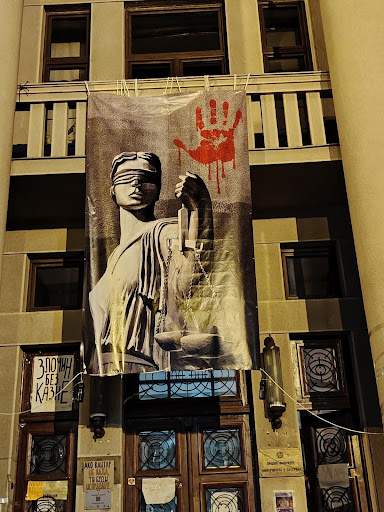
The initial student reaction to the disaster was focused on Novi Sad and was underpinned by a demand for a transparent investigation into how it had come about. Many suspected corruption had led to poor decision-making, poor materials and poor construction work, making the renovated structure unsafe. As administrative denial and inaction continued, including the Chinese construction companies involved removing themselves from the scene, the students became more frustrated. The protest spread to Belgrade.
On November 22nd, students of the Faculty of Dramatic Arts (FDU), conducting a silent tribute to the victims of the November 1st collapse, were attacked by (allegedly) SNS supporters. Belgrade University comprises several faculties spread across the city rather than a single campus. As a result of the assault on the FDU students, the rest of the student body decided to institute a blockade of all the faculties scattered across the city, occupying the faculty buildings and bringing the academic year to a halt. Furthermore, on a daily basis, there would be 15-minute (now 16-minute) silent vigils held across the city at crucial points in the road system, disrupting traffic flows.
The students are patriotic but in a positive sense. They love their country and want it to be better, to be like other European countries, to enjoy free and fair elections and be served by a free press and be a country where people can do their jobs properly, without fearing how the government might intercede.
These activities were not instigated by particular student leaders. Actions have been decided by student plenums held in each faculty. They are gatherings, with no spokespeople, during which individuals are allowed to speak and debate what actions the students should take. They are self-disciplining gatherings, guided by a set of coded signs that guide the discussions, and they are transparent and uncensored. They are underpinned by the dignity of the speaker and respect from the audience. Out of a set of plenums, the students issued a list of four demands. The students seek the release of all documents regarding the reconstruction of the canopy. The government has claimed this has been done but the students claim the only parts that have been made available do not show who was responsible for the collapse and to whom blame might be attributed. They have called for any charges against students who have been arrested during the protests to be dropped. They want the men who assaulted the FDU students arrested and to be made to go through the appropriate legal process. Finally, they want to see a 20 per cent increase in government funding for universities. To my knowledge, only the last demand has been met.
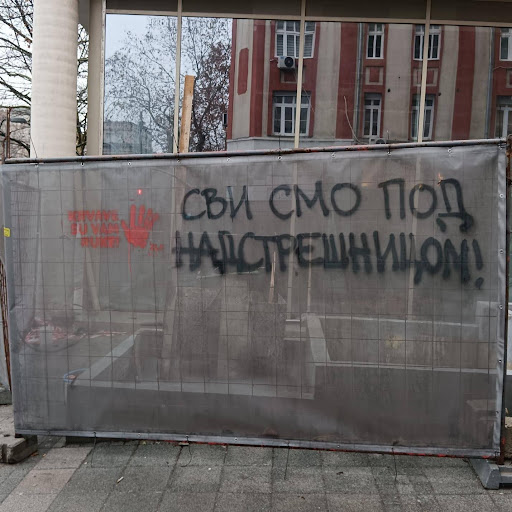
The protests are characterised by ‘tishina’ (silence) and ‘buka’ (noise). Tishina is followed when the 15 minutes are called to commemorate the victims of the canopy collapse. The noise is to signal protest. The buka is supplied by whistles, vuvuzela, and shouts of ‘Pumpaj’, roughly translated as ‘Pump it up’. The demonstrations are peaceful and non-confrontational. They are apolitical in that the students have not called for the overthrow or replacement of the government, nor do they act in concert with any opposition parties or politicians. Serbian flags abound at protest activities. The students are patriotic but in a positive sense. They love their country and want it to be better, to be like other European countries, to enjoy free and fair elections and be served by a free press and be a country where people can do their jobs properly, without fearing how the government might intercede. They no longer wish the country to be tainted by corruption and nepotism to the degree these currently exist. They do not want to leave Serbia when they graduate, as thousands have done already, in a diaspora of the intellectual; they want to stay here and build a new, stronger, better regulated society, one of which they can be proud.
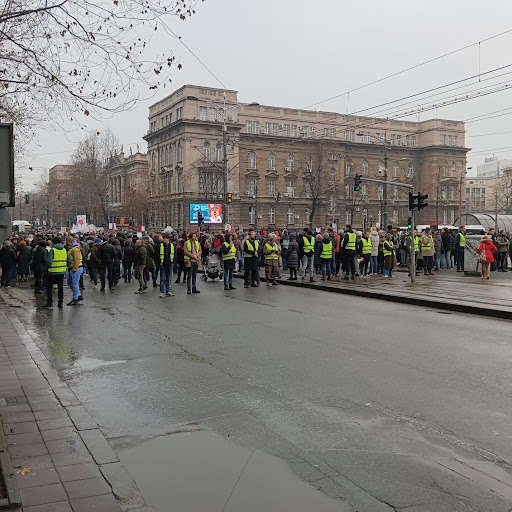
The tactics employed by the protestors have been fascinating to follow. At first, there were daily blockades coordinated across different major streets or junctions in the city. These occurred daily at 11.52, the time the canopy collapsed, and lasted 15, and then 16 minutes commemorating each life lost. These were permitted by the authorities and protected by the police. On at least three occasions, drivers have decided to try and circumvent the blockades by driving around them, hitting some protesters, and causing injuries. Although these drivers were arrested, I have heard nothing regarding any trial or punishment. Of one driver, the president said: ‘He was only trying to go about his daily business’.
Serbia is served by a range of online news outlets, newspapers, and TV channels. Some of these act as propaganda tools of the government and either refuse to acknowledge the protests exist or spread misinformation about them.
Serbia is served by a range of online news outlets, newspapers, and TV channels. Some of these act as propaganda tools of the government and either refuse to acknowledge the protests exist or spread misinformation about them. The two biggest broadcasters are Radio Televizija Srbije (RTS) and the Pink organization. These are important to the government as many voters, especially elderly voters, who live beyond the conurbations (and Serbia is still largely an agricultural country) only have access to these channels for information. For many, as the protest movement was growing in strength, they were unaware of what was happening, believing in the government and what they heard on the ‘news’, which the ruling party strictly controlled.
Two episodes illustrate how RTS approached what was happening and why they were distrusted by the protesters. The RTS offices have been blockaded on several occasions. The first RTS blockade occurred when the president, in an interview on RTS, claimed the students were being supported and guided by the Croatian secret services. This view was not challenged by the interviewer. RTS did not later inform their viewers there about the substantial crowd growing outside the building to protest this allegation. The second blockade was a result of the sparse coverage given to the mass protest at Slavija Trg (Square), a central point in Belgrade, attended by up to 100,000 people. Such a gathering had rarely, if ever, been seen in the capital. It barely got a mention on the news, and when it was its size was severely underestimated.
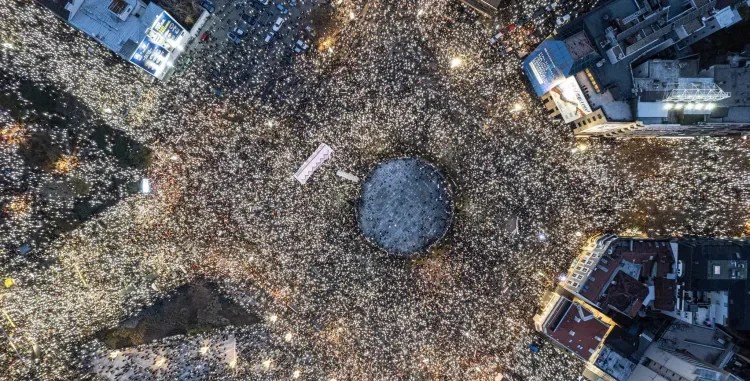
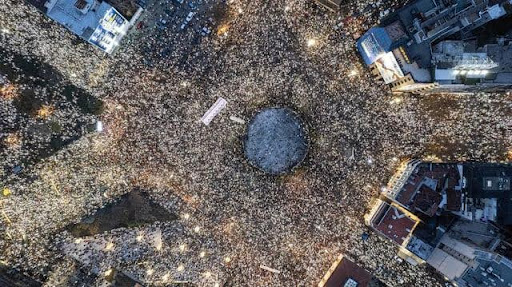
I attended this meeting. It took place relatively close to where I live. I went out and joined a constant flow of people of all backgrounds, streaming down to the square. I joined the crowd and was surrounded by a cacophony of buka, the level of noise immense. Suddenly a student moved among us calling for 15 minutes ‘Tishina’ (silence). This was repeated at the same time across the whole crowd, numbering tens of thousands. Everyone immediately fell silent and switched on the torches on their mobile phones and held them high. It was a simultaneously poignant and chilling moment. The abiding images of that demonstration were the photos taken from drones flying aloft. The government would later try to ground all drones other than theirs. This was the case at the later ‘biggest protest ever held in Belgrade’.
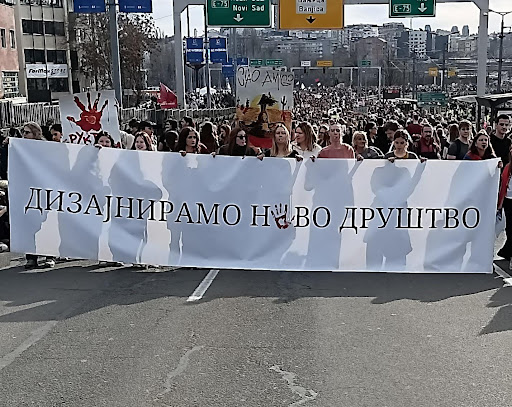
At this point, the protests could be seen to be widening and involving more of the general public, of all ages. High school students also started to blockade their schools and join in the protest movement. This brought the high school academic year to a halt, and this is still the case. The university and school students are widely supported by their professors and teachers. Attempts to re-open schools have all faltered. The actions by the school students, their teachers, and parents have been significant in raising the profile of the protests and widening support.
On Feb 1st, 2025, the Novi Sad students called for a demonstration to mark the third month since the collapse, and hundreds of Belgrade students decided to walk the 100km that separates the two cities to join them. The walkers were welcomed ecstatically by huge crowds at each town they passed through, fed and, where necessary, offered overnight accommodation. The protests were now moving beyond Belgrade and Novi Sad in a big way. Not only was the general public becoming involved but, simultaneously, various groups of students and others were being drawn in: student cyclists joined, riding in convoy, then the ‘Bikers’ joined, as did the agricultural workers, who brought their tractors to Novi Sad (most of the region around the city is agricultural). These latter two groups had played significant parts in previous anti-government demonstrations, going back to the downfall of Milosevic. The highways leading out of Belgrade were brought to a standstill by the number of cars heading north to join in.
Not only was the general public becoming involved but, simultaneously, various groups of students and others were being drawn in: student cyclists joined, riding in convoy, then the ‘Bikers’ joined, as did the agricultural workers, who brought their tractors to Novi Sad.
Further long-distance walks followed to cities across Serbia, drawing students and the public into the protests from all across the country. These walks, supported by the cyclists, culminated in a march on Belgrade in which students from across the country aimed to arrive in the capital the day before the biggest demonstration to date had been planned. Some students walked over 250 km to get there. They were greeted on the Friday evening by a huge, enthusiastic crowd.
The next day, March 15th (15th for 15 victims) saw the biggest demonstration ever seen in Serbia, in which an estimated 350-500,00 people took to the streets. As the authorities cancelled all bus services across the whole of Belgrade, many people had to walk many kilometres to join the protest. I was able to join relatively easily but was restricted to the periphery as the crowds towards the designated centres of protest were impenetrable.
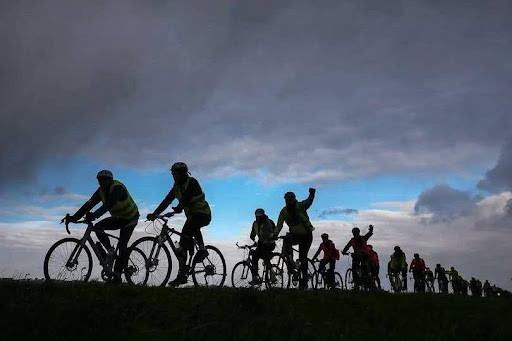
There was much concern over the potential for violence, expected to be instigated by the regime. The protest was joined by the tractors, the Bikers, and the Veterans — former members of the Serbian Armed Forces who had fought during the break-up of Yugoslavia — who promised to protect the demonstrators in any way they could against possible violence. This support had historical significance regarding these groups’ involvement in previous popular movements against the sitting government. Thanks to careful planning, strict discipline and the tracking of the police and others’ movements, violence was avoided. There was a report of the army using something called a ‘sound cannon’, an illegal sonic weapon, on the crowd but this has been disputed by the government and is currently under international investigation.
Since then, protests have appeared across many cities and towns across the country. The latest significant one saw thousands of students descend upon Novi Pazar, a city in the deep Southwest of Serbia with a majority population of Muslims (82%). In line with the students’ desire to make Serbian society more inclusive, they took their movement to a part of the country often ignored. Their attempts at involving the city as an active part in the protests were spectacularly successful.
Yet, EU commentary and international media coverage have been reluctant to report this. The question many here are asking is: Why?
In the latest organised action, to try and attract the attention of the European Parliament, a group of student cyclists have just ridden from Novi Sad to Strasburg over the course of a week to petition the EU. They are asking for them to acknowledge the ongoing situation in Serbia more publicly. The daily running of the country has been severely disrupted, and strong pressure has been brought to bear on President Vucic and his government, at both national and local levels. Yet, EU commentary and international media coverage have been reluctant to report this. The question many here are asking is: Why? There may be a couple of reasons for this. There are considerable deposits of lithium in Western Serbia. The multinational Rio Tinto mining corporation wants to mine it, and Germany has been in discussions with Vucic to be a major beneficiary of the mined metal. Should Vucic stand down, Germany may lose out on this, especially if a new government were to side with the people of the area of Serbia in question and refuse Rio Tinto mining concessions. Then, the EU sees Vucic as a relatively ‘stabilising’ presence in the unstable Western Balkan region, especially in the case of handling the thorny problem of Kosovo. It may be a case of the better the devil you know . . .
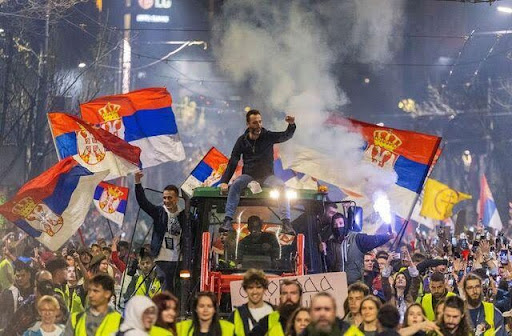
From another perspective, this unresponsiveness by the West may explain why Vucic has refrained from violence. He is frustrated beyond measure and would be quite prepared to set the police and armed forces on the students and crush the protest. But, his claims that Serbia is a democratic country, fully prepared for EU membership, would crumble if he were to do so. Then, there is the question of the 2027 Belgrade International Expo. It is said Vucic sees this as his legacy. Plans are in progress to create a site to house an international Expo near Belgrade Airport. Should the development of the required infrastructure be hampered by the demonstrations or should Vucic turn to violence, there is a strong likelihood the Expo will be cancelled by the international committee established to oversee it.
What lies ahead? Students are adamant they want all of their demands met and are determined not to back down. Vucic cannot turn to violence if he wants to keep Europe on his side. It is said up to 80% of the general public support the students’ demands and over 50% have attended some form of protest. Many SNS supporters have come out against the party. There are two possible reasons for this: first, the students’ move to take the protests out on the road, reaching as wide a swathe of the population as possible. This move has been supported by a strong social media campaign with stunning images and videos. Many people have learned about the students’ endeavours through Facebook or Instagram rather than through traditional media. Second, many people’s jobs still depend on party membership and loyalty. One can easily lose one’s job if one denies the party’s wishes — and jobs are not easy to come by, in either the cities or the countryside. More of those in such situations have made the decision to defy the party and act independently.
The current situation has raised a number of questions regarding the future of Serbia. The most common question raised regarding the movement is: How can the country be run without a political solution? What happens if Vucic and SNS fall? The opposition is weak and uncoordinated. They do not engender much faith in that many believe if they are given the power, they will behave as corruptly as their predecessors. Much of the student decision-making is carried out through plenums. These deliberative sessions are held at the faculty level, with decisions being passed on to a central body. This may be effective at a lower level for single issues, but few believe that the country could be run like this. There seems to be little alternative to the established system of parties and parliaments. Although people are asking these questions, support for the students is not wavering, it is still growing.
I, like everyone I know, have no answers to these questions. But, I live in the hope that the student movement prevails. This is a very affecting moment for me, living in my adopted and much-loved home. To see the dignity, strength and enthusiasm of the students, their refusal to be drawn into violence, and their commitment to spreading compassion and unity is remarkable. I have attended several protests, feeling both duty-bound to lend my support and privileged to have been standing alongside the future of Serbia. On many occasions, I have been brought to tears. And I am not alone in this.
The author of this article wishes to remain anonymous.

 magpiesmagazine.com