


Ellen Harvey’s beautiful little landscape paintings from her New York Beautification Project seem, at first, like magical glimpses into another world. But taken in the context of their settings, they become a continuation of the beauty that surrounds them in this world, and in the ever-changing network of the marks humans make. They become a testament to the strange beauty of the ephemeral, even in the way everything decays or gets covered over with time, becoming a part of the shifting layers of history, of the life of the city.
We are grateful to share a selection of stories from the project. To see photographs and read an account of what happened at and around the rest of the sites, please click here.
Words and pictures by Ellen Harvey
The New York Beautification Project consisted of forty oval landscape paintings in oils that I painted directly onto existing graffiti sites throughout New York City, without permission, from the summer of 1999 to the early spring of 2001. Each painting was approximately five by seven inches in size (17.8 x 12.7 cm). I discontinued painting and scraped off the paintings whenever anyone objected to them. My apologies to all the graffiti artists whose work I was unable to credit because I didn’t know their names. I did my best to find them. Almost all of the photography documenting the project was by Jan Baracz.
Concrete pylon in Highbridge Park at 181st Street and Amsterdam Avenue, Washington Heights, Manhattan
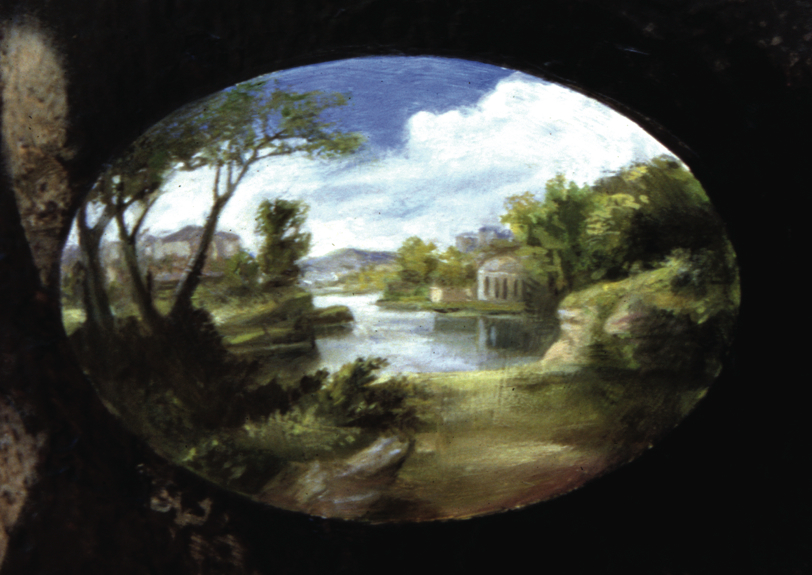
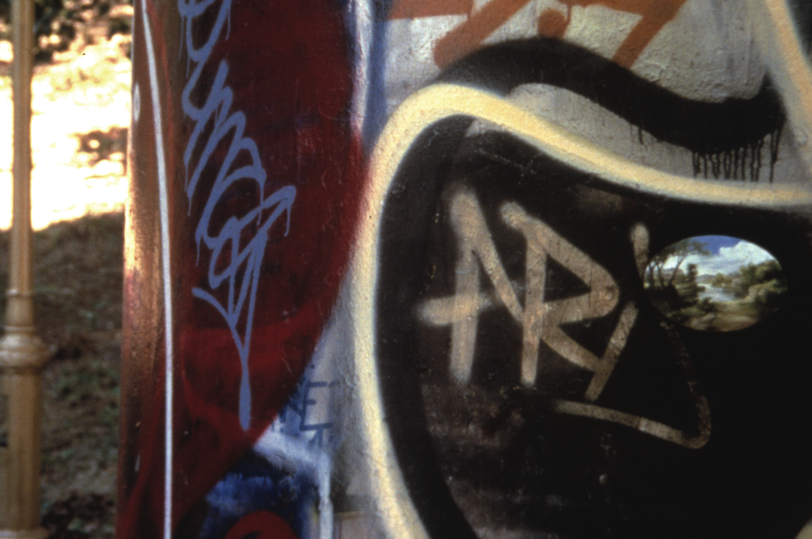
This is how it started. Mayday Productions, which was a group of curators and artists, asked me to do a piece for “Parking,” a one-day art event in Highbridge Park next to the East River, which was being organized by Laurie De Chiara. The park had just been renovated by the New York Restoration Project, and the event was supposed to persuade the community that it was safe to use the park again. It had been a pretty scary place. While clearing away all the stripped, stolen cars, the volunteers had even found a human torso in a bag. The volunteers were very romantic about the park, though. They kept on pointing out how beautiful it was.
I’m a painter, and this was the first time anyone had asked me to do anything outdoors, so I thought I’d better paint something. I bought a lot of horribly expensive gold paint and painted all the vandalized lampposts in the park gold. My friends helped.
Because I finished early with the lampposts, I thought I would paint some graffiti to add to all the existing graffiti. I spent two days painting a little oval landscape over a graffiti tag on one of the highway overpass pillars. I had never painted a landscape before, so I stole the background from Nicolas Poussin’s Landscape with Diogenes. I thought a classical landscape would be a nice reflection of the park’s aspirations. It also seemed like a good tag for a white European painter like me.
The park was quite busy. On the first day, a man masturbated in the bushes opposite me for what seemed like an improbably long time. Then a boy came by and asked what I was doing. I showed him and he said, “Man, that’s a good job — how’d you get a job like that?” He then asked me how much I was paid, and when I said that I was doing it for free, he said, “Man, you’ve got to get a better job.” The second day, a teenage couple came by and looked at the painting and said that it was “muy romantico” and then went into the bushes together. Fortunately, the man from the day before wasn’t there anymore. A lot of art people came to the show. There weren’t many people from the neighborhood except for the park regulars, who looked a bit surprised.
I don’t know who “ARD” is, but he or she later tagged the painting with a very small “ARD” in magic marker. I went back to take a photograph of the mini-tag, but my boyfriend Thom and I got mugged by a teenage boy. He claimed to have a gun, but we couldn’t see it. Despite the invisible gun, we gave him $15, which made him go away. He didn’t take my camera, but I decided not to stick around to take a photograph. I don’t know if this painting is still around or not, since I’ve not gone back.
Dumpster at 111 North 10th Street, Williamsburg, Brooklyn
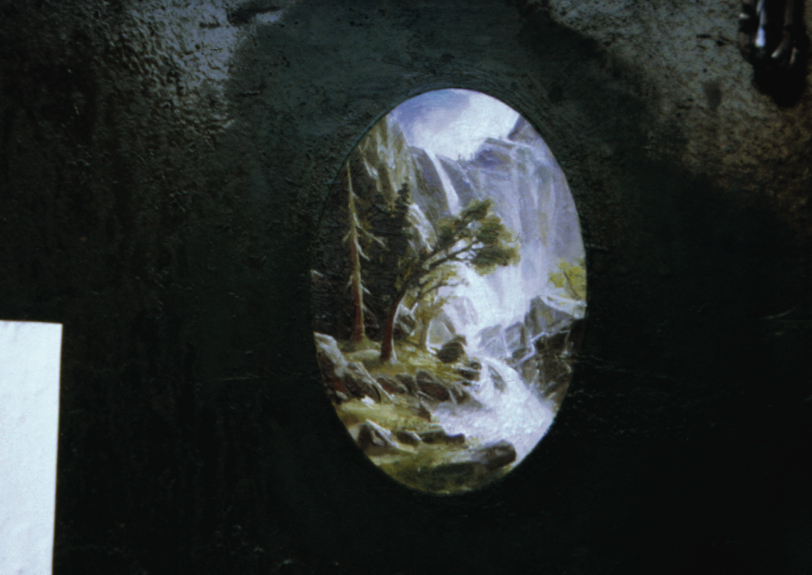
After I made the first painting, I wanted to keep going. So I thought that I would do a hundred.
I decided to paint only on sites that already had graffiti and where I didn’t have permission, and that I would erase the paintings whenever anyone objected. And since most of the city’s official beautification projects involved planting flowers or trees or somehow bringing nature into the city, I decided to call my landscapes the New York Beautification Project, which was a very grand title for a project that consisted of myself and a paintbrush. It took me a while to get started, because I was nervous about my new career as a vandal and because other things kept getting in the way. I’m a bit of a procrastinator.
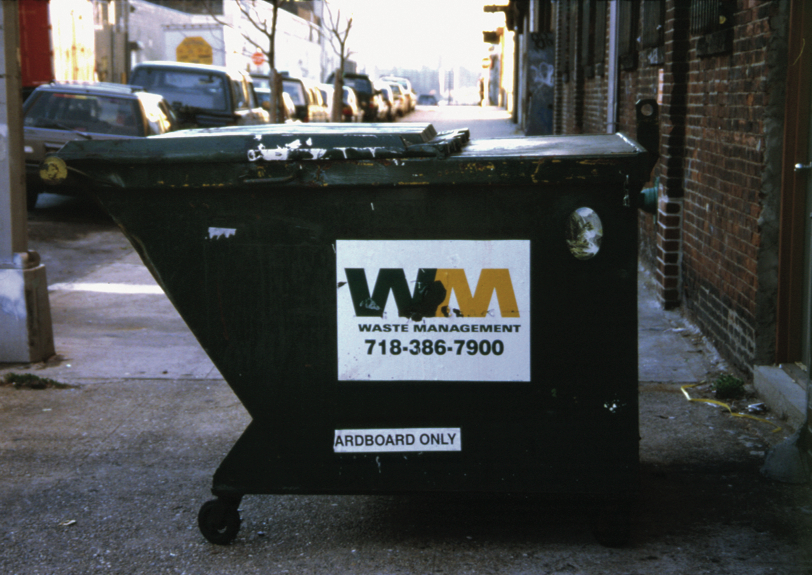
This painting was on a dumpster near my studio. While I was working, one of the women from the bakery upstairs came by and said, “It’s just like a postcard.” I think it was meant as a compliment, but I’m not sure. Oddly enough, the painting was based on a postcard of an American painting. I lost the postcard, so now I no longer know whose painting I copied. I think it may have been by Albert Bierstadt.
The dumpster is gone now. Our building replaced Waste Management with Bestway Carting for our trash needs.
Wall opposite 1087 East Tremont Avenue, South Bronx, Queens
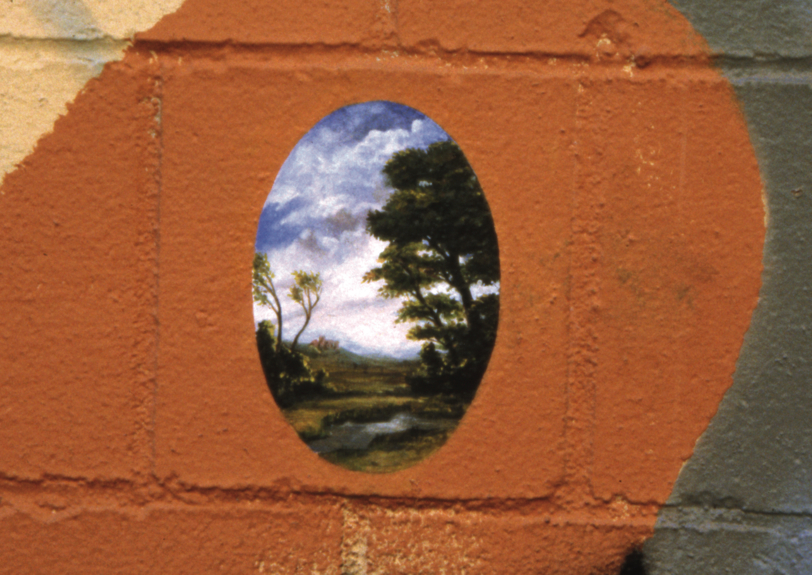
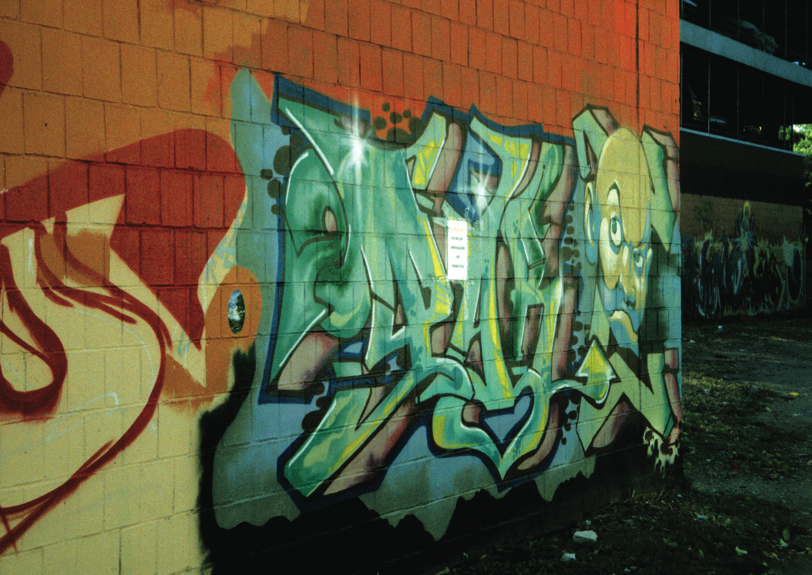
This wall is just opposite the Bronx River Art Center, where my friend Karen Jones was curating a show called “Environmentally Concerned II.” There are a lot of murals all around the area, but this one is especially good. It was made by a group of artists led by someone called “Ezo.” My painting was on a section of the mural that had been left unfinished. It was based on one of those nebulous Claude Lorrain classical scenes. Because I changed it quite a bit, I can’t figure out which one it was anymore.
People started coming up to me as soon as I started, probably because I didn’t look much as if I belonged to the neighborhood. A lot of people asked me if I was from Manhattan. When I told one girl that I was from Brooklyn, she said, “I have a cousin in Brooklyn.” She made Brooklyn sound a very long way away.
At the beginning of the second day, a boy came up to me and asked, “Are you doing that with respect?” I said that I was and he said, “Good, because if you weren’t, I’d have a problem with that. But I can see that you’re doing it with respect.” It was a good thing that he felt that way, because it turned out that I was painting on his brother’s section of the mural. His brother hadn’t finished it because he was too busy with his other commissions. My new acquaintance was worried about my graffiti career: “You’re doing it all wrong. It’s too small. You can’t even see it from a car. It takes too long. You’re never going to get anywhere like this.” His brother had a “dot com” now, he said, and was making good money painting signs for local merchants. He was also very concerned that I didn’t have a crew, so he stayed around for the rest of the day, keeping a lookout for the police. When he left, he said he’d send his cousin to look out for me, but he never came. I never figured out who his brother was. I got Ezo’s phone number from the Bronx River Art Center and sent him images to get the names of the artists who painted that section, but he never responded.
Late in the day, an old couple from Puerto Rico came by and said, “Finally, a good picture of Puerto Rico.” The last time I called the Bronx River Art Center, they told me that the painting was still there.
Northwest corner of Cortland Alley and White Street, in back of 380 Broadway, SoHo, Manhattan
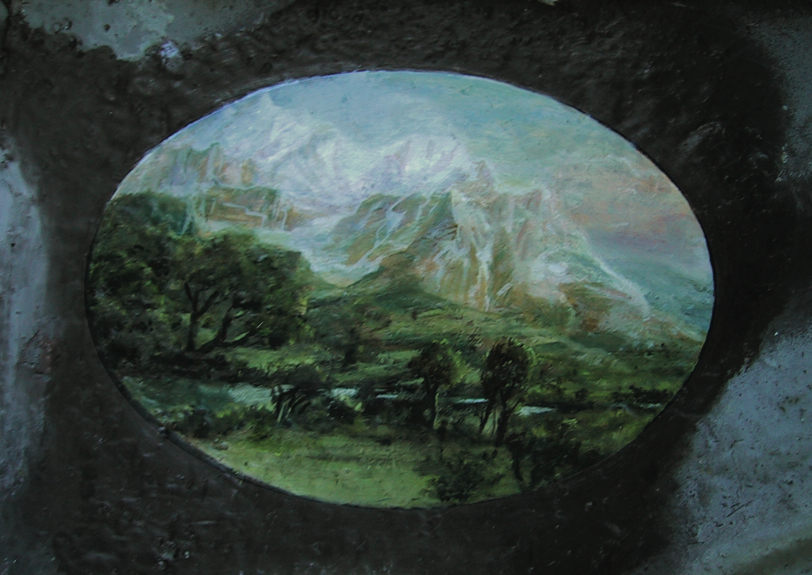
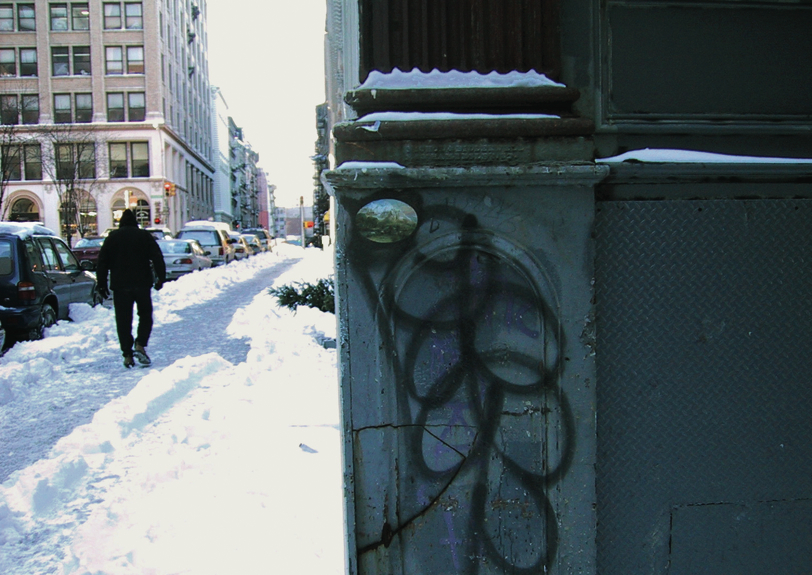
If you’ve ever seen a movie about New York City where the hero walks down a scary alley, this is probably the alley they used. It’s always being filmed.
Because the alley was quite close to my studio at the Clocktower, I spent a long time on this painting. Somehow, though, it never quite worked. It’s based on a painting by Carl Rottman, but I changed it a great deal and painted all these dubious little trees into it. Part of the problem may have been that it started getting very cold, and I found it difficult to paint while wearing gloves. Later, I started using those chemical handwarmers, which helped a lot.
This was a popular street corner. A group of homeless men hung out opposite; there was also a steady stream of teenage boys with gold teeth – the kind where the spaces between the teeth are filled, not the teeth themselves.
On the second day, a car full of cops drove down the alley very, very slowly. They rolled down their window, and I turned around and smiled as broadly as I could and waved enthusiastically, and then they rolled up their window and drove on. All the boys with the gold teeth had suddenly disappeared.
On the third day, a man came by because his truck had broken down and he was waiting for it to be towed. He asked me to do a painting on his truck, but I explained that I wasn’t doing commissions. He then said that if I didn’t paint his truck, he’d come back and blowtorch my painting off the wall. So I told him that I could tell that he was far too nice a person to do any such thing. He looked surprised and then asked me if I knew what he did for a living. It turned out that his job was to evict people who were behind on their rent. I said that had to be a tough job, and he said, “Yeah, I’ve got bad karma. Nothing ever goes right for me.” It took a long time for the tow truck to arrive, and the man stayed around for several hours, during which he kept grabbing passersby and pulling them into the alley to see me and my painting. Since he was quite a frightening man, most of the passersby were rather alarmed and kept trying to escape. They looked relieved when they realized that they were only the victims of forcible art appreciation. The painting was still there the last time I looked.
Southeast corner of West 14th Street and Tenth Avenue, Chelsea, Manhattan
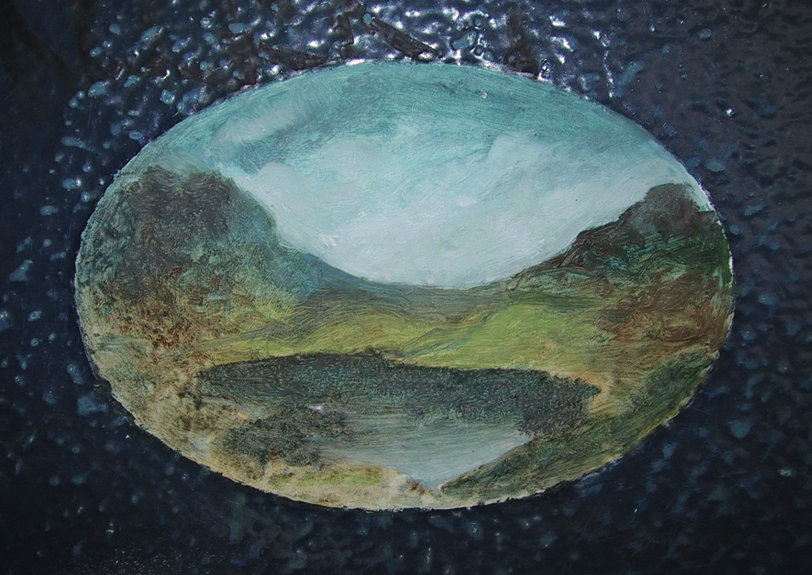
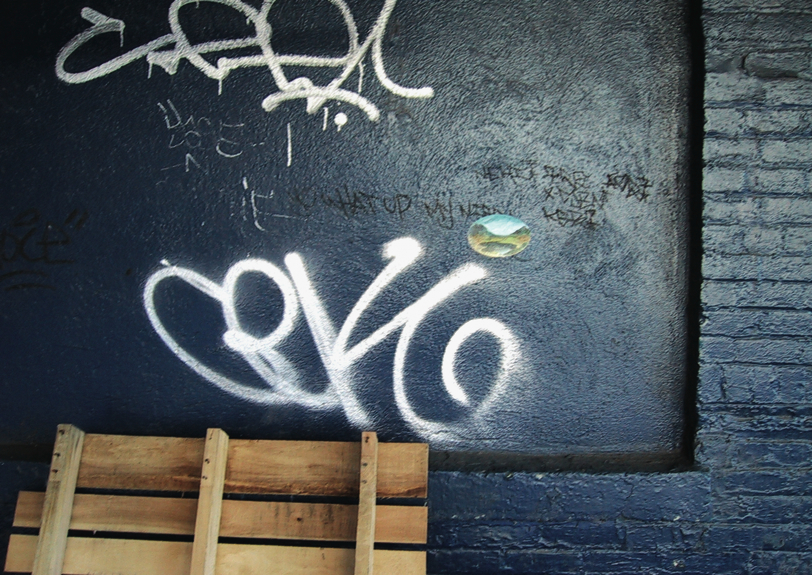
This painting was on the wall of a meatpacking plant. The wall already had a lot of graffiti. The meatpackers came by right away to tell me to leave, but then they decided that they liked the project and let me stay. The painting was based on a painting by Ludwig Richter of a pond in Poland. The workers kept coming back to see how it was going so it was hard to concentrate.
Halfway through the second day, I was suddenly slammed against the wall. Someone grabbed my arms and started banging me headfirst against the concrete. I thought I was being mugged. I was surprised to be mugged at two in the afternoon, but mainly I was terrified. Then I got turned around and saw that it was the police. There was a moment of silence before one of the two cops said, “We thought you were homeless.” I said the only thing that occurred to me, which was “I’m not homeless.” They looked at me for a bit, and then one of them asked, “You got permission to paint that?” I was so flustered that I said, “Well, not exactly, but it seems to be OK with the meatpackers.” So one of the cops went off to the plant to see if I had permission and the other one stayed to make sure that I didn’t run away. He told me that they’d been told to clean up the Meatpacking District. I tried to explain what I was doing, but he didn’t seem very interested. He just kept yelling that the mayor, Rudy Guiliani, hated graffiti and that they were going to arrest me if I was painting without permission. I offered to paint over my painting so that the wall would look like it had before I came – covered with graffiti but without any landscape. This seemed only to enrage him further: “You don’t touch that wall, ever, you understand?” Finally, his partner came back and pointed out that there was no way I could have permission, since the owner of the building was apparently dead. After shouting a bit more and telling me that they would arrest me if they ever saw me again, they let me go. Sometimes it really is a good thing to be a white woman in her thirties.
I didn’t dare go back, so this painting never got finished. I’m not very brave. I didn’t file a complaint, because I didn’t want to bring myself to the attention of the police when I still had so many more paintings to do. The wall is all clean and repainted now and fits in well with the Meatpacking District’s swank new look.
Inside courtyard opposite 45-31 Davies Street off Jackson Avenue, Long Island City, Queens
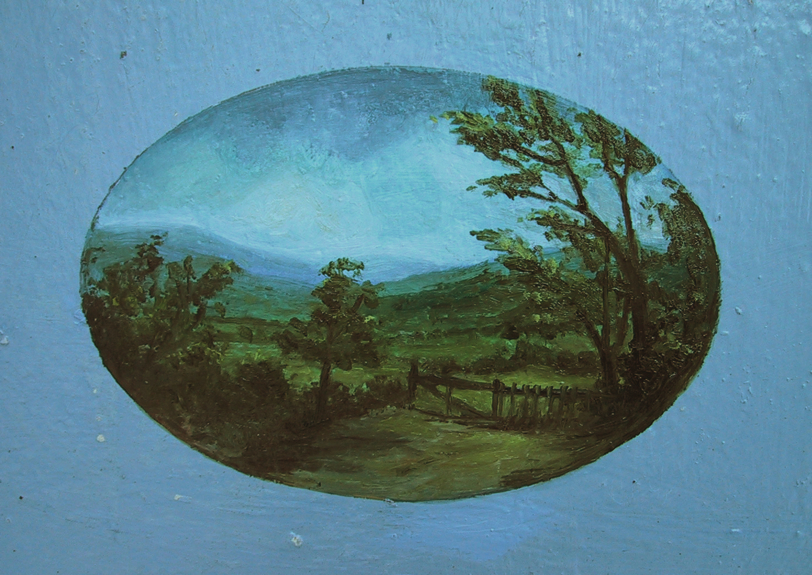
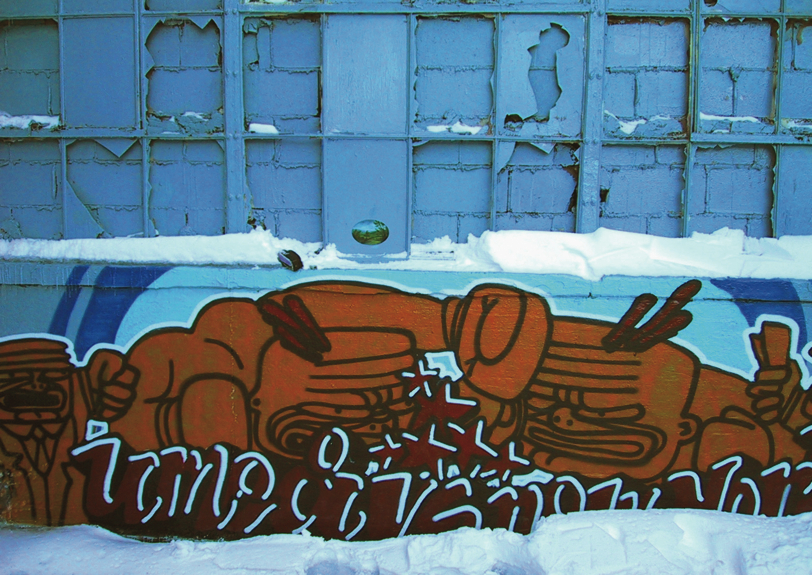
This was in the courtyard of the Fun Factory, a sort of graffiti museum. It has beautiful graffiti all over it that I’d always admired. I really wanted to add to the graffiti, but I wasn’t sure how to do it. Since I’m not a graffiti artist, I thought it would be best to do it by stealth. So I painted the undercoat one evening when the Factory looked empty. Then I came back at daybreak on New Year’s Day because I thought that any self-respecting graffiti artist would either still be out celebrating or fast asleep. Unfortunately, it had thawed slightly, so the space in front of my painting had turned into a lake of freezing slush. It was one of the more miserable New Year’s Days of my life.
I picked this graffiti because I thought it was beautiful. I didn’t paint over it because I liked it so much. I painted this painting so fast that it didn’t turn out terribly well. My painting is embarrassingly less beautiful than the graffiti. I made up the painting, so its shortcomings are all my own fault.
I don’t know who made this graffiti, because I was too shy to ask at the time. The Fun Factory doesn’t exist anymore, and this graffiti is gone, along with my painting. An organization called The Five Pointz took its place. I asked them if they could tell me who made this graffiti, but they couldn’t, nor could anyone else I asked.
Wooden siding west of 529 East 13th Street between Avenue A and Avenue B, East Village, Manhattan
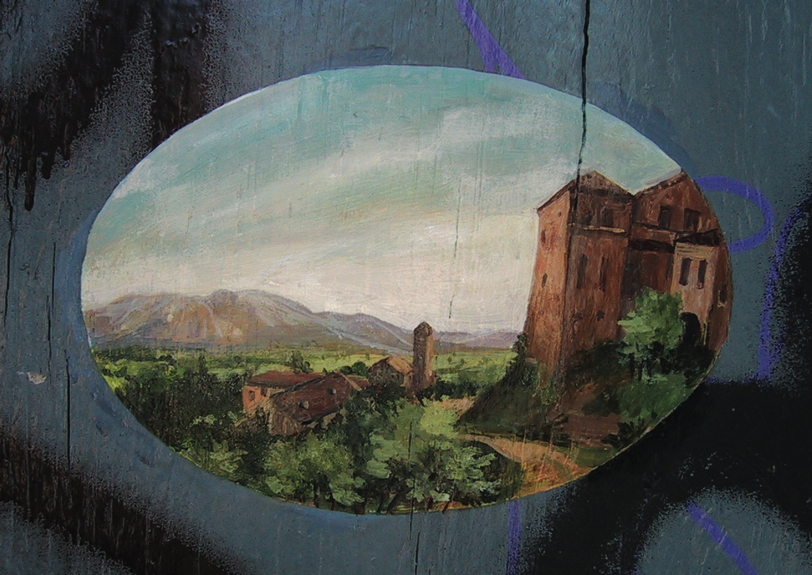
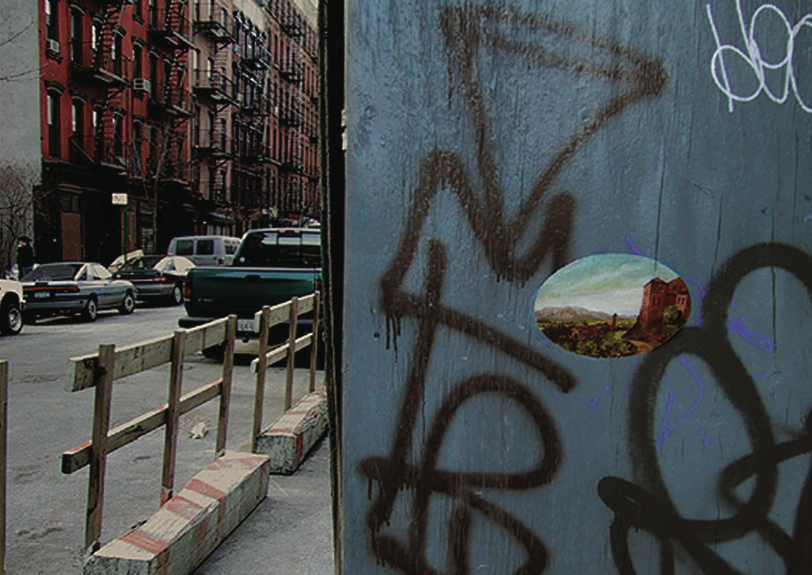
On the second day, a group of teenage boys sitting on the stoop opposite the wall kept yelling “Police!” and “Stop, graffiti!” and then laughing like hyenas every time I turned around in panic.
When I was almost finished, a man came up to me and asked me if I’d do a similar piece in one of the local community gardens. I explained that I wasn’t doing commissions, but because I really like community gardens, I agreed to do a separate piece for him later. Unfortunately, we never managed to meet up, so nothing came of it.
This is one of the images that I made into a postcard because I liked it so much. It’s based on Gustaf Palm’s View from Narni. The siding has been taken down now.
Trash receptacle at 256 West 108th Street at Broadway, Upper West Side, Manhattan
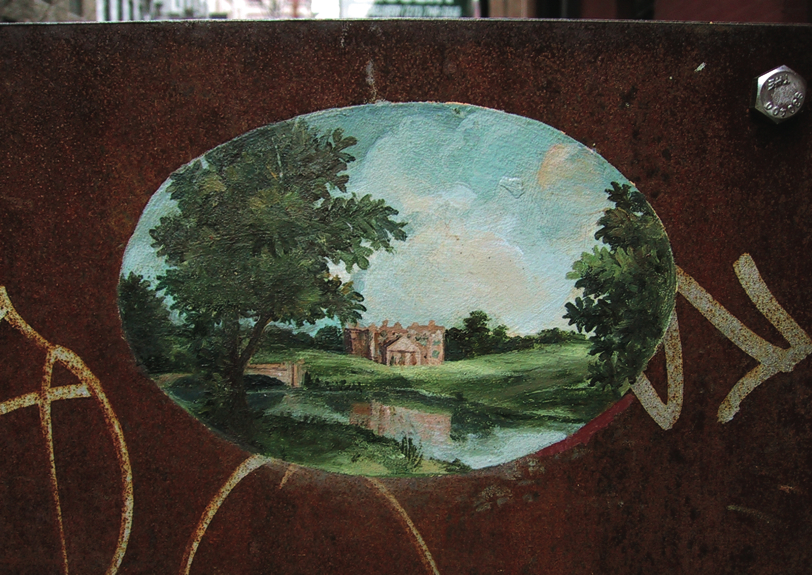
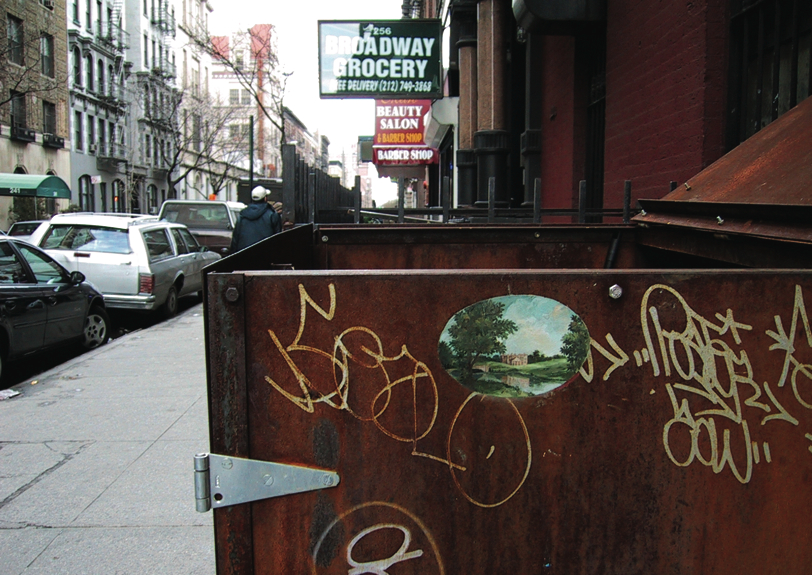
This trash receptacle turned out to belong to a restaurant. I got caught by the restaurant’s owner, but fortunately he liked the painting, so he told me that I could finish it. He was a watercolorist in his spare time and liked landscape paintings. We talked a lot about the relative difficulty of oil versus watercolor painting. I said that I thought watercolors are much more difficult because you can’t fix your mistakes. Around lunchtime, he brought me a sandwich and some coffee.
The painting is based on Richard Wilson’s painting of Croome Court and was still there when I was last uptown.
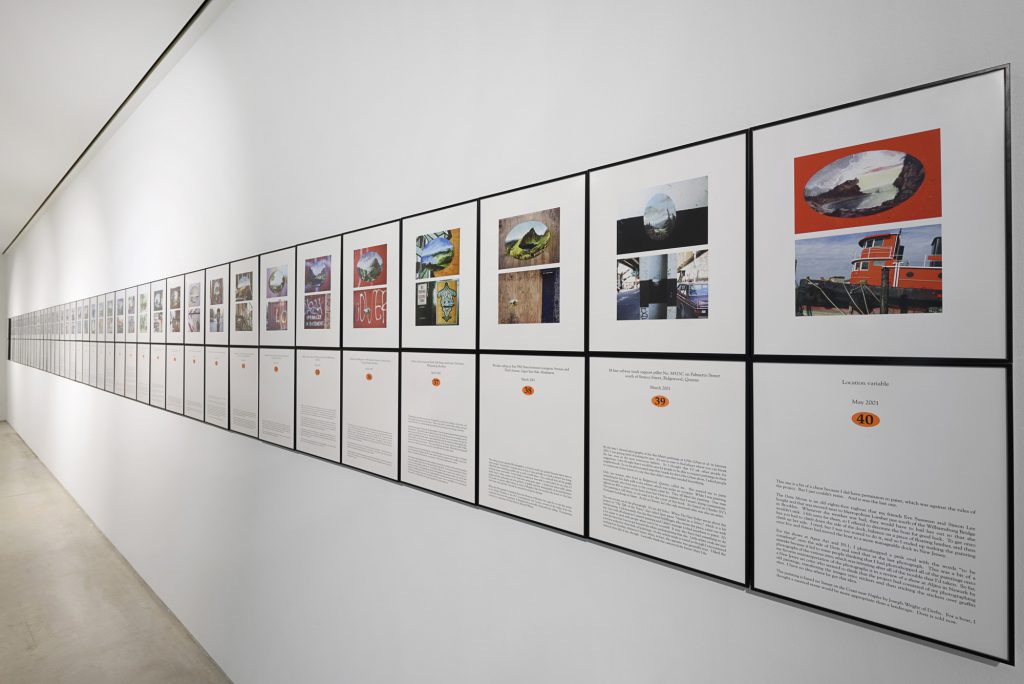

New York Beautification Project (installation at Turner Contemporary), Ellen Harvey, 1999-2001. 82 framed Giclee prints on Hahnemuehle Photo Rag Ultrasmooth paper. Texts by Ellen Harvey, photographs of paintings by Ellen Harvey Studio / Jan Baracz. Unframed: each 11 x 14” (28 x 35.5 cm). Photo: Thierry Bal.
These photographs and texts were published in 2005 by Gregory R. Miller & Co. as The New York Beautification Project, which has recently been reissued as a paperback. To purchase the book, click here.
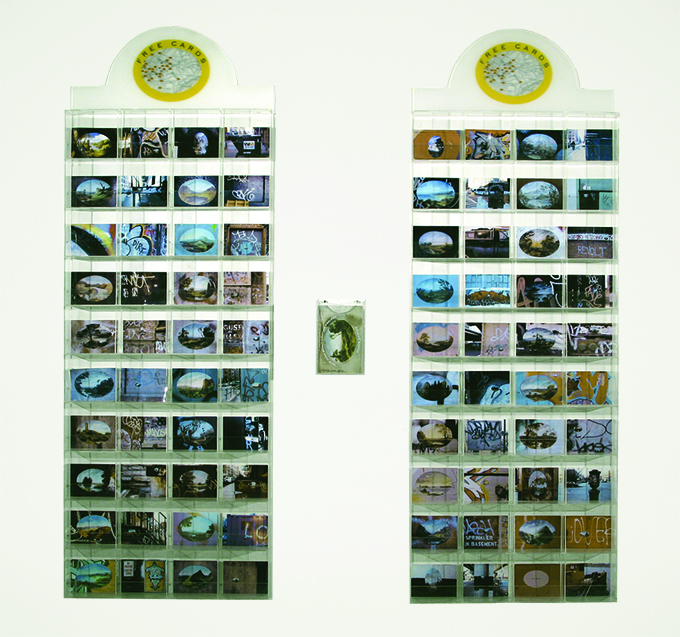
When I was done painting, I made postcards and a map of the project, just like any other New York attraction. I showed the postcards in plexiglass display cases that were made on Canal Street in one of the plastic shops there. They’re about two feet wide and six feet high.
Ellen Harvey is a British-born Brooklyn-based conceptual artist whose work ranges from guerrilla street interventions to immersive institutional installations to large-scale public artworks. Her work is painting-based but utilizes a wide variety of media and participatory strategies to explore a variety of reoccurring themes such as the social and ecological implications of the picturesque, the revolutionary potential of ornament, the potential detoxification of nostalgia and the role of art and the artist in our society. See more of her work at ellenharvey.info.
Categories: art, featured, featured artist, Photo Essay, photography

 magpiesmagazine.com