

To this day it seems that there’s an enduring sense that it’s a remarkable feat for a woman to play an instrument. Why is this? Is it because women’s inept and girlie fingers aren’t (or shouldn’t be) strong enough to play a barre chord on a guitar, or press the keys on a trumpet or bang a drum with wild abandon? Is it because our brains just aren’t technical enough to understand the complexities involved with mastering the skill? Is it because our job is to be the pretty face and voice of the band — the talentless candy? I imagine that it’s a competitive old job for male musicians to make a name for themselves, and women have the entire degrading and exploitative history of their existence in our society to vie with on top of that.
But all the same and notwithstanding, the history of music is peppered with women who play instruments well. Really really well. As well as any man. For these women, it often wasn’t a question of Can I do this? Am I allowed to do this? It was often a situation in which this ability brought them a necessary joy. Or this pleasure in creating something beautiful was a part of being alive to them, a part of what defined them, and they would pursue it by any means.
From the early days of the 20th century, girl bands have been seen as something of a novelty, whether they were big bands, swing bands, rock, or pop bands. But that doesn’t take away from the fact that these were accomplished musicians. For a woman to branch out from there and play with male musicians, who naturally were taken more seriously, was seen as a different level of success. I like to think that whatever form it took, playing an instrument well, playing it with others, making something beautiful together, was sustaining to them. As it is to us to hear it now, however many decades later.
This is not an exhaustive list by any means, and I didn’t include some of the women I’m more familiar with, like Memphis Minnie or Sister Rosetta Tharpe. These are also often taken from live performances rather than recordings, so they might be abbreviated, and you can hear snatches of dialogue as when a drummer is introduced as “our very charming little drummer.” Many of the performances are worth watching, and all of these stories are worth pursuing, so I apologize in advance for the aesthetic evil of YouTube and Wikipedia links.
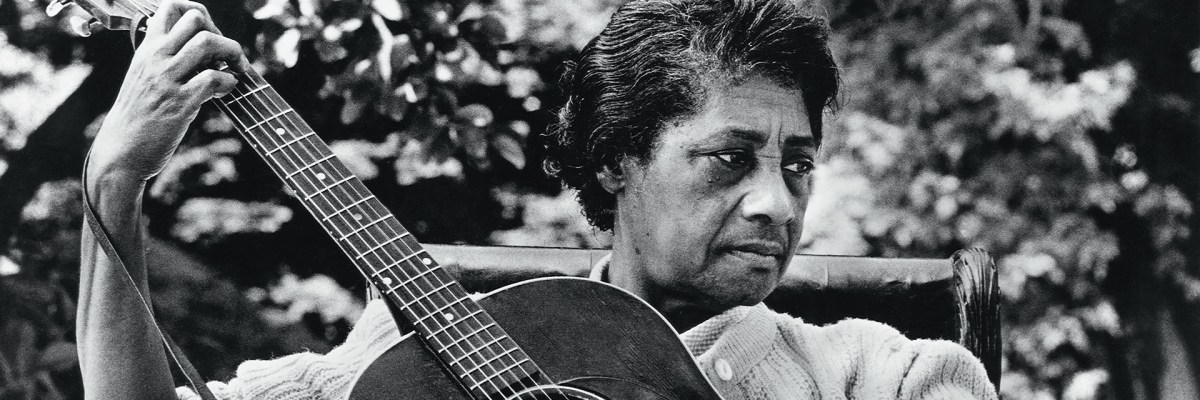
Elizabeth Cotten, born in 1893, taught herself to play guitar upside down because she was left-handed, so she played the bassline with her fingers and used her thumbs to play the melody. She had as sweet, sincere, and beautiful a sound as any guitarist who has ever played. She quit school as a child to work as a maid, but her mother saved up her earnings to buy her a guitar. She gave up the guitar after she married at 17, and rarely played again for decades until she worked for the Seeger family as a housekeeper and was “discovered” by them. Here’s Elizabeth Cotten on Rainbow Quest, telling the heartbreaking and hopeful story of how she met the Seegers because she worked for them as a cleaning lady and cook, and Pete Seeger’s step-mother discovered that she played the guitar, though she hadn’t played in years.
You might not know it, but you’ve heard Carol Kaye‘s bass playing many times. She was born in 1935, started her career as a guitarist, and switched to bass when a musician didn’t show up for session work. She played on Sam Cooke’s Summertime, electric bass on Nancy Sinatra’s These Boots Are Made for Walkin‘, Glen Campbell’s Wichita Lineman, and literally thousands of others. She worked with The Beach Boys, Quincy Jones, and Phil Spector, among many many others.
Pauline Braddy Wiliams, born in Mississippi in 1922 played drums for the International Sweethearts of Rhythm and a variety of other bands, and her solos were often considered the highlight of the show
Algia Mae Hinton, born in North Carolina in 1929, learned Piedmont-style guitar picking from her mother and buck dancing from her father. She had seven children and worked as a field laborer. She was “discovered” by folklorists in the late 70s.
Caterina Valente plays guitar, speaks six languages, and sings in seven. She was born in Paris in 1931, worked in both Europe and the U.S., and performed with a host of musical personalities.
Viola Smith lived to be 107, from 1912 to 2020, and she drummed until the end. She was a kick-ass drummer who performed in swing bands and orchestras. She wrote an article for Down Beat magazine in 1942 called Give Girl Musicians a Break!
Melba Doretta Liston, born in 1926 in Kansas City, played trombone and composed and arranged music. She taught herself to play trombone, and when she was 14 she started playing music with Dexter Gordon. She played in Dizzie Gillespie’s big band with John Coltrane, and toured with Count Basie and Billie Holiday.
Shirley Scott, born in Philadelphia in 1934, was known as the Queen of the Organ. She played the Hammond B-3 organ and the piano and recorded with Eddie Lockjaw Davis and Stanley Turrentine.
Dolly Jones, born in 1902, was the first female jazz trumpeter to be recorded. She worked with Josephine Baker, Ma Rainey (as a trombonist), and Lil Hardin Armstrong. Her mother was a trumpeter who taught Dolly and Valaida Snow, the Queen of the Trumpet, who was born in 1904 and played cello, bass, banjo, violin, mandolin, harp, accordion, clarinet, trumpet, and saxophone.
Honey Lantree, born in 1943, was a drummer for The Honeycombs, and the only female member of the band. She was born in 1943 and was one of the few women to play in a 1960s beat band. She did not want to be called a gimmick or a pioneer, she just wanted to play drums.

 magpiesmagazine.com
Now that I think of it, three more amazing guitarists deserving wider recognition:
Sister Rosetta Tharpe – a tremendous gospel singer starting out in the ’30s, who was also an early proponent of distortion on the electric guitar.
Mary Osborne – a soulful and subtle jazz guitarist who wasn’t recorded enough (there’s a wonderful video of Billie Holiday watching her solo.)
Emily Remler – an artist whose star was really ascending in the jazz world until her untimely death at age 33 in 1990.
LikeLike
Ah, thanks! I had mentioned that I wasn’t going to mention SRT, but I do love her! I’ve never heard of Osborne or Remler, though, and I will certainly check them out! Thanks so much.
LikeLike