


Walking the hot streets of town one Fourth of July a few years ago, I came across a basket of GI Joe figures in front of an antique store. It immediately brought to mind the movie Marwencol, a fascinating, absorbing documentary — the kind you think about for a long while after you’ve seen it. The film, directed by Jeff Walmberg, tells the story of a man named Mark Hogancamp. After being beaten and left for dead by five men, he emerged from the hospital 40 days later with little memory of his previous life. He healed himself by building a remarkably realized model of a WWII-era Belgian town, which he called Marwencol, and then by taking remarkable photographs of the town, preserving the world that he had made, saving the story, protecting the shifting memories.
When you can’t get the movie out of your mind and it’s Independence Day in the States, the story of Mark Hogancamp becomes a sort of allegory for America’s struggle for independence. In the face of violent intolerance, Hogancamp created his own country, with its own rules. The country, Marwencol, is hopeful, frightening, imperfect and evolving, and it’s the place where Hogancamp can escape from the physical and emotional reality of who he is, to be a different, better version of himself. And to pursue the justice that eludes him in the old world — the real world. Because the America he lives in — that we still live in — is far from the ideal of a country in which tolerance is a governing principle.
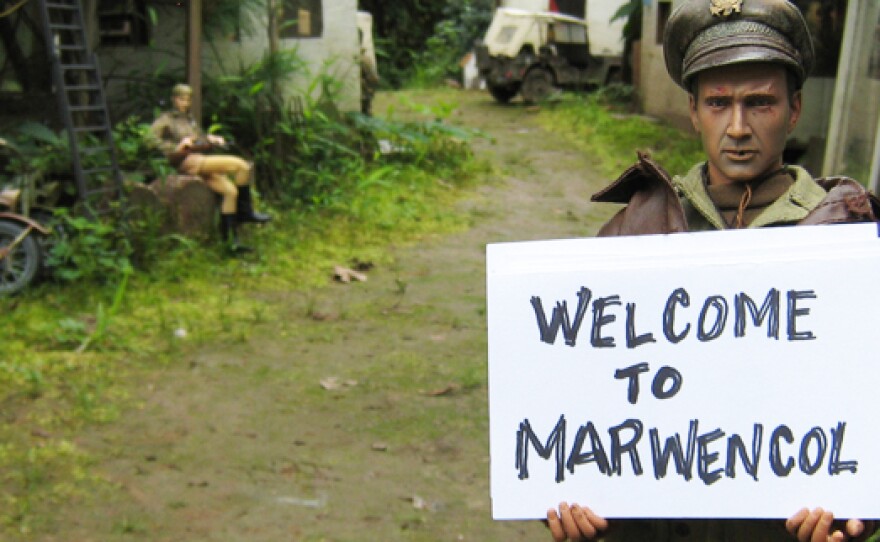
Hogancamp is a true American eccentric, just as the people who first came to America must have been, and the people who created our country, and those who forged a path out west, surely were. He’s a flawed, brilliant, pessimistically-hopeful, demon-haunted world-builder. It’s the creativity and passion attached to his eccentricity that makes his new world possible. And the story of the new world is beautiful and hopeful, but it’s also violent and disturbing at times. The documentarians who made Marencol did well respecting the value of this world to this strange and secretive man: Both the filmmakers and Hogancamp himself wonder if his world will still be his if he shares it with others. And the film leaves you with many questions, and a sense of disturbing injustice, as does the history of our country.
We haven’t made a lot of progress as a nation. Every step forward towards justice is met with an ocean of backward stumbles. Intolerance and stifling convention are twined so deeply in our fabric that we can’t even see it. But our eccentrics will remain, showing us who we are and how we act, reminding us of our brittle crippling vulnerability and of our strange enduring strength. The connections must be more powerful than the divisions, and in part Marwencol is a story of acceptance and of community, because the world that Hogancamp creates contains his friends and neighbors in versions of their own selves, as well. And they are fine with that, they embrace it.
Of course, the story of Independence Day is the struggle for freedom, just as the story of Marwencol is Hogancamp’s quest for freedom to be who he is and from all that he’s lost. In a powerful live performance of I Wish I Knew How it Feels to Be Free, Nina Simone, another true American eccentric genius, talks about what freedom means. She says it’s freedom from fear, it’s a new way of seeing something. There’s a line in the song in which she says that freedom means feeling a “little less like me.” She’d learn to fly, and she’d look down and see herself, and she wouldn’t know herself. She’d have new hands, new vision. This is what I am thinking about on the 4th of July — eccentricity, creativity, the freedom to create a world for yourself and reinvent yourself. A new way of looking, and of seeing. All of this is part of our origin story as it will be a part of the story we continue to tell.

Categories: art, featured, film, photography

 magpiesmagazine.com