

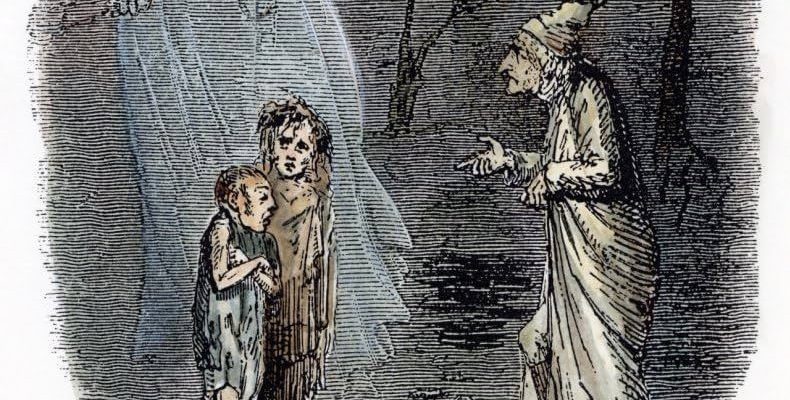
‘They were a boy and girl. Yellow, meagre, ragged, scowling, wolfish; but prostrate, too, in their humility. Where graceful youth should have filled their features out, and touched them with its freshest tints, a stale and shrivelled hand, like that of age, had pinched, and twisted them, and pulled them into shreds. Where angels might have sat enthroned, devils lurked, and glared out menacing. No change, no degradation, no perversion of humanity, in any grade, through all the mysteries of wonderful creation, has monsters half so horrible and dread. …
‘They are Man’s,’ said the Spirit, looking down upon them. ‘And they cling to me, appealing from their fathers. This boy is Ignorance. This girl is Want. Beware them both, and all of their degree, but most of all beware this boy, for on his brow I see that written which is Doom, unless the writing be erased. Deny it!’ cried the Spirit, stretching out its hand towards the city. ‘Slander those who tell it ye! Admit it for your factious purposes, and make it worse. And bide the end!'” -Charles Dickens, A Christmas Carol
As we come to the end of another whole rolling year (and what a sea-sickeningly rolling year it’s been), it would be lovely to wrap ourselves in the Dickensian spirit that is comfort and joy, fellowship and cheer, carols and goodwill to all. But as the year comes to a close and we reflect on what we’ve done and loved and admired, what has moved and inspired us, and what we’ve wished for in the past and what we hope for the future, we find ourselves, again, in an infuriatingly dark and unjust place. The powers that be in this blighted country are busily paving their road to hell, tripping over themselves to achieve Swiftian levels of self-satire.
Ignorance is not an accident. It doesn’t suggest a lack of intelligence and (like want) it is not an unavoidable situation; it is a tool. A technique to keep people uninformed, uneducated, misled, and misdirected. A tool that people use for their factious purposes, as they make it worse. A tool to spread divisiveness and ill will. It is a tool to ensure that those who want are always wanting and the wealthy always become wealthier.
But I don’t need to tell you about this. I don’t need to tell you about the dismantling of the Department of Education. I don’t need to tell you about the takeover of media, television, print, social, and all means of communication. I don’t need to tell you about the arrogant and inept but strangely successful machinations of covering up and erasing any disturbing news, any culpability. I don’t need to tell you about redactions and cover-ups, journalists attacked, stories pulled from the news. I don’t need to tell you about this injustice and how powerless it makes us all feel.
So sadly, it is Dickens’ warning that resonates with me now, as well as his blistering rage, which seems to make this measured and articulate writer spit out half-sentences, with mysteriously chipped language. It’s interesting to me that he framed ignorance and want as children — it seems almost cruel to warn us against these poor pathetic creatures. And if we’re going to carry on his metaphor, we have to admit that these children are not accidents; they are monsters of our own creation. We must see that it is our neglect of them and our cruelty toward them that has brought them to this state. And so it’s back to what has, I guess, become my mantra. We should care for all people as if they are children, and even as though they’re sick children, and we are all somebody’s child.
Because the story of A Christmas Carol has become so familiar, it’s easy to forget how strange and wild and beautiful it is. This second spirit, this cheerful, kind, and melancholy ghost of Christmas Present, takes Scrooge to “…almshouse, hospital, and jail, in misery’s every refuge, where vain man in his little brief authority had not made fast the door, and barred the Spirit out, he left his blessing, and taught Scrooge his precepts.” And the spirit ages as he does so, quickly, perceptibly, and his life is over at the strike of midnight. He teaches Scrooge (and us) about the important work we need to do, and he teaches us about the frightening, inevitable rate of the passing of time. And they pass through Scrooge’s past and present and future mingling with shadows, shifting like memories, urgent and just out of reach.
As some spew the hypocritical claim that the meaning of Christmas lies alone in saying the words “Merry Christmas,” with some odd sort of self-righteous little-mindedness — words which are sadly empty without any thought or feeling behind them — this message of the spirit resonates, “‘There are some upon this earth of yours,’ returned the Spirit, ‘who lay claim to know us, and who do their deeds of passion, pride, ill-will, hatred, envy, bigotry, and selfishness in our name, who are as strange to us and all our kith and kin, as if they had never lived. Remember that, and charge their doings on themselves, not us.’”
Luckily there’s some comfort in the fact that we’re all in this together. Dickens makes it clear that these are everybody’s children, this is everybody’s responsibility, and we have to work together to make it right and keep it right. And he gives us hope for redemption: these are not the shadows of things that must be, but the shadows of things that may be, only. We must look out for the good spirits, and listen when they speak to us, and try to find the meaning in the shifting shadowy light and darkness. Try to find some hope despite the times.
Well, thus endeth my Christmas address, and I only have left to wish cheer, comfort, peace and joy to fellow magpies throughout this whole round globe.
Categories: featured, literature

 magpiesmagazine.com