

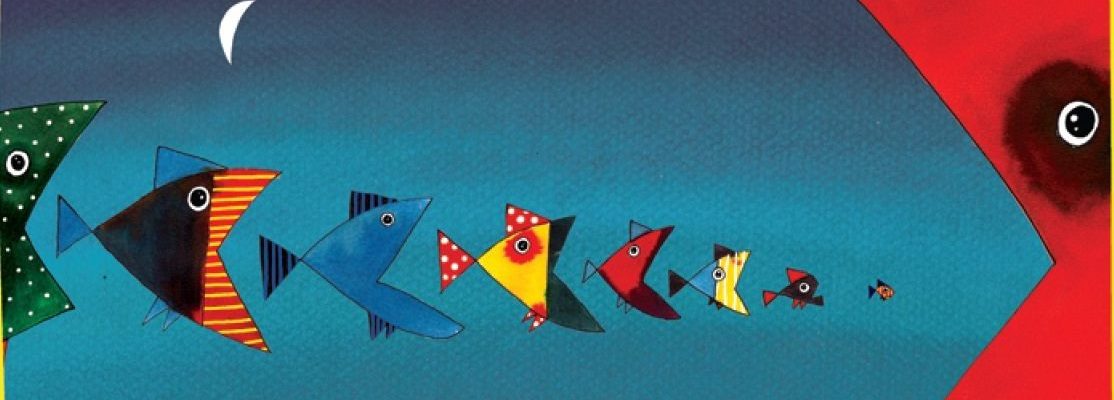
Manu Chao and friends.
Back at the turn of the century, I worked for a print newspaper in Boston. The best thing about the job, other than the cool, weird people who worked there and the fact that I could bring my dog to the office, was the free concert tickets and advance CDs. That’s where I caught my first glimpse of Manu Chao’s Album Proxima Estación: Esperanza. The very cover art was like a burst of mysterious energy: bright colors, strange pictures and symbols, song titles in about five different languages. This was before the internet was invented, so I didn’t know that much about Manu Chao (except that an intern who had just spent a year in Paris said he was all the rage there), but I knew I loved it.
The songs had a contagious energy, but there were a lot of sweet and thoughtful moments as well. The music was strangely vibrant and world-weary at the same time. Melancholy and irresistibly cheerful, bright and shadowed. And the songs were, indeed, in English, French, Spanish, Arabic, Galician, Portuguese, Brazilian Portuguese, and Mexican Spanish. Manu Chao, in his many different iterations, is one of those things that’s popular just about everywhere in the world besides the U.S. But I feel like we need his music now more than ever. We’re in a dark tunnel at the moment in this country, but maybe just maybe Proxima Estación: Esperanza — next station hope.
Chao’s parents are Basque and Galician, and the family moved from Spain to Paris to escape Franco’s dictatorship. So he grew up speaking or hearing Spanish, French, Galician, and Basque, and he also sings in Catalan, Italian, Portuguese, Wolof, and other languages as well. He’s a true polyglot, and his music reflects his international influences. His early bands, Los Carayos and Mano Negra, were also heavily influenced by punk and rockabilly, and they were big fans of The Clash. Once Mano Negra broke up, he toured with a band called Radio Bemba Sound System, made up of musicians from other bands like Tijuana No! from Mexico, Skank from Brazil, and Todos Tus Muertos from Argentina. The group traveled through South and Central America for several years soaking up the sounds of local street and bar scene music everywhere they went, and the songs often have a ska or reggae influence with hints of Algerion rai, salsa, and chanson. I met someone who traveled on the bus with the band and it sounds like a true musical pilgrimage. He describes his style as patchanka — patchwork — and the result is beautiful and full of life and warmth. He has been described by punk historian Vivien Goldman as the punkiest of artists because of the inclusionary spirit of his work.
All of the musicians he’s worked with and the musicians they work with and their side projects and collaborations seem to be political to the point of revolutionary, with the issue of human rights, in all of its various forms — social inequality, poverty, education, immigration — front and center in the music. Throughout, the music is vivid, tender, generous, and good to dance to. He has a rare and wonderful collaborative spirit, and he’s worked with musicians from so many different countries and musical styles. One song, called “The Merry Blues,” seems to sum up much of his music and the music of the people he works with (like Toots Hibbert, who collaborated on a version of the song). We know that things aren’t perfect, we know there’s sadness in the world, but we will remain cheerful and devote our energy to changing what we can.
This playlist represents a broad mix of music that Manu Chao made, collaborated on, or that bandmates from various stages of his career made or collaborated on. It’s a sprawling, multi-lingual patchwork of a playlist, but hopefully it captures the energy and power of the music and the ideas behind it.
Categories: featured, Magpie Mix Tape, music

 magpiesmagazine.com
Looks great! I will isten to this later. Not a musician, but your description of his multi-lingual upbrigning reminded me of Jaime de Angelo, on of the most astounding members of post-war bohemia in California https://www.angelfire.com/sk/syukhtun/Jaime.html
LikeLiked by 1 person