

By Robert Beck
So It Begins
“Come, Watson, come!” he cried. “The game is afoot! Not a word! Into your clothes and come!”
I love that opening by Arthur Conan Doyle. A sharp command from one who has been brought to feverish distraction by the chance to function at a high level. It’s been sixty years since I first read that line, and it still delivers the mystery, immediacy, and excitement of Sherlock Holmes grabbing his coat, hat, and cane from the hall rack and rushing out the door without as much as a glance at Watson as he speaks. I know that feeling. Every artist knows that feeling. Things come together out of nowhere, and you suddenly find yourself up on the horse at a gallop.
I have two painting modes: life and studio. When I work from life I’m recording my reaction to something. There are problems to solve and a time limit. Information presents itself, and I deal with it. Painting from life fine-tunes my understanding of the world around me and how to describe it. I can do it any time I want to.
My studio work originates within, and I must wait for several things to come together. I’ll make some chance connections among the many thoughts running in my head, and bang, there’s that horse again.
Ideas can gestate for months or years before I know I’m on to something, and even then I‘m not sure what I’ll have when I’m done. I start when I’ve got enough to launch. At that point, I can’t talk to anybody about my idea or it lets gas out of the bag. I do small sketches to determine composition, but not much more. I don’t want to uncover any big truths in the preliminary work; I want them to be found in the painting. That might not be the best way, but it’s how I keep engaged.
When you paint as a hobby, time and energy are at a premium. You might look forward to Saturday morning as free time to create, but when the weekend comes, something else has to be taken care of, you are distracted, or you’re just not up to it. That happens to professional artists too, but we have more time to work with and can make adjustments to suit opportunities and enthusiasm. Still, that time and energy need to be managed.
Preparing to paint involves focus and clarity. Plein air has an urgency, while studio work requires a calculated ramping up. There is no telling how long a drawing and possibly a monochromatic underpainting will take, so I need to clear out an entire day. I like starting early in the morning when the world is quiet, and things still feel cozy. It’s best if I haven’t read the news. Maybe I’ll start a fire in the wood stove. I’ll put out the colors and select brushes, but I won’t begin right away. I’ll go through the plan in my head with a cup of coffee. The experiments, risks, and unknowns need to be anticipated in a controlled way so that I can learn from mistakes without losing the entire image.
It’s essential to maintain a positive inertia during what can be a four or five-day process. I end each session at a point when I’m enthusiastic about what I’m going to do next. I don’t want to walk away from the easel angry or discouraged because then it is easy to lose the force. The painting is done when I can’t move it forward in a meaningful way.
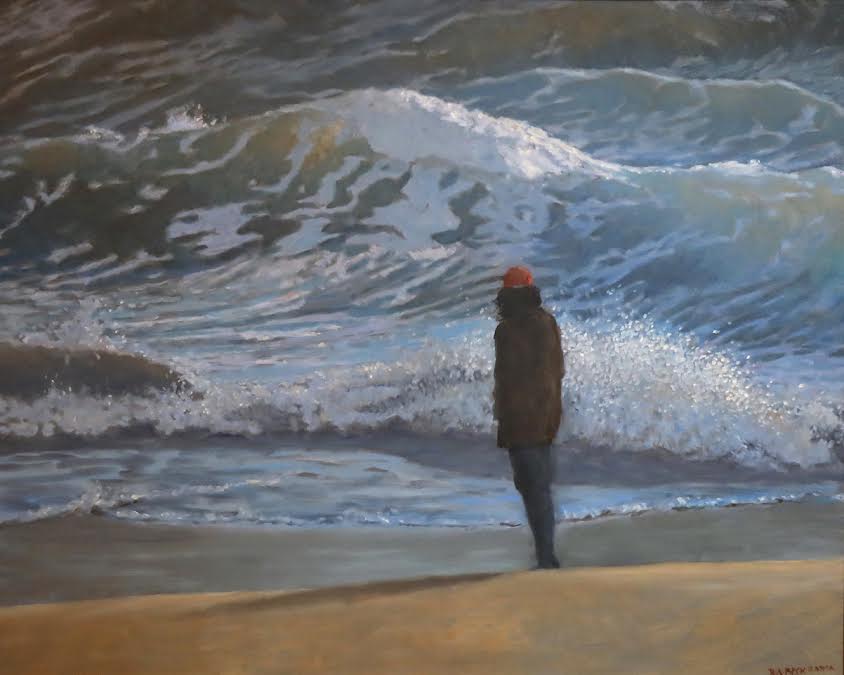
This image came from the desire to describe the crush of the waves at the shore. You feel and hear the surf from a distance. The force is under your feet and in the air, powerful and unnegotiable. The ocean chooses colors to match its mood. It changes its mind. It’s never still.
This perspective puts the painting’s viewer at a distance, emphasizing the size and might of the surf and leaving the figure alone in her contemplation. The woman was a decision I made after the rest of the painting was in place. I wanted a heartbeat. Not someone fishing, walking, or playing. No blankets or umbrellas. A person, bundled against the strength of the sea.
It’s not difficult for me to decide when a painting is complete, but that doesn’t mean I’m done with it. The finishing phase can be most gratifying. If the construction is sound, the final brushstrokes can be magical, but detail isn’t content, and a stroke too few is better than too many. In subsequent weeks, I might take time to look at it and see what I’ve done. Or in this case, listen to the waves.
Robert Beck is a painter, teacher, curator, lecturer and writer who divides his time between Bucks County, PA and New York City. See more of his work at Robertbeck.net, on Instagram @illhavecoffeethanks, and on Facebook .

 magpiesmagazine.com