

By Robert Beck
I received an email from Lise telling me her father died. I wanted to go sit on a tree stump in the woods somewhere and process everything that meant to me, but I was in New York and my only choice was Central Park. That’s not the raw, natural setting I was looking for. Not a lot of solitude on a warm spring day. No stumps.
I met Lisa’s parents through the church my mother joined when we moved to Pennsylvania from New Jersey. I was about 14 years old, and George and Erna ran a youth group, regularly hosting a handful of kids at their home. They had two children of their own, and a few years later a third. I continued to visit them long after the group ceased to meet. It wasn’t a religious thing. It was a needing people like Erna and George in my life thing.
My memories with them include not just good moments but important ones. When I first watched the “Teach The World To Sing” Coke commercial at their house and made some ignorant, youthful remark about it, they questioned what I meant, without rebuke. It changed how I saw things. More than addressing equality and morality, it was a lesson in mentorship and parenting. A demonstration of how much can be accomplished with some love, respect, and attention. It was not how my family worked. That functioned on the Seen And Not Heard operating system, which had a wall to be negotiated between parents and children.
It was the Viet Nam era, and I spent an evening at their house watching the televised Draft Board lottery drawing that would determine what the rest of my life might look like, and perhaps how short it would be. It was a sobering, scary time, and I wanted to be in a safe place with people I loved. When my lottery number put me beyond harm, we broke out the guitars. So many nights on their couch being part of a family. Yule logs at Christmas, badminton on the 4th of July.
One day their son came home from school and found Erna on the bed, breathing erratically. She was taken to the hospital where she died of a brain aneurysm. I was in my early twenties and it was difficult to understand and to know where to put my feelings. That period marked a change in orbits. I moved out of my house and became self-sustaining. George, who had three children to care for, eventually married again, to Pauline, who had four kids of her own. They bought a gentleman’s farm north of Doylestown (sheep, horses, chickens), and I stayed there at times to keep things running when they went on trips. But the whole dynamic had changed. There were no more evenings of patience and wisdom. No more breaking out the guitars.
By the time I was 30, I had moved away, and life was different for everybody. I’m not good at maintaining relationships that don’t have current relevancy, and contact with George was sporadic. We heard from each other every few years. They showed up at an exhibition reception in ‘99. That was the last time I saw him. Twenty-plus years ago. Now he is gone, too.
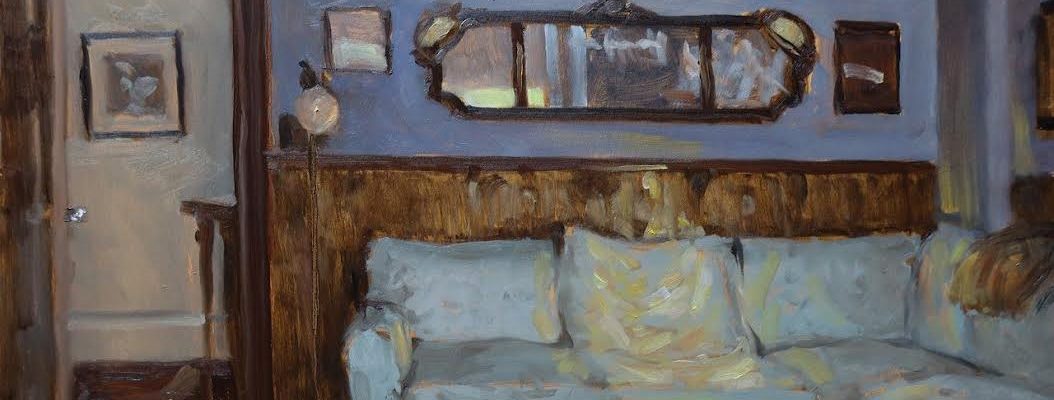
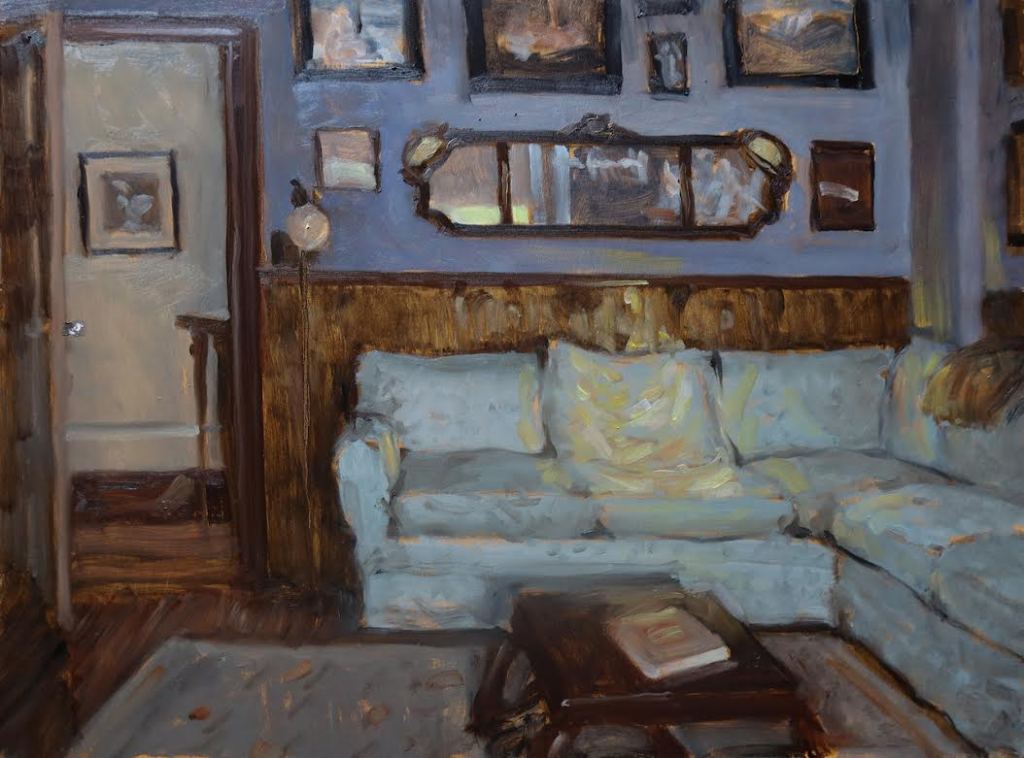
I sat at my desk looking out at the overcast dawn sky, thinking about the person I considered a surrogate father, and wondering where I was going to find a place in the city where I could just be alone, be quiet, and have a conversation with him. Then the sun broke through the clouds between the buildings on the East Side, reflecting off the cabinet doors behind me, casting a golden light toward the end of the room. A person-size section of the couch grew luminescent in the morning dimness. I’ve never seen that before. It gave me the chills.
I framed the first paragraphs of this essay with that glow in the corner of my eye. It eventually faded and was gone, but the experience stayed with me. There was a stillness and peace in the room. Whatever had happened—the way the clouds moved, where the light shone, what was going through my head, that radiance—was another chapter in a story that began a half-century ago. I pulled my kit out of the closet and set up to paint before it all wore away. Maybe it was just an unusual coincidence. Or maybe George stopped by to leave me with something to consider. This painting, for instance. It wouldn’t surprise me a bit.
Robert Beck is a painter, teacher, curator, lecturer and writer who divides his time between Bucks County, PA and New York City. See more of his work at Robertbeck.net, on Instagram @illhavecoffeethanks, and on Facebook .

 magpiesmagazine.com