

By Chimezie Chika
I
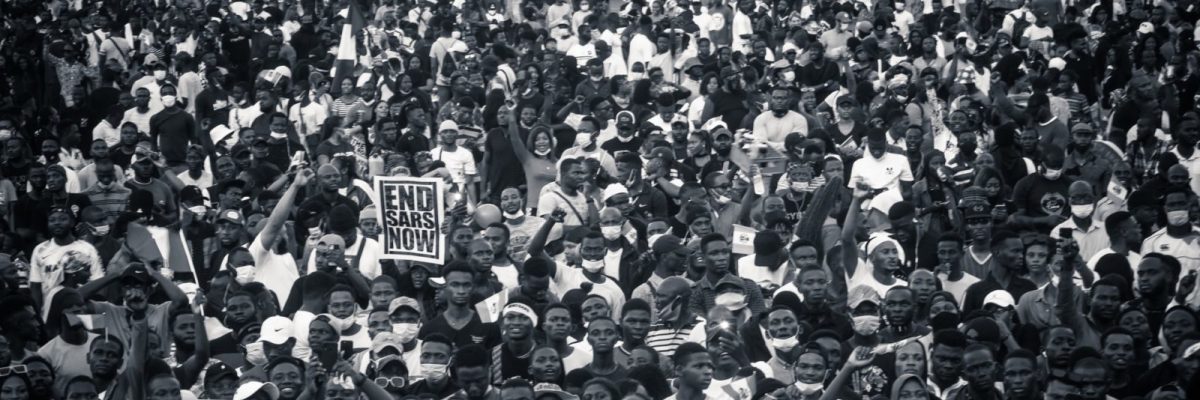
In her three poems published in Grit: The Northern School of Writing Journal, Nigerian poet Wendy Okeke uses the dark recent past of political failure, youth angst, and government violence against its own citizens as a point of entrance in poems that resonate with sensuality, self-affirmation, and a continuous search for freedom. These were some of the main markers of the cataclysm that rocked Nigeria in 2020 when the unanimously rousing, and subsequently violent, #ENDSARS protest took place. The protest began as a result of the growing discontent of Nigerians over the murders, harassment of youths, and other issues, resulting from the violent methods and behaviors of members of the Nigerian Police formation, SARS (Special Anti-Robbery Squad). Fed up with the group’s unchecked violence, especially with the murders (it was reported in several instances that SARS were known to kill in police custody and bury their victims in unknown locations) and harassment of innocent for having dreadlocks or using iPhones, Nigerians took to the streets to demand the dissolution of SARS—an act that proved to be arguably the largest civil protest the country had ever seen, spreading all over Nigerian cities in a systematic way, and maintaining its intensity for months. By October 20, 2020, soldiers opened fire on protesters at the Lekki Tollgate in the city of Lagos, killing and wounding dozens, a tragedy that the government initially denied authorizing (evidence emerged later that the government had indeed given the order to the army to commit what is now known as the Lekki Massacre).
In the first poem, “In the Middle of the END SARS Protest”, Okeke writes auto-referentially of the unfortunate events described above. But this is interpolated into the dark, intractable complexes of a relationship struggling to keep itself afloat as violence dominates in the background. The poet has a way of bringing the personal and political together in strikingly antithetical images. An example is the beginning of the poem:
We get out of the bedroom. Smoke hanging tightly to our hair. They outpour into your cold room, a revival.
As the speaker in the poem tries to negotiate a relationship that seems to acquire a new meaning as the ENDSARS protest intensified,—note the word, “revival”—her intimate relationship is placed side by side with the events around it. The revival is the urgency that the relationship takes, as if the lover knew that the end is imminent. (In the poem, the tone of the speaker indicates that she is retrospecting with greater wisdom than she had at the time; the urgency of the relationship appears to be a direct reference to end of the world; that is, for the speaker, looking back, it seemed that a great change—the end of an era as it were—was imminent in the political arena and the relationship embodied it.) Smoking was a lonesome indulgence before she met her lover; afterward it became an activity upon which they bonded—it became “a ritual and sometimes a revelation.” The subtextuality of layered meaning hanging in the poem makes it highly personal. The conscious reader would immediately see that the word “revelation” here projects more than we are able to deduce at first glance. We will get to that point however.
In the following cataleptic lines, the poet’s tendency to interpolate imagery—of personal relationship and ENDSARS, of love and violence, of sensuality and the quotidian—takes center stage.
Today, sitting next to you, hands clasped under the on
the soft soddened bench. Bullets run loose,
piercing the dark October. Your fingers whisper
against the hair on my skin.
Let’s take this inside. Tonight’s game is to the
death. I am learning a new trick. I hear
everything you say in an old Lauyrn Hill tune.
And thus these highly sensual lines hurtle on. We will particularly notice the speaker’s desire to escape the present with love-making. While “bullets run loose” outside and pierces “the dark October”—(recall that that the ENDSARS protest reached its climax in October 2020)—the speaker chose to gratify sexual desire for her lover; she seeks instead to escape aching reality, in other words, through sex. But even the freedom she seeks through love-making finds a way to corral the violence around (instances: “…dazed by the euphoria of longing and/ fucking. Our hands do not know where to settle./Much like the protesters. We do not have our/fists in the air”. “We are aching through our fear”). Sex, like smoking, is a game of sorts, but it is also a violent game that could also lead to death, for making love in those circumstances could put one unwittingly in the line of fire. Thus, a game to the death. The reference to Lauryn Hill consolidates the immersion in love as a way to seek personal freedom.
The persistence of framing love-making as an act as violent and necessary as the public protest for freedom by Nigerian youths is both enigmatic and ingenious. It is an affirmation that the attainment of freedom can be both self-destructive and elementally life-giving. In a world where major events are interpreted singularly through a multiplicity of personal views, who’s to say that those who lost their lives are not martyrs of a lost cause but have instead fulfilled a fundamental purpose? Freedom then, for the speaker, is a form of place-death, where a place ceases to exist because of its gruesome or ineffable memories.
II
The great poet and literary critic T.S. Eliot once stated that “the progress of an artist is a continual self-sacrifice, a continual extinction of personality.” Okeke seems to take the first part of this statement in literal terms in the writing of the second poem, “Journey Mercies”, which is more or less an extended affirmation of self-esteem and self-belief. The estimability of the lines, so to speak, lies in the poet’s fetching use of piercing images:
Today, I cut myself open again.
Bleeding into the lines, carved in the sharp corners of the tiles.
This is just a place I have forced my body to stay.
Stray, a loose definition for a thing looking to be found.
Say, no man born of a woman can hurt me.
Here: “cut”, “sharp corners of the tiles”, “forced”, “stray”, “hurt”. These words indicate a sense of loss and violence, which we can assume had been the speaker’s experiences, and which she affirms repeatedly that she will not experience these things again. It seems, too, that she is not only speaking her freedom into existence but has somehow made it happen:
I regenerate as much as I break
That soon I will carry myself to my place
Not where I was spat out, not where I was nailed to
Not where I first started gardening, not even here.
The speaker has mentally freed herself from bondage as it were and migrated mentally as well to a better place. There is also the underlying implication that all these references could be applied to the abusive relationship that many Nigerians are in with their country, and the speaker here appears not to be an exception. Especially, we feel the expansive reference for statements such as “I cannot commit to a thing I cannot fight for.” Thus, her interest, she affirms, is the solipsistic prioritization of the self as opposed to community or alliances with other people.
The third poem here, “Searching for an Orange City” conflates somewhat the insinuations and imagery of the first two poems in its vision of freedom. The poet runs through a gamut of references here to arrive at a rejection of violence, by country and by men. Every line here pulsates with double entendre, it seems. The speaker frames herself as someone on a journey to what she calls an “Orange City”—which we can perhaps understand as a place of immense and sultry sweetness and well-being. But on her way, she endures indignities from men in various places. She affirms now that she is “taking my power” back and shedding her past, after allowing herself to become a tool for a long time.
While the poet acknowledges that the best place for women like her is the Orange City (“There are no lost girls in the orange city. No broken girls. No running girls.”), she paints a gruesome picture of what goes on outside of it—the real world, Nigeria, that is:
Body, shaking from towing weights up a hill.
Crushing under its own deceit. All the ways it is
Attracted to its own destruction. Mine,
Womanhood, fore bearer of sin and desire.
It took 100 rolls of cigarettes, 35 men, 205 bottles of wine, 15 women
14 days in hospital beds, 5 blackouts, 2 deaths,
the entire season of girlfriends.
The speaker’s implication is that life’s Sisyphean bondage can be too much and that sometimes migration happens in REVERSE, and not towards the West. The speaker here is a prodigal who has been down under in the seedy struggles of base indulgences and the violence that comes with them. In this poem she bids farewell to all that, seeking a return home to the innocent bosom of a mother. Home, where a welcoming, non-judgmental mother exists is the orange city of her dreams and vision. It is where she attains freedom.
Chimezie Chika is an essayist, critic, and writer of fiction. His works have appeared in or
forthcoming from The Weganda Review, The Republic, Terrain.org, Efiko Magazine, Dappled
Things, Channel Magazine, and Afrocritik. He currently lives in Nigeria. Find him on Twitter @chimeziechika1.
Categories: featured, literature, poetry

 magpiesmagazine.com