

By John Wreford
City of Roses, the sign announced in French; it was the end of the line. I clambered over the tracks and walked through a busy street market selling second-hand clothes, the vendors shouting the prices, and a gaggle of women rummaging through the brightly coloured garments. The streets were broken, potholed, and dusty. I passed abandoned cars with sleeping dogs making use of the shade.
I deciphered the occasional splash of graffiti: alongside youthful declarations of love and football were vague revolutionary slogans: “Freedom is a Right”, “Liberty”, and “Just when I thought I was out, they pull me back in” Mafia references were common throughout the uprisings.
This was Ariana. Was it a suburb of Tunis or a separate town? I was never really sure. I didn’t see any roses.
This was my first visit to Tunisia. I had come to work on an environmental project 300km south of Tunis, and I really didn’t want to think about the Arab Spring, the Jasmine Revolution, and certainly not about Syria. But I knew very well it would be hard to avoid or ignore.
I had arrived late the previous night. I had agreed to pay the taxi driver double the going rate from the airport, so he threw in a potted history of the last 13 years. Things were grim. We drove through the unlit side streets looking for my accommodation. The car moved slowly, using both sides of the street to avoid obstacles. There were few other cars and fewer people. “The problem is the drugs,” the driver was telling me, “it makes everyone crazy. And the migrants… the trouble with the migrants,” he said, “is if you beat them, you get called a racist. Don’t go out at night,” he said for the second or third time and drove off, leaving me standing in the glow of the only working street light.
In the blinding morning sun, I blinked and squinted at the street sign. The light was harsh, but surely I was not imagining the name written in Arabic and French: Rue Assad Ibn Furat. It was still early, and my brain was still clouded in the fog of late-night travel, but my translation must surely be correct. My new address seemed to be Assad Son of the Euphrates Street. This made no sense to me in the slightest; I must be mistaken. I was, obviously. How could a street in Tunisia be named after the Syrian dictator? And, of all rivers, could Assad be the son of that one?

I walked off in search of the metro, my mind fumbling over the various connotations. I passed the Assad Ibn Furat Mosque as I walked. “Haunted” was a word that came to mind, and since, as usual, I had no internet data, Google would be of no help.
Needless to say, he was not that Assad but a prominent 8th-century Islamic scholar, but I didn’t know that each time I passed, twice a day, muttering under my breath.
The weight of my time in Syria may be less than it was, but it still sits uncomfortably on my shoulders. I had plenty of time to kill in Tunis and really only wanted to discover a new city, one I knew very little about, just recent political events and the Arab historian Ibn Khaldun, so I decided to focus my attention on one of the most celebrated thinkers of the Muslim Middle Ages. A bookshop and café was my to-do list.
Perhaps not so well known outside of the Middle East, Ibn Khaldun gave us *The Muqaddimah: An Introduction to History*, that is, the study of history, sociology, demography, and so much more. He was a clever bloke, an ambitious over-achiever, and an avid traveller. I was keen to meet him.
Avenue Habib Bourguiba has the strongest whiff of Tunisia’s colonial past, a wide boulevard of pavement cafes and arrogant waiters. According to the Tunisian tourist website, it’s a mirror that reflects its history, civilisation, and tolerance, although judging by the prolific police presence, the tolerance level may not be so high. I dipped into Al Kitab bookshop, perhaps the most prestigious of bookshops in Tunis, and acquired what was needed.
Further along the street, I met the man himself. With an austere gaze, he stood, lofty as he should, his mood clearly influenced by the surrounding barricades, armored police cars, and the ubiquitous plastic “I heart Tunis” sign. Flanked by the Cathedral of Saint Vincent de Paul on one side and the French embassy on the other, photography, as is often the case in the Middle East, seemed iffy at best. I considered approaching the soldiers taking shade under a picnic awning but decided against it. Tunisia has had its fair share of terrorist incidents in the not-so-distant past, and the French are considered complicit in the ongoing slaughter in Palestine, a statement made clear in French graffiti along a school wall in a neighbouring street. God forbid anyone attacks the “I heart Tunis” sign.
On the edge of the Medina, I settled into a wicker chair, ordered a coffee, and started to turn the pages of *The Muqaddimah*, slowly. As usual, when in a new city, it’s hard to focus on reading. The square in front of me was buzzing with activity: shoppers and shoe shines, small groups of tourists being ushered left and right, deep-fried doughnuts being Instagrammed. My espresso tasted good. I pondered the similarity between the Bab el Bhar (Gate of the Sea), which stood a few metres in front of me, and Bab Touma in Damascus, both gates situated on the eastern outskirts of ancient cities, both seemingly dislocated from the city walls, both taunted by traffic.

I had allocated an entire day to explore the Medina and hopefully find the childhood home of Ibn Khaldun. Getting lost in the labyrinth of narrow lanes and alleyways of ancient walled cities is a joy not to be missed. The tourists were following a well-trodden path, over shiny cobbled flagstones to the Grand Mosque and various restored houses with ample time to buy fridge magnets, but this is to miss the heart and soul of a living city. Streets were divided into various collected trades: the shoemakers and the shoe sellers, modern and ancient, a continuity of uninterrupted existence. Tunis Medina is well looked after, clean and tidy, every house painted, whitewashed walls and ornate coloured doors with intricate designs, symbolism, and storytelling studded by artisans.

Much is typical of North Africa. I thought of Mahfouz, who described Cairo houses so close together they were like the shoulders of soldiers. In Damascus, they leaned into each other almost touching, the light falling in shafts or puddles, and like Damascus, the Medina of Tunis has become popular with its younger population, restored old houses being used as restaurants and iced cappuccino-serving cafes. I was in my element, wandering aimlessly but not without a sense of sadness for a city I missed.

Ibn Khaldun had spent time in Damascus; he had been dispatched to mediate with Tamerlane, who was camped just outside the city walls in 1400, just as the Syrian opposition had. The siege of Damascus and Timur’s campaign was the last time Syria had seen such destruction.
I had half an idea of calling this piece “The Search for Ibn Khaldun”; how I spent weeks exploring the ancient city for his birthplace, following dead-end leads and exhaustive enquiries, but in reality, I stumbled upon his house by chance no sooner than entering the city. And of all the brightly coloured ornate doors that decorated the city, his was conspicuous in its simplicity, a sombre green, a colour not without meaning in Islam.


“Throughout history, many nations have suffered a physical defeat, but that has never marked the end of a nation. But when a nation has become the victim of a psychological defeat, then that marks the end of a nation.” – Ibn Khaldun
So the so-called Arab Spring began in Tunisia, in a previously almost unheard-of town in the central region of Tunisia. A market trader, frustrated at the constant corruption and bullying by police and officials, eventually cracked under the pressure and set himself on fire. Mohamed Bouazizi was fighting a seemingly losing battle of trying to feed his family, borrowing to buy fruit to sell from his cart and having the fruit confiscated for not paying bribes, a situation common throughout the regimes of the Middle East. I often watched in Damascus as underpaid, under educated, untrained police would drive around filling flatbed trucks with whatever they demanded. I watched many Mohamed Bouazizis plead for their goods, men beg and cry in the streets.
The outrage that followed in the small town of Sidi Bouzid soon spread across the country. Protestors filled the streets, and the security services couldn’t help themselves but shoot to kill, only causing more anger and more protests. The government offered feeble concessions but failed to win over a population that wanted its dignity as well as its freedom. The government collapsed, and the dictator Ben Ali fled. It was that simple. Throughout the oppressive regimes of the Middle East, the template was adopted: streets were filled with screams for freedom and dignity. But the success of Tunisia’s Jasmine Revolution was not so easily repeated elsewhere.
What happened on 17th December 2011 in Sidi Bouzid changed the lives of millions of people: hundreds of thousands dead, missing, displaced, incarcerated, and separated. It also changed my life; it changed the lives of all those closest to me. And believe it or not, I was trying to move on from it, and despite the temptation, I didn’t want to visit Sidi Bouzid.
I did, on the other hand, want to visit Carthage and was bemused to wake up to the news that Mark Zuckerberg was currently wearing a T-shirt which, when translated from Latin, read “Carthage must be Destroyed.” I wasn’t the only one bemused; Tunisia was bemused.
I did, on the other hand, want to visit Carthage and was bemused to wake up to the news that Mark Zuckerberg was currently wearing a T-shirt which, when translated from Latin, read “Carthage must be Destroyed.” I wasn’t the only one bemused; Tunisia was bemused.
I did my research the evening before, a short train ride from the centre of Tunis. I counted and memorised the stations; it wasn’t far, but I like to be prepared. I left very early the next morning to get ahead of the commuter crush. At the station, I was politely informed the trains were not running and I had to take a bus. He told me the number and either waved me away or pointed in the direction I should go. At the bus stop, there was a long queue and several informal groups. They couldn’t all be waiting for the same bus, surely. When the bus arrived, the informal groups rushed the doors, front and rear. The queue shunted forward; if you didn’t push, you didn’t get on. I squeezed myself and my suddenly very large camera bag into the middle section. As the bus moved forward, still more people were trying to board. I couldn’t see out of the windows and soon lost all sense of direction and missed the stop for Carthage. I did know the bus was going to Sidi Bou Said, a pretty hilltop village just beyond Carthage, and so decided to go wherever the bus took me. Carthage wasn’t going anywhere, despite fake Meta rumours.
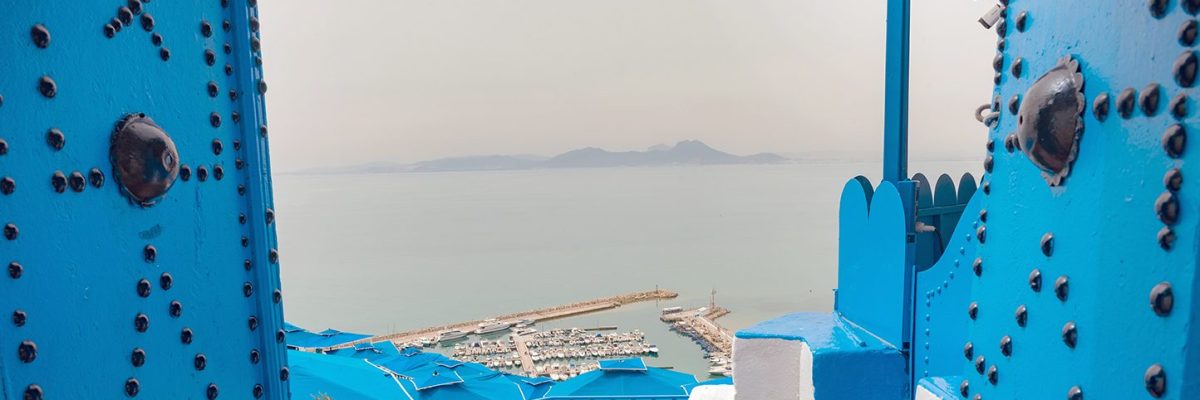
Sidi Bou Said looks like one of those Greek towns on the other side of the Mediterranean: whitewashed walls and blue-painted villas, bundles of bougainvillaea brushing against Arabesque window boxes along cobbled lanes. It was popular for its cafes and restaurants with palm-fringed views over the Gulf of Tunis, but at this still early hour, they were all closed. Still, I counted myself lucky to have the place to myself and the warm morning light. I set about making some images.

Then, in the silent streets, a voice called out “John.” I didn’t know anyone in Tunisia. It took me a second before swinging around to see who was calling me. “Faris,” I said, almost rubbing my eyes in total disbelief. For a minute, we just stared at each other at a distance. He was feeding the street cats, and they were pawing at the bag he was holding. While we had never really been close friends, I had known him the whole time I lived in Syria; we were neighbours. He was one of the first people I met when I moved there and he was one of the last people I saw before leaving. He was a dissident, had always been involved with the opposition long before the Arab Spring. He would often have handwritten placards tucked inside plastic bags as he headed off to court hearings for opposition figures being denied fair trials. In truth, I had kept Faris at a bit of a distance, for obvious reasons.
“John, I have some wine,” he suggested, just as he always did when we met by chance in Bab Shaqi or Shaalan. “Faris,” I said, “it’s only just past 8am, how about a coffee?” “Okay,” he said somewhat reluctantly, but needed to finish feeding the cats. As always, when meeting Syrians, the conversation is about how and when they left. It’s usually a convoluted story. I had known he was struggling to find a way out. Through one of my contacts, we had tried to help him, but it hadn’t worked out. Eventually, he found a way to Jordan and then Tunisia. “I left after the chemical attack in Ghouta,” he said. He lived on the edge of the Ghouta. We had both smelt the gas from previous attacks; it was getting closer. We swapped stories and reminisced. He was happy in Sidi Bou Said, and I was happy to see him.
The fittest got the seats first but always quickly gave them up without hesitation to the elderly. School kids with Hello Kitty backpacks were lost in a forest of legs. With each juddering stop, more people squeezed inside and the air grew thinner. A boy licked his thumb and cleaned the scuffs from his shoes. An old man got on selling chewing gum, as he did every day. He had flowers tucked behind his ears; I watched him pick them from the station master’s flower bed. Patiently, he nuzzled his way through the crowded carriage, passengers putting the straps of his bag back on his shoulders as they became dislodged in the crush.
I spent my remaining days in Tunis commuting back and forth along the overland metro between Ariana and the “Ville Nouvelle,” a journey described by my Airbnb host as a convenient short hop into town. It was hard to imagine that decrepit trains had seen better days, doors that were jammed shut and windows that were stuck open. As passengers dashed over the sun-dried platform in the vain hope of getting a seat, the agile climbed through the glass-less windows. The fittest got the seats first but always quickly gave them up without hesitation to the elderly. School kids with Hello Kitty backpacks were lost in a forest of legs. With each juddering stop, more people squeezed inside and the air grew thinner. A boy licked his thumb and cleaned the scuffs from his shoes. An old man got on selling chewing gum, as he did every day. He had flowers tucked behind his ears; I watched him pick them from the station master’s flower bed. Patiently, he nuzzled his way through the crowded carriage, passengers putting the straps of his bag back on his shoulders as they became dislodged in the crush. And then, to lighten the mood, just as the train was about to depart another urban conurbation, he called out “Silence” as the doors closed and then “Camera” as the gears were engaged. He paused, then “Action,” and the train pulled away. They had heard it many times before, but they smiled stoic smiles nonetheless. I read the station names: Palestine, Mandela, Independence, La Republique; storied titles of struggles past and present.
I travelled south along the coast to the city of Sfax; I had an appointment with a fisherman. As far as I could understand, the cost of a 1st class ticket was only a dollar more than the regular ticket. It was a 300km journey, and my recent experience of Tunisian public transport made me think it could be worth splashing out. The first-class carriage was almost empty; rampant inflation had put even a small step up in comfort out of reach for most Tunisians. The ticket collector spent the entire trip fending off chancers with regular tickets. I stretched out and wrestled with Khaldun.

The sound of Fairuz, cigarette smoke, and coffee: the continuity of Middle Eastern mornings. It could have been anywhere in the Arab world. The café was convenient; the view was uninspiring: a traffic junction and a car repair shop, and directly opposite me, the road sign for Sidi Bouzid. It was still some hundred kilometres away, and I didn’t know how to get there anyway, I told myself. “Booozid, Booozid!” shouted the minibus driver, touting for passengers.
“Just when I thought I was out, they pull me back in,” I thought. The Tunisian nation may have suffered a physical defeat; they have not suffered a psychological defeat. And Carthage will not be destroyed.
John Wreford is a freelance professional photographer based in Istanbul, specializing in images of the Middle East & Balkans. “For ten years I lived in Damascus, Syria where I watched a beautiful country slip into a vile war. I find art, in one form or another to be the answer to everything. My life now is about telling stories of the human condition, the good the bad and the beautiful. More recently I have returned to analogue and historical photographic processes as a medium to help share those stories.“
See/read more at John Wreford Photographer and on Instagram at johnwreford.
Categories: featured, memoir, Photo Essay, photography, Travel

 magpiesmagazine.com