

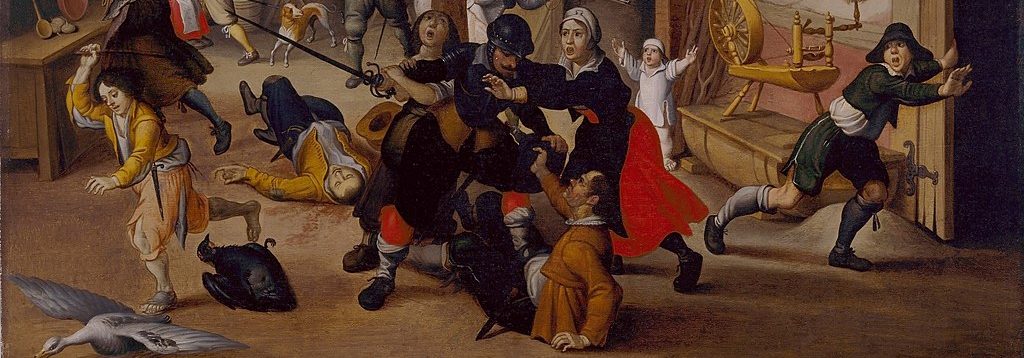
“Parachutists are dropped like bombs, and bombs do not need courage. The thing that would take courage would be to refuse to climb into the plane in the first place.” – Bertolt Brecht
In response to Hitler’s invasion of Poland in 1939, Bertolt Brecht reportedly wrote Mother Courage and Her Children in barely a month, taken by a sort of clear-eyed fever. Though the play was written in response to a specific terrible series of events and though it is set in the past, it is shockingly relevant today and sadly it always will be. It combines brutal beauty and dark humor to present the senseless drama that is war, and to describe a world (our world) in which human life can be bought, sold, or ended in no time, with no thought. Mother Courage and Her Children forces the viewer to make uneasy connections between distant historical events and the always-present endless cycle of violence and human suffering. Brecht examines uncomfortable emotions—greed, cowardice, hypocrisy—that breed war and feed on war and seem to ensure that war is perpetual and eternal.
Though set during the Thirty Years War, a religious conflict that ravaged Europe in the seventeenth century, Mother Courage describes every war and describes the business of war. The play is perpetually timely. Watching it reminded me painfully that in my lifetime America has constantly been involved in armed struggles, though they’re not always officially called “wars.” We have been and are continually creating, using, and selling weapons throughout the world. Do we start wars to pick up a sagging economy? To distract us from the peacetime scandals of our leaders? To boost someone’s “ratings?”
Into this atmosphere of eternal conflict swaggers Anna Fierling, “Mother Courage,” pulling a wagon, followed by her three children; Eilif, the brave; Swiss Cheese, the simple; and Kattrin, the mute. Courage sells boots, liquor, shirts, rags: anything a soldier might require. She has no loyalty to either army — her only hope is that the war will continue forever so that she will be forever in business. And it seems, tragically, that her wish will come true. In the course of the play, Courage calls upon young men to enlist, as they are the real goods that prolong war, the product that war consumes. By the end of the play, this comes devastatingly home to haunt her in the destruction of her own small family.
Courage is jaded and practical, a businesswoman first and foremost. But it is this very stoniness that makes her losses completely heartbreaking in a way that they might not be if she were a more tenderhearted and traditionally maternal character. Throughout the play, the deadpan humor, the aloofness, the toughness of all of the characters combine to make the emotional impact of their tragedy all the more brutal. This play does not manipulate you into feeling something, but provokes you to thought, which leads you to understanding, which leads you to emotion. Reportedly Brecht was upset by reviews of early performances of Mother Courage and Her Children that focussed on the pathos of the maternal, and he rewrote Courage to be harsher, more practical, more culpable. But we do care for Mother Courage, and grieve with her nonetheless, as we would for anyone who loses their children. As surely we would for anyone who loses their children. And we are all somebody’s child.
Mother Courage makes the distinction between wartime and peacetime morality. What insanity allows us to justify rape, pillage, or theft of scarce resources? What circumstance allows us to describe an act that we know is murder as “execution without trial?” Mother Courage’s son Eilif is pressed into service when her back is turned as she’s making a deal for a belt. Years later, as she’s trying to sell a scrawny capon to a regimental cook, she hears her son’s voice inside the general’s tent, where he is being lauded as a war hero. He’s massacred a group of peasants and stolen their cattle, all by using shady business tricks learned from his mother, and the general calls him a genius and says he’d like to have him for his own son. Years later Eilif is executed for the exact same action — he kills a peasant and steals their cattle. “They honored you for it in wartime, sat you to the right of the captain. Then, it was bravery.” Now it’s a crime, because during a very brief period of peace, the rules are different. Word travels slowly, however, and by the time the news of peace has arrived, the war is raging once again, though too late for Eilif.
“I see that. In one sense it’s a war because of all the cheating, plunder, rape, and so forth, but it’s different from all other wars because it’s a religious war and therefore pleasing unto God.”
In his earlier days of glory, the general reminds Eilif that his slaughter was an act for God, as this is a war of religion, a holy war. The Cook has his doubts about this idea. “My dear Cook, you talk as if dying for one’s beliefs were a misfortune—it is the highest privilege! This is not just any war, remember, it is a religious war, and therefore pleasing unto God.” The cook replies, “I see that. In one sense it’s a war because of all the cheating, plunder, rape, and so forth, but it’s different from all other wars because it’s a religious war and therefore pleasing unto God.” Mother Courage sums it up in her matter-of-fact way, “The higher-ups would tell you that they’re fighting in the name of God and for all things bright and beautiful. But take a closer look and they’re not that silly. They’re fighting for profit alone.” At some point during the play, Courage picks up a stray chaplain, who travels with her in the cart and changes his garments depending on which religion is in power. He laments that he has to do manual labor to survive, at the expense of his career as a preacher. “Nothing to be said for my God-given talents. … With one sermon alone, I can make a whole regiment think of the enemy as a flock of sheep. They treat their lives like a pair of old socks, chucking them away and thinking only of victory.” That eloquence, he explains, was a gift from God.
A captain dies in battle and is lauded as a hero. Mother Courage has no time for that tall tale. She explains instead that “He had been rousing his regiment, saying they should fight to the death before he rode back on his horse. But he got lost in the fog, found himself at the front of the battle, and caught a bullet for it.” In a rare moment of empathy, she says she feels sorry for the captain, because nobody will remember him, he died for nothing. It’s the common people who have courage because they wake up every morning and get to work, because they bring children into this world, despite seeing how the world is. Despite seeing the cruelty, injustice, and hypocrisy all around them.
“As a rule of thumb, both victory and defeat cost us little people dearly.”
Courage says, “As a rule of thumb, both victory and defeat cost us little people dearly.” And she sings a song called The Great Capitulation. Though we see the injustice, we’re so worn out by war and misery that we can’t maintain the anger necessary to do anything about it. As she says to a young soldier who has threatened to cut up his captain for not giving him the reward he deserves, “All of a sudden, you learn to take the injustice … Your anger didn’t last long enough to get anything done. Already, you can feel your tail between your legs.” They command him to SIT DOWN, and he does, instantly, without thinking. “Those men know us in and out, they know what they have to do. SIT DOWN! And here we sit. And there’s no upheaval when you’re sitting down … They’ve taken the wind out of our sails.” The Great Capitulation.
Perhaps the most heart-wrenching character is Courage’s daughter Kattrin. She’s mute because when she was young a soldier “put something in her mouth.” But she speaks to her mother with noises, which Courage seems to understand, most of the time. And she hears and sees everything. She’s gentle and kind. She longs for love, and she loves children, but Courage tells her she must wait till after the war. Till after the never-ending war. Courage protects her by smearing mud on her face and forbidding her from wearing red boots. But she can only protect her for so long. After Kattrin goes into town to pick up goods to sell, she comes home crying and wounded, raped and disfigured. (Though she still has the goods, because she’s learned well.)
Mother Courage is shaken, though she tries to hide it. After Kattrin crawls into the cart in shame and misery, the bells ring out for the funeral of the cowardly captain. The chaplain stands and says, ” … and now they’re burying the captain, we’re looking at history.” Mother Courage says, with something less than her usual wry coolness, with burning anguished anger, “History, for me, is my daughter getting her eye bashed in.” And Mother Courage, who lives by the war and relies on the war, and wants it to go on forever, says, “Damn the war.”
But she goes on, and the war goes on. She and Kattrin travel on through good times and hungry times. In one of the hungriest of times, they arrive in a town that is under siege, and the soldiers demand the support of the townspeople, threatening to kill their cattle if they resist. Kattrin hears a woman praying for the children in the town, her own children, and the children of others. And mute gentle Kattrin climbs to a roof and bangs a drum to warn the townspeople of the impending attack. Kattrin cannot be persuaded to come down from the roof. She has found a voice, and cannot be persuaded to stop banging the drum. The soldiers shoot her dead. Mother Courage, kneeling over her dying daughter, says to the townspeople, “You shouldn’t have told her about the children.” Because that’s the way of war. If you know about the children, if you think about the children, and feel for the children, how is it possible? And we’re all somebody’s child.
Mother Courage goes on alone, pulling her wagon, singing, “The new year’s come. The watchmen shout. The thaw sets in. The dead remain. Wherever life has not died out, it staggers to its feet again.”
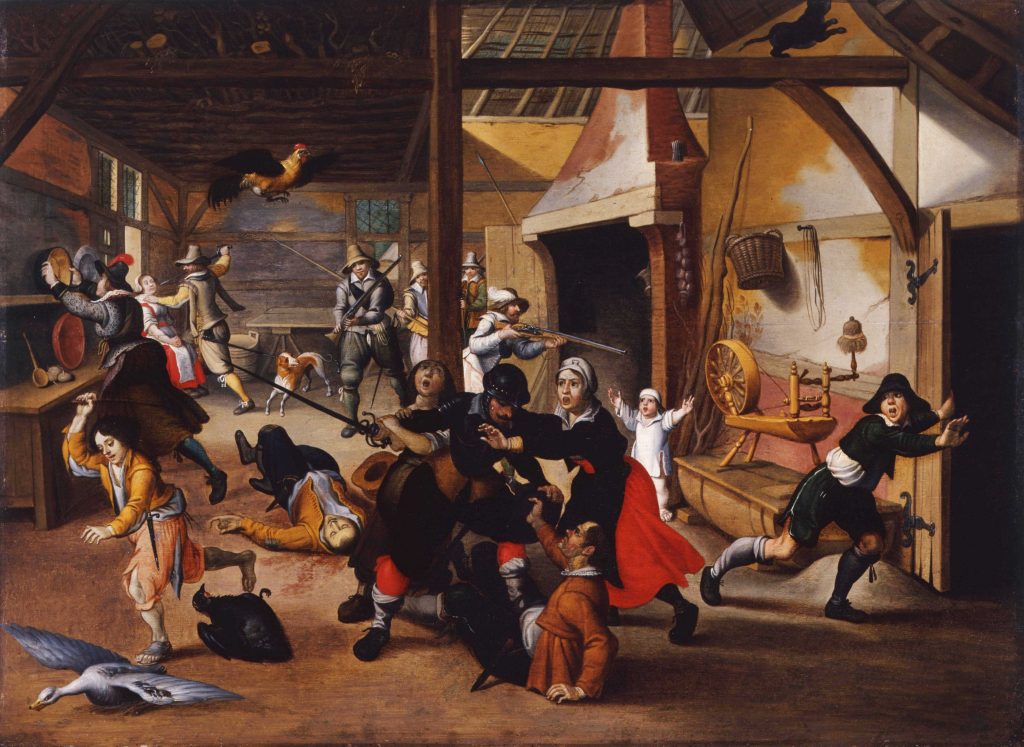
Mother Courage and Her Children 1965, starring the remarkable Lotte Lenya as Mother Courage. This is the version I’ve mostly been quoting from.
Categories: featured, literature

 magpiesmagazine.com
I remember seeing the play in York about 15:years ago. It stays with you.
LikeLike
It does! I saw it in Boston over 20 years ago and still think about it. Thanks for reading.
LikeLike