

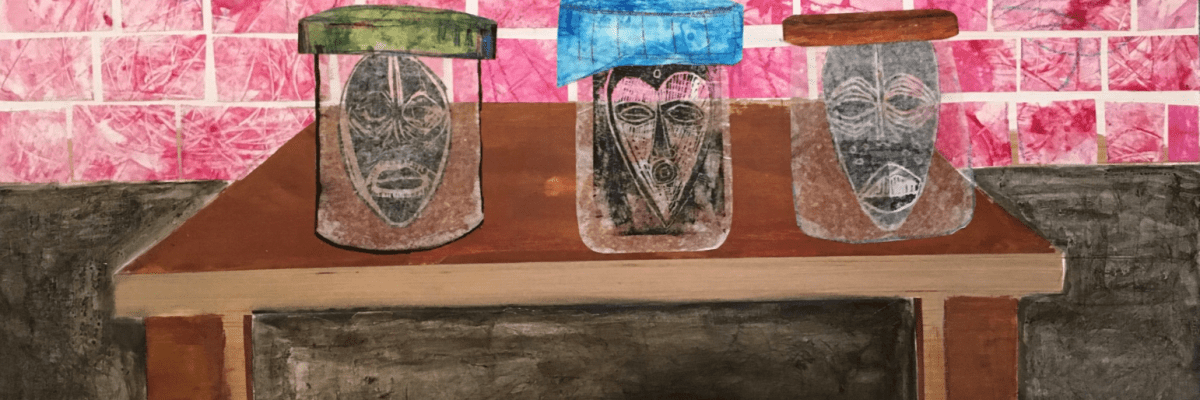
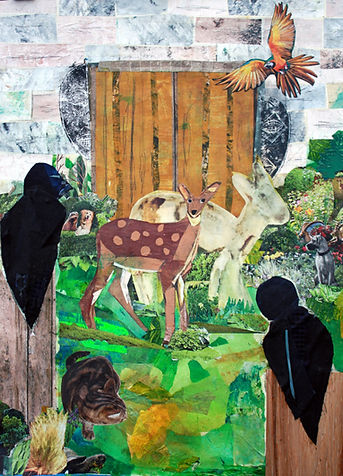
Tracy Jackson’s vibrant, celebratory artwork is full of joy and gratitude. Underneath the movement and bright colors we find questions: asked, pondered, answered, and asked again. A fine teeming network of ideas and philosophy ties the images together: ideas about what it means to interact with other humans and with the natural world around us, and about the transformative power of compassion, community, nonconformity, and creativity. We are happy to share Jackson’s work, and to have had the opportunity to ask him a few questions, for an interview as thoughtful and thought-provoking as his art.
I love how you say that you have a conversation with your artwork or that your artwork makes you have a conversation with yourself. Can you tell us what those conversations are like?
Though I am a teacher, the introvert in me still struggles to discuss and make conversations. Art and making serve as a primer or journal which allows me to collect my thoughts so that they can be articulated through oral discourse. This priming effect also naturally allows me to be in dialogue with my art. Sometimes I must ask my art about its meaning … especially when I am creating more improvisational pieces. The art responds to me through figures or even magazine clippings that have text that catches my eye.
Can you describe your creative process?
My creative process depends on what style I am working on. If I am creating a more abstract piece, I play music, sift through magazines for inspiration, and sometimes I just start with colorful scrap paper and begin pasting them to a substrate.
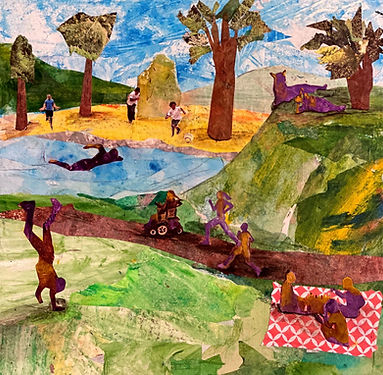
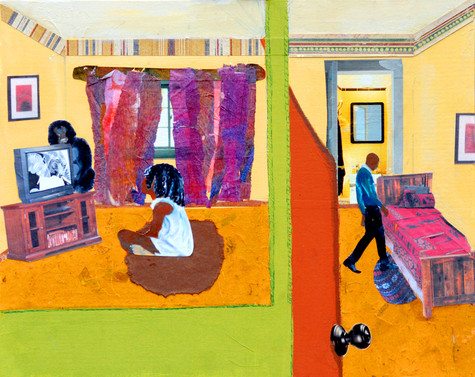
For my more detailed collages, I begin with a narrative, one that I’ve heard or witnessed. Sometimes the narrative might come about through an image taken that I decide to explore and create. These collages tend to be loosely sketched out with pencil and then painted with watercolor.
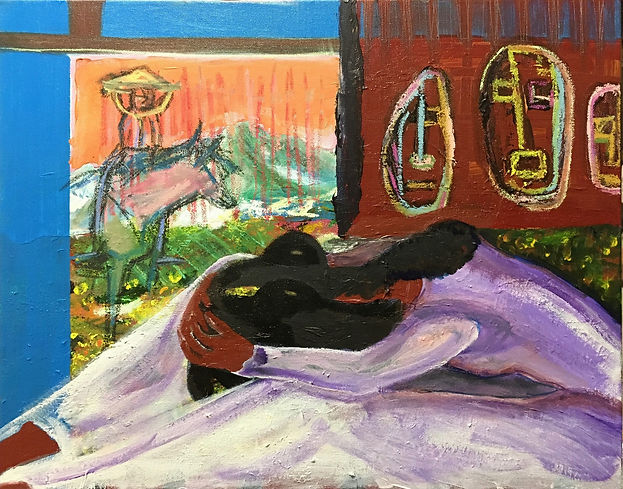
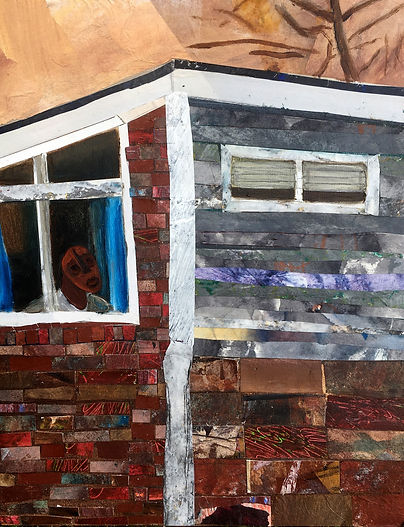
My mask figures are also slightly improvised in terms of composition. I usually have the mask print that I want to use and then I place them on a canvas and decide to use the papers and scraps around. I begin to add to each mask’s personality through clothing and hair.
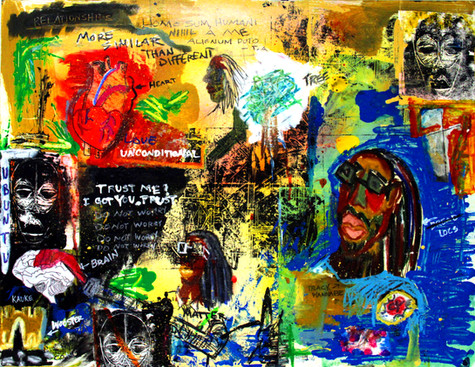
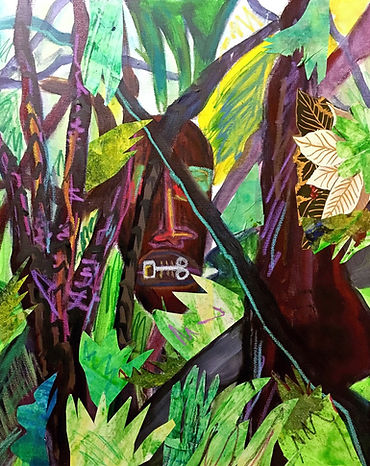
On a similar note, your pictures are brimming with ideas, but not at the expense of emotion. Can you talk about the balance of thoughts and feelings that go into the creation of your work?
This is a great question. Recently, I’ve been trying to search for a concise answer to this that is balanced, but I don’t think I have one as of yet.
I’m curious about the masks – their meaning and the method that goes into their construction.
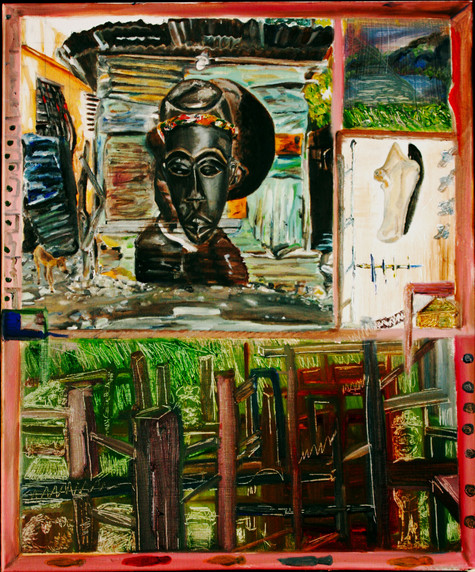
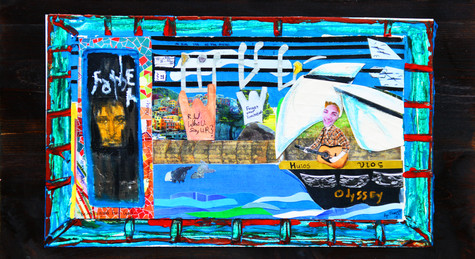
My masks series started from my fascination with African Masks. I think this started with my aunt, who always had a collection of interesting Masks in her home. Some of the artists that I draw upon, such as Picasso, Lois Mailou Jones, Romare Bearden, Basquiat, have all used masks in some form or another, whether it be a direct representation of a specific traditional mask or some form of abstraction (for instance Basquiat).
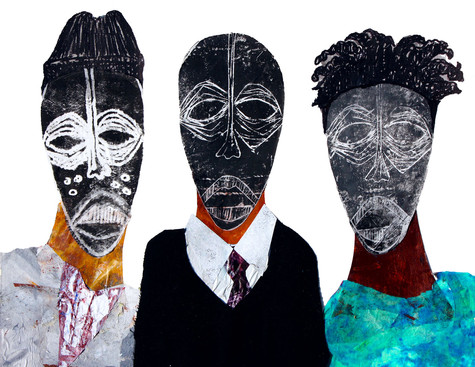
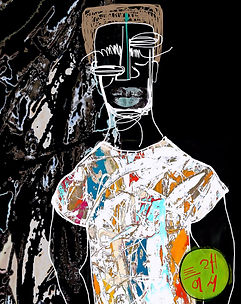
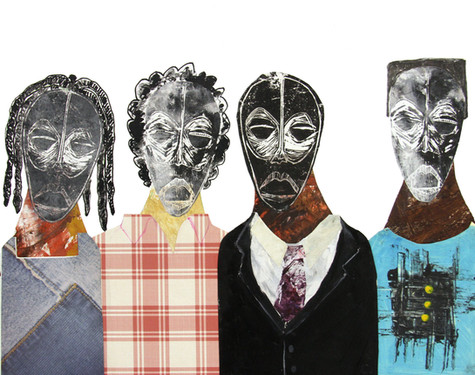
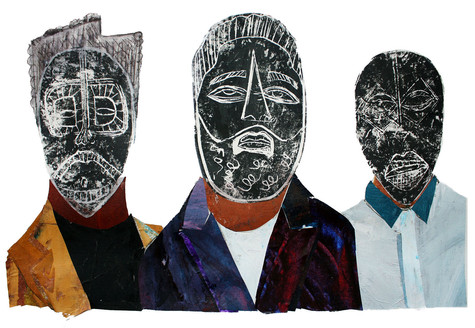
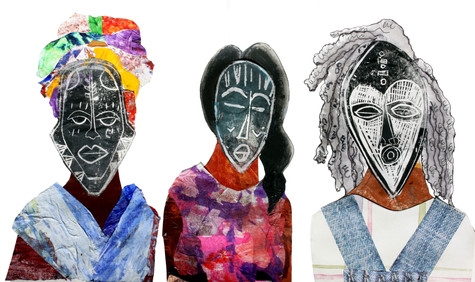
Two literary artists that I think of that have also encouraged my thoughts around masks are Paul Laurence Dunbar and Maya Angelou’s versions of “We Wear The Mask”. I also think of Jim Carey’s “The Mask”, which is a movie I took a liking to during my youth. Lastly, I would say my travels have inspired the different types of masks that I reflect in my artwork too. Many countries have their own traditional masks that have both similar and dissimilar meanings and purposes. All of these things sort of tie within the African Philosophy of Ubuntu. And I guess if I really had to be brief about the mask pieces, I suppose I could say that each piece isn’t necessarily designed with a unique deeply profound story … I don’t think I would want that anyway. Instead, my masks series as a collective body of work is created to personify and represent people from all walks of life rather than be a portrait of a single person or grouping of people. The masks allow for the viewer to identify or relate to the persona that the figures take.
Many of the mask shapes for my pieces are inspired by the Dan mask, which is a sacred mask created largely in Liberia. I think the oval shape of the masks attracted me to the mask, especially when thinking about the basic drawing of a typical face. Another reason would be the purpose behind the mask as a form of protection and communication with the spirit world. Though I don’t believe in the masks as a form of deity or truly having a supernatural power, I like the idea that it represents and it can even serve as a reminder of my ancestors and those who have come before me and even those who’ve positively impacted my life.
What is Ubuntu philosophy and how does it find expression in your artwork?
“Ubunutu” is a shortened version of a Zulu proverb, “Umuntu ngumuntu ngamantu,” which means: “I am a person through other people. My humanity is tied to yours.”
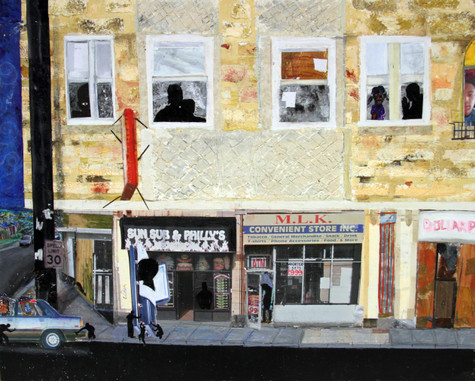
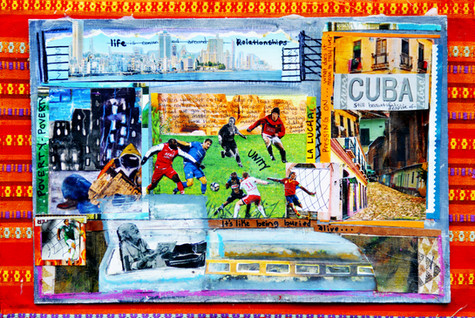
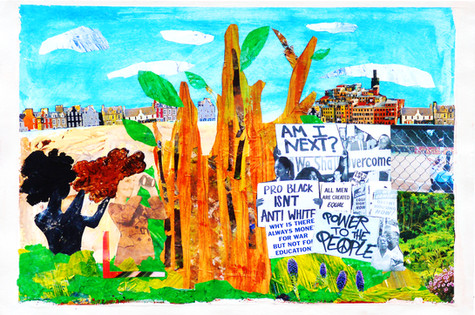
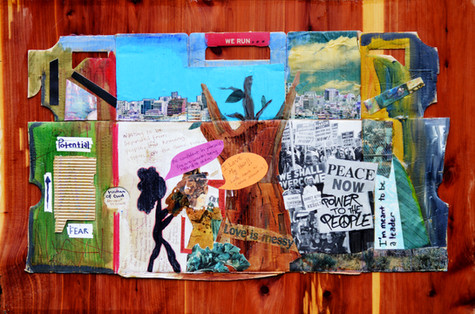
The spirit of Ubunto drives my work. This idea suggests that the invisible threads of interdependence connect individuals because of our shared humanity. Therefore, my works tend to explore these values through shared narrative themes (e.g., aspirations, longings, loss, happiness, etc.) and societal issues (e.g., institutional racism, politics, poverty, religion, etc.) which I have translated into collage paintings.
The spirit of Ubunto drives my work. This idea suggests that the invisible threads of interdependence connect individuals because of our shared humanity. Therefore, my works tend to explore these values through shared narrative themes (e.g., aspirations, longings, loss, happiness, etc.) and societal issues (e.g., institutional racism, politics, poverty, religion, etc.) which I have translated into collage paintings.
I first learned about Ubuntu during my service as a City Year Ameri-Corps member in the inner city of Chicago, IL. It was one of our values that still resonates with me today. The idea that “I am because you are” is very powerful to me. This philosophy also resonates with my Christian identity and value to love my neighbor as myself. And through my work, I try to embrace and highlight these efforts by presenting narratives that create dialogue or even shift thoughts/attitudes to help others realize that we are all human and we are truly more similar than different.
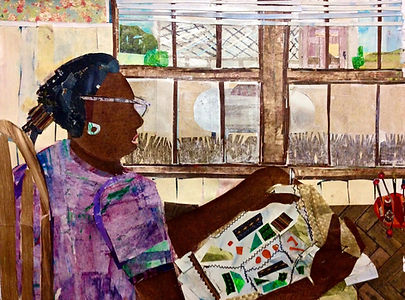
I love the series of images that portray women makers – the sense of creation and community as both a joyful act but also as an act of resistance. There’s a feeling that the everyday act of creation is as important as creativity that is sometimes seen as loftier. Can you talk a little more about this series and the ideas behind it?
In grade school, I took a few courses related to maker education which reshaped my perception of what creativity entails and who is considered to be creative. Shout out to Georgia State’s MACIE program! Anyway, one of my takeaways from my coursework is that everyone is a maker in some way, and everyone comes with their own funds of knowledge, which is passed down from our familiar interactions, etc. I think there becomes a point between adolescence and adulthood that creativity or maker skills become devalued or become thought of as tedious work that turns into something that is unenjoyable.
At the start of my sketches for the maker series, I didn’t pursue it with the thought of a specific gender creating the work. It just so happened that many of the maker activities that I wanted to capture in my collages were women. Also, the inspiration and reference material I used, whether in conversation or experienced or seen were captured by women. With this in consideration, it was a no-brainer for me to create a body of work that celebrates the overlooked creativity of women that is often taken for granted but has shaped and transformed the lives of many.
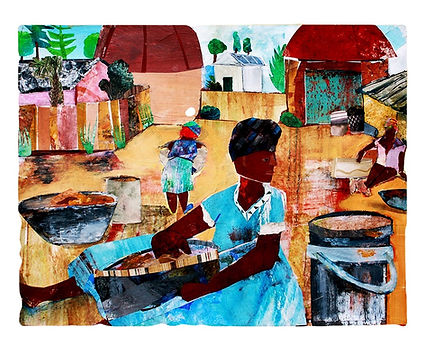
My first piece in the women maker series is titled “Shea Butter.” Shea butter from Ghana and other parts of West Africa has entered many beauty products that are used across the world. My college friend Abena and her successful skincare product Hanahana Beauty does a great job of showing the creative process of making shea through social media. As I watched one of the clips that she shared of a group of women making shea in her home country of Ghana, I thought back to my coursework at GSU around participatory creativity. It was refreshing to see a group of energy-filled women enjoying each other’s company through conversation and laughter while completing what could be a tiring process of handcrafting shea butter.
How does your work as a teacher impact your calling as an artist?
Ha! This is my third year teaching at Tri-Cities High School in East, point GA and I feel like there’s no end. I knew teaching would require a certain level of time, but there are only twenty-four hours in a day. I enjoy teaching as well as my school and students. However, finding balance to work on my own work is a challenge especially given that I am not an art teacher.
As an ESOL teacher, catering to the needs of my students has become my primary art practice. In a sense, I’m daily working on a mixed media collage, and even sculpture as I craft my lessons or school-wide initiatives and events that are of quality that my students can benefit from.
As an ESOL teacher, catering to the needs of my students has become my primary art practice. In a sense, I’m daily working on a mixed media collage, and even sculpture as I craft my lessons or school-wide initiatives and events that are of quality that my students can benefit from.
Being an ESOL teacher also reminds me of the Ubuntu philosophy, which reverberates in my thinking as both a teacher and learner from my students. Being blessed to work with students from diverse backgrounds, both culturally and linguistically, etc., continues to remind me that my role as an artist is to leverage my art as a medium that brings various people together, one collage narrative at a time.
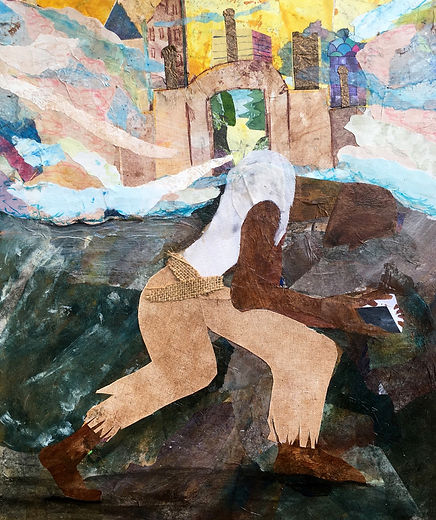

Your work is so full of appreciation: for the work of other artists you admire, for the workings of man and of nature. This feeling gives it such a visual and emotional vibrancy. How can art be used as an act of celebration?
Wow! Such a great question. I think there could be an entire book about this topic if it hasn’t already been written. The first things that come to mind are individual artists or collectives of artists and artwork. Both of these are broad categories that can be extracted.
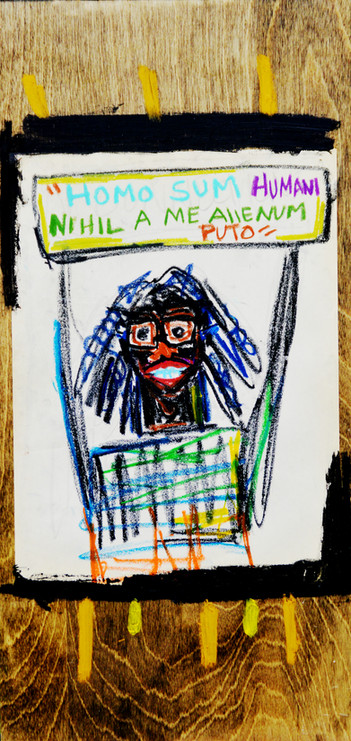
When I think of celebration with regard to an artist or collective of artists, I think of myself honoring and paying homage to those who paved the way for me as an artist. I don’t think my ideas or stylistic approaches would’ve come to be without celebrating or acknowledging the ideas and techniques that I’ve referenced and studied for my own works. I am also thinking about Maya Angelou’s quote from the playwright Terentius Afer: “Homo sum, humani nihil a me alienum puto,” which translated from Latin means “I am human, nothing human can be alien to me.”
I am also thinking about Maya Angelou’s quote from the playwright Terentius Afer: “Homo sum, humani nihil a me alienum puto,” which translated from Latin means “I am human, nothing human can be alien to me.”
For me, this means that because we have exemplars of those who have made the seemingly impossible possible, or even challenged themselves to think differently, so can and should I. It’s empowering to know that there are people who exist in the world who have established a trail for me to walk along and even expand upon.
On celebrating art as a composition, I think it’s important for us to celebrate the lives of artists, but I think it’s equally important to celebrate the art compositions. Celebrating art in general eliminates the need for putting someone on a pedestal and creates an opportunity for people to really immerse themselves in discovering the beauty and their connection to a piece.
Which artists do you admire?
I admire the works of Pheoby Beasly, Romare Bearden, Eric Carle, Jean-Michel Basquiat, Picasso, Matisse, David Driskell, and Bryan Collier.
Visual artists or musicians or writers?
Maya Angelou is one of my favorite poets, along with Sherman Alexie, Charles Johnson, and MLK’s essays and sermons. Whitney Houston, Donny Hathaway, Jacob Collier, Luciano Pavarotti, Ella Fitzgerald, and Gregory Porter.
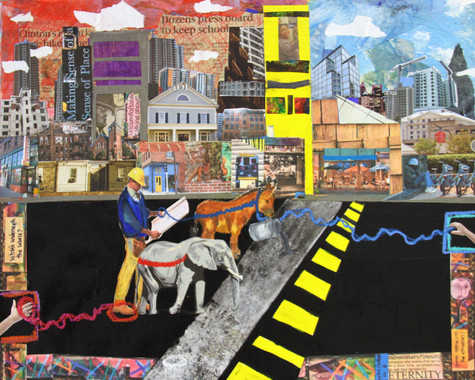
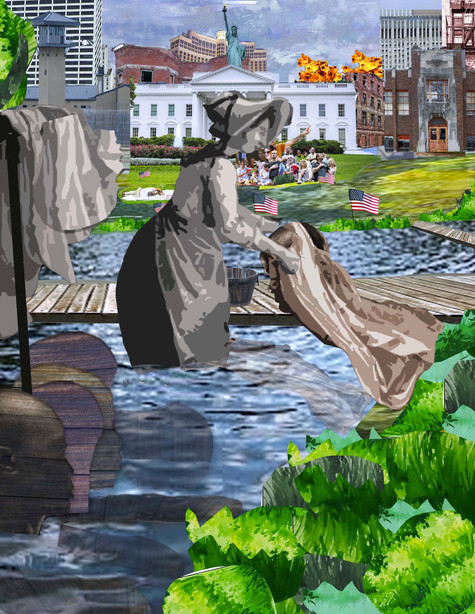
How do they inspire you?
Authors:
Maya Angelou- Though I’ve only read her literature and have listened and watched interviews and motivational clips, her words of wisdom and contributions have encouraged me in times when I needed. I think she was the grandmother, mom, and aunt to many Americans.
MLK’s literature is awesome, his sermons and essays are super profound and like Ms. Angelou has helped me think about humanity and my part in it.
Sherman Alexie, Ngozi Achebe, Ralph Waldo Emerson, and Charles Johnson are a few other authors who have helped me to understand more of the world and myself.
Musicians: I enjoy music that I can sing to or at least makes me want to sing. I also value music from musicians and vocalists that demonstrate that “it” factor.
Can you talk about the theme of belonging in your work — in terms of family, history, community? On the other side of the coin, can you discuss ideas of escape and nonconformity in this context as well?
Hmm… belonging is multi-layered and ties into my faith as well. To speak to my identity as a Christian, belonging is an acknowledgment that I was designed to be in community with others as well as God. And part of being part of a community here on earth is to share my talents/gifts to support and help others.
I think as humans, there are times when we experience loneliness for a number of factors. For me, I’ve felt this way at different points in my life such as living in a new country by myself (e.g. South Korea) or even returning home (e.g. Atlanta) to places that have now turned foreign to me due to the comings and goings of new development and industries.
Belonging deals with ideologies and beliefs, and there are also moments of gray area, of feeling connection as well as disconnection for various reasons. Given that there is so much to be considered when thinking about belonging and what it means and feels to belong, my art, in many ways, serves to spark conversations and, at the very least, models what belonging could look like in terms of connection that could function to reduce a feeling of isolation.
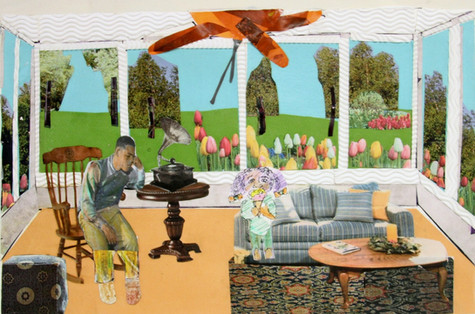
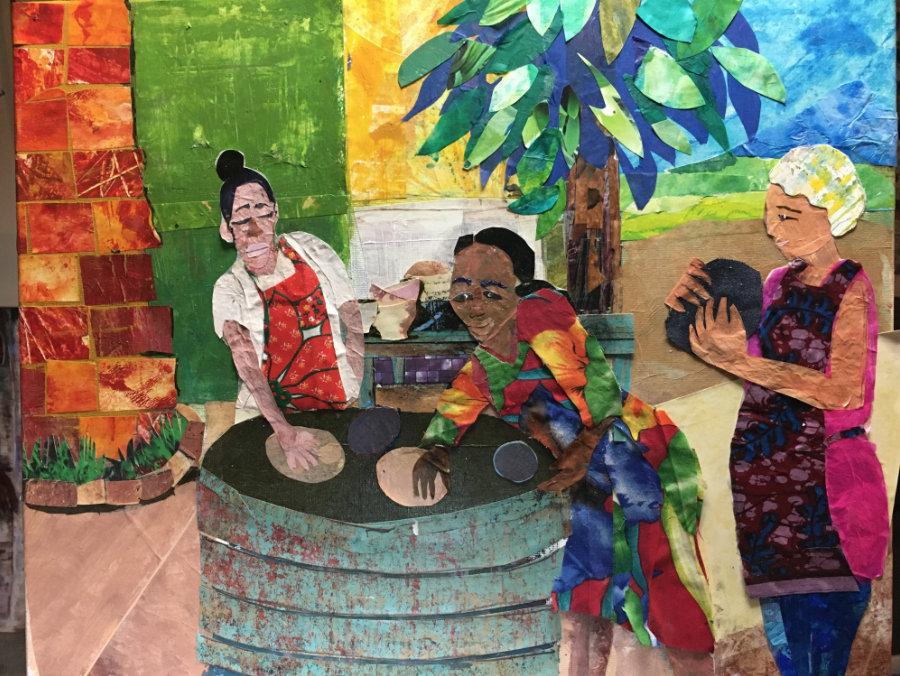
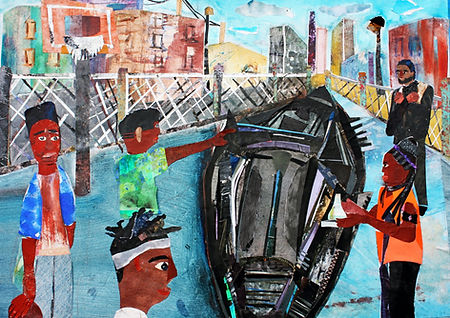
Belonging can be communal activities such as cooking (“Tortilla makers”) or establishing a place for one to belong (“Urban Wakanda”).
When I read Emerson’s Essay on Self-Reliance, I thought about a scriptural verse taken from Romans 12:2, which states: “Be not conformed to this world: but be ye transformed by the renewing of your mind, that ye may prove what is that good, and acceptable, and perfect, will of God.”
Sometimes I have to tell myself that sure I’m not the best rapid drawer of figures, but with time and even other collage techniques, I can still give the illusion of proper proportion. There’s always more than one way of doing something.
Hmm… With regards to criticism, I think it’s inevitable to avoid it, especially for anyone who dares not to conform to the status quo. I think constructive critiques are fine, but it is criticism that is meant to cause harm that should be fled from. I’ve recently watched Maxine’s Boy, a documentary about Tyler Perry’s life. In the film, one learns that Perry went through a lot, but it was his positive response to leave the negative criticism aside that transformed him into the mogul that he is today.
Emerging artist and Atlanta native, Tracy Jackson obtained a dual Masters in Creative and Innovative Education (MACIE) and Teaching English to Speakers of Other Languages (ESOL) from Georgia State University. He now serves as a teacher at Tri-Cities High School in East Point Ga. You can see more of his work at ycART and on Instagram @s_ycart.
Categories: art, featured, featured artist, interview

 magpiesmagazine.com