

Words and Paintings by Robert Beck
The wind that comes off the Sahara towards the Atlantic is called Harmattan. The breezes over Senegal and Mauritania mingle with the warm waters near Cape Verde and occasionally become one of those end-of-summer storms that plod their way up the Mid-Atlantic states, dropping enormous amounts of rain and causing damage.
Those Saharan breezes swirled around me as I set up my kit in a part of Dakar that doesn’t see a lot of foreigners. It looked like it might rain, and the sky was spitting. I had been there a week, and it was the first time I saw gray skies. I had walked just a few blocks from my small hotel, toward where roosters and goats could be heard in the morning. Parts were residential, as we think of it, and some were less than that.
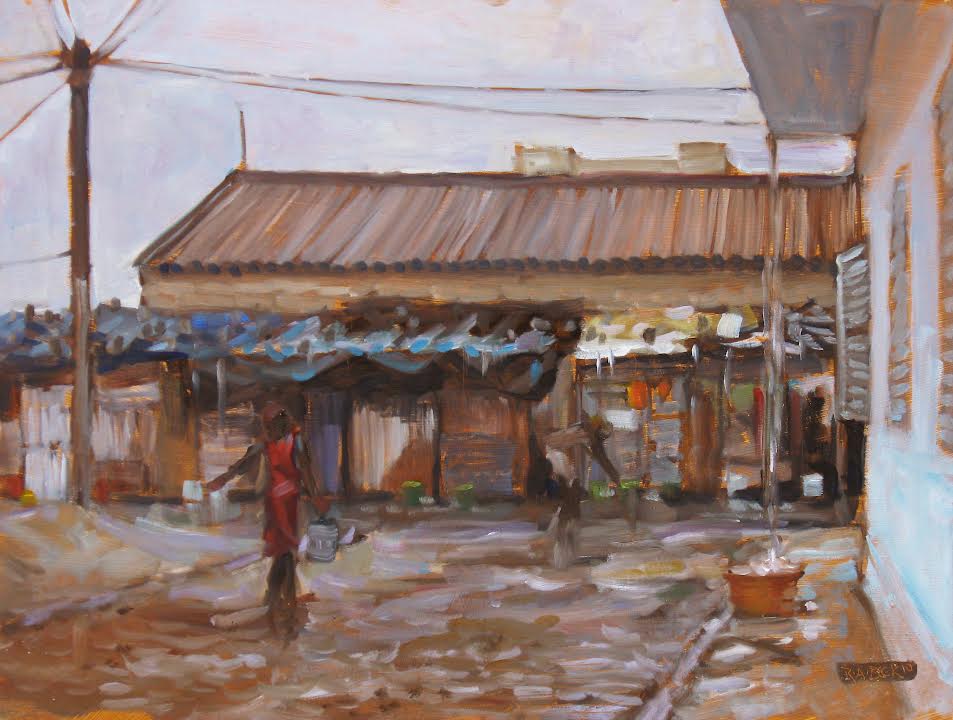
A high wall stretched down the side of one road, bordering a compound. Built against the wall were shacks. Shanties. Constructed from whatever could be found. Scrap wood walls. Corrugated metal roofs covered in black plastic. Big enough to sleep in but not much more. The dwellings looked like storage sheds or even a long heap of refuse piled against the wall, and I didn’t recognize them as houses at first glance.
It’s a common plein air problem. Sometimes, your subject doesn’t exhibit an identity. You can’t tell what it is when you look at it, so how are you supposed to paint it? It’s a reason to stick to subjects that come with a distinction that is easily recognized. The sky was darkening. I didn’t know what that might mean on the west coast of Africa. I didn’t have the time to keep looking; besides, I would only be in Senegal for so long. What I was looking at was Dakar, regardless of how recognizable it was at first. I set up my Easel under a building’s extended roof ledge.
A small group of people gathered around me to watch. They spoke Wolof, the indigenous language. I only know one word. It is a common term of affirmation, like one we would use in conversation to say “cool” or “nice.” The word is pronounced “wow.” So we communicated in smiles and glances. They stood close to me. They would brush my elbows. Kids would touch my easel. I concentrated on the shacks, knowing that I often find my subject’s identity over time, by paying attention. I ignored thoughts of vulnerability.
I was working for an hour when the sky opened up in a downpour. Water started pouring off roofs through gutters and scuppers. I shortened one easel leg so it leaned against the building, and turned my palette sideways. My audience lined up behind me, flat against the wall. My left arm was getting soaked.
Then the doors opened. Out of the shacks came women with buckets. They knew right where to place them and went back and forth, swapping them when full. The storm was maybe fifteen minutes. It gave me my painting, in the figure of the woman taking a filled bucket back to her home.
It was the same breeze, the same rain, but it was older now. Harmattan had traveled the ocean and was soaking me again. Ten days, maybe two weeks, from when I painted in Dakar, a few of us gathered on the old trestle behind the mill, watching the Deleware River show us who’s boss, raking through the trees on both sides.
It was the same breeze, the same rain, but it was older now. Harmattan had traveled the ocean and was soaking me again. Ten days, maybe two weeks, from when I painted in Dakar, a few of us gathered on the old trestle behind the mill, watching the Delaware River show us who’s boss, raking through the trees on both sides.
We didn’t talk much, and then not much above a whisper. The might of the river was captivating. Menacing. Large trees with their root balls rushed by in the current. Docks, backyard furniture, and a garage tumbled past. You could smell it, hear it, feel the brute mass of the river through your hand on the railing and ground under your feet.
I thought of the street with the shacks in Dakar and one of the women who stopped as she walked past me. The woman looked at the painting for a while, then turned to me and said, “Wow.” We traded smiles and glances, and then she picked up her bucket of rain and walked back to her shack in the graceful, upright manner in which Senegalese women move.
Robert Beck is a painter, teacher, curator, lecturer and writer who divides his time between Bucks County, PA and New York City. See more of his work at Robertbeck.net, on Instagram @illhavecoffeethanks, and on Facebook .

 magpiesmagazine.com