


The myth of Prometheus and Epimetheus is well-known, I think. Here’s my highly scholarly and authoritative version: After the warring gods have wiped out every living creature on earth, the titan brothers Prometheus and Epimetheus are charged with repopulating the earth. They make humans and animals out of clay, and they’re granted a certain amount of gifts to bestow on them. Epimetheus makes the animals, and Prometheus makes the humans, but Epimetheus uses up all the good gifts on the animals, and the humans are left weak and defenseless. So Prometheus, worried about his creation and sorry for mankind, steals fire hidden in a fennel stalk. He’s punished by Zeus and an eagle eats his immortal liver every single day, and Pandora is sent to marry Epimetheus and we all know what that leads to!
Both brothers have been adopted as philosophical or political metaphors over the ages. Prometheus represents the human quest for knowledge, particularly scientific knowledge, he symbolizes a thinking man’s rebellion, and he suggests the dangers of overreaching ambition. Epimetheus is seen as slower and more foolish. Prometheus is a forward (pro) thinker, and Epimetheus, who uses up all the gifts on the animals is seen as a backward thinker … he doesn’t have the foresight necessary to save some gifts for the humans.
And this is where the myth becomes especially fascinating to me. I’ve always been troubled by mythologies or religions that place humanity in the center of everything, as a sort of representative of god’s image and god’s will on earth. If you look at the workings of the world, of the universe, of nature, of every vast and incomprehensible concept of time, place, and space, humans start to seem fairly inconsequential. We’re part of the process, certainly, but we’re not the center of it. In most versions of the myth, Prometheus lovingly and skillfully crafted the humans to be objects of great beauty, but Epimetheus rushed through his work on the animals, throwing them together without foresight.
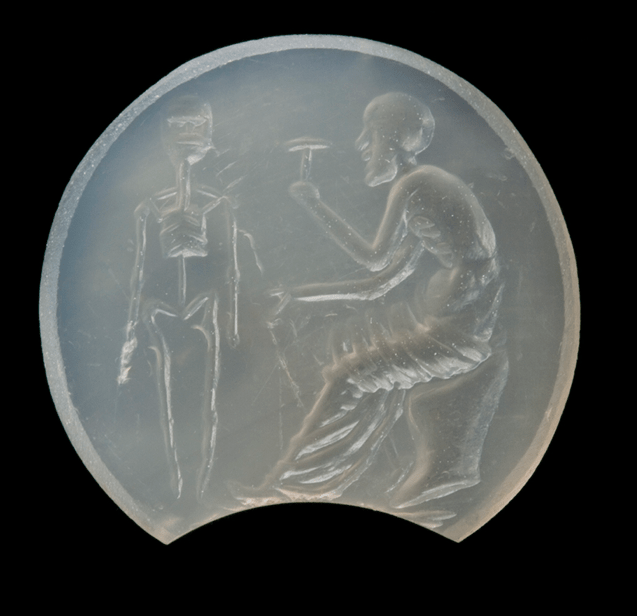
But this doesn’t fit with Plato’s description of Epimethius’ process. “There were some to whom he gave strength without swiftness, while he equipped the weaker with swiftness; some he armed, and others he left unarmed; and devised for the latter some other means of preservation, making some large, and having their size as a protection, and others small, whose nature was to fly in the air or burrow in the ground; this was to be their way of escape. Thus did he compensate them with the view of preventing any race from becoming extinct. And when he had provided against their destruction by one another, he contrived also a means of protecting them against the seasons of heaven; clothing them with close hair and thick skins sufficient to defend them against the winter cold and able to resist the summer heat, so that they might have a natural bed of their own when they wanted to rest; also he furnished them with hoofs and hair and hard and callous skins under their feet. Then he gave them varieties of food — herb of the soil to some, to others fruits of trees, and to others roots, and to some again he gave other animals as food. And some he made to have few young ones, while those who were their prey were very prolific; and in this manner the race was preserved.”
And maybe Epimethius wasn’t so slow or foolish, so backwards. Because “epi” also means upon, beside, about. Maybe he was thinking of the world aside from the struggle of gods and mortals. Maybe he was wisely thinking around that, beside that, of the rest of the world, which can continue with balance and equilibrium from day to day, regardless of the torments that gods and men bring upon themselves.
That sounds very carefully planned to me! He balanced the gifts of all of the creatures on earth so that they could live together in a sort of harmony! That’s not slap-dash. That’s not sloppy and ill-considered. And maybe Epimetheus wasn’t so slow or foolish, so backward. Because “epi” also means upon, beside, about. Maybe he was thinking of the world aside from the struggle of gods and mortals. Maybe he was wisely thinking around that, besides that, of the rest of the world, which can continue with balance and equilibrium from day to day, regardless of the torments that gods and men bring upon themselves.
Meanwhile, the humans began to hunger for everything the gods have. And when Zeus sent down lies, deceit, scolding, despair, accusation, envy, gossip, drudgery, scheming, and old age to put them in their place and make them meek and biddable once again, he found that his actions had the opposite effect, and people became horrible to each other and disrespectful to the gods. Prometheus, with his foresight, can literally predict the future, so why did he let this happen, why did he bring this about? Maybe he saw that the conflict was necessary to somehow make us human, because our scheming, deceit, gossip, and constant warring have certainly distinguished us from the animals over the centuries.
Because Prometheus and Epimetheus are not gods, and they are not humans either. They are titans, older than any god, and they are direct descendants of Mother Earth, of Gaea, and of her first child Oceanus (how closely they’re related varies from version to version). So perhaps Prometheus and Epimetheus didn’t have the interests of humans in mind at all, maybe they were thinking of Mother Earth herself. Maybe they understood that humans would torture the earth and the oceans, and do their best to best to make the lives of the animals miserable as well. So Epimetheus carefully made the animals as capable of defending themselves as possible and gave them systems of survival that would outlast us. And if Prometheus’ actions are mystifying, perhaps it is because we are thinking about this time, now, about how humans have strangled and burned and destroyed every part of the Earth and the Ocean and the Air that we could get our hands on. But he can see all time, all of the future, and as Aeschylus said in Prometheus Bound, “Men, whose life is but a day.” We can only hope he sees a time when the Earth will heal herself from the damage we have done.
Categories: featured, literature

 magpiesmagazine.com