


Le gamin au vélo is a 2011 film by the Dardenne brothers of Belgium, who are renowned for making emotionally and stylistically bleak and austere films. Their films explore the lives of marginalized people, people who have been abandoned by society, by their families, by any system of justice, and who face cruelty, abuse, and neglect. Their gaze is unflinching and unsentimental. They almost never use non-diegetic music — they don’t have a soundtrack. The sounds of the film are those that people make going about their day, and these sounds become oddly compelling as we become immersed in the rhythms of the characters’ lives, as we learn their routine and become alert for any small change in the patterns.
All of their films are quiet, they’re a succession of silent moments. And that’s why this scene is disarmingly beautiful. We’re given music! (And it does feel like a gift.) We’re given, specifically, a small, moving swell of music, like a warm gentle wave; a few notes from the second movement of Beethoven’s Emperor piano concerto. And then we return to the quiet world of this ridiculously beautiful expressive boy, to the sound of his breath, and of his madly pedaling feet, in a scene reminiscent of the remarkable sequence of Antoine Doinel running to the ocean at the end of 400 Blows. Throughout Le gamin au vélo, in certain scenes, this music washes over us, just a few notes, and then recedes. You feel that you need to hear the rest, you want the notes to resolve themselves. You want the boy’s life to resolve itself, you want him to care for himself, you want him to let somebody take care of him.
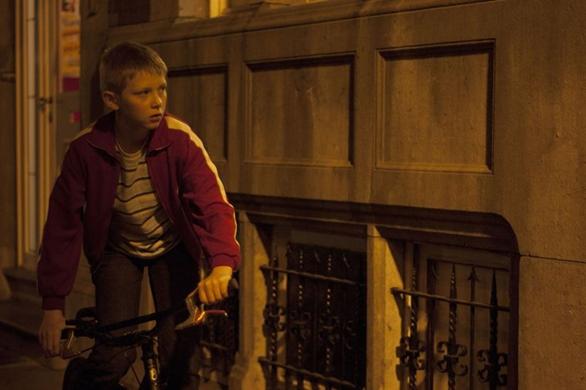
The Dardenne brothers’ films, though beautiful, are often hard for me to watch. The very honesty and rawness that makes them wonderful makes them painful. Their characters are battered by life, conflicted and rejected, and they spend a lot of time alone. We’re compelled to watch them in their solitude, drowning in the silence of their own company, facing rotten choices and making regrettable decisions. This raises all sorts of questions for me, as a film viewer, and as somebody who hopes to tell stories myself. You could make a film this revelatory of human nature as it actually is, this pessimistic — you could, and you probably should, but why would you? If you’re trying to tell the story of people whose stories are barely heard, if you’re trying to move people to act to challenge injustice, should you make some concession to make the film if not pleasurable to watch, at least not painful? Why watch something so depressing?
The older I get, I find I have less tolerance for unrelentingly grim movies. When I was younger I could watch anything, but now that I have children, I just can’t (which raises even more questions about the act of creation, in all of its many forms). I don’t need a happy ending. As the Dardenne brothers say, they’re not Spielberg, and I don’t want them to be. I don’t want to watch sickeningly sweet saccharine feel-good movies, but I do need some small hopeful sign. So I will admit to you that when we watched this film, we stopped halfway through, and I read about how the film ended, and only then did we watch the rest. Maybe it was a small gift to themselves or to their viewers, but this is one of the few Dardenne brothers’ films that offers a glimmer of hope, and it has been criticized for being soft and sentimental.
But I don’t find it so. Because in being entirely honest about human nature, sometimes you have to include moments of warmth and generosity and connection, and that’s what this film does, quietly, slowly, without melodrama or judgment. The few notes of Beethoven that we hear throughout the film are full of sweet sadness, the music veers between hope and despair, light and darkness, but it’s so beautiful that we need to follow it to the end, which they finally allow us to do during the credits.

 magpiesmagazine.com
Dear Claire, Thanks for the link to that scene. Now i need to find this film somewhere. I don’t know how you find all these amazingly eclectic wonderful gems, but you do.. That circle around you is becoming a spiral…
Thanks again for the interview with me last month. I know a lot of people saw it. Hope some signed up for your posts. (btw Do you have stats? I would be interested in knowing how wide my circle has become).
I’m really enjoying your posts. Admire your stamina and energy. Best always,
ellen w.
LikeLike
Thanks for the kind words! I checked the stats, I’m not sure how accurate they are, but to date it looks like 333 people have read your interview. Thank you for sharing it!
LikeLiked by 1 person
I’m sure 50 of those people who looked were me!!! LOL
Have a great day and week, Claire!
ellen
LikeLike
Beautifully stated (though I had to look up the meaning of “non-diegetic”!), and I can’t wait to see the rest of the film. The parallel with “400 Blows” seems very apt. I first saw “400 Blows” fifty years ago and that final scene has always stuck with me. When Doinel looks back toward the camera and the frame freezes, it is heartbreaking. One gets the sense of a person who has truly hit the end of the line and run out of options. I saw “Oppenheimer” this weekend, and was struck by how much different and less effective the use of music was than your example. Tone it down! Give us a break! Stop drowning out the dialogue! We don’t need our emotions telegraphed to us!
LikeLike
Thanks for reading! And yes, I know what you mean about that sound-by-the-pound Hollywood soundtrack. The Dardenne brothers actually talk about how sentimentality is the death of emotion, and I think that’s something the bigger movies could learn.
LikeLike