


This is the time of year Americans might have It’s a Wonderful Life playing in the background while they make Christmas cookies — it’s more of a Christmas tradition than a film at this point. And most people will come away with the impression of perfect snowy streets and angels getting their wings. For some, it’s a trite and sentimental celebration of outdated values. For others, it’s some sort of affirmation of a myth of American morality as it once was in “better days,” when men worked and women stayed home and had babies and everyone was white and proper and Christian. To me, this is a prime example of “a man hears what he wants to hear and disregards the rest,” a lyric that has been in my head often lately. The truth, as always, is more complicated, and not just because this “feel good” movie is actually about a suicidally depressed man who has wanted since childhood to escape the snow globe of a town he lives in.

It’s hard to talk about an American mythology without mentioning Frank Capra, and much has been written about his role in creating that mythology. Cassavetes said, “Maybe there really wasn’t an America, it was only Frank Capra.” Capra started making movies in an era when films were created to be some fantasy of an ideal world. His career began in earnest during the Great Depression, a time at which studios were churning out films that showed a frothy world of giddy wealth and luxury. Capra decided early in his career that he wanted to make films with a message. Yes, that message emanated from a world in which everyone was white and straight, but he was working within a system, and there can be great power in a message subverting the system from within. Though I’m sure he wouldn’t have thought of himself as subversive, I find his movies to be subtly so — perhaps subversive of even his own values.
“The art of Frank Capra is very, very simple: It’s the love of people. Add two simple ideals to this love of people: the freedom of each individual, and the equal importance of each individual, and you have the principle upon which I based all my films.”
Later in his life, he would explain his message this way, “The art of Frank Capra is very, very simple: It’s the love of people. Add two simple ideals to this love of people: the freedom of each individual, and the equal importance of each individual, and you have the principle upon which I based all my films.” Frank Capra was a conservative Republican. His idea of loving all people, supporting the underdog, and distrusting the rich isn’t some expression of liberal values. The situation is confused by the fact that several of Capra’s writers, including longtime collaborator Robert Riskin, were politically liberal, a fact that bothered Capra and caused him to fall out with Riskin over time. But fundamentally their beliefs stemmed from the same kernel of truth — every human life has value. This wasn’t a divisive issue.
Starting with Mr. Smith Goes to Washington, several of Capra’s “social” films were made in an era when fascism was spreading across Europe and much of the world was at war. America was facing difficult decisions on whether or not to join in the fighting, and many people felt that Capra shouldn’t release a film critical of corruption in American politics. But he said that in the face of evil and uncertainty, we should make a ringing statement of our democratic ideas, of simplicity, compassion, and moral courage. The message resonated with Americans and Europeans alike, and the film was a hit in America, and banned in Hitler’s Germany, Mussolini’s Italy, and Franco’s Spain.
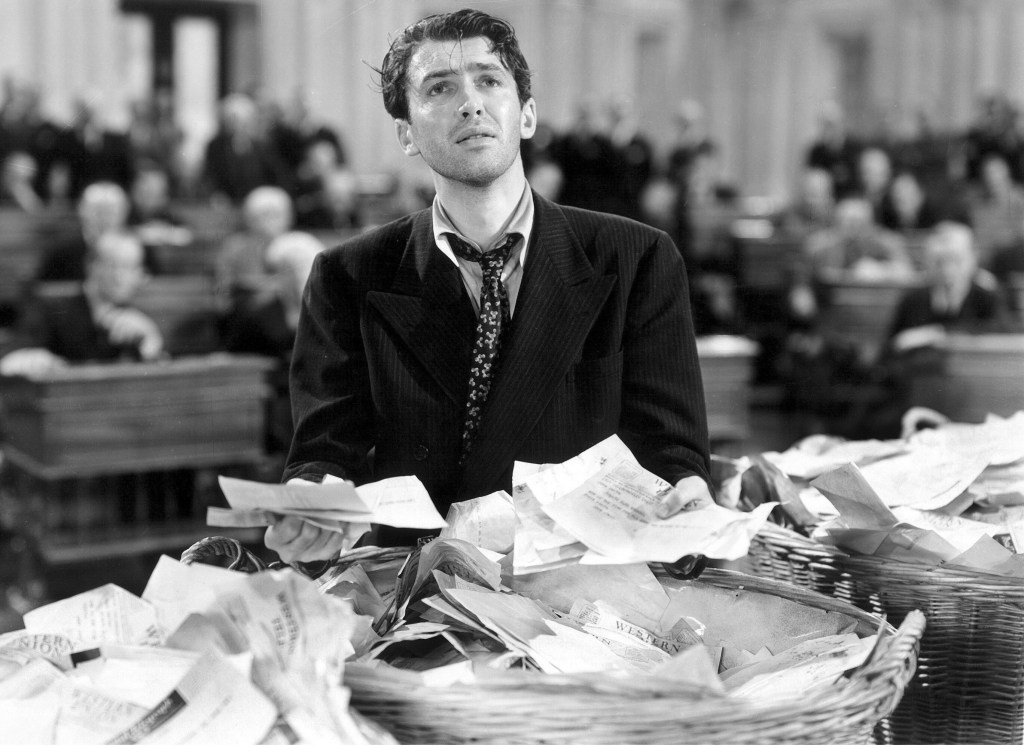
“Fighting so’s he can stand on his own two feet, free and decent, like he was created, no matter what his race, color, or creed. That’s what you’d see. There’s no place out there for graft, or greed, or lies, or compromise with human liberties.”
It might sound a little hokey to our cynical ears, but the message of Mr. Smith Goes to Washington that appealed to people in a time of great fear was simply love thy neighbor. “And you won’t just see scenery; you’ll see the whole parade of what Man’s carved out for himself, after centuries of fighting. Fighting for something better than just jungle law, fighting so’s he can stand on his own two feet, free and decent, like he was created, no matter what his race, color, or creed. That’s what you’d see. There’s no place out there for graft, or greed, or lies, or compromise with human liberties.” The plot of the film actually hinges on an environmental issue — preserving nature vs. political graft and greed. I find this passage oddly poetic, “Son, don’t miss the wonders that surround you; because, every tree, every rock, every ant hill, every star is filled with the wonders of nature. … Have you ever noticed how grateful you are to see daylight again after coming through a long, dark tunnel? Well … Always try to see life around you, as if you’d just come out a tunnel.”
Just before America entered the war, Capra released Meet John Doe, another film about a handpicked bumpkin chosen because he was easy to manipulate. John Doe, the creation of a journalist, is supposed to represent the common man, the forgotten man, the working class. What begins purportedly as a discussion of rectifying injustice and inequality segues neatly into the manipulation of the “common” man by a rich, powerful, and corrupt politician. John Doe’s message, however, resonates with people, and he builds up a following almost against his wishes or better judgment. Once again, the message is simple. “Be a better neighbor.”
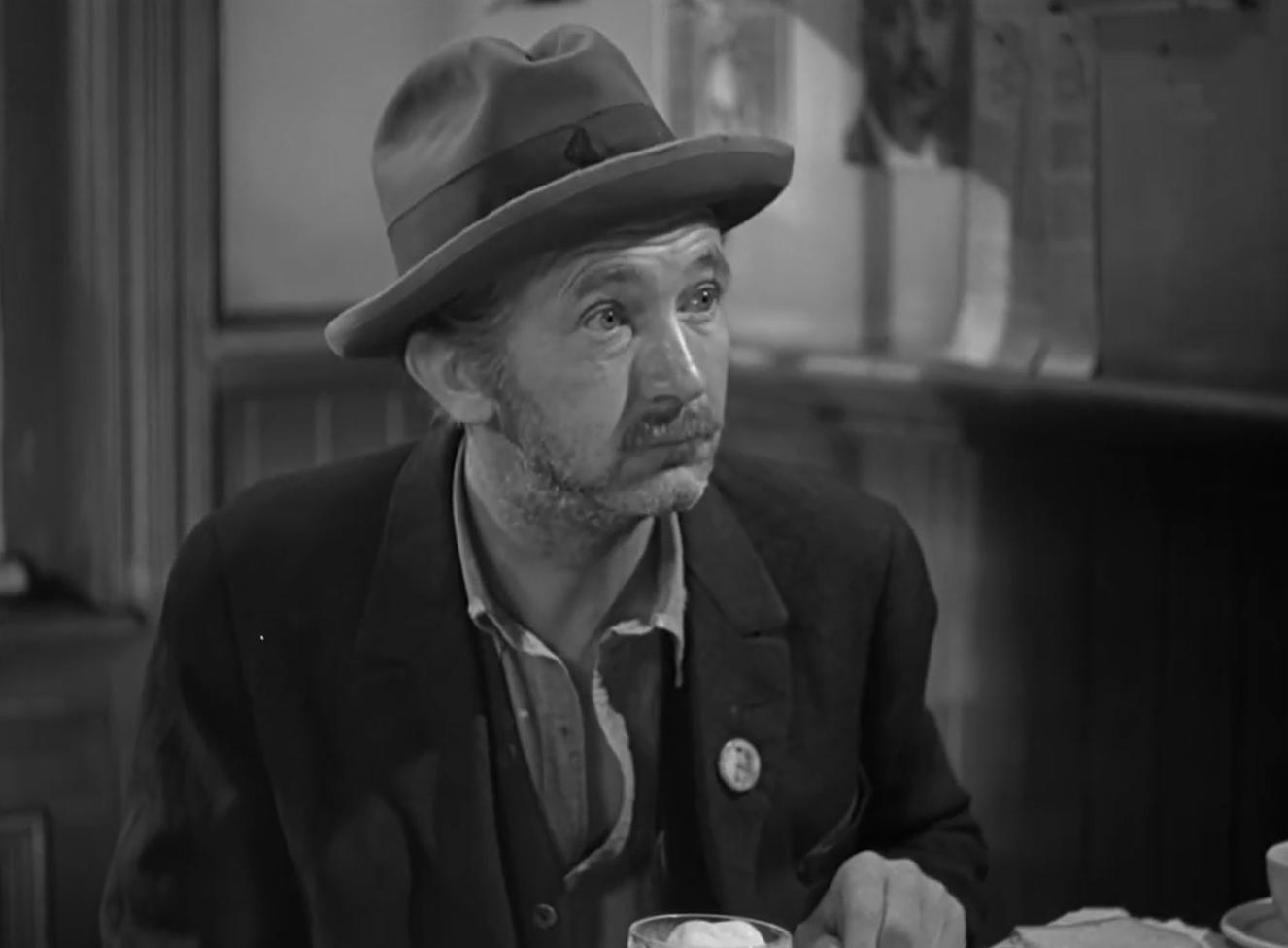
This dark film is steeped in distrust of the wealthy, particularly expressed in the words of John Doe’s companion and muse, The Colonel, a man he’s been riding the rails and sleeping rough with. If Republicanism has come to be associated with rich people making themselves richer, this is decidedly not that. This message is distinctly anti-capitalist. “All right. You’re walking along, not a nickel in your jeans, you’re free as the wind, nobody bothers ya. Hundreds of people pass you by in every line of business: shoes, hats, automobiles, radios, everything, and they’re all nice lovable people and they lets you alone, is that right? Then you get a hold of some dough and what happens, all those nice sweet lovable people become helots, a lotta heels. They begin to creep up on ya, trying to sell ya something: they get long claws and they get a stranglehold on ya, and you squirm and you duck and you holler and you try to push them away but you haven’t got the chance. They gots ya. First thing ya know you own things, a car for instance, now your whole life is messed up with alot more stuff: you get license fees and number plates and gas and oil and taxes and insurance and identification cards and letters and bills and flat tires and dents and traffic tickets and motorcycle cops and tickets and courtrooms and lawers and fines and … a million and one other things. What happens? You’re not the free and happy guy you used to be. You need to have money to pay for all those things, so you go after what the other fellas got. There you are, you’re a helot yourself.”
It’s a Wonderful Life was released in 1946, after the war, and the climate in the country had changed. The film was not a popular or commercial success, and it was one of the last films Capra made. Even at the time, the film was seen as overly sentimental and simplistic. Maybe after people had experienced so much loss and trauma during the war they weren’t in the mood for a sort of ideal presentation of life as it could be in America. Maybe they didn’t like the dark shadows on the edges of this glowing presentation, the sense of despair and entrapment, of disappointment and dreams set aside. On some level, the film itself provides a glimpse into this darkness, into the reality of the world under the gauzy film of cinematic ideal, in the form of Pottersville. Some have said that Pottersville is reality and that in Pottersville humans live as humans actually do, fighting and giving into greed and cruelty. But this is a world with no kindness.
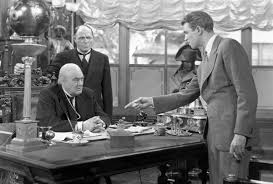
The alternate world, the world in which George Baily had been born is one in which people help each other. As he describes his father, “He didn’t save enough money to send Harry away to college, let alone me. But he did help a few people get out of your slums, Mr. Potter, and what’s wrong with that? Why… here, you’re all businessmen here. Doesn’t it make them better citizens? Doesn’t it make them better customers? … Wait? Wait for what? Until their children grow up and leave them? Until they’re so old and broken down that they … Do you know how long it takes a working man to save $5,000? Just remember this, Mr. Potter, that this rabble you’re talking about… they do most of the working and paying and living and dying in this community. Well, is it too much to have them work and pay and live and die in a couple of decent rooms and a bath?” During a run on the bank, a mob shows up at the Baily Savings and Loan and George explains that everybody is part of a system, a society, each person’s money is invested in everyone else’s houses. They support each other. Things only work if they’re all in it together.
“Just remember this, Mr. Potter, that this rabble you’re talking about… they do most of the working and paying and living and dying in this community. Well, is it too much to have them work and pay and live and die in a couple of decent rooms and a bath?”
Two of the writers of It’s a Wonderful Life, Frances Goodrich and her husband Albert Hackett, were accused of being communists. “According to [REDACTED] the writers Frances Goodrick [sic] and Albert Hackett were very close to known Communists …, Goodrick [sic] and Hackett practically lived with known Communists and were observed eating luncheon daily with such Communists…” In fact, It’s a Wonderful Life itself was considered communist propaganda. “With regard to the picture ‘It’s A Wonderful Life’, [REDACTED] stated in substance that the film represented a rather obvious attempt to discredit bankers by casting Lionel Barrymore as a ‘scrooge-type’ so that he would be the most hated man in the picture. This, according to these sources, is a common trick used by Communists. In addition, [REDACTED] stated that, in his opinion, this picture deliberately maligned the upper class, attempting to show the people who had money were mean and despicable characters.”
This was another way the climate in America changed during and after the war, with The House Committee on Un-American Activities investigating anyone they deemed disloyal or subversive. They cast fear and doubt about the “other,” however they chose to define that. They created a myth of the enemy within, and they played on fear to label certain groups of people as dangerous. They could call anyone a communist and therefore a threat to democracy, and they tended to target artists, liberals, or anyone with an alternative lifestyle. They blacklisted hundreds of writers, actors, and directors in the film industry. They recommended the internment of Japanese Americans during WWII in their “yellow report.” They declined, however, to go after the Ku Klux Klan saying, “After all, the KKK is an old American institution.”
Frank Capra’s films have been criticized for having unrealistically happy endings. They do often end with a scene in which the unlikely little guy achieves some kind of small victory over the overwhelming forces of oppression. A victory fueled by moral courage. But there’s always a creeping darkness, a sense that this is a temporary victory. The forces of evil and oppression are always gathering apace, dark clouds on the ideal horizon. This feels like our reality lately, minus the small victory or any kind of accountability.
We’re living in a world where the corrupt politician won. The Republicans have tried to fashion themselves as the party of the common man, using language straight out of a Depression-era film. The forgotten man. We have rich white men currying favor by making fun of kale, for some reason, and making skin-crawlingly awkward jokes to show they’re just regular guys. We see a rich corrupt pseudo-politician touted as the champion of the forgotten man, who is himself best known for owning a golden toilet. He’s never worked a day in his life, or changed a diaper, or walked his kids to school, or taken care of his own kids when they were sick, or taken a dog for a walk, or served in the military, or gone to the grocery store, or cooked a dinner for his family, or worried about the price of food it took to make the dinner, or driven his own car, or been held accountable for crimes that any non-white man would have spent their life behind bars for.
There is no kindness in this world. Somehow (how? how?) these corrupt politicians have tapped into a deep river of cruelty, pettiness, resentment, and fear. This is a different, terrifying myth of America that doesn’t accurately reflect the world I see around me — the everyday world of people interacting in real life. We’re usually kind to each other. We all like to be helpful. But the fear is powerful, and the means of spreading it insidious and seemingly unavoidable. There’s always an idea of “those people” in the U.S., that’s part of our mythology, too. Whether they’re seen as potential voters or potential consumers, there’s always someone trying to fool and manipulate “them.” That’s how our system is designed to work. But the truth is that we are all “those people.” The only thing that separates one from another is money, and that money has always been and will always be, I fear, divided unfairly. This leaves many people vulnerable to the frailties of the system, which works best if we’re all in it together, looking out for each other. Which might be why it rarely works as well as it could. Greed and self-interest have always tipped the scale and rotted the system, leaving people sick, uneducated, unable to feed their families, angry, hopeless, and fearful.
Today we’re still taught to be afraid of socialist communist fascists, and those words have no real meaning in this fear-talk other than as a trigger to provoke insecurity. We’re taught to be afraid of foreigners, immigrants, migrants, illegals — many names are thrown about like weapons. We’re particularly meant to distrust poor immigrants (“your tired, your poor, your huddled masses yearning to breathe free, the wretched refuse of your teeming shore, the homeless, tempest-tost” remember that part of our mythology, which Trump’s acting director of immigration services tried to revise and demean?). We’re taught to be afraid of people from “shithole countries” who are trying to take what is rightfully ours. Of course, it doesn’t work that way. America, like the good old Baily savings and loan, works better when we all share the benefit and the burden. And not just financially, but also when we share our cuisine and our music and our poetry and our art. When we share our roots the tree is stronger. Capra, who was himself an immigrant who escaped poverty in Italy to live for a while in poverty in the U.S., and Riskin, the son of Jewish Russian immigrants who lived in the Lower East side of NYC, would both have known this first-hand. I like to think their experience helped them to understand the value of all life.
So if you’re going to watch It’s a Wonderful Life this Christmas, pay it some attention. It’s a complicated film full of dark humor and at times conflicted and conflicting messages that merit some reflection. It’s been misread and misinterpreted, and it’s certainly not without its flaws. But it has become part of our mythology of who we are and what we value, and it feels more important now than ever to stop and think about how we got here and where we’re going. And if you’re going to hear what you want to hear and disregard the rest, hear the part that everybody, regardless of race or creed, deserves to be free and equal. Hear the part about the love of all people, the freedom of each individual, and the equal importance of each individual. It might feel like we’re headed into a long dark tunnel surrounded by graft, greed, lies, and compromise of human liberties at the moment, but we’re bound to come out of it someday.
Categories: american mythologies, featured, film

 magpiesmagazine.com