

I follow the line of cockroaches under the ground. We’re all moving inexorably in the same direction, spilling down the stairs. All of the cockroaches in the city dress in hard shiny suits and speak in clicking tongues, about themselves, about their money. They don’t try to hide their words from me because they know I don’t understand them, and they can barely see me with their cockroach eyes. I pass through unnoticed.
Clearly I don’t need to buy a ticket anymore, but I want to because I have a soft bruising love for the last human ticket-seller, with his lined face and thick smudged glasses. In this last station, at the center of the world. I raise my hand to him, in his fluorescent tank, but he’s nodding off, and all the tourists are clustered, bewildered, around the ticket machines. And all the pass-bearers are clicking clicking clicking their way through.
Down more stairs, down down into the ground, and a thick hot piss-scented fog swallows me like a sadness. Everything makes me sad. FUCK YOU says the graffiti on the wall. FUCK YOU says the man pissing in the corner. Fuck you, quietly quietly says the young man with pale pockmarked skin sitting alone, sipping hot coffee through a straw, looking like a child.
The subway car reeks and creaks. In the sickly flickering light of a hundred cellphones I see my demons in the window, as the soft, stinking, rat-filled darkness pulses by. Sometimes they laugh, sometimes they sneer. One of them wants to talk to me, I can tell, but I’m not falling for that again. I’m glad to see them all disappear as we pull into the bright lights of the white-tiled station.
My neighborhood is human, is people yelling from doorways and fanning themselves in open windows, leaning over fire escapes and sliding down their stoops. My neighborhood is memory-smells from the hot kitchen screendoors of cool restaurants. They see me, here, but they don’t bother looking. They used to yell, but not so much any more.
At the whining of the heavy door, the troll of the vestibule pops her wrinkled winking face out and stares at me in routine astonishment. I count the winding stairs, shifting on every landing. The hallways stretch off at each floor, rows of closed doors with lives lived behind them that I will never see, hollows of humanity I will never know. And cockroaches and bedbugs scuttle in the dust-scented darkness. At the turning of the fourth flight I look down and see the familiar figure of the devil of the stairs. He’s curious, no more, and not quick enough for me.
My books greet me and they stare up at me like needy children, babbling in small voices, words straining from each page, begging to be read, begging to be loved and understood. Strays I brought home. Paperbacks and hardcovers, bending the make-shift bookshelves, piled on cheap tables, holding up the walls. The words escape their covers and fly around my head, buzzing and flapping, but I don’t try to catch them.
Sweatful. I can tell by the color of the sky, the lights of windows opposite, the searching headlights of passing cars, that it’s 3 am. Fully awake, heart pounding, racing, skipping beats. And now the words come alive, they’re awake, too, and they feast on me. They buzz with sudden noise into my ears and eyes. If I let them land they leave angry welts, which will fester and grow the more I scratch at them. I can tear at them with my nails until I bleed, and they’ll only plague me more, with their fiendish itching. They rise insubstantial and weightless in lazy persistent circles, these prickly devils, these demons bred in the stagnant water of my half-sleeping mind.
I know I won’t make it through the night.
Morning. Weak light that smells of rain stirs through my curtains and does nothing to warm my stale aching head.
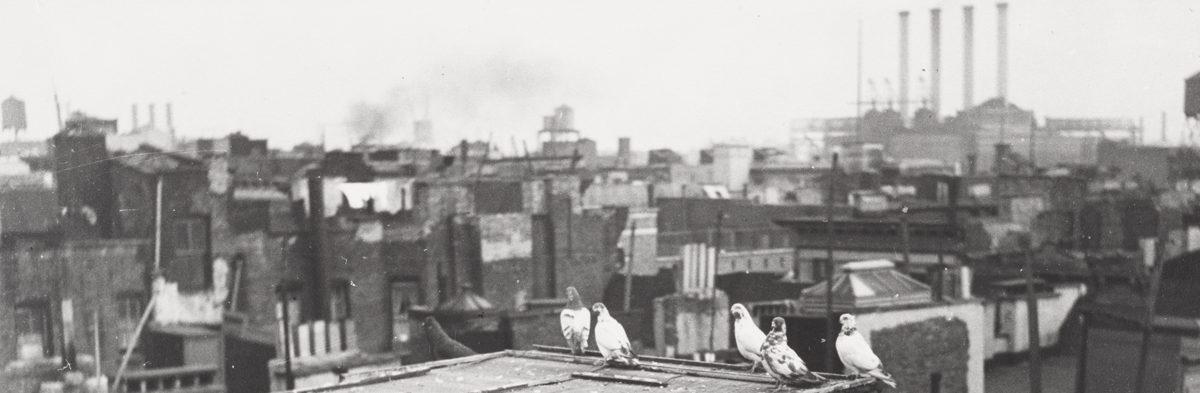
I like the warm dusty tar soft on my feet. I like staring straight up into the vast reeling sky, into the fast wheeling birds. I like when the birds land and speak to me with gentle soothing voices. I like the soft sounds they make when they all settle together. I like to watch people from my roof, to see them washing over the sidewalk in waves—coming together, breaking apart.
When the plague comes I don’t go into the city any more, because it’s all shut down. The crowds on the sidewalk below are sparse and their waves veer away from each other. I rarely leave the house, but for once I’m not alone in this, or so they say. And it’s strangely welcome to be together in this isolation.
It’s strange to see that other people are still alive, still living. Sometimes I hear them yelling on the stoops and sidewalks, but I don’t listen to what they say. And I like to watch people through their windows. I like to watch them walk from room to room and move in and out of the circles of light that their lamps make. When they go farther back into the house, into the darkness where I can’t see them, I’ll watch and wait until they come back.
They’re all swimming in my aquarium. The lady with the clocks and mirrors, who watches time passing. The man with rivers of cats to wade through and ice cream every day; the boy who spits out the window on people walking by; the girls who sing with their caged birds; the woman who piles all her mail on the table, till she has walls of yellowing letters and newspapers to hide behind. The man with a different girlfriend every day of the week, sometimes two in one day. During a plague year, no less. They dance and kiss in the light of his living room, and then disappear into the shadows, into his bedroom, into my imagination.
In the summer on hot evenings all the windows hang open, and the neighborhood is deafening and fragrant, with all the sounds and smells melting together in the heat. My feet stick to molten tar, and I have to put papers down to walk across. In the winter everything is frozen and closed and silent, and icicles hang from the edges and overhangs, and melt slowly in the cold sunlight.
In the springtime I watch a man die. Cat man puts a bowl of ice cream on the floor for the cats and sits at the table with a bowl for himself. He raises the spoon to his mouth. He coughs, once, twice, and then he falls still. My arms and the top of my head prickle with electric fear. I wait for him to move, I want him to move, I will him to move with all my strength. But he never moves again. I worry about his ice cream melting. I worry about who will take care of the cats, who will know that they like to eat ice cream, who will keep them all together.
I watch him all through that day, until the sun goes down. The blue becomes deeper and thicker all around my roof until I feel I could hold it, but I can’t see through it. The ice cream man’s home fills up with shadows. I lie in bed regretting him, and sorely sorry that I can’t save him.
In the morning I watch again. The cats rub against him, they eat his ice cream. In the afternoon they howl for food. Somebody finally comes for him the next day. They carry him away. Then they come for the cats, they pack them hissing into crates. Some people come a few days later and wrap everything in newspaper and put it all in boxes. When they find the freezer full of ice cream, they take a break, they take off their masks, and they each eat a bowlful. Then they wash the bowls and dry them and wrap them in newspaper and fit them into boxes. The apartment lies empty for a while, with nothing to watch but the sun moving across the walls with the hours of the day.
Finally a man moves in. He is skinny with short hair and a blue suit, he is strange in all his movements, gentle and awkward, but I like him. He doesn’t have a television or cats, but he has dozens of photographs, and he hangs them all over his walls. He sits and watches the pictures as if they might move. I wonder if they plague him the way my books plague me, if they chatter at him. I wonder if he has demons, too.
He watches out the window, too. On the lengthening spring days he sits in the open window and watches the people hurrying down below. He puts crumbs and seeds out for the pigeons, and then he takes pictures of them. He has cameras, and he takes pictures of strange things, I can’t tell why, then he hangs the pictures on his wall and watches them.
When he leaves his home, I watch him. I wait for him to come out on the street, and watch which direction he walks. I watch as he walks off and turns away around a corner, and I wonder where he goes. One day he leaves his apartment, and I watch the street door and wait, and wait. But he never comes, and I freeze when I see him come out onto the roof. He is in his shirtsleeves, and his feet are bare. He walks all around looking down. He takes off his shirt, and I see his shoulder blades, his ribs, the hollows of his collarbone; he is pale and gleaming. He lies down and disappears below the low wall of his roof. I get scared, and I go down below to my room, but I think about him up on the roof and don’t sleep for days.
In the early hours of the second day the light falls on my closed eyes in waves like pain. The chattering voices rise and fall and rise and fall, but there’s nothing really nothing to tune out. The sudden silence should be a relief, but it’s not. I’m all too familiar; I know what it means. It’s the smell that creeps in first. The scent of a disappointed grade school teacher. Sour. Stale. Coffee, cigarettes, and cheap cologne.
“Get. The. Fuck. Out!”
That voice, that crass and reedy tone. Dripping with ignorance and cruelty.
“You never leave the fucking house anymore!”
Sigh.
“Get the fuck out of here you dumb bitch. I need some ME time. You’re so dreary and exhausting.”
I roll over and pull the pillow over my head. There’s no muffling this voice. “And you smell like a hamper of dirty laundry.”
I sit up and knuckle my tired eyes like a little kid.
“Look at you, knuckling your eyes. Like a little kid in a soft pink nightgown on Christmas morning, who can’t believe the fucking bounty of presents she’s received.”
But what a sad and sorry gift is this, my least favorite demon, the most persistent and pestilential of fiends.
She’s sitting in the window where the light is, blocking it. She’s dressed like a bank teller from a decade ago: a polyester magenta pants suit with frayed sleeves, stained with mayonnaise and ketchup. Threadbare. Her jacket is so tight it’s coming apart at the seams. She knocks a stack of books over with her worn low-heeled boot, but the words are so scared of her they don’t wake up. They’re too scared to fly around the room, they just tremble in the shadows of their pages.
I don’t bother telling her that nobody is leaving their house at the moment. She knows. She knows everything I know. I don’t bother talking to her at all. She goes away faster if I don’t speak.
She’s polishing her nails, a garish neon fuchsia, the polish dripping bright slick scars on the windowsill. “Remember when we first met?”
“Have we met? I don’t recall. I don’t recall ever laying eyes on you before.” She hates being forgotten more than she hates being ignored. Her face crumples in anger, but it quickly passes.
“You were in 7th? 8th? Grade? You tried to call Bobby Carvahallo to ask him to the homecoming dance.”
“Valentine’s. The Valentine’s Day Dance.”
“And his mom answered and you hung up.”
“His big sister, Valerie. But yeah, I hung up.”
“And then you called again.” What a laughing sneer in her voice.
“Yeah, I called two times.”
“THREE times! You called three times! And hung up Every. Single. Damn. Time.” It’s true. She’s right. I can’t deny it. “And then you went up and cried in your wittle beddie, and what a jump you gave when you lifted your wittle tear-stained face to see me sitting across the room.”
“Laughing at me.”
“Laughing at you! You sorry little fool.”
All I can do is sigh. I recall the feeling of seeing her for the first time and it’s like the memory of a vivid bad dream. Fading, shifting, depressing. Though it was shocking to see her, there in my room, it was oddly not surprising. I wasn’t scared, but a vivid thrill of fear traveled the length of my limbs and set my hair on end.
“And the next day he gave you a funny look and you suspected that he knew. But you never talked to him, did you?”
I don’t bother to tell her that I did talk to him. I told him that I liked his spiky hair, I blurted out, “I like your spiky hair,” and he laughed a cruel short laugh with a shake of his spiky head. The laugh she would laugh if I told her. Though of course she knew.
After that first time she would show up often. She’d lie on my bed with her feet kicking in the air and fill the room with cigarette smoke. She’d prank call people from my school I wanted to be friends with but never would. She helped me with my homework but got all the answers wrong. I hated her when she was there but somehow I always missed her when she was gone.
“Hey! Hey hey hey. You know what I am? I thought of it the other night when you couldn’t sleep. Guess! Guess guess guess guess.”
I pick up the stacks of books she’s knocked over and set them back in a neat pile. She kicks them over again. “Guess!” I stack the books again. I’m not guessing. I’m not playing her silly game. “I’m a PANDEMON! A PAN FUCKING DEMON!! Geddit?”
Well. I laugh. I can’t help myself. “You didn’t get that from me!”
“No. Of course not. It’s funny. And honey, you ain’t.”
She is not wrong.
“Remember when you went into the kitchen and found strangers eating your breakfast?”
“That never happened.”
“Did too.”
“No, no it did not.”
“They drank your coffee and ate your bread and made such a mess of your kitchen. Jam on the floor, broken teacups in the sink.”
“Were they wearing masks?”
“What? What what what?”
“Masks, masks. Were they wearing masks? Because of the plague.”
“The?…fuck. The absolute fuck. Fucking humans. Weak. Needy. Mortal. Why would they be wearing masks when they don’t even exist, you dumb fuck?”
“Right.”
She snorts. Smoke comes out of her nose. She sighs and shakes her head. “Well you don’t exist, either.”
“What?”
She scoffs. “You’re not real. When’s the last time anyone looked at you?’
“That’s not … that doesn’t … What are you, a child?”
“No, I’m right and you’re wrong.”
“So, yes, you are.”
“Ha!” Her eyes gleam with a small red glow. She loves to win an argument.
“Yes, you are a child.”
“I know I am but what are you?”
What can I do but sigh?
“No, really. What are you?” She opens the window and a warm, feeble breeze slowly creeps across the room, smelling like baked tar, old rain, and slowly, slowly creeping in, food other people have cooked and eaten; breakfast smells, melted butter, coffee, toast. Maybe they’re together, maybe talking. Laughing, remembering. “And why don’t you talk to this one?”
“What one?”
“Fuck you.” She slides all the books off the table and they land in a quivering heap on the floor. “Hey. Hey hey hey. You know what this guy needs? He needs a picture of you. A picture of you.”
“No.”
“Yes! Hear me out! Hear me out. He likes pictures. He likes pigeons. I mean, you’re not as pretty as a pigeon, but, you know, as a curiosity it might go over. Hey, hey hey hey, you know what I am? Guess. Guess! I’m a DARE devil. Get it? I’m daring you to give him a picture of your stupid little face.”
She only says it because she knows it will make me anxious. And it does. How my heart races at the thought of it! What a cold sweat suddenly covers my body. Nobody has seen me. Nobody has looked at me. I can’t say how long. It’s not just the plague. It’s been longer than the plague.
I pace the room. I scatter the books she’s knocked over. The thought is so strange to me. So piquant. Pricking at me, pinching at me. She has stolen my peace, as she well knows, but I doubt she realizes she’s raised something else, something new. Not hope, of course, never that. A “why not?” maybe. A great, resounding, perplexing, terrifying “why not?”
When I turn back to the window she is gone, and I feel her loss as a strange regret, though her presence makes me sick and I would be happy to never see her again.
While I lie awake that night I decide I want him to have a picture of me. I only have the camera my mother left behind, with the better part of a roll of 35 mm film in it. I took some pictures with it a decade ago, as a teenager, but I never bothered to develop them. I had no desire to see what I see.
Now I take a few pictures of my world and I push against the voice telling me to throw the camera off the roof. Do it fast, then. Take it now. Take it now. I set the camera on a chair, set the timer and run to sit on the hot dusty ledge on the edge of the roof. The camera’s blinking eye is quick and painless. I do it again and again, until the film won’t advance anymore. The sun is behind me, warming my back, sending my shadow, long, across the hot tar. Once or twice I stumble, and cling to the small wall for dear life, heart racing.
I wait all week for the photos to be developed, sick and excited and scared, making plans for how I’ll give him the picture, how I will get it to him. I haven’t been out among people in so long. I watch from the roof until the crowds dwindle in the late afternoon. The deep slanting shadows stir the darkening honeyed light, and people move slowly, as if in my dream. And as in my dreams I fly down the stairs, flight after flight, not even touching the steps. Nobody will see me. Nobody can catch me.
A stale smell of old air conditioning, medicine and cleaning products; unhealthy underwater fluorescent light. Elderly ladies behind the counter, their masks sagging off their sagging faces. They take tissues from their sleeves to wipe their noses, and blink at me with drowsy eyes. The ticket from the photo envelope shakes in my hand, and the woman behind the counter seems to strangely recognize it. She shakes her head at me, and looks sad. She has red-rimmed green eyes, large and watery, and soft, wrinkled, powdered skin. She smells like powder and perfume, like a field full of dead flowers you’d never find on this earth. She looks kind and I’m sorry she is sad, but too nervous about my pictures to worry much about her. She says, “Tsk tsk tsk.” I clutch my wallet, waiting for the pictures, and think about opening the envelope, and smelling the fresh filmy smell, and picking one picture.
She says, “Poor girl.” I don’t know who she’s talking about, but I’m sorry she’s sad for the poor girl. I say my name, and look to see if I can find my pictures. She has them in her hand, and she’s worrying the edges, folding the corners. I feel nearly frantic. She says, “Did you see, dear, on your way in, that you passed some nice lipstick? Some face powder? Some hairbrushes? Did you … happen to notice?”
I think “Why why why?”
The woman says, “Sometimes a girl likes to make herself…pretty. She likes to look…nice.” I think there must be something wrong with her, talking to me in this way, and I wonder how she got a job in the shop. Then it dawns on me. The archaic language, the ill-fitting skin. She’s a demon. She’s one of my familiar demons in a strange disguise.
The other woman behind the counter is stooped and skinny. She holds her thin wrinkled arms crossed over her small belly. She whistles a familiar tune, and the grubby blue fabric of her mask puffs out with each note. She looks out of the side of her sharp shrewd eyes and says, “Leave her alone. She’s fine.”
“She’s not. She’s clearly not. She has….she is…” She seems very nervous, and I can’t understand why.
“She’s perfectly pretty. Stop your nonsense, you old-fashioned, self-hating, perpetually-doubting fright. Girls don’t care about that sort of thing any more.” And this is just what I need. Two demons fighting over me. I don’t have time for this. I don’t have time for this.
The woman holding the photos sniffles, and her sagging mask falls off her face. She grinds the dull blue mask into the grey industrial carpet with her grey orthopedic shoe. The skinny demon hands her a new mask without even looking. The other demon stands shaking, holding the mask and my photographs in her trembling hands, and I see the bright fuchsia lipstick smeared messily on her doubting lips and echoed on the dingy mask on the floor. And then it hits me, hard. There’s only one demon here and it is not her. The skinny demon gives me an acid look, she knows I know, cause they always do. It’s strange to me to see someone else’s demon. I will puzzle about it later, night after night, I will go over all the possibilities, the permutations of similarities, the novelty of the situation. But now, just now, I want the damn pictures.
The human looks as though she might cry and she breaks my heart as she bows her head and loops the mask over her soft red ears. (People are so ridiculous and fragile.) She glances at the demon with a mixture of fear and hatred that I know all too well, and then she looks at me with such a deep sadness brimming in her eyes that I put my hands to my face, suddenly frightened that it might be gone.
“Oh for fuck’s sake.” The demon tears the envelope from her hands and hands it to me.
I am truly sorry truly sorry for the woman. But the shaking light and the smell and the demon and my worries are leaving me weak, so I take the envelope and I leave the store, into a very certain evening light of regret and hope.
I race up the stairs, two at a time and come out in the squinting sunshine on the roof. I sit on the newspaper and look at the envelope. I make myself wait. Then I take out one photo at a time. A picture my mother took of a dark and blurry man – not my father – disappearing around a corner into a dark and shadowed alley. Also, a picture my mother took of a perfect hard-boiled egg, from above, centered perfectly on a round mat, radiating layers of perfect circles. And how well did I know her?
And then my pictures, from years ago. The shadows under the bleachers at school, and I can still remember the smell of dirt and grass and gasoline and garbage. I can still remember the biting March wind through the seats and the thawing earth beneath my feet. A chain link fence strangled by weeds. A sea of bodies, just a muddle of grey upon grey upon grey, grainy and confusing, as people were at that time.
And from now. I’m trembling. I see one of a water tower, one of the staring sky, one of birds’ shadows, one of the secret edge of roof coated in moss, one of skinny stripes of wires, one of bricks and one of cracked tar. And then I see myself. And how well do I know myself? Who is this person with the strange sad haunted face, the wild hair, the pale skinny limbs. In a blur as she stumbles towards the edge of the roof, over and over.
In my head is so much noise. All the colors, the frantic lines and the strange pressure behind my eyes. And then. Silence. I know it well. But now…I don’t want to be alone. I don’t want to be alone.
“Remember how you hated every song that you had loved? That was me.” She’s sitting on the edge of the roof. Her stupid scuffed beige outdated low-heeled boots (god, I coveted them so much, and never got them) sticking in the tar. She’s leaning back so far she might hope she’s worrying me. But I know she won’t fall, and I wouldn’t care if she did. I stand with my eyes on the tattered newspaper, with its ads for hand sanitizer and free hams and diet pills. And I can feel myself trembling, trembling.
The photographs have fallen like shot pigeons to the ground, where they lie in a sorry ragged pile, trembling trembling, as she stoops to pick them up. She splits her pants, of course, because they’re so worn and so tight. She doesn’t care because she never cares about that kind of thing. I sit on the edge of the roof with my hands over my ears, but I can hear her shrieking with laughter as she flips through the photos.
When she gets to the photographs of me she stops. Her face falls, she’s genuinely dismayed. And she says. But I didn’t do this. Even I wouldn’t do this. I live to torment you, and I wouldn’t do this. She holds the photos up, weakly waving them, and she coughs, like she has the plague.
The light on the roof is so strange. You can see all the changes of the hours on the edges of the world.
And she then gives another ghastly howl of laughter and she comes as close to me as she ever has. Near enough to touch. She looks into my face, and I can smell her sour hot smoking breath. She says, “Naw. I’m kidding. You’re fine. Fine. Fiiiiiine. I mean, how did you expect to look? How did you expect to look? And how did you get to be the age you are? And how did you get that face, the face that you look out of? And how those eyes that you see with? How did it all come to this? And how did we get here? ” She stamps the roof. “And yet here we are.”
In a white blind rage I throw myself from the roof. I float down in weightless silence, and land foolish and forlorn on the sidewalk. I watch myself there, I watch myself crumpled under shoes, kicked to the curb, falling nearly into the street. And then I see a blur of blue, a familiar blue suit in the deepening blue twilight. The man picks me up, he smooths me out, he runs his fingers down my body. He turns his face up to me, pale and still and shining in the sea of moving bodies.

 magpiesmagazine.com